
What Are Creationism and Evolution: Defining the Boundaries of the Intellectual Battlefield
Before analyzing arguments, we must clearly define what the dispute is actually about. Creationism and evolution are not simply two theories of life's origins, but two fundamentally different epistemological approaches to explaining reality (S001).
🔎 Creationism: A Religious Concept of Divine Creation
Creationism is a religious-philosophical concept asserting that the Universe, Earth, and life on it were created by a supernatural being (God or gods) through an act of creation (S001). The key distinction of creationism from scientific theories is its reliance on sacred texts and revelation as sources of knowledge, rather than on empirical observations and testable hypotheses (S003).
- Young Earth Creationism
- Claims Earth's age at 6–10 thousand years, based on literal reading of biblical genealogy.
- Theistic Evolution
- Accepts evolutionary processes as instruments of divine design, combining scientific data with belief in a Creator.
- Orthodox Interpretation
- Allows various interpretations of the biblical creation narrative, not insisting on the literalness of six days (S004).
🧬 Evolution: A Scientific Theory of Natural Selection and Variation
Evolutionary theory is a scientific model explaining life's diversity on Earth through mechanisms of hereditary variation, natural selection, and adaptation over millions of years (S005). The key distinction from creationism is methodological naturalism: evolution explains biological phenomena exclusively through natural causes, without resorting to supernatural factors.
In science, the word "theory" does not mean "guess" or "speculation." A scientific theory is a well-substantiated explanation of natural phenomena, confirmed by multiple independent lines of evidence and capable of making testable predictions. Evolution stands at the same level of proof as the theory of gravity or atomic theory of matter.
⚙️ Why Conflict Is Inevitable: Incompatibility of Knowledge Methodologies
The fundamental cause of conflict lies not in specific facts, but in methodological incompatibility. Science requires falsifiability of hypotheses: any claim must be potentially refutable by empirical data (S005). Creationism, relying on divine revelation, cannot by definition be refuted—any contradictory data can be explained by the inscrutability of divine design.
| Parameter | Creationism | Evolution |
|---|---|---|
| Source of Knowledge | Sacred texts, revelation | Empirical observations, experiments |
| Falsifiability | No (by definition) | Yes (any claim can be refuted) |
| Domain of Application | Philosophy, religion, worldview | Natural sciences |
| Testability of Predictions | Impossible | Possible and regularly conducted |
This does not make creationism "wrong" in an absolute sense—but it places it outside the bounds of the scientific method. The question "does God exist?" lies beyond science's competence, which studies only natural, repeatable, and testable phenomena (S004). Conflict arises when creationism claims the status of a scientific theory or when evolution is interpreted as proof of God's absence.
Understanding this distinction is critical for analyzing the psychology of belief and the mechanisms that have kept this dispute alive for 150 years. The dispute cannot be resolved at the level of facts—it requires clarity about what questions science can actually address.
Steel Version of Creationism: Seven Strongest Arguments from Proponents of Divine Creation
Intellectual honesty requires presenting the opponent's position in its strongest form — this is called a "steel man" argument (steelman). Creationists raise a number of serious objections to evolutionary theory that cannot be dismissed with a simple "that's unscientific." More details in the Cell Biology section.
🧩 Argument from Complexity: The Problem of "Irreducible Complexity"
One of creationism's central arguments is the existence of biological systems so complex that they could not have arisen gradually through successive small changes. A classic example is the bacterial flagellum, consisting of dozens of protein components working together as a molecular motor.
Creationists argue: removing any component renders the system nonfunctional, therefore intermediate forms would have had no selective advantage (S002). This argument appeals to intuition: complex mechanisms (watches, computers) always have an intelligent designer. Why should biological "machines," which far exceed human inventions in complexity, be an exception?
The probability of a functional protein arising randomly from amino acids is astronomically small — comparable to the probability that a tornado sweeping through a junkyard would assemble a Boeing 747 (S003).
🕳️ The Problem of Life's Origin: Abiogenesis as the Weak Link
Evolutionary theory explains how simple organisms become complex, but does not explain how the first living cell arose from non-living matter. Abiogenesis (chemical evolution) remains one of science's greatest unsolved problems.
Creationists rightly point out: even the simplest self-replicating system requires the simultaneous presence of informational molecules (DNA/RNA), mechanisms for copying them (protein enzymes), and energy supply — a classic "chicken and egg" problem (S005).
- Miller-Urey Experiment
- Demonstrated the possibility of amino acid formation under early Earth conditions, but the path from amino acids to a functioning cell remains unclear.
- Creationist Position
- This knowledge gap points to the necessity of intelligent intervention at the critical stage of life's origin (S003).
📊 Gaps in the Fossil Record: Absence of Transitional Forms
If evolution occurred gradually, the fossil record should abound with transitional forms — organisms displaying intermediate characteristics between major groups. Instead of a smooth continuum, we see "punctuated equilibrium" — long periods of stability interrupted by the sudden appearance of new forms in the geological record (S002).
A classic example is the Cambrian explosion (about 540 million years ago), when most modern animal phyla appeared over a relatively short geological period. Creationists interpret this as evidence of instantaneous creation rather than gradual evolution.
- Absence of clear transitional forms between fish and amphibians
- Absence of transitional forms between reptiles and birds
- Absence of transitional forms between terrestrial mammals and whales
🧠 The Problem of Consciousness and Morality: Reduction Is Impossible
Creationists argue: even if evolution explains the physical structure of the brain, it cannot explain the subjective experience of consciousness (qualia), free will, and objective morality. How could natural selection, optimizing for survival and reproduction, have produced the capacity for abstract thought, mathematics, art, and altruism toward strangers? (S004)
Why are physical processes in the brain accompanied by subjective experiences? Creationists see in this an indication of an immaterial soul, bestowed by the Creator, which cannot be explained through materialistic evolution (S003).
⚠️ Methodological Limitations of Science: Naturalism as Dogma
Creationists criticize science's methodological naturalism — the principle that scientific explanations must appeal only to natural causes. They argue: this a priori exclusion of supernatural explanations is a philosophical presupposition, not a conclusion from data.
If God actually created life, methodological naturalism by definition would not allow science to discover this truth (S005). Isn't the exclusion of supernatural causes a form of metaphysical faith, just as unprovable as belief in God? Creationists propose "theistic science," admitting intelligent design as a legitimate scientific explanation (S002).
This argument points to the philosophical foundations of the scientific method — why should we accept that all phenomena have natural causes?
🔁 Microevolution Versus Macroevolution: Extrapolation Without Foundation
Creationists often acknowledge microevolution — small changes within species (for example, the emergence of bacterial antibiotic resistance or the diversity of dog breeds). However, they reject macroevolution — the emergence of fundamentally new organs and organizational types.
Observed changes always occur within existing genetic information, whereas macroevolution requires the emergence of qualitatively new information (S003).
Creationists argue: extrapolation from microevolution to macroevolution is logically unfounded. That selection can change finch beak size does not prove it can transform a reptile into a bird — the difference is not quantitative but qualitative (S002).
📌 Social Consequences of Evolutionism: From Darwin to Eugenics
Creationists point to historical abuses of evolutionary theory: social Darwinism, which justified colonialism and racism; eugenic programs, including the Nazi ideology of "racial hygiene." If humans are merely products of blind evolutionary forces, then objective morality, human dignity, and rights become illusions.
Evolutionism allegedly leads to moral relativism and dehumanization (S004). This is not an argument about evolution's scientific truth, but about its social consequences. Even if evolution is scientifically sound, teaching it as the sole truth destroys society's moral foundations, which are based on the conception of humans as made in God's image (S003).
Creationists appeal to the psychology of belief and social mechanisms: a worldview that deprives humans of transcendent meaning creates an existential vacuum, filled by ideology and violence.
Evidence Base for Evolution: What Data from Five Independent Scientific Fields Tell Us
A scientific theory is considered robust when supported by multiple independent lines of evidence from different disciplines. Evolution is unique in being supported by data from paleontology, comparative anatomy, molecular biology, biogeography, and direct observations—each field independently arriving at the same conclusions. More details in the Chemistry section.
🧪 Paleontological Evidence: Transitional Forms Exist
Contrary to creationist claims, the fossil record contains numerous transitional forms. Archaeopteryx demonstrates a mosaic combination of reptilian features (teeth, wing claws, long bony tail) and avian features (feathers, wishbone). Tiktaalik is a transitional form between fish and tetrapods, with fins containing bones homologous to the limb bones of terrestrial vertebrates (S005).
Cetacean evolution is documented by a series of fossil forms: Pakicetus (terrestrial mammal with adaptations to aquatic environments), Ambulocetus (amphibious lifestyle), Rodhocetus (reduced hind limbs, tail beginning to form a fluke), Basilosaurus (fully aquatic, with rudimentary hind limbs). This sequence spans approximately 10 million years and shows gradual transition from land to water (S005).
The Cambrian explosion, which creationists present as instantaneous appearance of life, actually stretched over 20–25 million years—an instant by geological standards, but sufficient time for evolutionary changes. It was preceded by Ediacaran fauna with simpler organization.
🧬 Molecular Biology: DNA as an Evolutionary Record
Comparing genomes of different species provides independent confirmation of evolutionary relationships established through morphology. The degree of DNA similarity correlates with evolutionary relatedness: humans and chimpanzees share 98–99% identical DNA sequences, humans and mice share about 85%, humans and yeast share about 26% (S005).
Particularly compelling are "molecular fossils"—nonfunctional genes (pseudogenes) and endogenous retroviruses embedded in the genome. The vitamin C synthesis gene is functional in most mammals, but in primates (including humans) contains a mutation rendering it nonfunctional. This same mutation in the same location exists in all primates—explained by common descent, but inexplicable from independent creation (S005).
- Endogenous Retroviruses
- Fragments of viral DNA embedded in the genome and inherited. They serve as "molecular markers" of relatedness: humans and chimpanzees have identical viral insertions in the same genomic locations, which is statistically impossible to explain by independent infection, but naturally follows from a common ancestor (S005).
📊 Comparative Anatomy: Homologous Structures and Vestiges
Homologous structures—organs with different functions but similar structure and origin—indicate modification of a common body plan. The forelimbs of humans, bat wings, whale flippers, and mole paws have the same set of bones (humerus, ulna, radius, carpals, metacarpals, phalanges), despite radically different functions. This is explained by modification of a common ancestor's limb, but inexplicable from independent design (S005).
Vestigial organs—structures that have lost their original function—testify to evolutionary history. Whales and snakes have rudimentary pelvic bones and hind limb bones, useless for their lifestyle, but explained by descent from four-legged ancestors. In humans—the coccyx (tail remnant), appendix (reduced cecum), muscles for moving ears (S005).
🌍 Biogeography: Species Distribution Explained by History
Geographic distribution of species corresponds to evolutionary predictions, not patterns of optimal design. Oceanic islands never connected to continents have impoverished fauna: Hawaii has no terrestrial mammals (except one bat species), though climate and ecosystems suit them. This is explained by evolution from organisms capable of crossing oceans (birds, insects, plant seeds) (S005).
Endemic species—organisms found only in specific regions—concentrate in isolated territories (islands, isolated lakes, mountain peaks). Galápagos finches, Madagascar lemurs, Australian marsupials demonstrate adaptive radiation from a common ancestor in isolation. Marsupials dominate Australia not because they're optimal for that continent, but because Australia separated from other continents before placental mammals appeared (S005).
🔎 Direct Observations of Evolution in Real Time
Evolution is directly observed in populations with short generation times. A classic example is evolution of bacterial antibiotic resistance: mutations conferring resistance spread through populations under selection pressure. Richard Lenski's experiment with E. coli, ongoing since 1988 (over 70,000 generations), has documented emergence of new metabolic capabilities, including ability to metabolize citrate under aerobic conditions—a trait absent in the original strain (S005).
Evolution is also observed in multicellular organisms. Italian wall lizards introduced to Pod Mrčaru island in 1971 developed larger heads, more powerful jaws, and cecal valves in the intestine (a structure absent in the source population) over 36 years (about 30 generations), adapting to a diet with higher plant content (S005).
⚙️ Design Imperfections: Evidence of Historical Constraints
If organisms were created by an intelligent designer, why do they contain suboptimal solutions explainable by evolutionary history? The recurrent laryngeal nerve in mammals runs from the brain down to the aorta, loops around it, and returns to the larynx—in giraffes this path is about 4 meters instead of a few centimeters direct. This is explained by evolutionary history: in fish this nerve runs directly, but as evolution proceeded and heart position changed, the nerve became "stuck" in a suboptimal configuration (S005).
The vertebrate eye retina is "installed backwards": photoreceptor cells are located behind the layer of nerve fibers and blood vessels, reducing image clarity and creating a blind spot. In cephalopod mollusks the retina is oriented correctly—this difference is explained by different evolutionary paths, but inexplicable from optimal design.
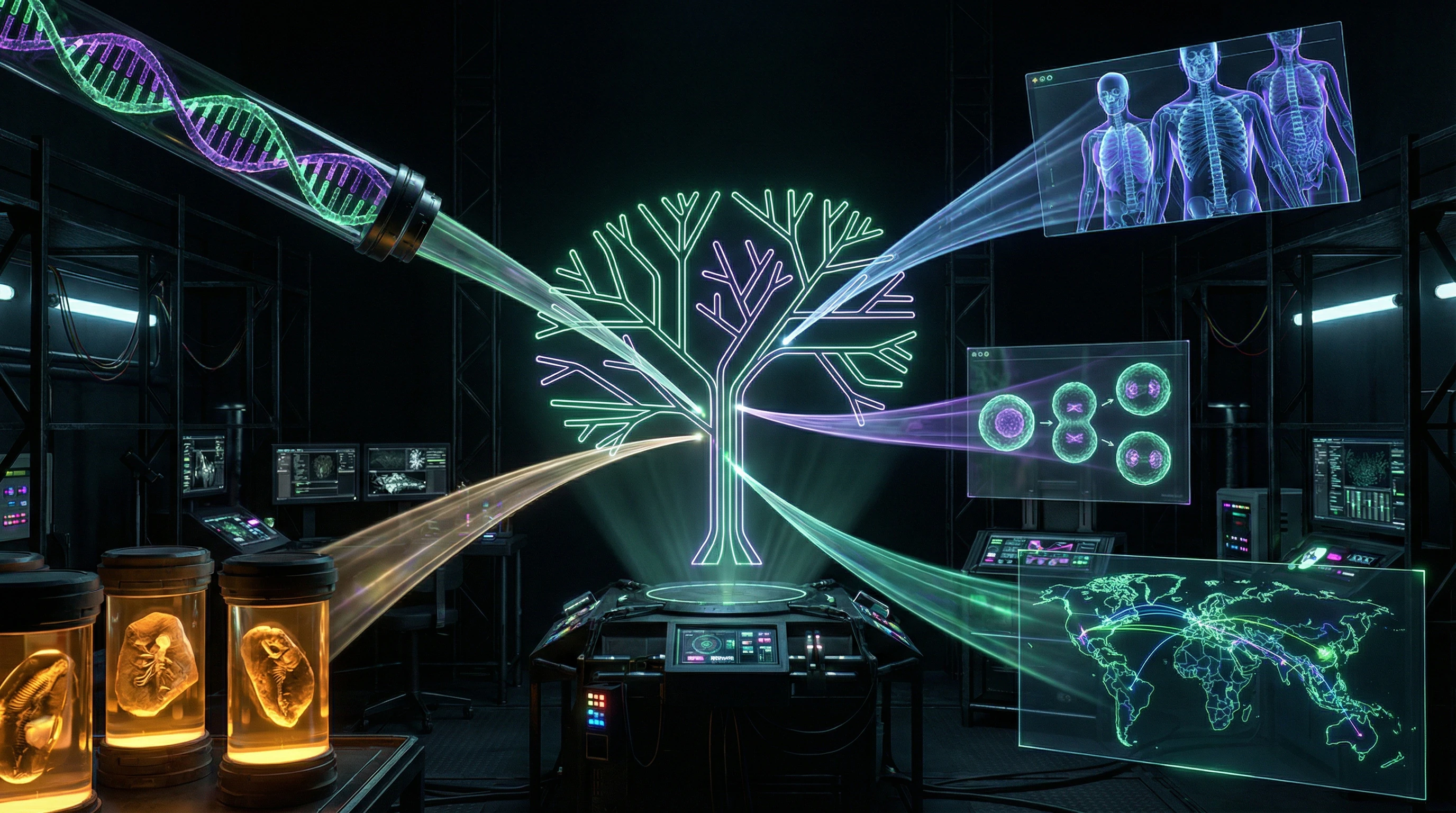
Mechanisms of Evolution: How Natural Selection Works and Why It's Not Random
Evolution is not a random process. It consists of two parts: random variation (mutations) plus non-random selection. Without this distinction, creationist arguments about the improbability of complex structures lose their foundation (verification methodology). More details in the Cosmology and Astronomy section.
🔁 Mutations and Recombination: Sources of Genetic Variation
Mutations—random changes in DNA—occur at a rate of approximately 10⁻⁸ per nucleotide per generation in mammals. In the human genome (3 billion nucleotides), this yields 30–100 new mutations per individual (S005). Most are neutral or harmful, but some provide selective advantage under specific conditions.
Sexual reproduction adds variation through recombination—the reshuffling of genes from two parents. Each offspring (except identical twins) is genetically unique.
The randomness of mutations does not mean evolution is random. Selection is a filter that transforms random variations into directional change.
⚖️ Natural Selection: Non-Random Survival
Natural selection works simply: organisms with traits that increase survival or reproduction in a given environment leave more offspring. Their genes become more frequent in the population. This isn't "nature's choice"—it's a mathematical consequence of differential reproduction.
Example: in a moth population, a mutation appears making wings darker. During England's Industrial Revolution, pollution blackened trees. Dark moths became less visible to predators—survived more often, left more offspring. Over 50 years, the frequency of the dark variant rose from 1% to 99% (S001).
| Component | Nature | Result |
|---|---|---|
| Mutation | Random | Genetic diversity |
| Selection | Non-random | Adaptation to environment |
| Genetic drift | Random | Changes in small populations |
🔄 Why Complexity Increases Without a "Plan"
Creationists often ask: how do random mutations create an eye, wing, or brain? Answer: not in one step. Selection works on each generation, reinforcing small improvements.
The eye didn't evolve all at once. First step—a light-sensitive protein (rhodopsin) in single-celled organisms. Then—a cluster of light-sensitive cells. Next—a depression in tissue (pineal eye). Then—a lens. At each stage, even slight improvement in vision provides selective advantage (on the risks of adaptationist stories).
Evolution doesn't plan. It optimizes locally, each generation. Complexity grows as a byproduct of this optimization.
This explains why organisms contain "vestiges"—remnants of old structures (human tailbone, whale pelvic bones). If there were a designer, they would be removed. With evolution—they remain as evidence of history (S001).
🎯 Adaptation vs Randomness: Where's the Boundary
Important clarification: selection isn't omnipotent. It only works on traits that affect survival and reproduction. Neutral traits drift randomly. Harmful traits are filtered out. Beneficial ones—reinforced.
Evolution speed depends on: population size, selection strength, generation time. In bacteria (generation—hours), evolution is visible within days. In elephants (generation—20 years)—over millennia (on rates of selection in humans).
- Mutation creates a trait variant
- Selection tests: does it help survival/reproduction
- If yes—frequency increases in population
- If no—variant disappears
- Repeat millions of times = observable evolution
This isn't magic or randomness. It's mechanics that work predictably and verifiably (S001).