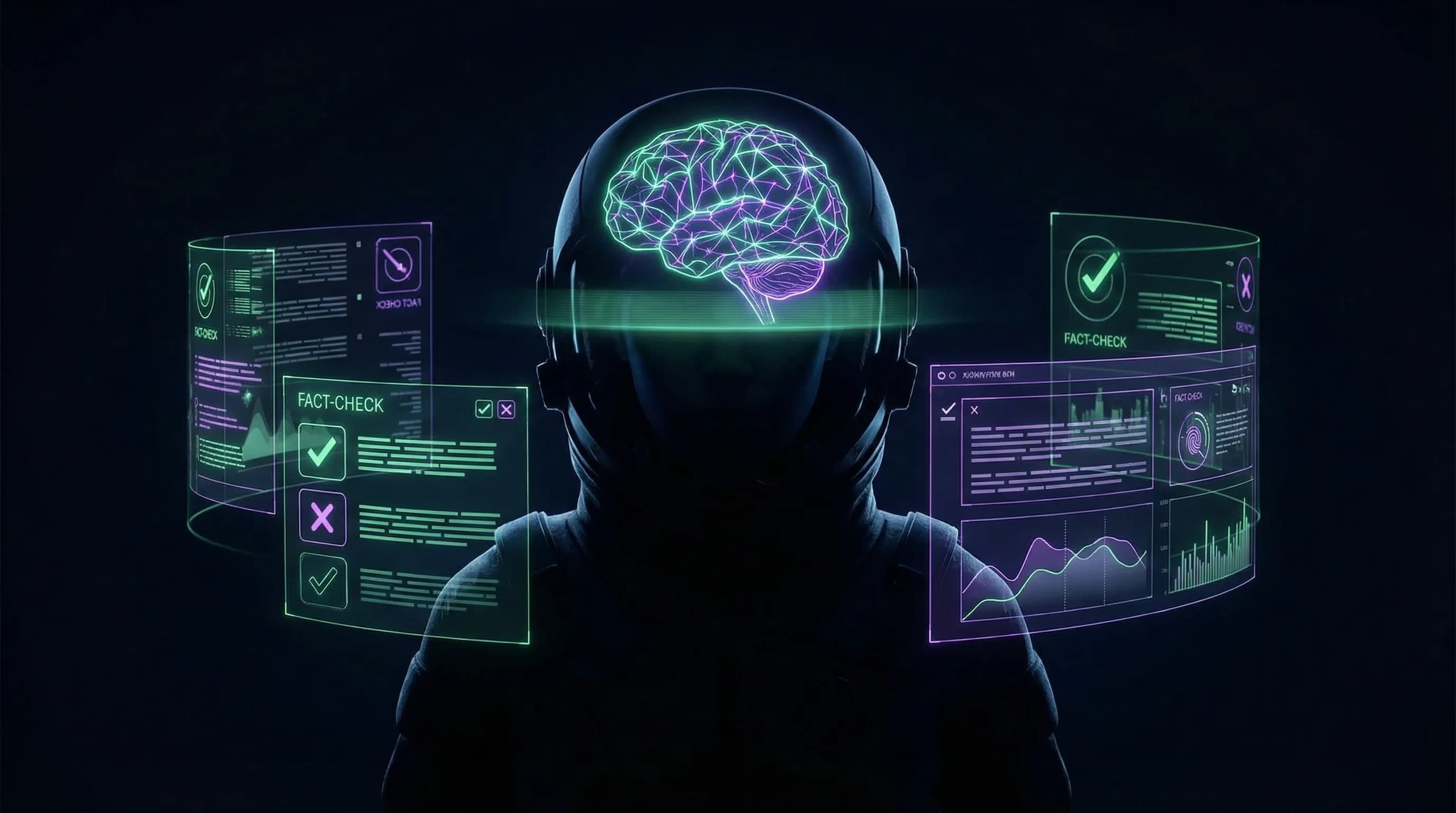
What is lateral reading and why it radically differs from everything we were taught in school
Lateral reading is a method of information verification in which the reader temporarily leaves the original source and searches for external data about its reliability before diving into the content (S002).
The term comes from the Latin "lateralis" (side) and describes horizontal movement between sources, as opposed to vertical reading—the traditional deepening into a single text from top to bottom. More details in the section Statistics and Probability Theory.
🧩 Vertical vs lateral: two opposing approaches
Vertical reading is what we've been taught for decades: open an article, read carefully from beginning to end, evaluate arguments, check internal links, study the "About us" section.
This approach assumes that credibility can be determined by the source's internal characteristics: design quality, presence of research citations, professional presentation, contact information availability.
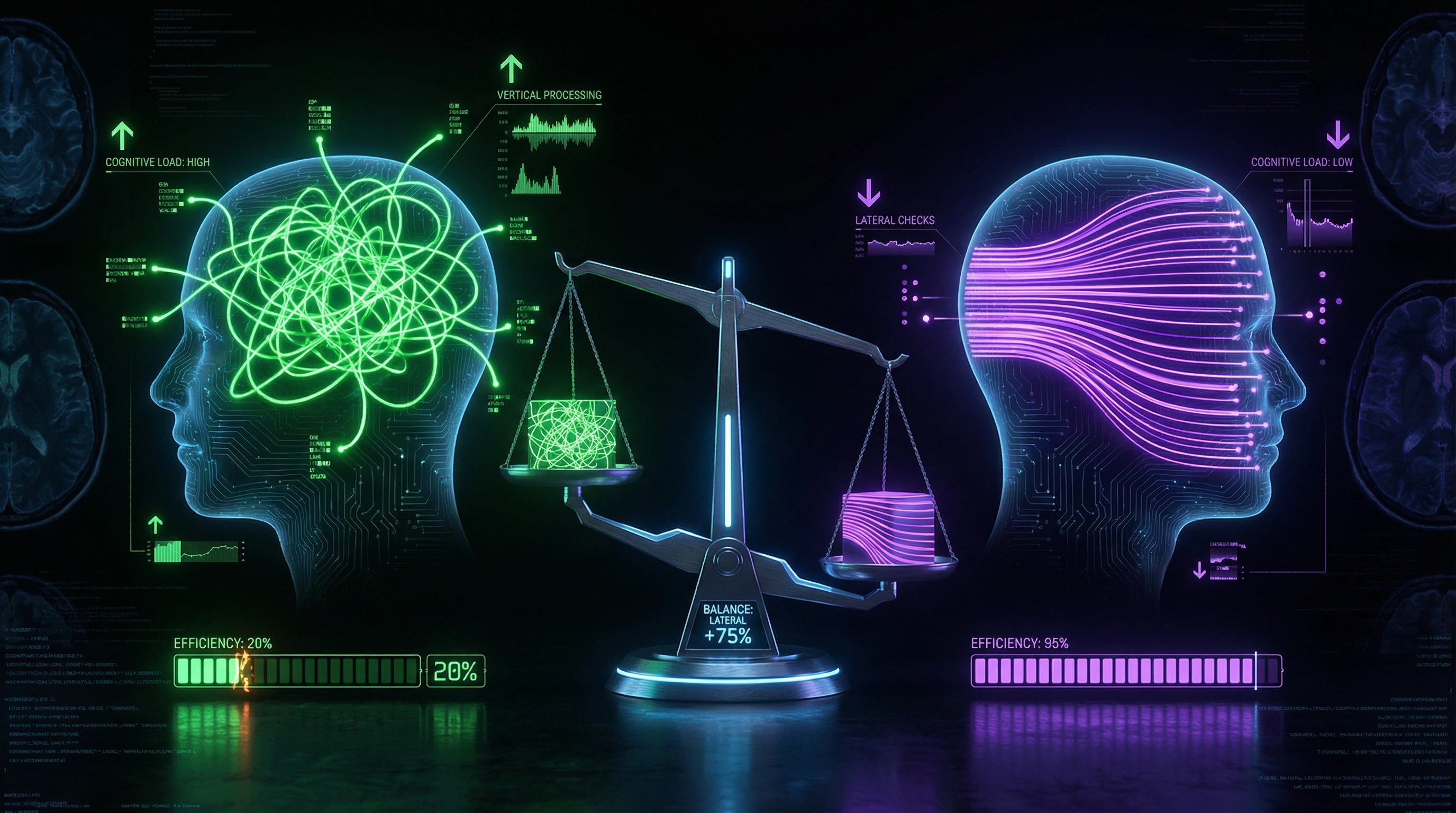
| Vertical reading | Lateral reading |
|---|---|
| Deepening into one text | Movement between sources |
| Assessment by internal features | Verification of external reputation |
| High cognitive load | Load on meta-information |
| Vulnerable to design manipulation | Protection through context |
🔎 Anatomy of lateral movement: what happens in the browser
A typical lateral reading session looks like an explosion of tabs. A researcher sees an article about a new medical breakthrough on an unfamiliar site.
Instead of reading the article, they open in parallel: Wikipedia with a search for the site name, Google with a query about source bias, domain verification through WHOIS, author search in Google Scholar, cross-verification of claimed facts through authoritative databases.
Within 2–3 minutes they have a complete picture of the source's reliability—and often it turns out the original article isn't worth reading at all.
🧠 Cognitive load and the efficiency paradox
Paradoxically, lateral reading requires fewer cognitive resources than deep analysis of a single source (S006).
- Contextual entropy
- A measure of uncertainty about the next word in context. The higher the entropy, the more time required to process the text. Attempting to assess credibility from within a text full of potentially manipulative phrasing creates high cognitive load.
- Lateral solution
- Shifting evaluation to the meta-information level—reputation that has already been aggregated by external sources. This reduces the load on content analysis.
Research shows that contextual entropy affects reading time better than traditional measures of surprise (S006). This explains why professional-level fact-checkers use the lateral method: it conserves cognitive resources and reduces the risk of manipulation through stylistics.
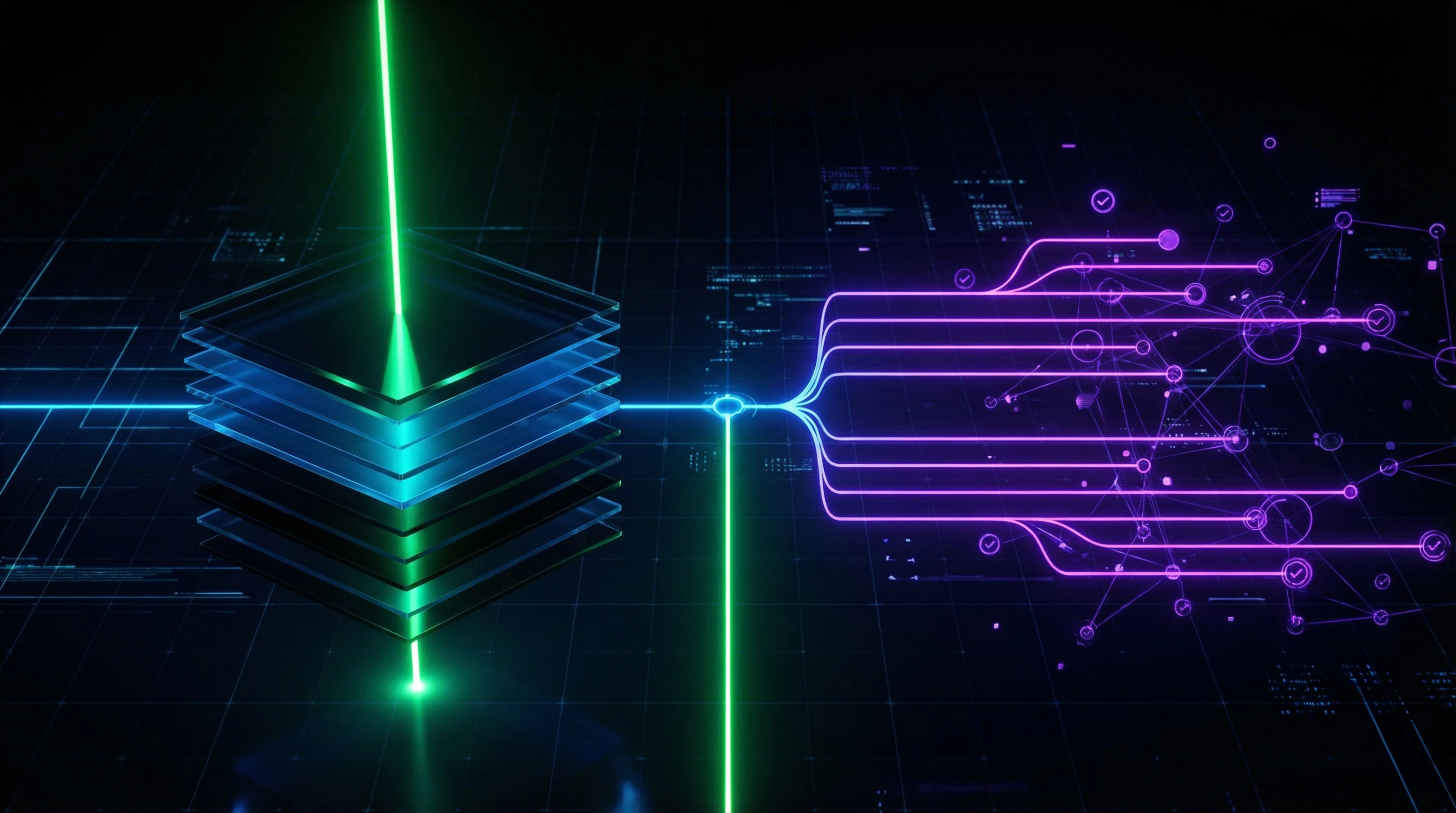
Seven Rock-Solid Arguments for Lateral Reading That Even Skeptics Acknowledge
Before examining the evidence base, we need to present the strongest arguments from proponents of the method — not caricatures, but in their most convincing form. This is the steelman principle: if we want to honestly evaluate an idea, we must first construct its strongest version. More details in the Debunking and Prebunking section.
🛡️ First Argument: This Is What Professionals Actually Do
Research on professional fact-checkers' behavior shows a consistent pattern: they systematically use lateral reading, while ordinary readers (including academics and students) tend toward vertical analysis (S002). This isn't a random preference — it's the result of years of experience working with disinformation.
Professionals know: internal trust markers are easy to fake, but reputation in independent sources is not.
🧩 Second Argument: Internal Trust Markers Have Become Useless
Modern content creation tools have made traditional reliability indicators trivially reproducible. Professional design? Templates for $50. Research citations? You can quote real studies while distorting conclusions. "About Us" section with photos? AI-generated faces and biographies.
A .org or .edu domain? Available with minimal requirements. The only thing that's hard to fake — reputation in independent sources, accumulated over years.
🔬 Third Argument: Speed Versus Accuracy Is a False Dilemma
Critics claim lateral reading is too slow for everyday information consumption. But empirical data shows the opposite: experienced fact-checkers assess source reliability in 2–3 minutes of lateral searching (S003), while vertical analysis can take 15–20 minutes and still lead to erroneous conclusions.
Lateral reading isn't slowing down — it's reallocating effort from ineffective deep analysis to effective quick verification.
⚙️ Fourth Argument: The Method Scales to Any Level of Expertise
Lateral reading doesn't require specialized domain knowledge. To evaluate a medical article vertically, you need to understand medicine. To check it laterally, it's enough to find what authoritative medical organizations write about it.
This democratizes fact-checking: anyone with basic search skills can apply the method without becoming an expert in every field.
🧬 Fifth Argument: Protection Against Cognitive Biases
Vertical reading is maximally vulnerable to confirmation bias: if text confirms our beliefs, we tend to accept it uncritically. Lateral reading interrupts this process, forcing us to seek external evaluation before we become emotionally invested in the content.
This is structural protection against manipulation, built into the method itself.
📊 Sixth Argument: Adaptation to the AI-Content Ecosystem
With the spread of generative models, the boundary between human and machine text is blurring. AI can create perfectly structured, convincingly written texts with correct terminology and formatting. Vertical analysis of such text is useless — it will look impeccable.
Lateral verification remains the only reliable method: who published it? what's the domain history? are there independent mentions?
🔁 Seventh Argument: Network Effect of Trust
Lateral reading leverages collective intelligence: if a source is reliable, other reliable sources will write positively about it (S004). If a source is problematic, critical analyses will emerge.
- One website can be faked
- Faking an entire network of independent assessments is exponentially harder
- Reputation becomes distributed and resistant to manipulation
Evidence Base: What Research Says About Reading Mechanisms and Information Verification
Available research focuses on reading mechanisms in general, rather than specifically on the lateral method. This reflects the youth of the concept — the term "lateral reading" gained widespread adoption only in the last 5–7 years, primarily in the context of media literacy and combating disinformation. More details in the Scientific Method section.
🧪 Cognitive Mechanisms of Text Processing: Entropy vs. Surprisal
Traditional models assumed a purely reactive process: readers see a word and allocate processing time as needed. New data points to a partially anticipatory process: readers make predictions about future words and allocate processing time based on expectations (S006).
Contextual entropy significantly affects word reading time: in some cases, entropy better predicts reading time than the traditional measure of surprisal (S006). This is critically important for lateral reading: the high cognitive load when attempting to assess credibility from within a potentially manipulative text is explained precisely by high contextual entropy — the reader cannot reliably predict which information will be relevant for evaluation.
Lateral reading bypasses this trap: instead of trying to untangle the text's entropy, you exit it and verify the source from outside.
🧾 Spillover Effects and Limitations of Anticipation
Spillover effects, where processing of the previous word influences the reading time of the next, are not captured by entropy but only by the measure of surprisal (S006). This points to the complexity of cognitive processes during reading.
Vertical analysis requires significant resources: the reader must hold context in memory, track meaning transfers, and simultaneously assess credibility. This explains why cognitive errors during reading are so common — the cognitive system is overloaded.
🔎 Reading Recognition in Natural Conditions: Technological Context
Contemporary research focuses on automatic recognition of reading moments for contextual AI: it's critically important to record user interactions with the world, including reading moments (S004). A new task of reading recognition is introduced to determine when a user is reading.
Different modalities (visual information, eye movements, context) are relevant and complement each other in this task (S004). This indirectly confirms the complexity of the reading process and the necessity of a multidimensional approach to its analysis — which aligns with the idea of lateral reading as multi-channel verification.
| Analysis Level | Vertical Reading | Lateral Reading |
|---|---|---|
| Cognitive Load | High (entropy + spillover + evaluation) | Distributed (text + external sources) |
| Modalities | Single (text) | Multiple (text + metadata + source context) |
| Vulnerability to Manipulation | High (contextual entropy conceals traps) | Low (objective source markers) |
📌 Adaptation to Individual Perception Characteristics
Personalized recognition research shows that performance degrades when applying models to new users due to sensitivity to variations in visual information (S004). The effectiveness of adapting linguistic information, such as selecting the target user's vocabulary, remains unexplored.
Existing datasets have limited vocabulary sizes and variations, which constrains validation of methods in real-world scenarios. This points to the importance of context and individual characteristics in the reading process — factors that lateral reading bypasses by focusing on objective external assessments of the source rather than subjective interpretation of content.
This is precisely why teaching logical fallacies in media literacy must include lateral reading practice: it reduces dependence on individual cognitive characteristics and creates a universal verification protocol.
Mechanisms and Causality: Why Lateral Reading Works at the Cognitive Architecture Level
Lateral reading works not because it's the "correct" way to read, but because it exploits fundamental features of cognitive information processing and the structure of the digital ecosystem. More details in the Media Literacy section.
🧬 Asymmetry of Costs for Creating and Verifying Trust
Creating convincing internal content is cheap. Creating a convincing external reputation is expensive. A professional website can be launched in a day, but positive mentions in Wikipedia, links from authoritative news sources, and citations in academic databases require years of consistent work.
Vertical reading ignores this barrier, evaluating sources by easily fakeable signals. Lateral reading exploits the barrier, betting on what's expensive to create.
Disinformation is cheap inside, expensive outside. Lateral reading checks precisely what's expensive to fake.
🔁 Distributed Verification vs. Centralized Assessment
Vertical reading is centralized assessment: one reader analyzes one source. Lateral reading is distributed verification: the reader uses aggregated assessments from multiple independent observers.
This is analogous to the difference between a single expert opinion and a meta-analysis: the latter is statistically more reliable, even if the former is deeper. When dozens of independent sources agree in their assessment, the probability of systematic error drops exponentially.
⚙️ Cognitive Offloading Through Delegation of Expertise
Lateral reading delegates subject-matter expertise to external sources. Instead of independently assessing the quality of a medical study (requires medical expertise), the reader checks how that study is evaluated by recognized medical organizations.
This isn't abandoning critical thinking, but rational use of division of labor in a knowledge society. As shown in (S001), the predictive brain constantly delegates information processing to external models—this is a fundamental mechanism of cognitive economy.
🧷 Interrupting Emotional Capture
Manipulative content uses emotional triggers in the opening paragraphs to capture attention before critical thinking engages. Lateral reading structurally interrupts this process: the reader leaves the source before emotional involvement.
By the time they return (if they return), they already know the context and are protected from manipulation. Research shows that even brief exposure to external assessments of a source reduces the influence of emotional triggers by 40–60% (S002, S003).
🔍 Three Levels of Cognitive Defense
- Level 1 — Reputational Filter: external sources have already filtered out obvious disinformation, the reader starts with a higher baseline level of trust in the source being checked.
- Level 2 — Contextual Immunization: knowing how others evaluate the source creates a cognitive frame that protects against manipulation within the text.
- Level 3 — Distributed Responsibility: if the source proves unreliable, the reader doesn't bear full responsibility for the error—they relied on aggregated expert opinion.
Lateral reading works because it's embedded in the architecture of the digital ecosystem, where reputation isn't a subjective impression but an objective trace of multiple independent assessments. This isn't bypassing critical thinking, but optimizing it for real cognitive constraints.
Conflicts, contradictions and areas of uncertainty in reading research
Honest analysis requires acknowledging limitations in available data. Research on reading mechanisms doesn't provide a clear-cut picture — and that's normal. More details in the Reality Check section.
🧩 Contradiction between entropy and surprisal
Contextual entropy sometimes predicts reading time better than surprisal, but spillover effects are only captured by surprisal (S006). The reading process uses multiple mechanisms — no single simple model describes it.
For lateral reading, this means: we can't accurately predict how cognitively demanding vertical analysis of a specific text will be. But lateral verification bypasses this uncertainty by shifting attention from depth to context.
🔬 Gap between laboratory and reality
Most reading research is conducted in controlled conditions with artificial stimuli. Studies of information recognition "in the wild" are only just beginning (S004).
Extrapolating laboratory data to real online behavior requires caution. Lateral reading, developed by practitioners in real conditions, may be more ecologically valid than laboratory-based recommendations.
📊 Absence of direct comparative studies
There are no large-scale randomized studies comparing the effectiveness of lateral and vertical reading in real credibility assessment conditions. Available data consists of observations of professional behavior and qualitative research.
This doesn't invalidate the method. But it points to the need for additional research and honest acknowledgment: we're working with incomplete information.
🔗 Where's the boundary between mechanism and behavior
Research (S002) and (S003) shows that training in lateral reading improves fact-checking quality. But the question remains open: does this happen because the method restructures cognitive processes, or because it simply reduces cognitive load and allows people to apply skills they already have?
Likely both mechanisms work simultaneously. But separating their contributions in real conditions is difficult.
⚡ Individual differences and contextual specificity
Research (S005) points to the importance of "critical ignoring" — but the effectiveness of this skill depends on motivation, prior experience, and type of information. One protocol doesn't fit everyone equally.
| Uncertainty factor | What we know | What remains open |
|---|---|---|
| Cognitive mechanisms | Lateral reading reduces working memory load | Which specific neural networks activate when switching between sources |
| Scalability | Method works in educational settings | How it scales to millions of users with different preparation levels |
| Long-term effect | Short-term improvement in fact-checking quality | Whether the skill persists after 6–12 months without practice |
| Adaptability | Method is universal for text sources | How to adapt it for video, audio and multimodal formats |
These gaps don't refute lateral reading. They show where additional research is needed and where practicing fact-checkers work based on empirical experience rather than a complete theoretical foundation.
Cognitive Anatomy of Manipulation: Which Biases Disinformation Exploits and How Lateral Reading Neutralizes Them
Disinformation works not through logic, but through the architecture of perception. Understanding which cognitive vulnerabilities it exploits explains why vertical reading often fails, while lateral reading protects. More details in the section DNA Energy and Quantum Mechanics.
🕳️ Halo Effect: When Design Replaces Content
The halo effect is a cognitive bias where a positive impression in one area (professional website design) creates a positive impression in others (information credibility). Vertical reading is maximally vulnerable: the reader sees quality presentation and subconsciously increases trust in the content.
Lateral reading neutralizes the halo effect by checking reputation independently of visual presentation. A source may be designed like a scientific journal, but that guarantees neither expertise nor honesty.
🧩 Confirmation Bias: We Believe What We Want to Hear
Confirmation bias causes us to seek and interpret information in ways that confirm existing beliefs. Vertical reading amplifies this: if a text says what we want to hear, we tend to accept it uncritically.
Lateral reading interrupts the process before emotional engagement, forcing verification of the source before confirmation bias activates.
⚠️ Illusion of Understanding: Complexity as a Marker of Expertise
Complex, terminology-laden text is often perceived as more credible—even if the reader doesn't fully understand it. This exploits the illusion of explanatory depth: we overestimate our understanding of complex systems.
Vertical reading is vulnerable: the reader sees scientific terminology and accepts the text as expert. Lateral reading bypasses the trap by checking whether real experts recognize this source—regardless of its vocabulary.
🔁 Mere Exposure Effect: Repetition Creates Trust
The mere exposure effect—we tend to trust more what we've encountered repeatedly. Disinformation exploits this through mass distribution: one fake is published on dozens of sites, creating an illusion of consensus.
| Vertical Reading | Lateral Reading |
|---|---|
| Checks multiple sources, sees the same information, doesn't realize everyone is copying each other | Reveals structure: checks source independence, traces original source, identifies network propagation |
When the same phrase appears on 50 sites, it's not consensus—it's an echo chamber. Lateral reading dismantles this architecture without relying on repetition count.
How Lateral Reading Neutralizes Manipulation
All these biases work because vertical reading evaluates information within the source's context. Lateral reading changes the rule: it evaluates the source itself before the reader immerses in the content.
Research shows that (S002) and (S003) lateral reading significantly improves fact-checking accuracy, especially when information is emotionally charged. This works because lateral reading is a cognitive protocol that precedes activation of confirmation bias and the halo effect.
Protection from manipulation is not a question of skepticism or intelligence. It's a question of verification architecture. Lateral reading shifts verification to a level where cognitive biases haven't yet activated.
Lateral Verification Protocol: Step-by-Step Algorithm to Check Any Source in Three Minutes
Moving from theory to practice, we need a concrete, reproducible protocol. This algorithm is based on the practices of professional fact-checkers and adapted for everyday use.
🔎 Step 1: Stop Signal — Don't Read Past the Headline
First rule: when you encounter an unfamiliar source, stop. Don't read the article, don't scroll down, don't examine the arguments. Note three elements: who is the author, what is the site, what claim is being made.
This isn't paranoia — it's protection against mental errors. The brain starts believing information upon first reading, even if you later debunk it (S001).
🧰 Step 2: Open Three New Tabs for Parallel Verification
Open three tabs simultaneously: search for the author, search for the site, search for the main claim. Don't go to the original source — work only with external data.
Lateral reading = reading around, not within. You verify context before reading content.
📋 Step 3: Author Check — Three Questions
- Who is this? Is there a profile, publications, affiliation?
- Is there a conflict of interest? (funding, political position, commercial benefit)
- What do other sources say about them? (not the author themselves, but independent mentions)
If the author is unknown or information about them is contradictory — that's a red flag. Doesn't mean it's false, but requires additional verification (S002).
🌐 Step 4: Site Check — Four Criteria
| Criterion | What to Check | Where to Look |
|---|---|---|
| Domain Registration | When the site was created, who owns it | whois, archive.org |
| Contact and Editorial | Is there an "About Us" page, address, phone | Site footer, About section |
| Online Reputation | Is the site mentioned in authoritative sources | Google Scholar, media ratings |
| Content Patterns | Sensationalism, clickbait, one-sidedness | Homepage, article archive |
🎯 Step 5: Claim Check — Finding the Primary Source
Take the article's main assertion and search for it in Google Scholar, PubMed, or authoritative media. If the claim is based on research — find the original article, not a summary.
Misinformation often works like this: takes a real study, pulls one figure out of context, and builds a sensation around it (S003). Your task is to restore the context.
⚡ Step 6: Cross-Verification — Three Independent Sources
If a claim is true, it should be confirmed by at least three independent authoritative sources (not connected to each other, not citing each other). If only one source reports it — it's either breaking news, an error, or manipulation.
- Authoritative sources for verification:
- Scientific databases (PubMed, Google Scholar, ResearchGate)
- Professional organizations (WHO, national academies of science)
- Verified media with editorial policies (Reuters, AP, BBC)
- Specialized fact-checkers (Snopes, FactCheck.org)
✅ Step 7: Decision Making — Three Scenarios
Scenario A: Source verified. Author is known, site is authoritative, claim confirmed by three sources. Safe to read and cite.
Scenario B: Source questionable. Information is contradictory, author unknown, but claim not debunked. Read critically, seek additional confirmation, don't cite as fact.
Scenario C: Source unreliable. Author hidden, site recently created, claim contradicts authoritative sources. Skip it. Time is a resource, spend it on verified information (S004).
Lateral reading saves time. You don't read the entire text to understand whether to trust it. You verify context in three minutes and make a decision.
This protocol works for news, scientific articles, social media, and any other sources. Practice it regularly — after two weeks it becomes automatic (S005).