
"Gallop" is not only a horse's gait but also the name of three unrelated machine learning technologies, a rhetorical fallacy in debates, and a subject of biomechanical research. This article examines five meanings of the term "gallop/galop/GaLLoP/GalLoP," shows how context changes meaning, and explains why confusion between them creates information noise. Level of evidence: moderate (technical papers, preprints, biomechanical data).
👁️ Type the word "gallop" into a search engine—and you'll get biomechanical studies of quadrupedal animals, three unrelated machine learning technologies with identical acronyms, and a description of a rhetorical fallacy named after creationist Duane Gish. This isn't an indexing error or random coincidence—it's a demonstration of how a single term can simultaneously exist in five parallel semantic universes, creating information noise and hindering scientific communication. Each of these meanings has its own evidence base, its own scientific community, and its own validity criteria, yet they all compete for the same search space.
📌 Five Parallel Worlds of One Word: What Lies Behind the Term "Gallop" and Why Context Determines Everything
The term "gallop" exists simultaneously in five unrelated contexts, each with its own history, methodology, and scientific community. Context determines meaning entirely — one word, five different realities. More details in the section Statistics and Probability Theory.
- Biomechanics
- Gallop as a high-speed gait of quadrupeds: a specific sequence of limb placement, flight phases, and movement energetics.
- Rhetoric
- "Gish gallop" — a debate technique: rapid deployment of numerous weak arguments whose refutation requires disproportionately greater effort.
- Machine Learning (variant 1)
- GalLoP — a method for learning global and local prompts for vision-language models (S002).
- Machine Learning (variant 2)
- GaLLoP — a gradient-based sparse learning technique on low-magnitude parameters (S006).
- Future Variants
- Potentially other acronyms that may emerge in scientific literature.
Biomechanical Gallop: From Horses to Robots
In biomechanics, gallop is an asymmetric gait with three or four beats, during which the animal passes through one or two flight phases per cycle (S004). This is a common high-speed gait for both animals and quadrupedal robots, but its energetic characteristics remain insufficiently studied.
The number of flight phases significantly affects energy efficiency: gallop without flight phases is optimal at low speeds, gallop with two flight phases minimizes energy consumption at high speeds (S004).
Biomechanical research reveals individual preferences in lead limb selection. The choice depends on the individual animal rather than the species, and does not change with running speed (S008). This indicates system complexity where individual variability plays a significant role.
Gish Gallop: Rhetorical Fallacy as Eponym
The term "Gish gallop" is named after creationist Duane Gish. The technique: rapid enumeration of numerous weak or erroneous arguments, creating an illusion of persuasiveness because the opponent cannot refute all claims within the allotted time.
The article "Rebuttal of Holliday et al.'s Comprehensive Gish Gallop of the Younger Dryas Impact Hypothesis" uses this term in its title, characterizing criticism of the impact event hypothesis as an example of precisely this strategy (S001). The authors argue that opponents advanced numerous objections, each requiring detailed examination.
This technique is effective not because of argument quality, but because of effort asymmetry: an unverified claim can be made in seconds, refutation requires hours of research work.
In scientific context, "Gish gallop" becomes a metaphor for publications overloaded with weak objections, creating the appearance of critical analysis without real evidentiary power. This relates to the broader problem of cognitive traps in rapid decision-making — when information volume overwhelms the capacity for critical evaluation.
Two Technical Acronyms: When Machine Learning Creates Homonyms
In machine learning, "GalLoP" and "GaLLoP" emerged independently in different research groups, creating an acronymic collision. Both address the problem of efficient adaptation of large pretrained models, but through different methods.
| Variant | Full Name | Approach | Source |
|---|---|---|---|
| GalLoP | Global and Local Prompts | Prompt learning for vision-language models; focus on relevant features through local alignment and sparsity | (S002) |
| GaLLoP | Gradient-based Sparse Learning on Low-Magnitude Parameters | Sparse fine-tuning; training parameters with largest gradients and smallest pretrained magnitudes | (S006) |
The first variant focuses on prompts and features, the second on parameter selection for updates. The acronym collision creates confusion in scientific literature and complicates searches for relevant work, especially for researchers unfamiliar with the context of each publication.
The effectiveness of sparse adaptation depends on optimal selection of model parameters for fine-tuning (S006). This reflects a more general principle: choosing relevant features or parameters is critical for adaptation success.
The name collision is not coincidence, but a consequence of convergent thinking in machine learning. Different teams independently arrive at similar ideas (locality, sparsity, adaptation), but use different acronyms. This creates a semantic collision requiring contextual resolution — exactly as in the other four worlds of one word.
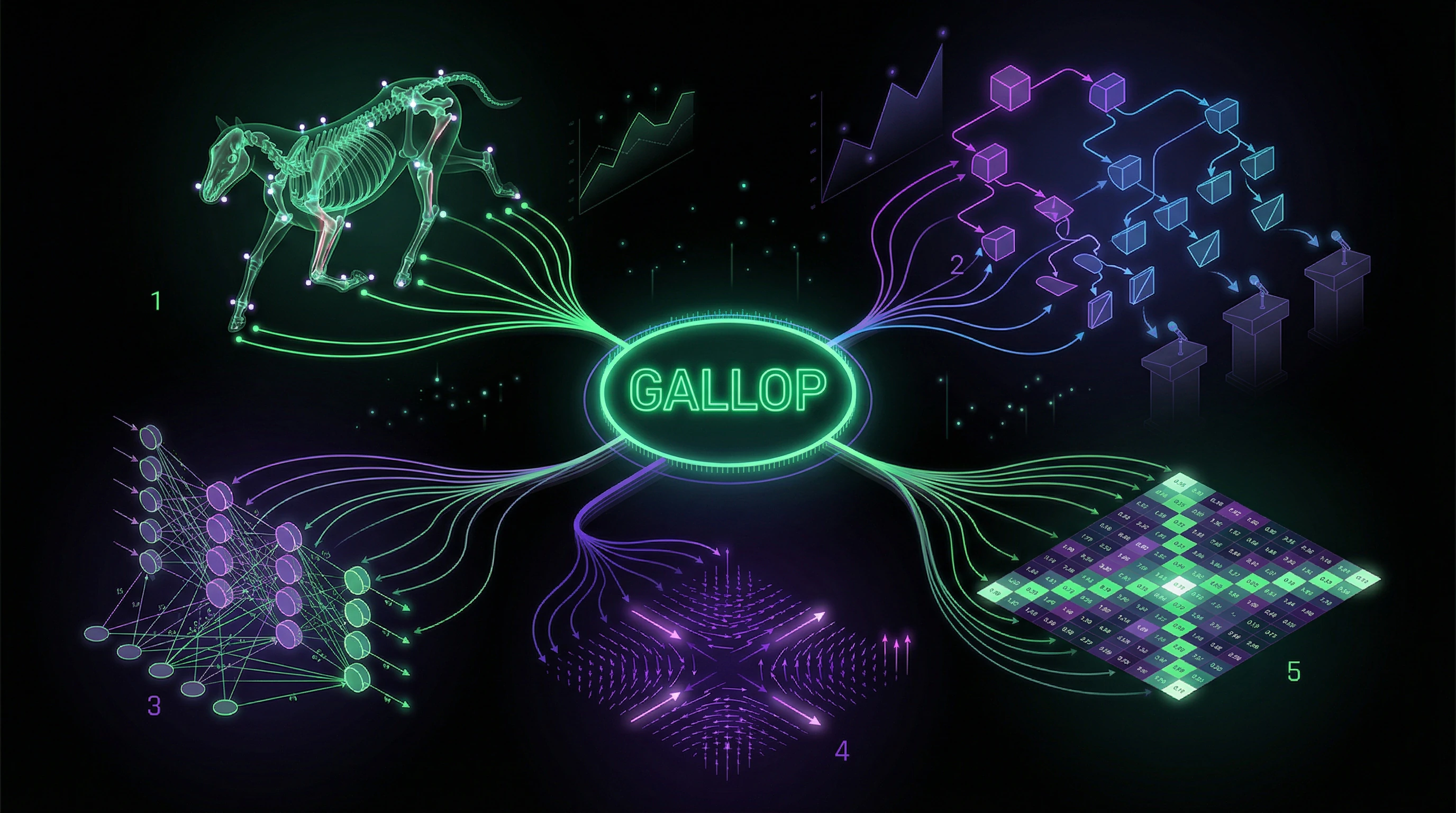
Why One Word Creates Five Worlds: Linguistic, Technical, and Social Causes of Semantic Collision
Five unrelated meanings of a single term result from the interaction of linguistic economy, technical traditions of acronym formation, absence of centralized control over scientific terminology, and cognitive tendency to reuse successful metaphors. Each factor reinforces the others, creating an overloaded term that remains in active use across all contexts simultaneously. More details in the Critical Thinking section.
🔬 Linguistic Economy and Metaphorical Transfer
The biomechanical term "gallop" described observable horse behavior—fast running with a characteristic rhythm. The repeating "g" and "l" sounds create a sense of rhythmic movement, making the word convenient for metaphorical transfer.
When Duane Gish used the technique of rapid argument enumeration, critics drew a parallel with a galloping horse—fast, continuous movement, difficult to stop. The "Gish gallop" metaphor stuck because it's intuitively clear: just as a horse at gallop covers great distance in short time, a speaker advances numerous arguments in a limited period.
Metaphorical transfer works effectively when the source meaning possesses vivid perceptual characteristics. Gallop is movement with defined rhythm, speed, and visual dynamics, easily transferred to other domains: rapid argument enumeration, swift data processing, dynamic model parameter adaptation.
All these processes are described through the gallop metaphor, explaining the independent emergence of the term in such different fields. This isn't coincidence but pattern: successful metaphors spread because they work cognitively.
⚙️ Acronym Collision in Machine Learning
In machine learning, there's an established tradition of creating memorable acronyms for methods and algorithms. The space of possible letter combinations is limited, and different research groups independently arrive at similar acronyms.
"GalLoP" and "GaLLoP" exemplify such collision. The first stands for "Global and Local Prompts" (S002), the second for "Gradient-based Sparse Learning on Low-Magnitude Parameters" (S006). Both contain elements related to key method concepts, but their phonetic similarity creates confusion.
- No centralized acronym registry exists in machine learning
- Researchers choose names independently, often without checking prior usage
- Both methods relate to adjacent areas (pretrained model adaptation), increasing likelihood of conflation
- Literature search becomes difficult, risk of result misinterpretation increases
The situation is complicated by review articles and educational materials easily mixing methods due to acronym phonetic similarity.
🧷 Absence of Semantic Control in Scientific Communication
Unlike medical terminology with international classifications (ICD, MeSH) and controlled vocabularies, most scientific fields develop terminology spontaneously. No authority can prohibit use of an occupied term or require acronym uniqueness.
This creates competition for semantic space, where the winner isn't the first term user but the author of highly-cited work or researcher from a more popular field. The connection between this phenomenon and cognitive traps in rapid decisions is obvious: the brain selects the most accessible term meaning, often incorrectly.
- Contextual analysis in search engines
- Databases attempt to determine whether users are interested in vision-language models, sparse learning, biomechanics, or rhetoric. Without additional keywords, results remain mixed.
- Cognitive load on researchers
- Term ambiguity reduces scientific communication efficiency and requires additional effort for context clarification.
- Absence of centralized control
- Unlike medicine, no mechanism exists to prevent semantic collisions at the scientific community level.
Search engines work only partially. When a user enters "GalLoP," the system must determine context, but without explicit filters results will be mixed. This increases cognitive load and reduces scientific communication efficiency—a problem that worsens when researchers work under time pressure.
Evidence Base for Each Meaning: From Biomechanical Experiments to Machine Learning Preprints
Each of the five meanings of the term "gallop/GalLoP" relies on its own evidence base, differing in methodology, validation, and consensus. Biomechanics uses high-speed videography, motion sensors, and energy measurements. Rhetorical analysis of "Gish gallop" is based on qualitative examination of argumentative strategies. For more details, see the Reality Check section.
Technical machine learning methods are validated through experiments on datasets and comparison with baseline methods. The level of evidence is determined by the standards of each field—direct comparison is impossible.
📊 Biomechanics of Galloping: Experimental Data and Energy Analysis
The study "16 Ways to Gallop" systematizes the energetics and dynamics of different galloping variants (S004). The authors model 16 galloping patterns that differ in the number of flight phases (0, 1, or 2) and the sequence of limb placement.
Key finding: the number of flight phases critically affects energy efficiency (S004). Galloping without flight phases is optimal at low speeds; galloping with two flight phases minimizes energy consumption at high speeds. This has practical implications for the development of quadrupedal robots.
| Parameter | Data Collection Method | Validation Level |
|---|---|---|
| Galloping energy efficiency | Robot simulation model | Experimental (reproducible) |
| Leading limb preference | High-speed videography, kinematic analysis | Experimental (statistically significant) |
| Limb coordination | Motion sensors, pattern analysis | Experimental (standardized) |
Research on dogs and pikas shows that leading limb choice depends on individual characteristics rather than species (S008). The strength of preference does not depend on running speed. This indicates that galloping biomechanics includes not only physical constraints but also neuromotor preferences that vary between individuals.
🧾 Gish Gallop in Scientific Debate: Qualitative Analysis of Argumentative Strategies
The term "Gish gallop" in scientific literature denotes a qualitative assessment of argumentative strategy. The article "Rebuttal of Holliday et al.'s Comprehensive Gish Gallop of the Younger Dryas Impact Hypothesis" (S001) uses this term to describe a multitude of weak objections, each requiring detailed examination.
The evidence base here is not quantitative: it is based on analysis of argumentation structure, the ratio between the number of objections and the depth of their justification, and comparison with known examples of this rhetorical technique. However, the accusation of "Gish gallop" is itself a rhetorical device that can discredit an opponent without detailed examination of their arguments.
Methodological problem: how to distinguish legitimate criticism of multiple weaknesses in a theory from using "Gish gallop" as a way to avoid responding to serious objections? The scientific community has not developed clear criteria for such distinction.
This creates a situation where the use of the term in scientific debate remains controversial. Risk: the accusation of "Gish gallop" can be applied to any opponent who presents multiple arguments simultaneously, regardless of their quality. The connection to logical fallacies in discourse is obvious—this is one of the mechanisms by which smart people believe foolish things.
🧪 Technical Machine Learning Methods: Experiments on Datasets and Performance Metrics
The GalLoP method for learning global and local prompts is validated through experiments on standard datasets for vision-language learning (S002). The approach focuses on relevant features through local alignment with a sparsity strategy in selecting local features.
The authors demonstrate superiority over baseline methods in accuracy and efficiency metrics (S002). The evidence base includes comparative results tables, learning curves, and computational complexity analysis. However, the work is presented as a preprint (arXiv)—without formal peer review. Results should be considered preliminary.
The GaLLoP method for gradient sparse learning is also presented as a preprint and validated on fine-tuning tasks for large language models (S006). The technique trains only parameters with the largest gradient magnitudes on lower-level tasks and the smallest pretrained magnitudes.
Result: comparable or better performance compared to full fine-tuning with significantly fewer updated parameters (S006). The authors note that the effectiveness of sparse adaptation depends on optimal parameter selection—further research is needed.
- arXiv Preprints
- Do not undergo the rigorous peer review characteristic of journal publications. Results may contain methodological errors or be irreproducible.
- Dataset Limitations
- Experiments are conducted on a limited set of datasets and tasks, which limits the generalizability of results.
- Requirements for Full Validation
- Independent reproduction of results, testing on a broader spectrum of tasks, comparison with a wider set of baseline methods.
Both machine learning methods are at an early stage of validation. The difference in evidence level between biomechanical studies (experimental data, reproducibility) and preprints (preliminary results, lack of peer review) is substantial. This reflects a general principle: the correlation between the number of publications and the reliability of conclusions is not linear.

Mechanisms of Confusion: Why Our Brain Mixes Unrelated Concepts and How Context Controls Interpretation
The human brain processes ambiguous terms through contextual cues that activate corresponding semantic networks. When context is ambiguous or absent, the brain uses heuristics to select the most probable meaning—relying on frequency of occurrence, recent experience, and dominant associations. More details in the Mental Errors section.
A biomechanics specialist encountering the term "GalLoP" in a machine learning context for the first time experiences cognitive dissonance: their semantic network activates the meaning related to animal gait (S002), while the text requires interpretation in the context of neural networks.
- Primary activation: the brain selects the dominant meaning (gallop as biomechanics).
- Conflict: new information doesn't match the activated network.
- Reinterpretation: conscious effort is required to switch contexts.
- Reinforcement: repeated exposure to the new context strengthens the alternative meaning.
This phenomenon is related to cognitive traps in fast decisions. The brain conserves resources by choosing the first suitable option rather than examining all possible interpretations.
Context is not decoration for text, but its architecture. Without explicit markers (discipline, genre, audience), the brain fills gaps with its own assumptions, often erroneous ones.
Research on animal movement coordination shows that transitions between locomotion modes (trot, gallop) are governed by energy threshold values (S005, S006). Similarly, transitions between semantic interpretations require sufficient "energy" from contextual information.
When context is weak, the brain remains in primary interpretation mode—like an animal stuck in one gait. This explains why people unfamiliar with machine learning continue to see only biomechanics in "GalLoP," even when shown code.
- Semantic Inertia
- The brain's tendency to maintain the initial interpretation of a term, even in the presence of contradictory signals. Requires explicit attention switching and recoding.
- Contextual Threshold
- The minimum amount of specific markers (terminology, structure, social signal) necessary to activate an alternative meaning. Below the threshold—the brain ignores the new context.
This is not a brain error—it's optimization. Under conditions of uncertainty, choosing the most probable meaning conserves cognitive resources. The problem arises when context is deliberately hidden or when the author assumes the reader is already in the required semantic network.
Solution: explicit context marking from the first sentence. Not "gallop," but "horse gallop" or "GalLoP algorithm for training quadruped robots." One word—the difference between understanding and confusion.