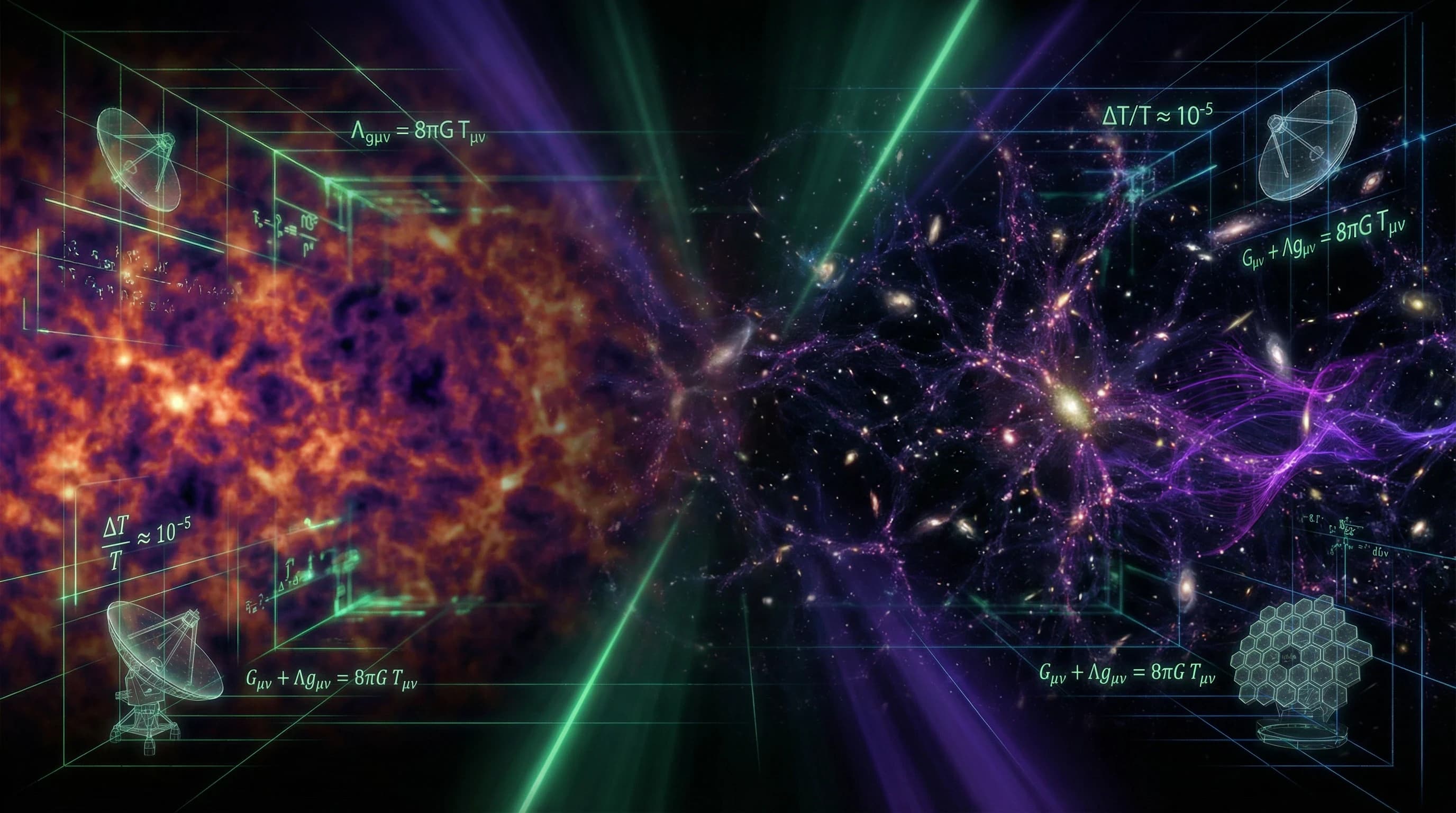
Cosmology: Scientific Study of the Universe as a Wholeλ
From ancient philosophical contemplations to modern empirical science — cosmology explores the structure, origin, evolution, and fate of the Universe based on astronomical observations and physical theories.
Overview
Cosmology studies the Universe as a unified whole — its structure, origin, evolution, and fate based on physical laws and astronomical observations. In the 1920s, Edwin Hubble proved: 🧬 galaxies are receding, the Universe is expanding — cosmology ceased to be philosophy and became an empirical science. Today, general relativity, quantum mechanics, and telescope data allow us to reconstruct the history of the cosmos from the Big Bang to dark energy.
🛡️
Laplace Protocol: Cosmology is neither astrology nor pure philosophy. It is an empirical science with testable predictions, grounded in astronomical data, particle physics experiments, and mathematical models. Approximately 95% of the Universe's content consists of dark matter and dark energy — whose nature remains one of the greatest mysteries of modern science.
Reference Protocol
Scientific Foundation
Evidence-based framework for critical analysis
Protocol: Evaluation
Test Yourself
Quizzes on this topic coming soon
⚡
Deep Dive
From Philosophy to Empirical Science: How Cosmology Became a Precise Discipline
Aristotelian and Ptolemaic Cosmology as the Foundation of the Medieval Worldview
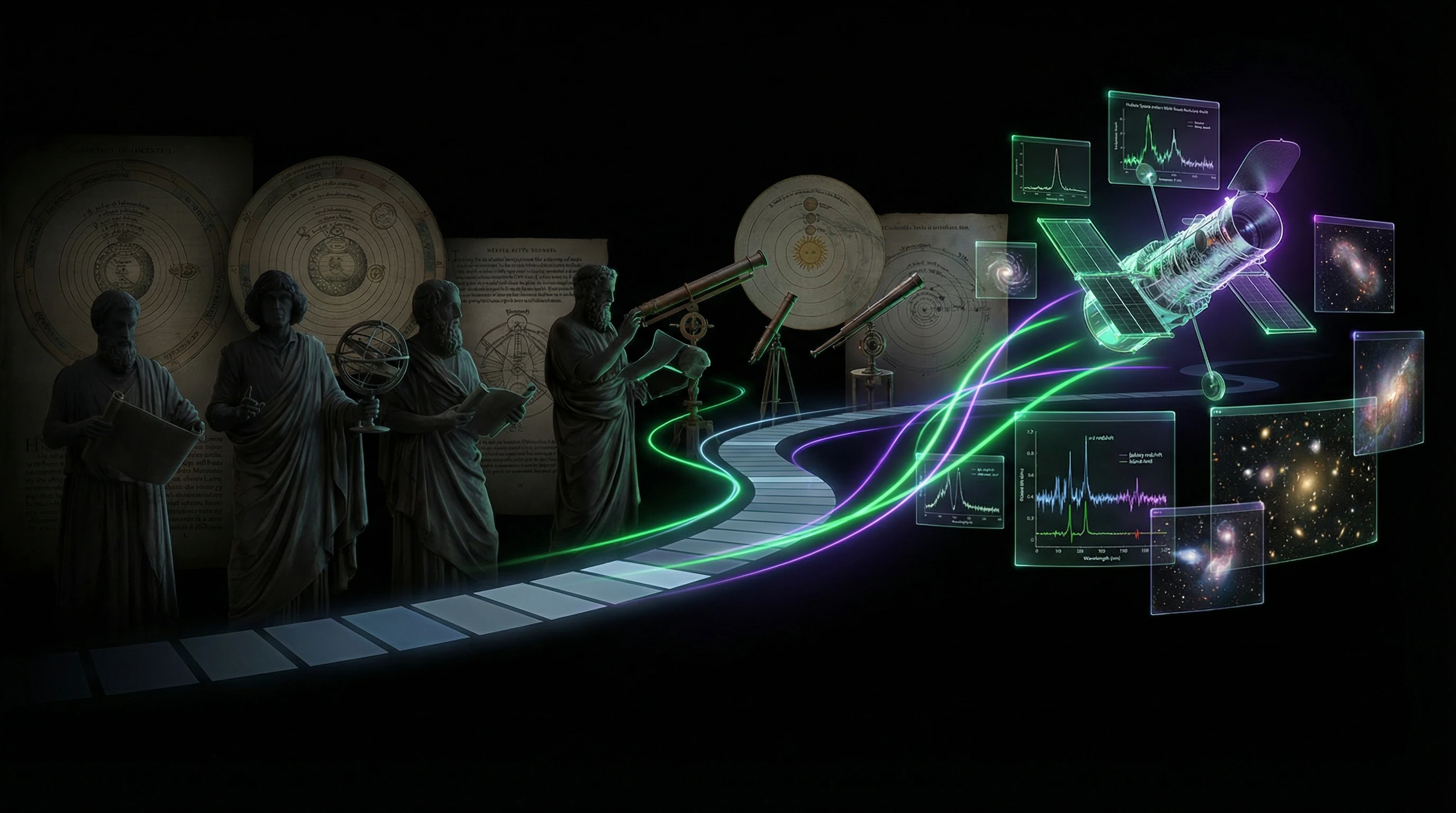
For over a thousand years, cosmology remained part of metaphysics, relying on the philosophical constructs of Aristotle and the mathematical model of Ptolemy.
Aristotelian cosmology postulated a geocentric universe with concentric spheres: the sublunary world was subject to laws of change and decay, while the superlunary realm followed eternal circular motion. Ptolemaic planetary theory complemented this picture with a complex system of epicycles and deferents, allowing prediction of planetary positions with remarkable accuracy for its time.
The synthetic model of Aristotle and Ptolemy dominated both Christian and Islamic intellectual traditions, defining medieval cosmological thinking—not because it was true, but because it was logically self-contained and consistent with observational data within the precision limits of contemporary instruments.
Hubble's Revolution and the Birth of Modern Cosmology in the 1920s
The transformation of cosmology from a philosophical discipline into an empirical science occurred in the 1920s through Edwin Hubble's observations, which first established the true scale of the Universe.
- Hubble's Key Discovery
- Proof that many nebulous objects are separate galaxies at enormous distances from the Milky Way—this radically expanded conceptions of cosmic scale and definitively shattered the geocentric paradigm.
- Redshift and the Law of Recession
- Discovery of the correlation between a galaxy's distance and its recession velocity laid the observational foundation for the expanding universe theory and enabled linking cosmology with relativistic physics.
From this moment, cosmology began relying on testable empirical data and robust physical theories, transforming into a rigorous natural science.
Fundamental Definitions and Scales: What Cosmology Studies
What Distinguishes Cosmology from Astronomy and Other Natural Sciences
Cosmology studies the Universe as a unified whole, not individual objects. Astronomy investigates specific stars, planets, and galaxies; cosmology addresses the general laws governing the structure of the entire observable Universe.
This is a holistic approach: cosmology integrates astronomy, physics, mathematics, and philosophy to understand the large-scale properties and evolution of the cosmos.
| Discipline | Object of Study | Scale |
|---|---|---|
| Astronomy | Stars, planets, galaxies | From light-years to millions of light-years |
| Cosmology | Universe as a whole | Billions of light-years and beyond |
The Universe as Research Object: Scales and Structure
Cosmology investigates the Universe from its birth to its ultimate fate: origin, expansion, shape, geometry, size, structure, composition. The subject is the large-scale properties of the cosmos at scales of billions of light-years.
Modern cosmology is the science of cosmic evolution, studying dynamic processes on cosmological timescales, not static states.
- Distribution of matter at scales of billions of light-years
- Formation of large-scale structure
- Galaxy evolution
- Nature of dark matter and dark energy (comprising ~95% of the Universe's content)
Theoretical Foundations of Physical Cosmology: From Einstein to Lambda-CDM
General Relativity and Cosmology as Its Application
Physical cosmology relies on Einstein's general theory of relativity and quantum mechanics. General relativity describes the geometry of spacetime in the presence of matter and energy — this is critical for understanding the large-scale structure of the Universe.
Cosmological models are built on solutions to Einstein's equations for a homogeneous and isotropic Universe. This allows for quantitative predictions about its evolution and transforms cosmology into an exact science with testable hypotheses.
The mathematical apparatus of general relativity is not merely a convenient tool, but a necessary condition for cosmology to compare theory with observations.
The Standard Lambda-CDM Cosmological Model and Its Empirical Pillars
The standard Lambda-CDM cosmological model combines the cosmological constant (Lambda) and cold dark matter (CDM). This is the prevailing theoretical framework of modern cosmology.
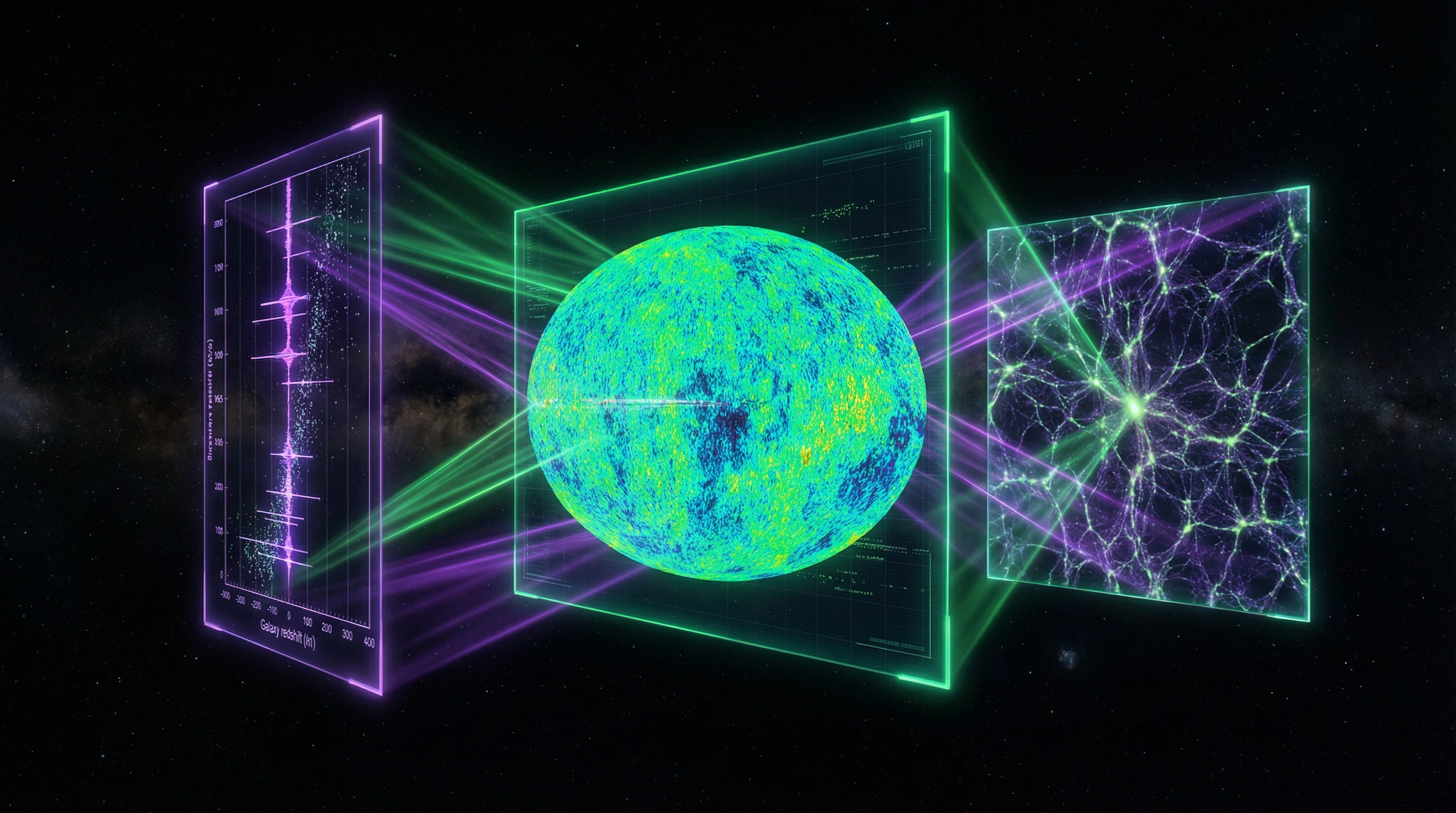
The model rests on three main observational pillars: the cosmic microwave background radiation, galactic redshift, and the large-scale structure of the Universe. Big Bang theory describes the evolution of the Universe from a super-dense and super-hot initial state.
- Cosmic microwave background radiation — imprint of the early Universe
- Galactic redshift — evidence of expansion
- Large-scale structure — distribution of matter in space
Despite the model's success in explaining observed phenomena, the nature of dark matter and dark energy remains one of the greatest unsolved problems in modern physics.
Observational Pillars of Modern Cosmology: Three Cornerstones of the Empirical Universe
Modern cosmology rests on three fundamental observational phenomena: the cosmic microwave background radiation, galactic redshift, and the large-scale structure of the Universe. Each independently confirms the model of an expanding and evolving Universe.
These pillars provide unique windows into the past, present, and future of the cosmos, allowing theoretical predictions to be tested with unprecedented precision.
Cosmology transformed from philosophical speculation into an exact empirical science thanks to three independent observational phenomena that coherently describe the same reality.
Relic Radiation and Redshift as Witnesses to Evolution
The cosmic microwave background radiation (CMB) is the relic glow of the early Universe, arising approximately 380,000 years after the Big Bang. Its temperature is about 2.7 K, and fluctuations on the order of one hundred-thousandth became the seeds of future galaxies and clusters.
Galactic redshift, systematically measured by Edwin Hubble in the 1920s, showed that the farther a galaxy is, the faster it recedes from us. The effect arises from the stretching of light wavelengths as space expands — direct proof of the dynamic nature of the Universe.
- CMB captures the state of the Universe at the moment of recombination (380,000 years after the Big Bang)
- Redshift measures the recession velocity of galaxies at the present moment
- Both phenomena independently confirm the expansion of space
Large-Scale Structure of the Universe as a Cosmic Web
Large-scale structure is the distribution of galaxies and clusters in the form of a giant cosmic web of filaments, nodes, and voids. This structure formed under the action of gravity from primordial density fluctuations imprinted in the relic radiation over billions of years.
Visible matter constitutes only a small fraction of the mass needed to explain the observed structure and dynamics of galaxies. The distribution of galaxies on scales of hundreds of millions of light-years confirms predictions of the Lambda-CDM model and allows estimation of dark matter and dark energy parameters.
The cosmic web is not a random distribution, but the imprint of primordial quantum fluctuations amplified by gravity over 13.8 billion years.
Dark Matter and Dark Energy: The Invisible Majority of the Cosmos
Ordinary matter — stars, planets, ourselves — comprises only 5% of the Universe. The remaining 95% consists of dark matter (~27%) and dark energy (~68%), which emit no light and manifest only gravitationally.
The nature of these components remains one of the greatest unsolved problems in physics, despite decades of research.
Invisible Components and Their Gravitational Signatures
Dark matter was postulated to explain anomalously high rotation speeds of galaxies and their motion in clusters — phenomena that visible matter cannot account for.
Gravitational lensing independently confirms the existence of invisible mass: massive objects bend light paths from distant sources.
- Observations of galaxy rotation speeds revealed excess mass
- Gravitational lensing maps dark matter distribution
- Galaxy motion in clusters indicates an invisible gravitating medium
Dark energy manifests through the accelerated expansion of the Universe, discovered in the late 1990s through observations of distant Type Ia supernovae. This component acts as anti-gravity, causing space to expand at an increasing rate.
Accelerated Expansion and Cosmic Fate
The discovery of accelerated expansion radically changed our understanding of the Universe's future. If dark energy maintains its properties, the cosmos will expand forever, becoming colder and more diffuse.
The fate of the Universe depends on the nature of dark energy and precise values of cosmological parameters, which continue to be refined through observations.
Alternative scenarios include the "Big Rip" — acceleration so strong it will tear apart all structures down to atoms, or cyclic models with alternating phases of expansion and contraction.
Unsolved Problems and the Future of Cosmology: Frontiers of Knowledge
Despite the successes of the standard cosmological model, modern cosmology faces fundamental questions whose answers may require revolutionary changes in physics.
The nature of dark matter and dark energy remains unknown. Their detection and understanding are active research areas uniting astronomy, particle physics, mathematics, and philosophy.
The Nature of Dark Components as Physics' Primary Challenge
Identifying dark matter particles remains a priority task: numerous experiments aim for direct detection in terrestrial detectors and indirect detection through annihilation products in space.
Candidates include Weakly Interacting Massive Particles (WIMPs), axions, and sterile neutrinos, but none have received experimental confirmation yet.
The nature of dark energy is even more mysterious: is it a cosmological constant (vacuum energy), a dynamic field (quintessence), or evidence of the need to modify general relativity on cosmological scales.
Solving these problems may require new physics beyond the Standard Model of particles and general relativity.
Methods for Testing Cosmological Theories in Empirical Science
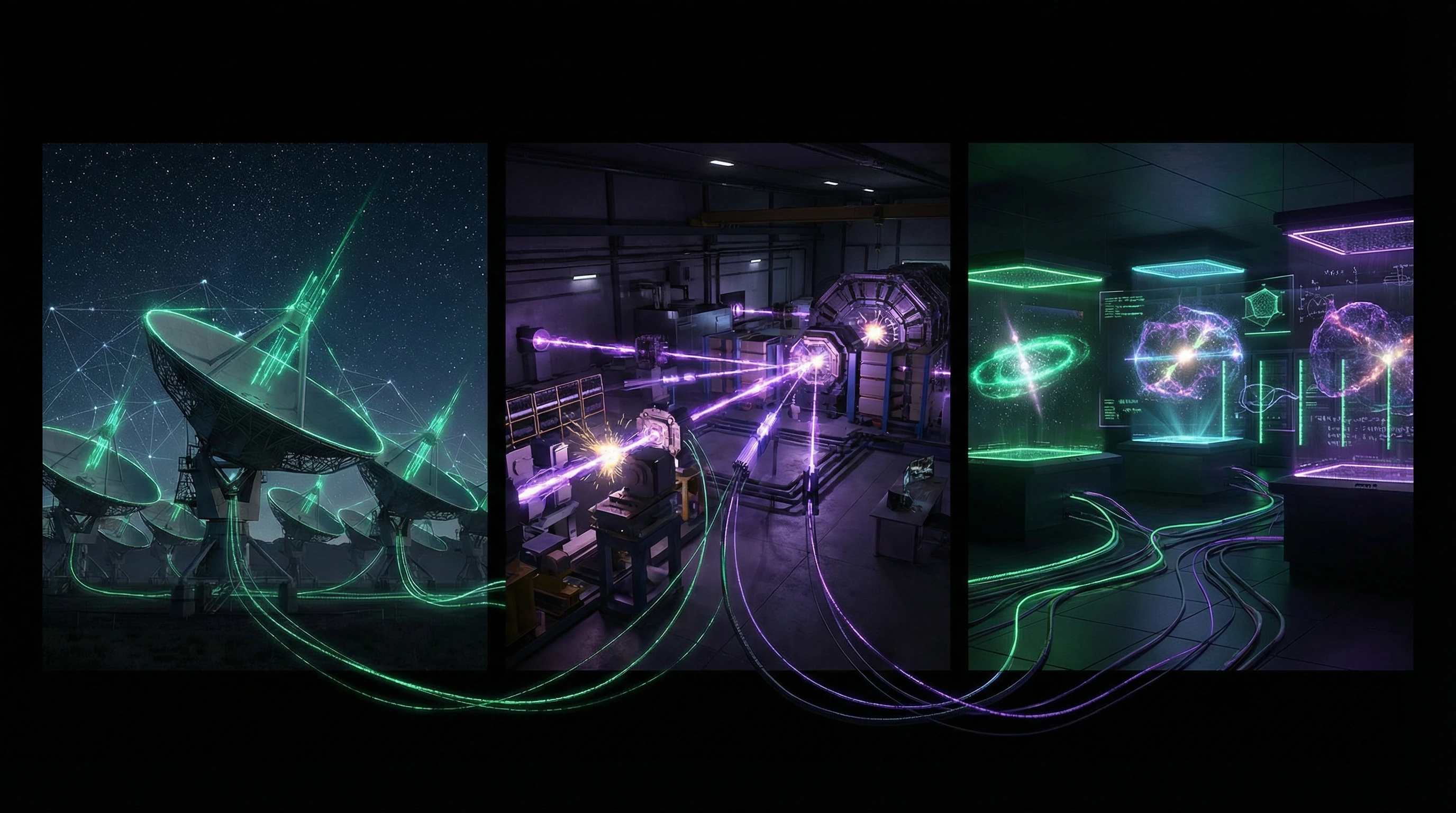
Cosmology tests its theories through observational astronomy, particle physics experiments, and mathematical modeling.
- Observational methods: studying cosmic microwave background radiation with satellites like Planck, mapping large-scale structure in surveys like the Sloan Digital Sky Survey, monitoring distant supernovae to measure expansion parameters.
- Laboratory experiments: searching for dark matter particles in deep underground detectors and at accelerators like the Large Hadron Collider.
- Computer simulations: testing how theoretical models reproduce the observed structure of the Universe through virtual universes with varying parameters.
This multi-level approach distinguishes modern cosmology from philosophical speculation and makes it a full-fledged empirical science with testable predictions.
Knowledge Access Protocol
FAQ
Frequently Asked Questions
Cosmology is the science of the Universe as a whole, studying its origin, evolution, and ultimate fate. Astronomy investigates individual celestial objects (stars, planets, galaxies), while cosmology examines the general laws and large-scale structure of the entire Universe. Modern cosmology relies on observational data and physical theories, especially general relativity.
No, modern cosmology is an empirical science based on observations and testable predictions. It uses data from telescopes, measurements of cosmic microwave background radiation, galactic redshift, and other observational facts. Theoretical models in cosmology are constantly tested experimentally and revised based on new data.
Lambda-CDM is the standard cosmological model describing the Universe as composed of three components: ordinary matter (~5%), cold dark matter (~27%), and dark energy Lambda (~68%). The model explains the expansion of the Universe, structure formation, and cosmic microwave background radiation. It is confirmed by numerous independent observations and forms the foundation of modern cosmology.
Cosmology is a rigorous scientific discipline using the scientific method, mathematics, and empirical data to study the Universe. Astrology is a pseudoscience without scientific basis, claiming celestial bodies influence human destinies. Cosmology makes testable predictions and constantly evolves based on observations, while astrology relies on ancient beliefs.
Dark matter is an invisible form of matter comprising about 27% of the Universe, manifesting only through gravitational effects. It is necessary to explain galaxy rotation, large-scale structure formation, and gravitational lensing. The nature of dark matter remains one of the major unsolved problems in modern cosmology.
Dark energy is a mysterious form of energy comprising ~68% of the Universe and causing accelerated expansion of space. Discovered in 1998 through observations of distant supernovae. Its nature is unknown: it may be Einstein's cosmological constant or a dynamic field determining the future fate of the Universe.
Expansion is measured through redshift of light from distant galaxies: the farther the object, the faster it recedes and the more its spectrum shifts toward the red. Edwin Hubble established the relationship between distance and recession velocity in the 1920s. Modern methods use Type Ia supernovae as 'standard candles' for precise measurements.
Cosmic microwave background radiation (CMB) is microwave radiation filling the entire Universe, remaining from the recombination era 380 thousand years after the Big Bang. Discovered in 1965, it confirms the theory of the Universe's hot beginning. Its temperature is ~2.7 K, and tiny fluctuations contain information about the early Universe and structure formation.
Yes, cosmological theories are tested through astronomical observations: measurements of cosmic microwave background radiation, galaxy distribution, gravitational waves, and redshift. Satellites (Planck, WMAP), ground-based telescopes, and gravitational wave detectors (LIGO) provide data for testing predictions. Discrepancies between theory and observations lead to model revisions.
The Universe has evolved from the Big Bang (13.8 billion years ago) through inflation, the radiation era, recombination (380 thousand years), the dark ages, formation of first stars and galaxies to the present structure. Currently dark energy dominates, causing accelerated expansion. The future depends on the ratio of the Universe's components.
No, cosmology studies the past, present, and future of the Universe. It investigates current expansion processes, structure formation, galaxy evolution, and predicts possible scenarios for the fate of the Universe. Models describe both past events and the future: eternal expansion, the Big Rip, or other outcomes.
Einstein's general theory of relativity is the mathematical foundation of modern cosmology, describing gravity as the curvature of spacetime. It enables modeling the evolution of the Universe, predicts expansion, black holes, and gravitational waves. Cosmological solutions to Einstein's equations (Friedmann equations) form the basis of the Lambda-CDM model.
No, fundamental mysteries remain: the nature of dark matter and dark energy (~95% of the Universe), the mechanism of inflation, the cosmological constant problem, and the fate of the Universe. Details of early structure formation and the connection between quantum mechanics and gravity are also unclear. These questions define current research directions.
In the 1920s, Edwin Hubble proved that galaxies exist far beyond the Milky Way and that the Universe is expanding. This transformed cosmology from philosophical speculation into an empirical science with an observational foundation. The discovery of expansion led to the Big Bang concept and established the basis of modern cosmology.
Large-scale structure is the distribution of galaxies, clusters, and voids in space, forming a "cosmic web" of filaments and voids. It formed through gravity acting on primordial density fluctuations visible in the cosmic microwave background. Studying this structure helps understand the role of dark matter and test cosmological models.
According to modern cosmology, the observable Universe has no center or edge in the conventional sense—it is homogeneous and isotropic on large scales. Expansion occurs everywhere simultaneously, not from a single point. The Universe may be infinite or closed, but in either case it has no privileged center or boundary.