
What is climate change denial and why it's not simply skepticism
Climate change denial is not scientific skepticism. Scientific skepticism demands evidence, tests hypotheses, and is willing to change position when new data emerges. For more details, see the Space and Earth section.
Climate denial is the systematic rejection of scientific consensus regardless of accumulated evidence (S005). It is characterized by selective use of data, ignoring inconvenient facts, and creating a false impression of scientific uncertainty.
Three levels of denial
- Trend denial
- The claim that global warming is not happening or that observed changes are within the range of natural variability.
- Attribution denial
- Acknowledging warming but denying the role of human activity, especially greenhouse gas emissions.
- Impact denial
- Acknowledging the problem but claiming that consequences will be minor, adaptation is cheaper than mitigation, or that the economic costs of action are unacceptable (S008).
Disproportionate influence of a minority
Climate deniers constitute a minority among both scientists and the general public. But their influence on public discourse and political decisions is disproportionately large.
This influence is secured not by scientific arguments, but by organizational resources, media access, and political connections (S001).
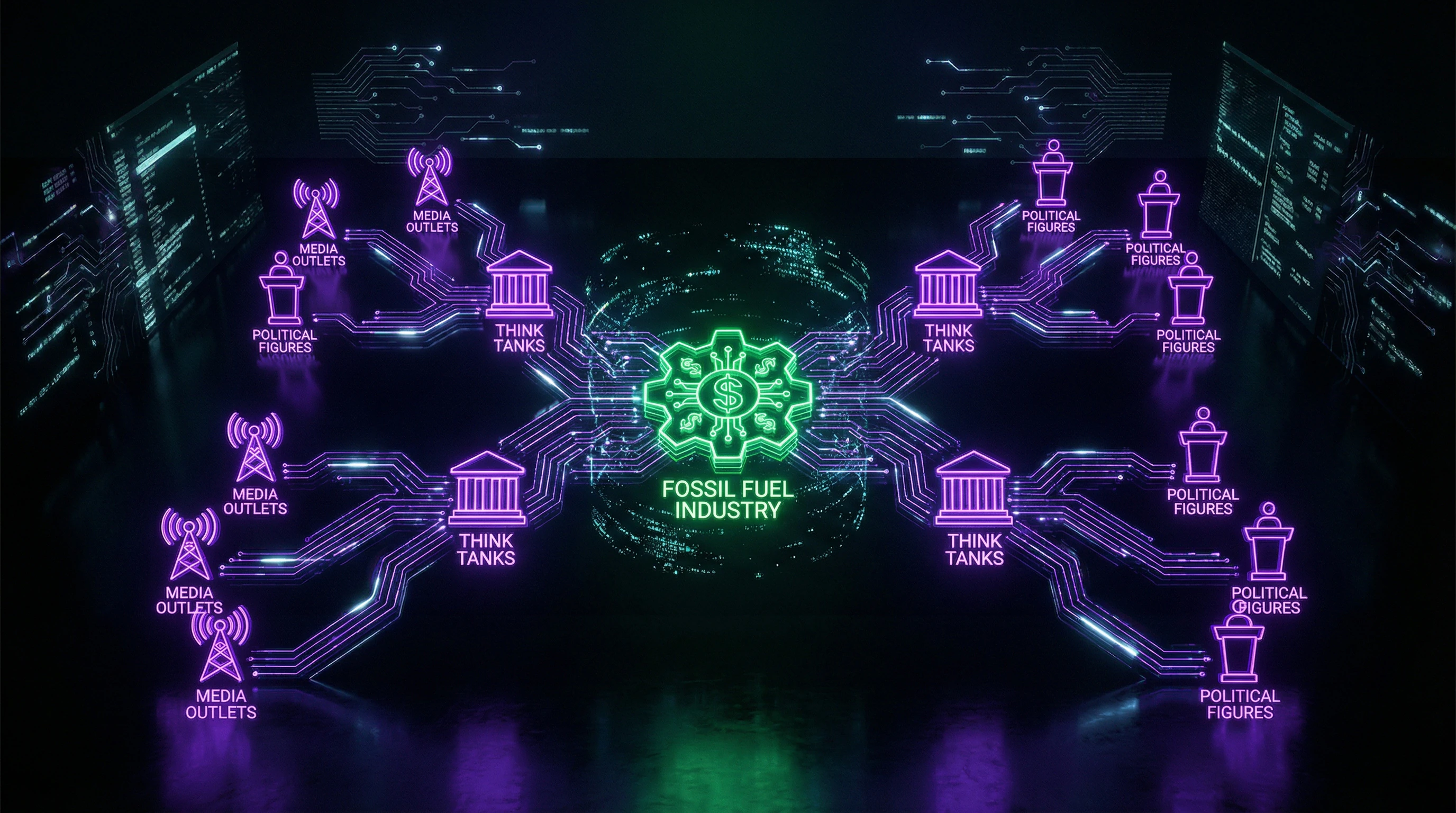
A network of conservative foundations funds think tanks that produce materials mimicking scientific research but not undergoing peer review. These materials are then amplified by friendly media and politicians, creating an echo chamber in which denial appears as a legitimate position.
Geographic focus of analysis
While climate denial exists in many countries, the most organized and influential denial network has formed in the United States (S005). This network serves as a model and resource source for deniers in other countries.
| Analysis level | Scope |
|---|---|
| Primary focus | American denial network and its mechanisms |
| Secondary context | Global spread of arguments and tactics |
| Practical significance | Recognizing manifestations of denial in any jurisdiction |
Arguments developed by American think tanks are disseminated by international media, and lobbying tactics are copied in other countries. Understanding the mechanism of American denial is critical for recognizing its manifestations everywhere.
For deeper understanding of scientific consensus, see "The Climate Crisis in Numbers." On the cognitive mechanisms underlying denial, see section 5 of this article.
Steel Version of Denialist Arguments: Seven Strongest Objections to Climate Consensus
Honest analysis requires presenting denialist arguments in their most convincing form — the so-called "steelman," opposite of a straw man. Below are seven of the strongest objections to climate consensus in their best formulation. More details in the Theory of Relativity section.
🧩 Argument 1: Climate Has Always Changed Naturally, Current Changes Don't Exceed Historical Bounds
Deniers point to historical climate fluctuations — the Medieval Warm Period, Little Ice Age, glaciation cycles — as proof of natural climate variability. They argue that current warming may be part of a natural cycle related to solar activity, ocean circulation, or other natural factors.
If climate changed before the industrial era, why should current changes be anthropogenic?
🧩 Argument 2: Climate Models Are Unreliable and Constantly Wrong in Their Predictions
Critics point to cases where climate models made predictions that didn't fully match subsequent observations. They argue that the climate system is too complex for accurate modeling, that models contain numerous parameters fitted to match past data (overfitting).
The uncertainty in models, in their view, is so large that it makes them useless for policy decisions. This argument resonates with public skepticism toward computer models and expert forecasts.
🧩 Argument 3: Scientific Consensus Is Fabricated and Maintained by Groupthink and Pressure on Dissenters
Some deniers claim that the apparent scientific consensus results not from objective evaluation of evidence, but from social pressure within the scientific community. They point to cases where scientists expressing skepticism faced criticism or difficulties in publishing.
This creates an atmosphere where dissent is suppressed, and deniers position themselves as brave dissidents challenging orthodoxy.
🧩 Argument 4: Temperature Data Is Unreliable Due to Urban Heat Island Effect and Data Manipulation
Deniers claim that observed warming is partially or fully explained by the urban heat island effect: weather stations initially located in rural areas became surrounded by urban development, artificially inflating measured temperatures.
- Historical data correction procedures (homogenization) are applied arbitrarily
- Corrections create the appearance of warming
- The technical complexity of climatology is exploited to create distrust in the data
🧩 Argument 5: CO₂ Is Not a Pollutant but a Gas Necessary for Life, and Its Increase Benefits Plants
Deniers emphasize that carbon dioxide is necessary for photosynthesis and that increasing its concentration can boost plant productivity — an effect known as "global greening." They argue that demonizing CO₂ as a "pollutant" is scientifically incorrect.
In their view, moderate warming and increased CO₂ may have positive effects: longer growing seasons, increased crop yields. The argument appeals to intuition: more CO₂ = more plant growth = good.
🧩 Argument 6: Economic Costs of Fighting Climate Change Are Unacceptably High and Will Cause Greater Harm Than Warming Itself
Even while acknowledging the reality of anthropogenic climate change, some critics argue that proposed mitigation measures — transition to renewable energy, carbon taxes, emissions regulations — are economically destructive. They point to potential job losses in fossil fuel industries, rising energy prices, and reduced economic competitiveness.
Adaptation to climate change is cheaper and more practical than attempting to prevent it, especially given the uncertainty in forecasts.
🧩 Argument 7: Developing Countries Won't Limit Emissions, So Developed Countries' Actions Are Pointless
Deniers point to rapid emissions growth in developing countries, especially China and India, and argue that any emissions reductions in developed countries will be offset by growth in developing ones. Unilateral actions by developed countries will only lead to relocation of carbon-intensive production to jurisdictions with less stringent regulation (carbon leakage), not reducing global emissions but damaging their own economies.
This argument exploits the collective action problem and geopolitical contradictions. For deeper understanding of denial mechanisms, see thinking tools and the climate crisis in numbers.
Evidence Base: What Science Actually Says About Climate and How Strong the Consensus Is
Having presented the deniers' arguments in their most persuasive form, let's move to a systematic analysis of the evidence. The scientific consensus on climate change is not the result of groupthink or political pressure—it's based on the convergence of multiple independent lines of evidence from different disciplines. More details in the Scientific Databases section.
📊 Scale of Scientific Consensus: Over 97% of Climate Scientists Agree on Anthropogenic Warming
Multiple studies using different methodologies consistently show that the overwhelming majority of actively publishing climate scientists agree that climate change is happening and is caused predominantly by human activity. This isn't just majority opinion—it's the result of decades of research including paleoclimate reconstructions, direct measurements, satellite observations, physical modeling, and numerous other methods.
Consensus doesn't mean unanimity on every detail, but the fundamental conclusions—warming is real, anthropogenic, and requires action—are supported by virtually the entire scientific community (S001).
🧪 Multiple Independent Lines of Evidence Converge to One Conclusion
The strength of the scientific consensus on climate lies not in the authority of individual scientists or institutions, but in the convergence of multiple independent lines of evidence.
- Direct temperature measurements from weather stations, ocean buoys, and satellites show warming.
- Paleoclimate data from ice cores, tree rings, and marine sediments show that the current rate and scale of change is unprecedented in the context of recent millennia.
- Physical models based on fundamental laws of thermodynamics and radiative transfer reproduce observed warming only when anthropogenic greenhouse gas emissions are included.
- Biological indicators—changes in species distribution, migration timing, and flowering—are consistent with warming (S006).
When independent methods from different disciplines point to one conclusion, it's not coincidence—it's signal, not noise.
🧾 Documented Consequences of Climate Change Are Already Observed and Measured
Climate change is not a hypothetical future threat but an observed present reality. Documented consequences include rising global average temperature, melting glaciers and ice sheets, rising sea levels, changing precipitation patterns, increasing frequency and intensity of extreme weather events (S005), and changing distribution of pests and plant diseases.
These consequences are not subject to debate—they are measured, documented, and published in peer-reviewed literature. Attempts to deny these observed changes require ignoring an enormous body of empirical data.
🔬 Attribution Studies Quantify the Contribution of Human Activity
Modern climatology doesn't just claim that human activity affects climate—it quantifies that contribution. Attribution studies use climate models to compare observed changes with what would be expected from natural factors alone (solar activity, volcanism, natural variability).
These studies consistently show that observed warming cannot be explained by natural factors alone and that anthropogenic greenhouse gas emissions are the dominant cause of warming since the mid-20th century (S003). Moreover, attribution studies can now quantify the contribution of climate change to the probability and intensity of specific extreme weather events.
📊 Responses to Denier Arguments: Why "Steel" Arguments Don't Withstand Evidence
- Climate changed naturally in the past
- True, but the current rate of change is unprecedented, and the physical mechanisms (greenhouse effect) are well understood. Past changes occurred more slowly and were caused by known natural factors that aren't operating at this scale now.
- Climate models have uncertainties
- Yes, but their core projections are consistently confirmed by observations. Uncertainty doesn't mean ignorance—it's quantified and accounted for in risk analysis.
- Scientific consensus is fabricated
- It's based on convergence of evidence, and the mechanisms of scientific publication, including peer review, are specifically designed to detect errors and prevent manipulation (S008).
- Temperature data is manipulated
- It's corrected according to objective, documented protocols, and multiple independent analyses yield consistent results. If manipulation were systematic, independent groups would get different results.
- CO₂ is necessary for photosynthesis
- True, but its excess causes warming that has numerous negative consequences outweighing the fertilization effect. This is a classic error: beneficial in small amounts becomes harmful in large ones.
- Economic costs of action are too high
- Economic analyses show that the costs of inaction significantly exceed the costs of mitigation. Lack of action isn't savings—it's a deferred and increased bill.
- Global coordination is impossible
- This isn't an argument against action—it's an argument for more effective international cooperation. The complexity of the problem doesn't negate its reality.
Denial doesn't refute evidence—it simply demands ever greater persuasiveness from it, while offering no alternative explanation for observed facts.
The scientific consensus on climate is not a political decision or the result of groupthink. It's the convergence of independent lines of evidence, each of which can be tested, reproduced, and challenged. The mechanism of science works precisely this way: hypotheses are tested, errors are identified, alternative explanations are considered. If a convincing alternative explanation for observed warming existed, it would be published and discussed. Instead, deniers offer not alternative theories but criticism of the consensus—which is a sign that no alternative exists.

The Mechanism of Organized Denial: How the Illusion of Scientific Debate Is Created
Understanding that scientific consensus is strong raises a critical question: why does public perception differ so dramatically from scientific reality? The answer lies in the existence of an organized, well-funded network deliberately creating the illusion of scientific debate (S005), (S008).
💰 The Conservative Foundation Network: Who Funds Climate Denial and Why
Climate change denial is cultivated by a network of conservative donors, think tanks, and media organizations that deliberately attempt to cast doubt on scientific consensus and the need for action (S001). Funding for this network has historically come from fossil fuel companies and associated foundations, though in recent years financial flows have become more opaque.
The motivation is clear: acknowledging the reality of climate change and the need for action threatens the business model of the fossil fuel industry. Investment in climate denial is a rational strategy for protecting assets and delaying regulation, even if it is socially destructive (S002).
Denial is not a failure of science, but a product of engineering: the deliberate manufacture of doubt as a commodity.
🏛️ Think Tanks as Doubt Factories: Manufacturing Pseudo-Scientific Materials
Conservative think tanks play a key role in the denial network, producing materials that mimic scientific research but do not undergo peer review and do not meet scientific standards (S001). These materials—reports, briefings, commentaries—create the appearance of scientific debate and provide politicians and media with "alternative" sources of information.
- Selective citation of research (choosing only fragments that support the narrative)
- Exaggerating uncertainties (normal scientific uncertainty is translated into "controversy")
- Attacks on individual scientists and institutions (ad hominem instead of argumentation)
- Promoting marginal scientists (whose views don't align with consensus but receive a platform)
The goal is not to win the scientific debate—the goal is to create the impression that a debate exists. More details in the section Cognitive Biases.
📺 Media and False Balance: How Journalistic Norms Are Exploited to Create the Illusion of Equivalence
The traditional journalistic norm of "balance"—presenting both sides of a dispute—is exploited by the denial network to create a false impression of equivalence between scientific consensus and the marginal views of deniers (S005). When media invite one climate scientist and one denier for a "balanced" discussion, they create the impression that the scientific community is divided 50/50, when the actual ratio is closer to 97/3.
This practice of false balance is particularly prevalent in conservative media, which systematically provide a platform for deniers and downplay scientific consensus. The result—the public receives a distorted picture of the state of scientific knowledge.
- False Balance
- A journalistic practice where marginal positions receive airtime proportional to their popularity rather than their scientific support. The trap: it seems fair, but it reproduces falsehood.
- Scientific Consensus
- Agreement among the majority of experts based on evidence, not voting. Consensus doesn't mean unanimity, but it does mean that marginal positions remain marginal for a reason.
🔁 The Denial Echo Chamber: How Arguments Circulate and Amplify Within a Closed System
The denial network functions as an echo chamber: arguments produced by think tanks are amplified by friendly media, repeated by politicians, cited back by think tanks as evidence of "debate," and the cycle repeats (S008). Within this system, arguments are not tested against evidence—they are evaluated by their effectiveness in creating doubt and delaying action.
Network participants cite each other, creating the appearance of multiple independent sources, though all are connected by common funding and ideology. This circular system makes denial resistant to refutation: when one argument is discredited, it is simply replaced by another from the same repertoire.
The echo chamber works not because participants lie, but because they hear only each other. Truth becomes a question of which voice is louder.
The mechanism of organized denial is not a conspiracy in the classical sense. It is a system of incentives: financial interests, ideological beliefs, career ambitions, and media logic align to produce and disseminate doubt. Each participant may act rationally within their own interests, but the result is systematic distortion of public understanding of science. Understanding this mechanism is the first step toward overcoming it.
Cognitive Anatomy of Denial: What Psychological Mechanisms Make Denial Effective
Organized climate denial is effective not only because it is well-funded, but because it exploits fundamental features of human cognition and decision-making. Learn more in the Psychology of Belief section.
🧩 Motivated Reasoning: Why People Reject Evidence That Contradicts Their Identity
Motivated reasoning is the tendency to process information in ways that lead to a desired conclusion rather than the conclusion most supported by evidence (S003). When acknowledging climate change threatens a person's identity (conservative, free-market advocate, member of a fossil fuel-dependent community), the brain activates defensive mechanisms.
Evidence is processed not as neutral information, but as a threat to be neutralized. Providing more scientific evidence often fails to convince deniers—the problem isn't lack of information, but motivation to reject it (S003).
Identity defense is often stronger than the pursuit of truth. A person is willing to reprocess facts, but not willing to reprocess themselves.
🧠 Availability and Recency Heuristics: Why a Cold Winter "Disproves" Global Warming
The availability heuristic causes people to assess the probability of events based on how easily examples come to mind. A cold winter or snowstorm is more available in memory and more salient than the gradual increase in global average temperature.
Deniers exploit this heuristic by pointing to local cold events as "proof" against global warming (S002). Local weather and global climate are different phenomena, but this tactic is effective because it resonates with people's immediate experience, which feels more convincing than abstract statistics.
🕳️ Illusion of Understanding: Why Climate Science Complexity Makes People Vulnerable to Simplified Counterarguments
Climate science is complex: multiple disciplines, statistics, modeling. The illusion of understanding is a cognitive bias where people overestimate the depth of their understanding of complex systems.
When a person doesn't fully understand the mechanism (greenhouse effect, feedback loops in the climate system), they become vulnerable to simplified counterarguments that sound logical at a superficial level (S001). Deniers offer simple explanations (solar activity, natural cycles) that seem more comprehensible than multifactorial climate models.
- Person encounters complex information (climate model)
- Illusion of understanding activates—they feel they've grasped it
- Simplified counterargument sounds more logical than complex reality
- Choice in favor of counterargument is reinforced by sense of personal competence
🎭 Identity and Tribalism: Why Climate Skepticism Became a Marker of Political Affiliation
Climate denial has long ceased to be a question of science—it has become a question of identity (S004). Conservative identity, anti-establishment attitudes, and preference for hierarchical structures correlate with climate skepticism.
When a position becomes a group marker, a person defends it not because it's correct, but because it signals belonging. To reject climate denial means to reject one's group. This explains why tools of logic and critical thinking are often ineffective—they don't address the identity problem.
🔄 Polarization and Echo Chambers: How Networks Amplify Cognitive Biases
Organized denial creates an ecosystem of media and communities where climate denial becomes the norm. Social media algorithms amplify polarization by showing people content that confirms their beliefs (S005).
In an echo chamber, deniers see only arguments supporting denial, creating the illusion of scientific debate where none exists. Each new counterargument is perceived as confirmation that "science disagrees," when in reality it's just noise in the information environment.
- Echo Chamber
- An information environment where a person sees only messages confirming their beliefs. Amplifies confidence in incorrect beliefs and reduces capacity for critical evaluation.
- Polarization
- A process where people with different beliefs become increasingly hostile to each other. The climate question transforms from a scientific into a political conflict.
⚡ Why Facts Don't Work: When Cognitive Mechanisms Are Stronger Than Evidence
Attempting to persuade deniers through facts often leads to a backfire effect—scientific data is perceived as yet another attack on identity, and defensive mechanisms activate more strongly (S003).
Effective opposition to denial requires not more facts, but reframing the context: from political conflict to shared problem, from identity defense to group interest protection. This requires understanding the psychological mechanisms that make denial effective, not just refuting its arguments.