 🌡️ Climate and Geology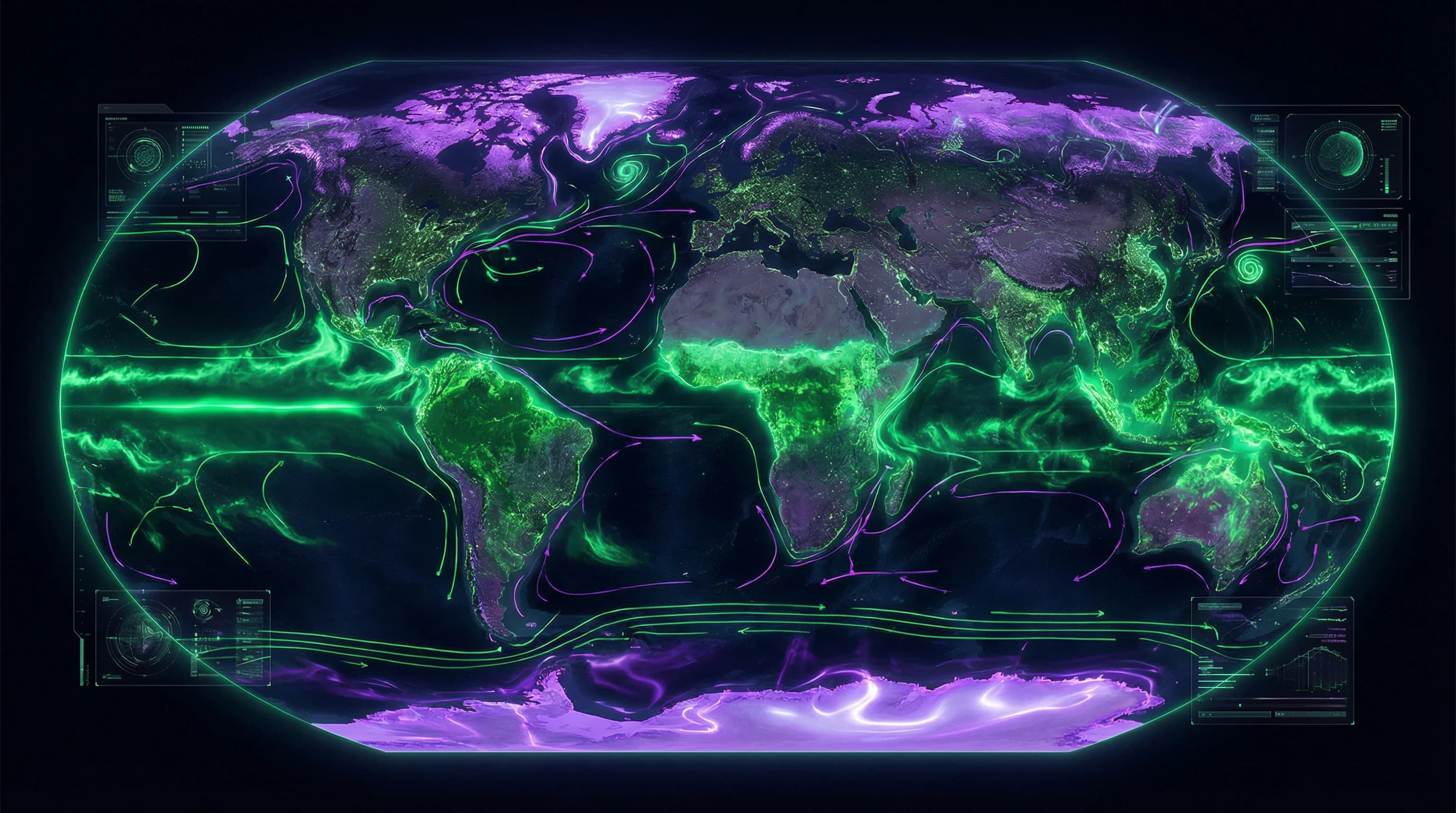
Earth's Climate: Long-term Weather Patterns and Climate Zonesλ
Climate represents averaged weather conditions over an extended period of time, typically measured in thirty-year intervals according to World Meteorological Organization standards, forming the planet's unique climate zones.
Overview
Climate isn't "next week's weather"—it's the statistical portrait of the atmosphere across decades. The World Meteorological Organization tracks 🧩 30-year windows: long enough to filter out noise and reveal patterns—tropical monsoons, continental freezes, oceanic storm tracks. Shaped by latitude, proximity to water, air mass circulation, and—increasingly loud—the anthropogenic signal.
🛡️
Laplace Protocol: Data drawn from official World Meteorological Organization publications, academic encyclopedic sources, and educational platforms, ensuring scientifically grounded understanding of climate processes and their classification.
Reference Protocol
Scientific Foundation
Evidence-based framework for critical analysis
Protocol: Evaluation
Test Yourself
Quizzes on this topic coming soon
Sector L1
Articles
Research materials, essays, and deep dives into critical thinking mechanisms.
🌡️ Climate and Geology 🌡️ Climate and Geology
 🌡️ Climate and Geology
⚡
Deep Dive
Defining Climate and Distinguishing It from Weather: What Meteorologists Measure
Climate is the averaged weather over an extended period. The World Meteorological Organization (WMO) has established a standard: 30 years.
Weather refers to current atmospheric conditions that change daily or weekly. Climate is a statistical description of average values and variability over periods ranging from months to millions of years.
| Parameter | Weather | Climate |
|---|---|---|
| Time Scale | Hours, days | Decades, centuries |
| Variability | High, unpredictable | Stable trends |
| Measurement Method | Current observations | Statistical processing of 30-year data |
| Forecasting | 1–2 weeks | Decades |
WMO Standards and Instrumental Observations
The 30-year period filters out short-term fluctuations and reveals stable trends. According to WMO projections for 2025–2029, global temperatures will continue at record or near-record levels.
Key distinction: weather changes over hours and days, climate over decades and centuries. This makes climate projections fundamentally different from meteorological forecasts.
Reconstructing Past Climate
Modern methods enable reconstruction of past climate using proxy data—ice cores, tree rings, ocean sediments. This extends understanding of climate cycles far beyond instrumental observations, which span only a few centuries.
- Proxy data
- Physical, chemical, or biological indicators preserved in natural archives (ice, wood, sediments). Enable reconstruction of climate over thousands and millions of years.
- Instrumental observations
- Direct measurements of temperature, pressure, precipitation using instruments. Cover the last 150–200 years with high precision.

Earth's Climate Zones and Belts: Global Classification
Earth's climate zones are shaped by air mass circulation, temperature, precipitation, and latitude. Each zone results from the interaction of solar radiation, atmospheric movement, and geography.
Tropical Climate and Its Characteristics
Tropical climate maintains high temperatures year-round, but precipitation is unevenly distributed. Tropical deserts receive less than 4–10 inches annually, while equatorial forests receive excess moisture.
Seasonal temperature fluctuations are minimal, but precipitation variability creates a spectrum: from rainforests to arid deserts within the same belt.
- Equatorial subtype: high humidity, abundant precipitation year-round
- Monsoon subtype: alternating wet and dry seasons
- Desert subtype: minimal precipitation, extreme aridity
Continental and Oceanic Climate
Continental climate emerges in the interior of landmasses, far from oceans. Here annual and diurnal temperature ranges are large, precipitation is scarce, and air is dry.
Oceanic climate is the opposite. Proximity to the sea moderates temperature swings, increases humidity, and boosts precipitation. Water heats and cools more slowly than land, smoothing climatic extremes.
| Parameter | Continental | Oceanic |
|---|---|---|
| Temperature range | Large (54–90 °F) | Small (18–36 °F) |
| Precipitation | Scarce | Abundant |
| Air humidity | Low | High |
| Influencing factor | Distance from water | Proximity to sea |

Climate-Forming Factors: Mechanisms of Climate Formation
Climate results from the interaction of geographic location, air mass circulation, oceanic processes, and anthropogenic influence. Each factor amplifies or weakens others, creating a region's unique climate profile.
Geographic Location and Air Mass Circulation
Latitude, elevation, and topography determine incoming solar radiation and atmospheric flow direction. Trade winds, westerlies, and monsoons redistribute heat and moisture, forming climate zones.
| Circulation type | Mechanism | Climate effect |
|---|---|---|
| Westerly flow | West-to-east air movement in mid-latitudes | Unstable weather, frequent cyclones |
| Tropical circulation | Trade winds and monsoons in equatorial regions | Seasonal precipitation, stable winds |
Ocean Influence on Climate
Water stores and releases heat more slowly than land, stabilizing coastal temperatures. Ocean currents function as conveyor belts: warm currents (Gulf Stream) carry heat to high latitudes, cold currents cool coastlines.
Evaporation from ocean surfaces is the primary source of atmospheric moisture and continental precipitation. Greenhouse gas emissions alter atmospheric heat capacity and evaporation rates, restructuring planetary-scale climate systems.

Climate Types and Their Classification: From Continental Masses to Ocean Currents
Continental Climate and Its Characteristic Features
Continental climate forms in the interior of continents, far from oceanic influences. Annual temperature amplitude reaches 40–60°C: hot summers and cold winters due to the absence of the ocean's thermostabilizing effect.
Precipitation in continental zones is moderate and concentrated in the warm period, when convection intensifies and thunderstorm systems form.
| Climate Type | Temperature Regime | Precipitation | Key Factor |
|---|---|---|---|
| Continental | Sharp contrasts (40–60°C) | Moderate, summer | Distance from ocean |
| Oceanic | Mild winters, cool summers | Uniform year-round | Proximity to ocean |
| Tropical desert | Extreme diurnal fluctuations | 100–250 mm/year | Anticyclonic system |
Oceanic climate features mild winters and cool summers with uniform precipitation distribution. Proximity to the ocean ensures high humidity and frequent cyclonic systems bringing rain in all seasons.
Tropical climate of desert regions is an extreme variant with minimal precipitation (100–250 mm per year), making these territories among the most arid on the planet.
Western Climate and Atmospheric Circulation Patterns
Western climate forms under the influence of prevailing westerly winds in temperate latitudes, which transport moist oceanic air masses onto continents. In Western Europe, the warm North Atlantic Current moderates temperatures, creating an anomalously mild climate for these latitudes.
Westerly transport provides abundant precipitation on windward mountain slopes and forms characteristic cloudiness for most of the year—this is a mechanism, not coincidence.
Earth's climate zones are organized according to global atmospheric circulation and the distribution of solar radiation by latitude. Each zone is characterized by specific air masses, temperature regimes, and precipitation amounts.
Transitional zones between belts demonstrate seasonal shifts in air masses, leading to pronounced climate seasonality and creating unique conditions for ecosystems and human activity.

Climate Change and Projections: What WMO Data Shows
World Meteorological Organization Forecasts for 2025-2029
According to WMO projections, global temperatures during 2025-2029 will remain at record or near-record levels. The probability of exceeding pre-industrial temperatures by 1.5°C in at least one of these years is assessed as high.
Climate risks increase exponentially with each tenth of a degree of warming, intensifying the frequency and intensity of extreme events. Forecast models indicate continued glacier melting, rising sea levels, and changing precipitation patterns.
- Water resource deficits in vulnerable regions
- Declining agricultural productivity
- Increased migration flows
- Ecosystem shifts in polar and mountain zones
WMO uses 30-year periods to assess climate trends, separating long-term changes from natural year-to-year variability.
Human Influence on Climate Systems
Anthropogenic impact is recognized by authoritative sources as a significant climate-forming factor of the modern era. Greenhouse gas emissions, land use changes, urbanization, and industrial activity modify natural climate processes.
Atmospheric CO₂ concentrations have reached levels unseen in hundreds of thousands of years, intensifying the greenhouse effect and heat accumulation in the climate system.
Natural climate variability has occurred throughout Earth's history, but current trends are characterized by unprecedented speed over recent decades. Climate models accounting only for natural factors do not explain the observed warming.
| Model Type | Result |
|---|---|
| Natural factors only | Does not match actual data |
| Including anthropogenic factors | Matches observed warming |
This confirms that current climate changes are largely driven by human activity.
Methods for Studying and Reconstructing Climate: From Satellites to Ice Cores
Modern Tools for Measuring Climate Parameters
Climatology relies on a global network of meteorological stations, ocean buoys, radiosondes, and satellite systems. Satellites track sea surface temperature, greenhouse gas concentrations, ice cover extent, and vegetation changes with high resolution.
The WMO coordinates international data exchange, ensuring standardization of measurements and accessibility of information for the scientific community.
- Meteorological stations — local measurements of temperature, pressure, humidity, precipitation
- Satellite systems — global monitoring of atmosphere, oceans, ice cover
- Ocean buoys — data on temperature and circulation of ocean currents
- Radiosondes — vertical atmospheric profiles up to 30 km altitude
Climate portals aggregate data from multiple sources, providing access to historical temperature and precipitation records. Standard 30-year periods for calculating climate normals follow WMO recommendations and ensure comparability across regions.
Paleoclimate Data and Proxy Indicators of the Past
Reconstruction of past climate is based on analysis of proxy indicators — indirect evidence preserved in natural archives. Ice cores from Antarctica and Greenland contain bubbles of ancient atmosphere, allowing determination of greenhouse gas concentrations over the past 800,000 years.
| Data Source | Information | Temporal Resolution |
|---|---|---|
| Ice cores | Greenhouse gases, temperature | Years–centuries |
| Tree rings | Temperature, precipitation | Years |
| Sediment deposits | Ocean circulation, vegetation | Centuries–millennia |
| Cave stalagmites | Temperature, humidity | Years–centuries |
| Coral reefs | Sea water temperature | Years–decades |
Isotopic analysis of oxygen and hydrogen in ice cores reconstructs past temperatures. Pollen analysis restores vegetation and climatic conditions of ancient epochs.
Earth's climate has experienced significant fluctuations in the past, including glacial and interglacial periods, but the rate of modern changes exceeds the natural pace observed in paleoclimate records.
Comparison of paleodata with modern observations and models validates climate projections and assesses the sensitivity of the climate system to various forcings.

Knowledge Access Protocol
FAQ
Frequently Asked Questions
Climate is the average weather conditions over an extended period of time, typically several decades. Weather changes daily and weekly, while climate reflects long-term patterns. According to WMO standards, climate is measured over 30-year periods (S1, S2).
Earth has several main climate zones: tropical, temperate, continental, and oceanic. Each zone is characterized by distinct temperature regimes, precipitation levels, and air mass circulation patterns. The classification is based on geographic location and climate-forming factors (S3, S4).
No, this is a myth—climate has always changed naturally throughout Earth's history. However, current changes are occurring significantly faster and are linked to human influence. Climate varies across different time scales, from decades to millions of years (S5, S6).
Geographic location determines the amount of solar radiation, air mass circulation, and proximity to oceans. Regions near the equator receive more heat, while distance from oceans creates continental climate with large temperature variations. Latitude, elevation, and topography also play key roles (S7, S8).
Continental climate is characteristic of territories located deep within continents, far from oceans. It features large annual and daily temperature variations and relatively low precipitation. Oceans do not exert a moderating influence on the temperature regime (S9, S10).
Oceans moderate the climate of coastal areas, reducing temperature fluctuations between seasons. Water heats and cools slowly, creating a more stable temperature regime. Oceanic climate is characterized by increased humidity and abundant precipitation (S11, S12).
No, determining climate requires data over an extended period—at minimum several decades. Short-term observations reflect only weather conditions, not climatic patterns. The WMO recommends using 30-year periods for climate assessment (S1, S13).
Climate is shaped by geographic location, air mass circulation, proximity to oceans, and local topography. Solar radiation, prevailing winds, and elevation above sea level play important roles. In recent decades, human activity has exerted significant influence (S14, S15).
WMO forecasts indicate that global temperatures during 2025-2029 will remain at or near record-high levels. Climate risks will continue to increase, requiring adaptation measures. Human influence on climate systems is becoming increasingly evident (S16, S17).
No, this is an oversimplification—continental climate varies significantly depending on latitude, elevation, and other factors. For example, continental regions at different latitudes have different temperature regimes and precipitation amounts. Topography and distance from water bodies also create local variations (S18, S19).
Tropical climate is characterized by high temperatures year-round and specific precipitation patterns. Tropical deserts receive minimal rainfall (250-100 mm/year or less), while humid tropics experience abundant precipitation. Seasonal temperature variations are minimal (S20, S21).
Scientists use paleoclimatic data and proxy indicators: ice cores, tree rings, sediment deposits, and fossils. These methods allow reconstruction of climate conditions from thousands to millions of years ago. Modern instruments complement historical data with precise measurements (S22, S23).
Western climate is associated with specific air mass circulation patterns characteristic of western continental coasts. It forms under the influence of prevailing westerly winds and ocean currents. This climate type features moderate temperatures and evenly distributed precipitation (S24, S25).
No, current weather does not allow prediction of long-term climate trends. Climate is determined by statistical analysis of weather data over decades, not short-term observations. Climate forecasts require complex models and multi-year datasets (S26, S27).
Yes, human influence on climate is scientifically proven and recognized by international organizations, including the WMO. Greenhouse gas emissions, land use changes, and industrialization have significantly accelerated climate change. Current warming is occurring at unprecedented rates (S28, S29).
Yes, the World Meteorological Organization (WMO) has established international standards for climate measurements. The primary standard uses 30-year periods to calculate climate normals. This ensures data comparability across countries and regions (S30, S31).