 🌡️ Climate and Geology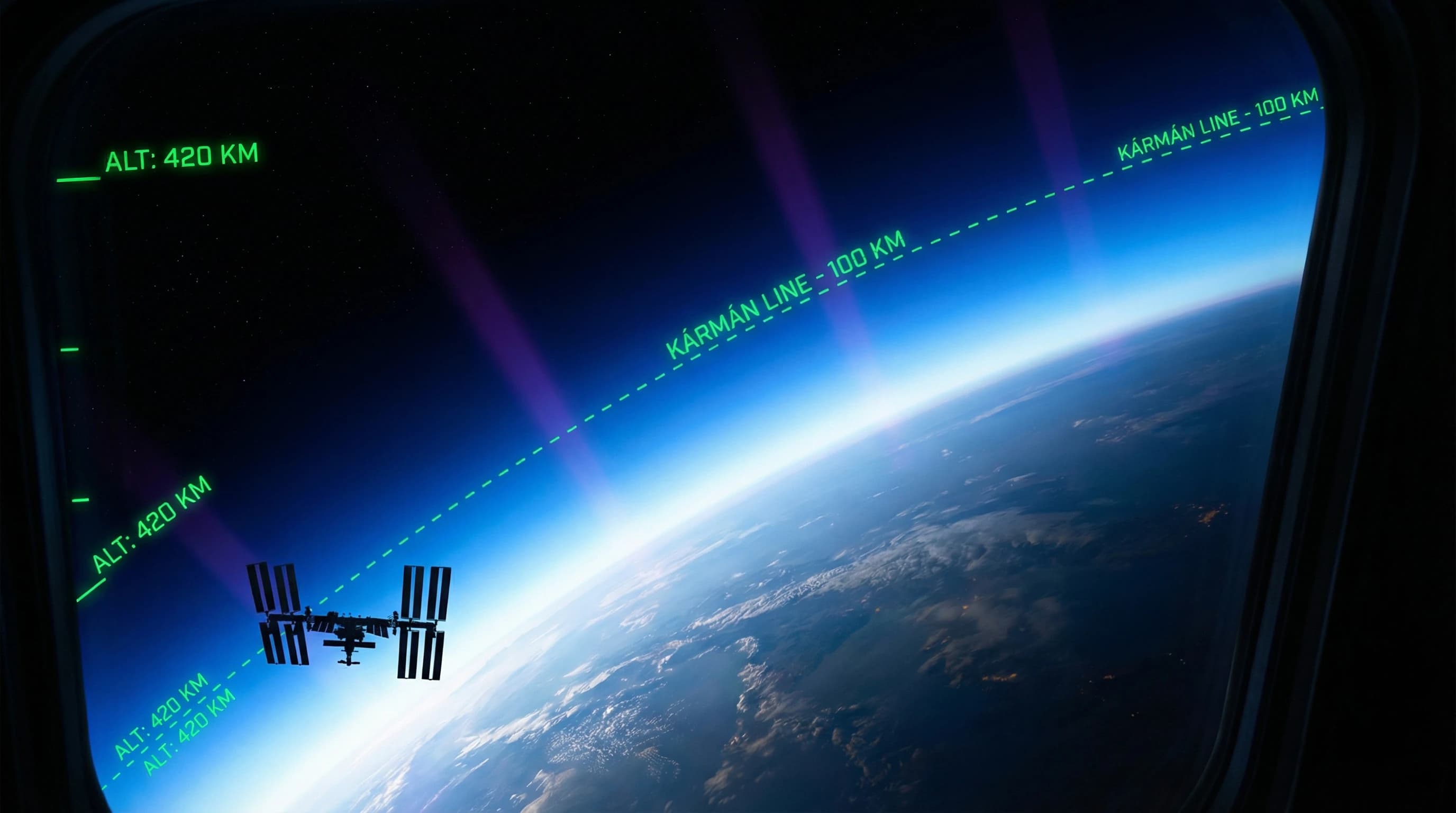
The Boundary Between Earth and Space: A Scientific Perspectiveλ
Exploring the gradual transition from Earth's atmosphere to outer space, the Kármán line, and our planet's place in the Solar System
Overview
The boundary between Earth and space isn't a sharp line, but a gradual transition 🧩: the atmosphere thins until it disappears into vacuum. The international community conventionally accepts 100 km (the Kármán line) as the beginning of space, though physically the atmosphere extends further. Earth occupies the third orbit from the Sun—a unique zone where life in known forms is possible.
🛡️
Laplace Protocol: We distinguish between "space" (ordered realm beyond the atmosphere) and "the Universe" (the totality of all that exists), recognizing the gradual nature of the transition and the absence of absolute boundaries in nature.
Reference Protocol
Scientific Foundation
Evidence-based framework for critical analysis
Navigation Matrix
Subsections
[climate-geology]
Climate and Geology
Climate represents averaged weather conditions over an extended period of time, typically measured in thirty-year intervals according to World Meteorological Organization standards, forming the planet's unique climate zones.
Explore
[cosmology-astronomy]
Cosmology and Astronomy
From ancient philosophical contemplations to modern empirical science — cosmology explores the structure, origin, evolution, and fate of the Universe based on astronomical observations and physical theories.
Explore
Protocol: Evaluation
Test Yourself
Quizzes on this topic coming soon
Sector L1
Articles
Research materials, essays, and deep dives into critical thinking mechanisms.
🌡️ Climate and Geology 🌡️ Climate and Geology
 🌡️ Climate and Geology
⚡
Deep Dive
Atmospheric Layers and the Transition to Space: Where Earth Ends
Structure of Earth's Atmosphere from Surface to Boundary
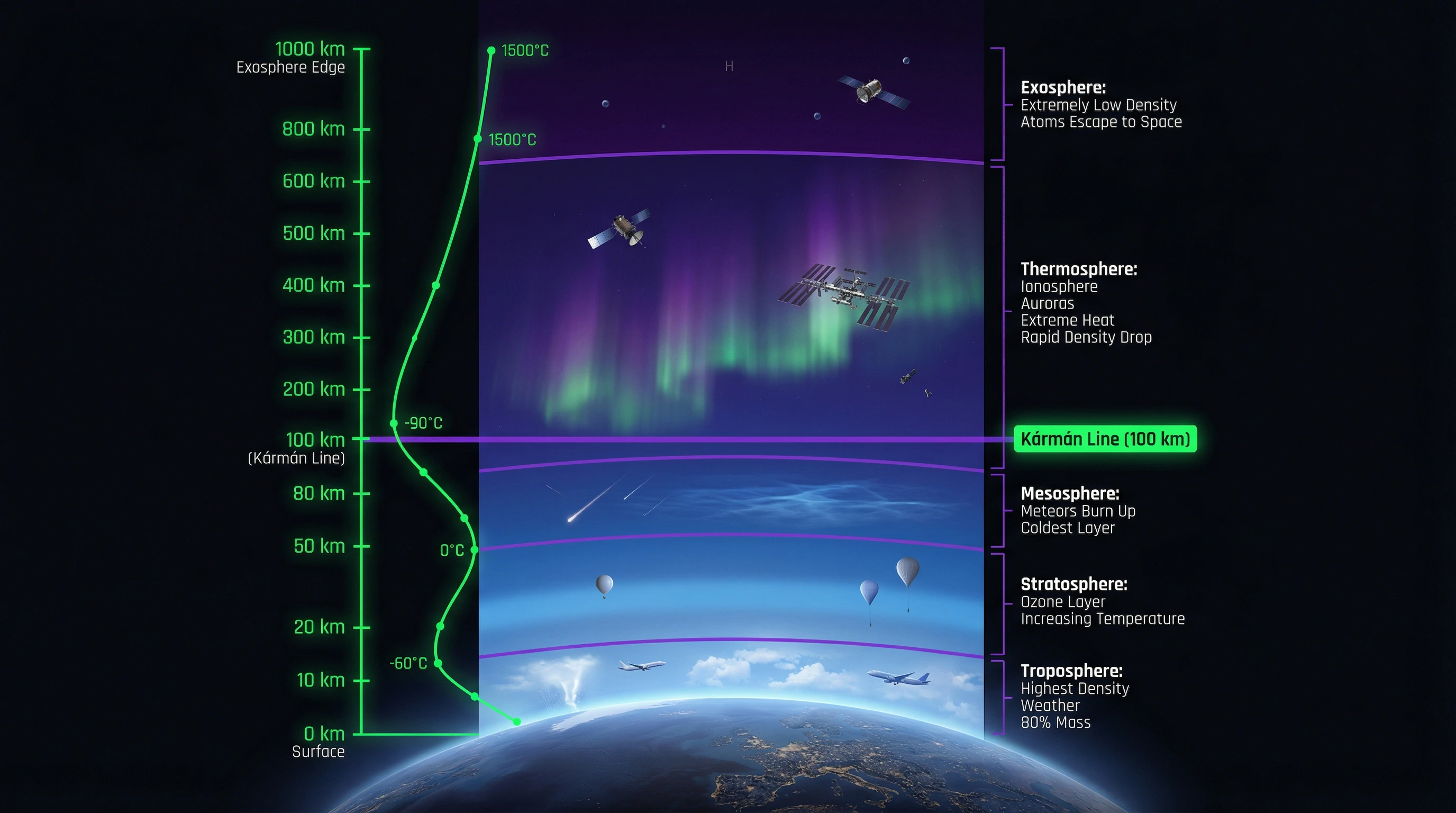
Earth's atmosphere has no sharp upper boundary—it gradually thins with altitude, transitioning into the interplanetary medium. The troposphere extends to 8–18 km and contains about 80% of atmospheric mass; all weather phenomena occur here.
| Layer | Altitude, km | Key Characteristic |
|---|---|---|
| Troposphere | 0–18 | 80% of atmospheric mass, all weather phenomena |
| Stratosphere | 18–50 | Ozone layer, temperature increases with altitude |
| Mesosphere | 50–85 | Temperature drops to −90°C at mesopause |
| Thermosphere | 85–600–1000 | Temperature up to 1500°C, low gas density |
| Exosphere | 600–1000+ | Molecules on ballistic trajectories |
The ionosphere is not a separate layer but a region with high concentration of ions and free electrons (50–1000 km), overlapping the mesosphere and thermosphere. It enables radio wave reflection and forms the boundary between atmosphere and space in an electromagnetic sense.
The Kármán Line and Its Physical Basis
The Kármán line at 100 km altitude is the conventional boundary between atmosphere and space, recognized by the Fédération Aéronautique Internationale. This is an agreement, not a physical barrier.
At 100 km altitude, air density becomes so low that aerodynamic lift from wings disappears. An aircraft would need to move at speeds exceeding orbital velocity, making aerodynamic flight impossible.
NASA and the U.S. Air Force use an 80 km (50 miles) boundary for awarding astronaut status—reflecting the absence of a unified international standard.
- Physical Transition
- Characterized by atmospheric pressure dropping to 10⁻⁶ of sea level at 100 km altitude and further exponential decline.
- At 200 km Altitude
- Pressure less than 10⁻⁹ atmosphere—high vacuum conditions, comparable to laboratory setups.
- At 400–420 km Altitude
- Orbit of the International Space Station; atmosphere creates sufficient drag for gradual orbital decay, requiring periodic corrections.
Physical Characteristics of Space Beyond the Atmosphere
Vacuum and Rarefied Matter in the Interplanetary Medium
Space is not an absolute void—it is a highly rarefied medium containing an average of 5 hydrogen atoms per cubic centimeter in the interplanetary space of the Solar System. Air at sea level contains approximately 2.5×10¹⁹ molecules per cm³, which is 18 orders of magnitude denser.
The interstellar medium is even more rarefied—0.1–1 atom per cm³, while in intergalactic space the density drops to 10⁻⁶ atoms per cm³. The solar wind—a stream of charged particles from the Sun—creates a dynamic environment with a density of 3–10 particles per cm³ at Earth's orbit and velocities of 300–800 km/s.
- Interplanetary space: 5 atoms/cm³
- Interstellar space: 0.1–1 atom/cm³
- Intergalactic space: 10⁻⁶ atoms/cm³
- Earth's atmosphere (sea level): 2.5×10¹⁹ molecules/cm³
The temperature of the cosmic vacuum is a conditional concept due to the low density of matter; the cosmic microwave background radiation corresponds to 2.7 K (−270.45°C). An object in space heats or cools depending on the balance of absorbed and radiated heat.
In near-Earth space, an object on the sunlit side can heat up to +120°C, while in shadow it can cool to −150°C—an extreme gradient without atmospheric buffering.
Pressure in interplanetary space is less than 10⁻¹⁷ atmospheres—a deep vacuum unattainable in terrestrial laboratories.
Cosmic Radiation and Its Sources
Space is permeated by various forms of radiation: the electromagnetic spectrum from radio waves to gamma rays and streams of high-energy particles. Solar electromagnetic radiation dominates the Solar System, providing an energy flux of 1361 W/m² at Earth's orbit (the solar constant).
| Spectral Component | Share of Solar Radiation |
|---|---|
| Visible light | 44% |
| Infrared radiation | 49% |
| Ultraviolet radiation | 7% |
Galactic cosmic rays—high-energy protons and atomic nuclei accelerated by supernova explosions and other catastrophic events—create a constant background of ionizing radiation with energies up to 10²⁰ eV.
Solar flares and coronal mass ejections generate intense streams of charged particles capable of increasing the radiation background in near-Earth space by hundreds of times within hours. Earth's magnetosphere—the region where the planet's magnetic field dominates over the solar wind—extends to 10 Earth radii on the sunward side and forms a long magnetic tail on the night side.
- Van Allen Radiation Belts
- Zones of charged particles trapped by the magnetic field at altitudes of 1000–6000 km (inner belt) and 13000–60000 km (outer belt). They pose a serious hazard to spacecraft and astronauts when passing through these regions.
Earth in the Context of the Solar System and Cosmic Environment
Orbital Position and Habitable Zone
Earth occupies the third orbit from the Sun at a distance of 149.6 million km, completing a full revolution in 365.25 days at a speed of 29.78 km/s. The axial tilt of 23.44° determines seasonal changes, not the variation in distance (147.1–152.1 million km between perihelion and aphelion).
Earth lies within the "habitable zone"—a range of 0.95–1.37 AU where surface temperatures allow liquid water to exist at atmospheric pressure.
| Parameter | Value | Consequence |
|---|---|---|
| Mass | 5.97×10²⁴ kg | Atmospheric retention |
| Mean radius | 6371 km | Orbital velocity 7.91 km/s |
| Mean density | 5.52 g/cm³ | Highest among planets (iron-nickel core) |
| Gravitational acceleration | 9.81 m/s² | Escape velocity 11.2 km/s |
The Moon—the only natural satellite with a mass of 7.35×10²² kg—orbits at a distance of 384,400 km, creating tidal forces and stabilizing Earth's axial tilt.
Interaction with the Cosmic Environment
Earth's magnetic field (25–65 μT at the surface) forms the magnetosphere—a protective barrier that deflects solar wind and galactic cosmic rays.
Without the magnetosphere, solar wind would gradually strip away the atmosphere, as happened to Mars after its global magnetic field disappeared 4 billion years ago.
Auroras are the visible manifestation of solar wind charged particles interacting with the atmosphere in polar regions. Geomagnetic storms, caused by coronal mass ejections, disrupt satellite operations, communication systems, and power grids.
- Meteor dust and micrometeorites. Earth receives approximately 100 tons of cosmic material daily. Most burns up in the atmosphere at altitudes of 80–120 km; objects smaller than 25 meters disintegrate upon entry, while larger ones reach the surface.
- Space debris. Satellite and rocket fragments accumulate in orbits at 200–2000 km. More than 34,000 objects larger than 10 cm are in orbit, posing a threat to operational satellites and spacecraft.
Terminological Distinctions: Space and Universe in Scientific Context
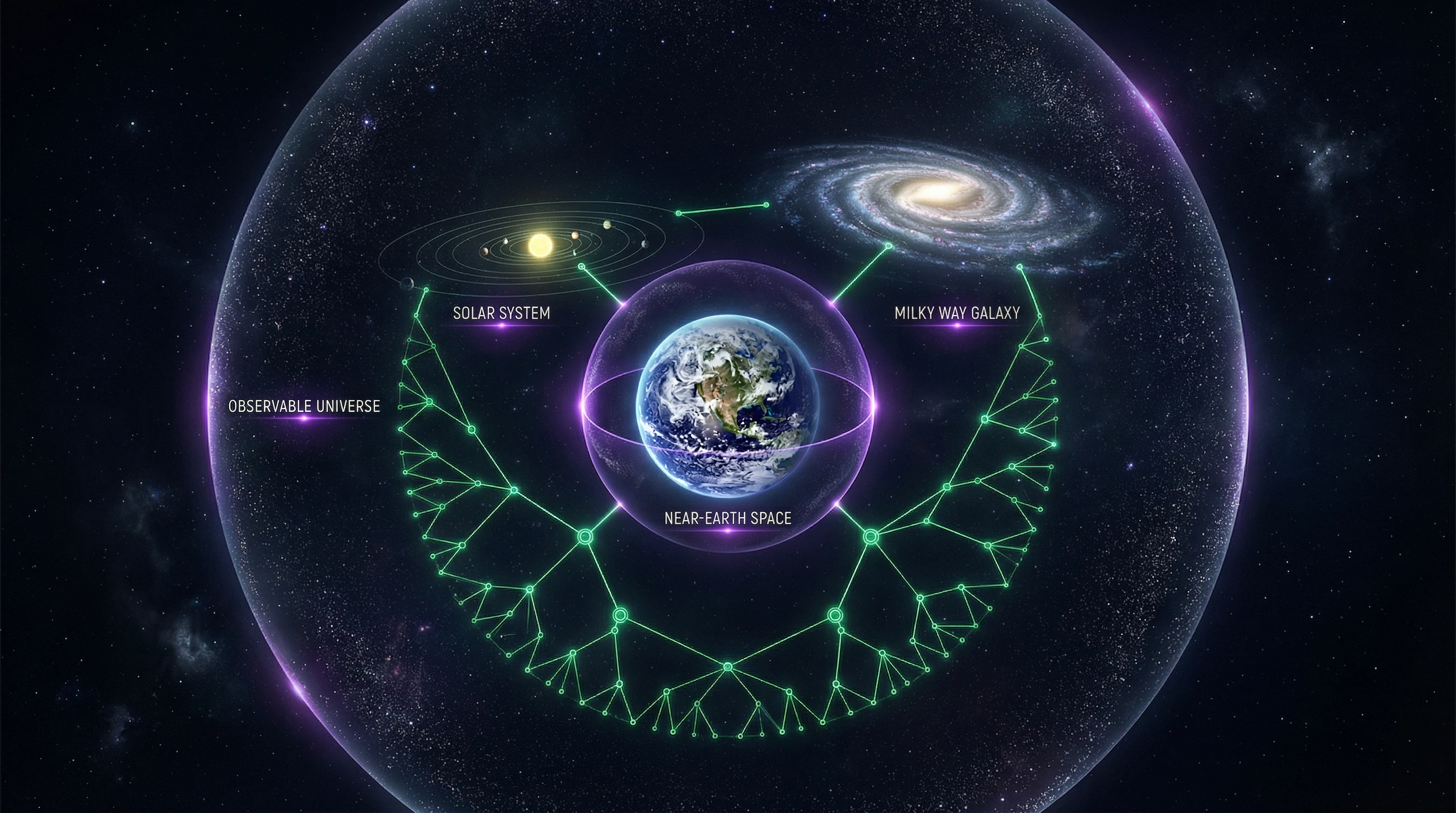
In English, "space" and "universe" are often used interchangeably, but in science they denote different concepts. Space (from Latin spatium — "extent") — the ordered expanse beyond Earth's atmosphere, beginning at 100 km altitude, where the laws of celestial mechanics apply.
The Universe encompasses everything that exists: matter, energy, space, and time. The Greek concept "cosmos" (κόσμος) emphasized order and harmony in contrast to chaos — an idea developed by Pythagoras and Plato.
| Term | Field of Application | Scale |
|---|---|---|
| Space | Practical astronautics, astronomy | Near-Earth and interplanetary space |
| Universe | Cosmology, fundamental physics | All galaxies, stars, planets (radius ~46.5 billion light-years) |
In modern English, "outer space" designates the physical medium between celestial bodies: a vacuum with density less than 1 atom per cm³, permeated by radiation and magnetic fields.
The term "Universe" in English carries connotations of totality and universality, derived from Latin "universum" — "all things turned into one."
Terminological differentiation is critical for precision in scientific communication, especially when translating international documents and standards.
In scientific cosmology, the Universe is defined as a spacetime continuum that originated 13.8 billion years ago in the Big Bang and continues to expand with acceleration.
The International Astronomical Union does not establish strict boundaries between these terms, recognizing their contextual nature. In physics, space is considered the region where gravitational and electromagnetic interactions of celestial bodies dominate, and atmospheric pressure drops below 0.0063 kPa — the triple point of water.
Practical Aspects of the Space Boundary and Legal Regulation
The Kármán line at 100 km altitude serves as a practical criterion for distinguishing airspace from outer space, although this boundary is not legally established in international law. At this altitude, aerodynamic lift becomes insufficient to sustain flight of conventional aircraft, and orbital velocity of approximately 7.9 km/s is required for stable motion.
The United States recognizes as astronauts individuals who have ascended above 80 km (50 miles), while the Fédération Aéronautique Internationale uses the 100-kilometer standard.
| Boundary | Altitude | Criterion |
|---|---|---|
| Kármán Line | 100 km | Physical threshold where aerodynamic flight becomes impossible |
| U.S. Standard | 80 km | Criterion for astronaut status designation |
| FAI Standard | 100 km | International aviation standard |
International Space Law and Sovereignty
The Outer Space Treaty of 1967 establishes that outer space is not subject to national appropriation and is open for exploration by all states on equal terms. However, the treaty does not define the precise altitude where outer space begins, creating legal uncertainty for suborbital flights and high-altitude balloons.
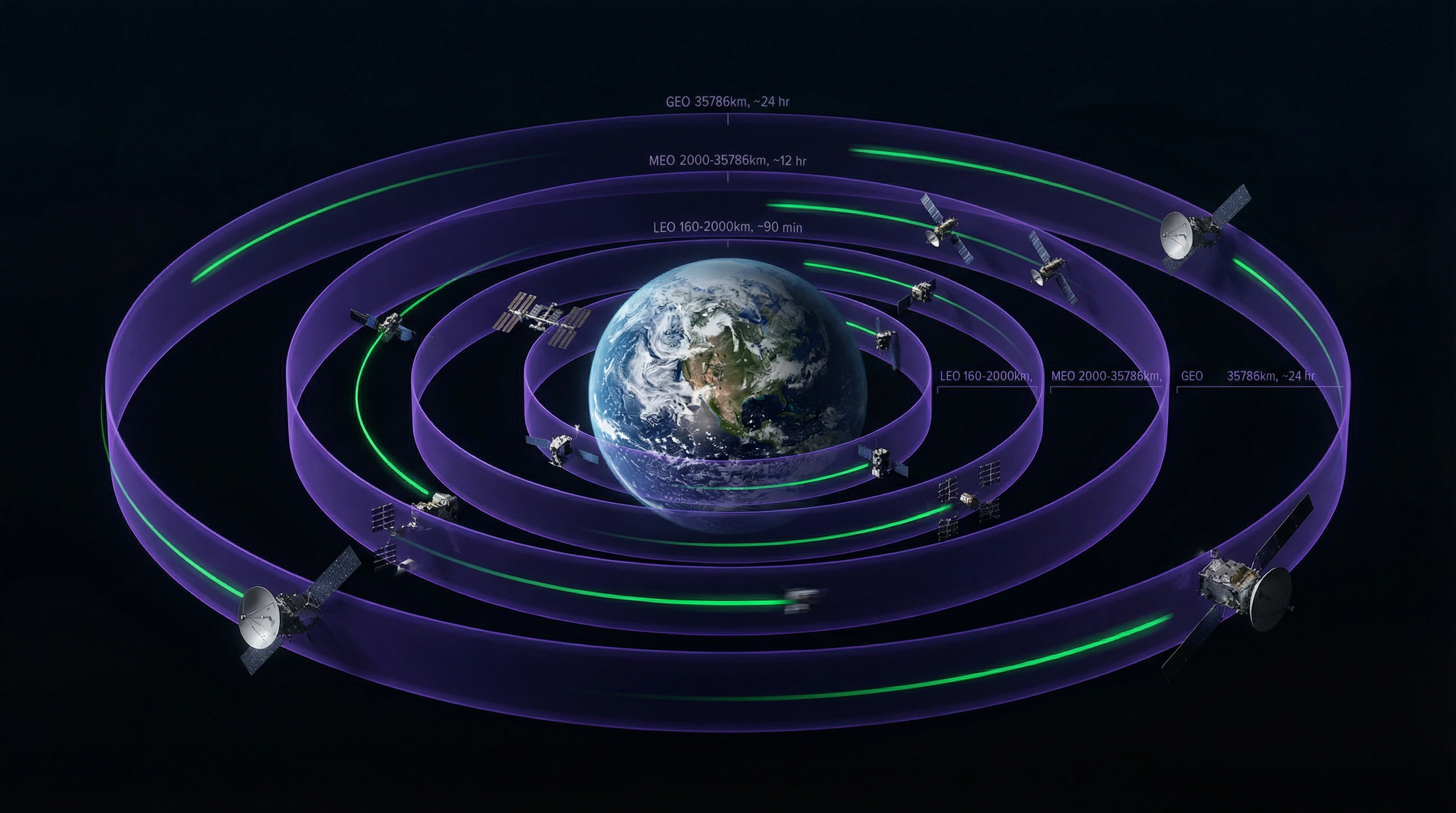
Geostationary orbit at 35,786 km altitude has special status: equatorial states periodically assert sovereignty claims over sections of this orbit, which contradicts the principles of international space law.
The Convention on International Civil Aviation (Chicago Convention of 1944) regulates airspace up to altitudes where aerodynamic flight is possible, but does not establish an upper boundary. This creates a "gray zone" between 20 and 100 km, where the applicability of air law and space law remains subject to debate.
In practice, states do not object to satellite overflight of their territory at altitudes above 100–110 km, which forms customary international law.
Technical Requirements for Spacecraft
Spacecraft are designed to withstand extreme conditions: temperature fluctuations from –150°C to +150°C, vacuum with pressure of 10⁻⁶ Pa, intense ultraviolet and X-ray radiation.
- At altitudes of 200–600 km, residual atmosphere creates aerodynamic drag requiring periodic orbital correction.
- The International Space Station at 400 km altitude loses approximately 2 km of altitude monthly without correction.
- Protection from micrometeoroids and space debris is provided by multi-layer Whipple shields capable of withstanding impacts from particles up to 1 cm at velocities of 10 km/s.
Near-Earth Space Exploration: Current State and Prospects
Near-Earth space up to 2000 km altitude is the most developed zone with over 8000 active satellites as of 2024. Low Earth Orbit (LEO, 200–2000 km) is used for remote sensing, scientific experiments, and crewed stations due to low energy requirements and orbital periods of 90–120 minutes.
Medium Earth Orbit (MEO, 2000–35786 km) hosts navigation systems GPS (20200 km) and GLONASS (19100 km), providing global positioning with meter-level accuracy.
| Orbit | Altitude | Purpose | Limitations |
|---|---|---|---|
| Geostationary (GEO) | 35786 km | Telecommunications, meteorology | ~1800 positions, 2° angular separation |
| ISS | 400 km | Microgravity research | Bone mass loss 1.5%/month |
Geostationary orbit keeps satellites stationary relative to Earth's surface—critical for telecommunications and meteorology. Capacity is limited to approximately 1800 positions with minimum 2° angular separation, making it a strategic resource allocated by the International Telecommunication Union.
The International Space Station at 400 km altitude serves as a platform for microgravity research. Crews experience bone mass loss up to 1.5% per month and muscle atrophy during extended stays.
Satellite Megaconstellations and Risks
Commercialization of low orbit is accelerating with satellite network deployments: Starlink plans 42000 spacecraft, OneWeb—6372. This increases collision risks and orbital debris.
Active debris removal technologies—harpoons, nets, laser ablation—are undergoing testing to clear orbits at 800–1000 km, where natural decay time for debris exceeds 100 years.
Prospects and Space Accessibility
The Lunar Gateway station, planned for 2028 in highly elliptical lunar orbit, will serve as an intermediate base for deep space exploration and testing life support technologies for Mars missions.
Reusable launch vehicles have reduced LEO payload costs from $10,000 to $1,500 per kilogram, making space more accessible for scientific and commercial projects.
- Suborbital tourism: Virgin Galactic, Blue Origin offer flights for $250,000–450,000 per ticket with prospects for price reduction and mass adoption.
- Space-based solar power: Design concepts in GEO could provide up to 30% of global energy needs by 2050.
Knowledge Access Protocol
FAQ
Frequently Asked Questions
Space conventionally begins at an altitude of 100 kilometers — this is the Kármán line, an internationally recognized boundary. The atmosphere doesn't end abruptly but gradually thins out, so this boundary was chosen for practical reasons: above this point, aerodynamic flight becomes impossible.
Space typically refers to the region beyond Earth's atmosphere, while the Universe encompasses everything that exists: matter, energy, space, and time. Space is the part of the Universe accessible for observation and exploration. The term also implies order and structure, as opposed to chaos.
No, absolute vacuum doesn't exist in space. Outer space contains rarefied gas, cosmic dust, radiation, and elementary particles. Matter density is extremely low — about one atom per cubic centimeter in interstellar space — but it's not complete emptiness.
The ISS orbits at approximately 400-420 kilometers altitude, in the low Earth orbit region. Satellites are positioned at various altitudes: low-orbit satellites at 200-2,000 km, geostationary satellites at around 36,000 km. Orbital selection depends on the spacecraft's purpose and Earth communication requirements.
Earth occupies the third position by distance from the Sun, after Mercury and Venus. This location provides optimal temperature for liquid water and life — the so-called habitable zone. The average distance from the Sun is approximately 150 million kilometers.
The Kármán line is a boundary at 100 km altitude, named after Hungarian physicist Theodore von Kármán. He calculated that at this altitude, the atmosphere becomes so thin that generating aerodynamic lift would require speeds exceeding orbital velocity. The Fédération Aéronautique Internationale officially recognizes this boundary.
No, breathing is impossible at 100 km altitude due to critically low pressure and oxygen concentration. Even at 15-20 km altitude, humans require oxygen masks, and above 19 km — pressurized suits. Without protection at the edge of space, loss of consciousness occurs instantly.
Earth's magnetic field and atmosphere shield the surface from most cosmic radiation. Solar wind and galactic cosmic rays interact with the magnetosphere, creating auroras. Without this protection, life on the surface would be impossible due to high radiation doses.
Yes, space is regulated by the Outer Space Treaty of 1967 and other international agreements. Outer space is declared the common heritage of all humanity, and deployment of weapons of mass destruction is prohibited. However, many issues, including resource extraction, remain subjects of ongoing debate.
There's no single temperature in space due to the absence of a medium for heat transfer. In shadow, objects cool to -270°C (close to absolute zero), while in sunlight they heat up to +120°C and higher. Temperature depends on radiation, distance from stars, and an object's thermal balance.
Yes, in microgravity the spine stretches, and astronauts grow 2-3 inches taller. This occurs due to the absence of gravitational load on the intervertebral discs. After returning to Earth, height returns to normal within several months.
This is a terminological distinction by country: Russia and CIS countries use "cosmonaut," while the U.S. and Western countries use "astronaut." Professional requirements and training are virtually identical. China uses the term "taikonaut," but all refer to spaceflight specialists.
Earth's atmosphere consists of five main layers: troposphere (up to 7 miles), stratosphere (up to 31 miles), mesosphere (up to 50 miles), thermosphere (up to 435 miles), and exosphere (gradually transitions into space). Each layer has unique temperature and chemical characteristics.
This is a common myth—it's impossible to see the wall with the naked eye from orbit. From the ISS, large cities, roads, and rivers are visible, but the wall is too narrow. The claim about its visibility from space appeared long before the first space flights and doesn't correspond to reality.
Contrary to Hollywood films, a person won't explode or freeze instantly. Rapid loss of consciousness occurs due to decompression and lack of oxygen (within 15 seconds). Death would occur within 1-2 minutes from asphyxiation, not from freezing or blood boiling.
Spacecraft must withstand extreme temperatures, vacuum, radiation, and micrometeoroids. Airtightness, reliable life support systems, and protection from overloads during launch and landing are required. All components undergo repeated testing under conditions simulating the space environment.