Electromagnetism: A Fundamental Force of Nature and Its Modern Applicationsλ
The study of electromagnetic interaction — one of the four fundamental forces, unifying electrical and magnetic phenomena from Maxwell's classical theory to modern quantum applications
Overview
Electromagnetism is one of the four fundamental forces of nature, unifying electrical and magnetic phenomena into a single theory. Ørsted's discovery in 1820 and Maxwell's synthesis in the 19th century laid the foundation: from classical field theory to quantum electrodynamics, from particle accelerators to photonics and biophysics. Dielectric permittivity, wave propagation, charged particle interactions 🧬 — mechanisms that define the structure of matter and modern technologies.
🛡️
Laplace Protocol: Electromagnetism remains an active area of research, despite the fundamental nature of Maxwell's equations. It is important to distinguish established scientific facts from speculative claims, especially regarding biological effects of electromagnetic fields, relying on verified academic sources and experimental data.
Reference Protocol
Scientific Foundation
Evidence-based framework for critical analysis
Protocol: Evaluation
Test Yourself
Quizzes on this topic coming soon
⚡
Deep Dive
From Accidental Lecture to Revolution: How Electromagnetism Was Born 200 Years Ago
Ørsted's Discovery and Early Magnetism Research
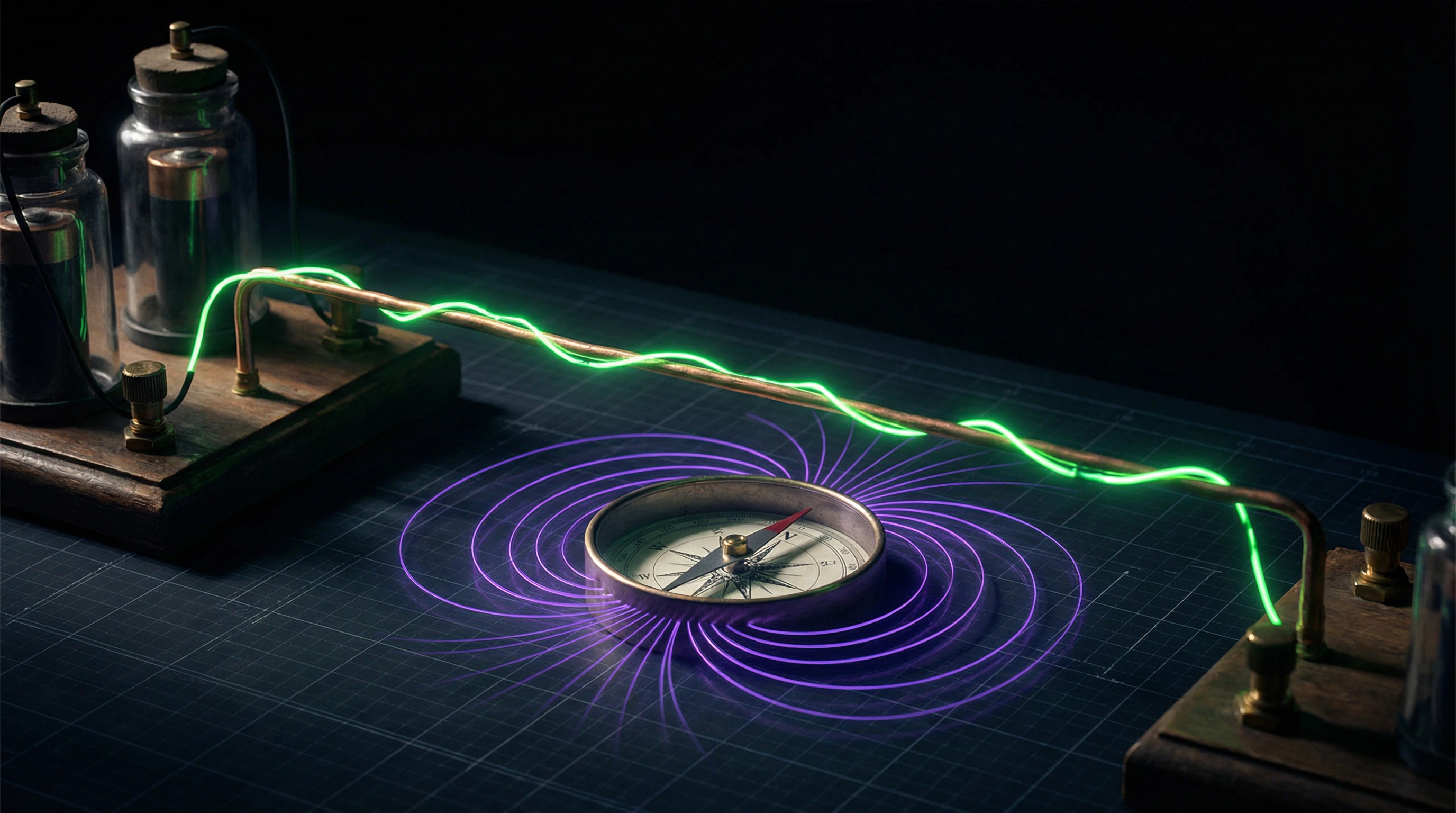
On February 15, 1820, Hans Christian Ørsted at the University of Copenhagen accidentally observed the deflection of a magnetic needle near a conductor carrying electric current. Until then, electricity and magnetism were considered independent phenomena, despite William Gilbert's systematization of magnetism during the Renaissance era.
Ørsted's experiment proved the fundamental connection between electric currents and magnetic fields—this was the birth moment of electromagnetism as an independent field of physics.
- Why This Was Revolutionary
- Early researchers described the properties of permanent magnets and Earth's magnetic field but couldn't explain their nature. Ørsted's discovery linked two seemingly independent forces into a unified system.
- Wave of Experiments After 1820
- André-Marie Ampère developed the mathematical theory of current interactions. Michael Faraday discovered electromagnetic induction in 1831. These works created the experimental foundation for theoretical synthesis.
Maxwell's Synthesis: When Two Sciences Became One
James Clerk Maxwell in the 19th century unified optics and electromagnetism into a single theoretical structure. His equations showed that light is an electromagnetic wave propagating at a speed determined by the electrical and magnetic properties of the medium.
Maxwell's synthesis predicted the existence of the entire electromagnetic spectrum—from radio waves to gamma radiation—long before their experimental detection. This wasn't merely a synthesis of two physics branches, but a transition to a new level of understanding nature.
Maxwell's equations connected the dielectric permittivity and magnetic permeability of a medium with electromagnetic wave propagation. This mathematical framework described field interactions with matter and completed classical electrodynamics, opening the path to quantum electrodynamics of the 20th century.
Mathematical Foundation: Fields, Forces and Equations of Modern Physics
Electric and Magnetic Fields as Vector Quantities
Electromagnetism studies the electromagnetic force — one of four fundamental interactions in nature, arising between electrically charged particles. The electric field describes the force acting on stationary charges, while the magnetic field is a vector field describing the influence on moving charges, currents, and magnetic materials.
Both fields are characterized by direction and magnitude at each point in space — these are vector fields with specific mathematical properties. The properties of the medium are determined by dielectric and magnetic permeability, which affect the propagation of electromagnetic waves.
| Parameter | Electric Field | Magnetic Field |
|---|---|---|
| Acts on | Stationary and moving charges | Moving charges and currents |
| Force direction | Along field lines | Perpendicular to velocity |
| Source | Electric charges | Moving charges and magnetic materials |
The interaction of electric and magnetic components creates complex dynamics described by a system of differential equations. Understanding the vector nature of fields is critically important for solving practical problems — from designing particle accelerators to investigating Earth's internal structure through geophysical methods.
Lorentz Force and Maxwell's Equations
The Lorentz force describes the effect of an electromagnetic field on a charged particle, combining electric and magnetic components into a single mathematical expression. This force is proportional to the particle's charge, its velocity, and the magnitude of the fields, with the magnetic component acting perpendicular to the direction of motion.
The Lorentz force underlies the operation of particle accelerators, mass spectrometers, and numerous other devices in modern physics and engineering — this is not merely a theoretical construct, but an engineering tool that works.
Maxwell's equations are a system of four differential equations that completely describe the classical electromagnetic field and its interaction with charges and currents. These equations connect electric and magnetic fields to each other, showing how changes in one field generate the other.
- Gauss's law: electric charges create an electric field
- Gauss's law for magnetism: magnetic monopoles do not exist
- Faraday's law: a changing magnetic field creates an electric field
- Ampère-Maxwell law: electric current and a changing electric field create a magnetic field
Maxwell's equations explain the propagation of electromagnetic waves in vacuum and matter. Despite their fundamental nature, modern research continues to study their applicability under extreme conditions and their connection to quantum field theory.
Induction and Medium: How Matter Influences Electromagnetic Processes
Faraday's Electromagnetic Induction Phenomenon
Electromagnetic induction is the generation of electric current in a conductor when the magnetic field passing through a circuit changes. Michael Faraday discovered this effect in 1831: a varying magnetic field creates an electromotive force proportional to the rate of change of magnetic flux.
This discovery became the foundation for electric generators, transformers, and all modern electrical power engineering.
Faraday's law shows that the induced EMF opposes the change in magnetic field according to Lenz's rule. Practical applications span wireless charging, magnetic resonance imaging, and minimization of parasitic currents in electrical devices.
Dielectric and Magnetic Permeability of Medium
Dielectric permittivity characterizes a medium's ability to polarize under an electric field, affecting the propagation speed of electromagnetic waves and capacitor capacitance. Magnetic permeability describes a material's response to a magnetic field, determining the magnetization of matter and inductance of coils.
| Parameter | Effect on Waves | Dependence |
|---|---|---|
| Dielectric permittivity | Wave slowdown in dielectrics | On frequency and temperature |
| Magnetic permeability | Attenuation in conductors (Joule heating) | On frequency and temperature |
In dielectrics, waves slow down proportionally to the square root of the product of permeabilities; in conductors, they rapidly attenuate due to Joule heat dissipation.
Modern metamaterials and photonic systems manipulate dielectric and magnetic permeability to create materials with unusual optical properties, including negative refractive index.
Study of electromagnetic properties of biological tissues opens possibilities for medical diagnostics, but requires separating scientifically validated effects from pseudoscientific claims.
Modern Research Directions: From Quantum Electrodynamics to Plasma Technologies
Quantum Electrodynamics and Metamaterials as the Cutting Edge of Science
Quantum Electrodynamics (QED) — a quantum field theory of electromagnetic interaction, remains an active research area despite the century-long history of classical electrodynamics. Modern applications include calculations of light-matter interactions at the subatomic level, quantum computer development, and studies of vacuum fluctuations in the electromagnetic field.
In parallel, the field of metamaterials is developing — artificially created structures with electromagnetic properties not found in nature: negative refractive index, "invisibility cloaks," control of light flows at scales smaller than the wavelength.
- Photonic crystals — periodic structures for controlling light propagation
- Plasmonic structures — light interaction with collective electron oscillations
- Optical metasurfaces — thin layers for transforming light wavefronts
Electromagnetism is far from being a "solved" science and continues to generate breakthrough technologies in quantum computing and ultra-fast optical communications.
Computational Electrodynamics and Plasma Physics
Computational electrodynamics uses numerical methods to solve Maxwell's equations in complex geometries and nonlinear media. The development of supercomputers has expanded modeling capabilities to the scale of entire city districts.
| Method | Application |
|---|---|
| FDTD (Finite-Difference Time-Domain) | Wave propagation in biological tissues |
| Finite Element Method | Antenna design |
| Boundary Element Method | Electromagnetic compatibility of devices |
Plasma physics as the fourth state of matter is closely linked to electromagnetism: plasma is an ionized gas that responds to electric and magnetic fields. Modern research encompasses controlled thermonuclear fusion in tokamaks, where magnetic fields confine plasma at temperatures of millions of degrees.
The interaction of electromagnetic waves with plasma is studied for creating compact particle accelerators and understanding cosmic phenomena: solar wind, magnetospheric storms, industrial plasma technologies for material processing.
Practical Applications of Electromagnetism: From Accelerators to Geophysics
Particle Accelerators and Medical Technologies
Particle accelerators embody the Lorentz force in engineering: charged particles are accelerated to near-light speeds in controlled electromagnetic fields. The Large Hadron Collider (LHC) at CERN maintains proton beams on a 27-kilometer trajectory using superconducting magnets (8.3 Tesla), while radiofrequency resonators provide acceleration.
Synchrotron radiation—a byproduct of accelerating relativistic electrons in a magnetic field—has become a tool: protein structure research, materials science, microelectronics.
- Magnetic Resonance Imaging (MRI): strong magnetic fields (1.5–7 Tesla) and radiofrequency pulses interact with hydrogen nuclear spins, creating detailed images of soft tissues.
- Proton and ion cancer therapy: charged particle beams deliver energy precisely to tumors, minimizing damage to healthy tissues through the Bragg peak.
- Transcranial magnetic stimulation: induction of local currents in neurons for treating depression and studying brain function.
Geophysical Research and Electromagnetic Compatibility
Electromagnetic exploration methods measure natural and artificial fields to study Earth's internal structure and search for mineral deposits.
Magnetotelluric sounding uses natural variations in Earth's magnetic field to determine rock conductivity at depths from hundreds of meters to tens of kilometers—mapping geothermal reservoirs and oil-gas structures becomes possible without drilling.
Controlled-source electromagnetic profiling (CSEM) is applied in offshore hydrocarbon exploration: low-frequency electromagnetic waves penetrate through seawater and sedimentary rocks.
Electromagnetic compatibility (EMC) is a critical engineering discipline in an era of ubiquitous electronics. Devices must function in a shared electromagnetic environment without mutual interference.
- International EMC Standards
- Regulate permissible emission and susceptibility levels for consumer electronics, industrial equipment, and medical devices.
- Practical EMC Methods
- Electromagnetic field shielding, filtering, and grounding are based on fundamental laws of electromagnetism—wave reflection from conductive surfaces and absorption in materials with high permeability.
Electromagnetism in Biological Systems: Science and the Boundaries of Knowledge
Measurable Electromagnetic Processes in Living Organisms
Biological systems generate measurable electromagnetic fields as a result of ionic currents across cell membranes and synchronized activity of excitable tissues.
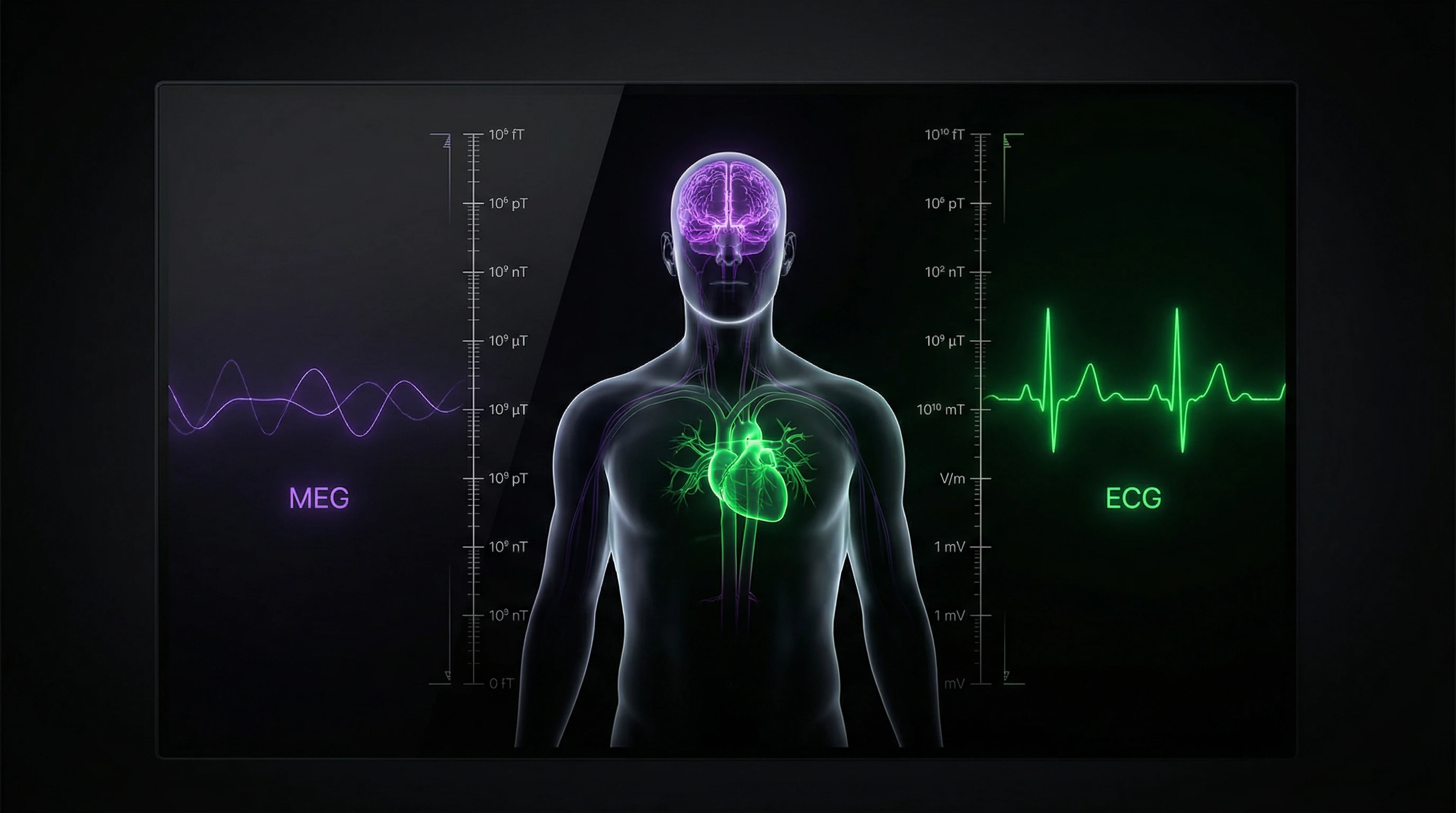
Electrocardiography (ECG) records electrical potentials of the heart with amplitudes around 1 millivolt at the skin surface, reflecting myocardial depolarization and repolarization. Electroencephalography (EEG) measures the summed activity of millions of neurons with amplitudes of 10–100 microvolts. Magnetoencephalography (MEG) detects magnetic fields on the order of 10–100 femtotesla created by intracellular currents in neurons, using ultra-sensitive SQUID magnetometers in shielded rooms.
| Method | Signal Amplitude | Physical Mechanism |
|---|---|---|
| ECG | ~1 mV | Myocardial depolarization |
| EEG | 10–100 μV | Synchronous neuronal activity |
| MEG | 10–100 fT | Intracellular currents |
Electromagnetic properties of biological tissues are characterized by frequency-dependent dielectric permittivity and conductivity, which is utilized in impedance tomography to distinguish healthy from pathological tissues.
Cell membranes act as capacitors with a capacitance of approximately 1 microfarad per square centimeter, creating a resting transmembrane potential of −70 millivolts. This corresponds to an electric field strength of about 10 million volts per meter in the lipid bilayer—a magnitude sufficient to influence ion channels and protein conformations.
Critical Evaluation of Scientific Data and Pseudoscience
The boundary between scientifically validated electromagnetic effects in biology and pseudoscientific claims requires rigorous methodological analysis.
- Proven effects: thermal effects of high-frequency fields (diathermy), stimulation of nerves and muscles by pulsed fields (pacemakers), photobiomodulation with visible and near-infrared light. All are reproducible, dose-dependent, and have understood biophysical mechanisms.
- Speculative claims: "biofields," "energy meridians," effects of weak fields without thermal effects. These do not withstand scrutiny in double-blind controlled studies.
- Criteria for scientific validity: reproducibility in independent laboratories, control groups with sham exposure, blinded coding of conditions, biologically plausible mechanisms.
The International Commission on Non-Ionizing Radiation Protection (ICNIRP) establishes exposure threshold values based on systematic reviews of scientific literature, separating proven effects from speculative hypotheses.
Educational programs on electromagnetism should include critical thinking to distinguish scientific facts from pseudoscientific claims, especially in the context of growing public concern regarding electromagnetic fields from household devices and telecommunications networks.
Knowledge Access Protocol
FAQ
Frequently Asked Questions
Electromagnetism is a branch of physics that studies the interaction between electric charges and magnetic fields. It explains how moving charges create magnetic fields, and how changing magnetic fields generate electric current. It's one of the four fundamental forces of nature, discovered 200 years ago by Professor Ørsted.
Electromagnetism was discovered on February 15, 1820, by Danish professor Hans Christian Ørsted during a lecture at the University of Copenhagen. He found that electric current deflects a compass needle, proving the connection between electricity and magnetism. Later, Maxwell created a mathematical theory that unified optics and electromagnetism.
The Lorentz force is the force acting on a charged particle moving in an electromagnetic field. It determines the trajectory of particles in accelerators and magnetic traps. The formula accounts for both the electric and magnetic components of the field.
The scientific consensus states that mobile phone radiation is in the safe range and causes no proven harm with normal use. While electromagnetic processes in organisms are real and measurable, radiation levels from household devices are too low for biological impact. It's important to distinguish legitimate research from pseudoscientific claims.
Electromagnetic induction is the phenomenon of electric current arising in a conductor when the magnetic field changes. Discovered by Faraday, this phenomenon underlies the operation of generators, transformers, and wireless charging. It's precisely because of induction that electrical energy transmission over distances is possible.
Start with understanding the basics of electric and magnetic fields, then study the Lorentz force and the law of electromagnetic induction. Use university textbooks and solve practical problems to reinforce the material. Gradually move on to Maxwell's equations—the mathematical foundation of the entire theory.
Maxwell's equations are four fundamental equations describing all electromagnetic phenomena. They unify electricity, magnetism, and optics into a single theory and predict the existence of electromagnetic waves. These equations are the foundation of modern electrical engineering, radio communication, and photonics.
This is a common myth—electromagnetism remains an active area of research. Modern scientists work on quantum electrodynamics, metamaterials, plasma physics, and computational electrodynamics. New applications constantly emerge in nanotechnology, photonics, and materials science.
Dielectric permittivity is a property of a medium showing how much it weakens an electric field compared to vacuum. This parameter is critically important for calculating capacitor capacitance, radio wave propagation, and designing electronic components. Different materials have different permittivity.
Electromagnetism is used in MRI scanners, which create detailed images of internal organs using powerful magnetic fields. It's also applied in physical therapy, pacemakers, and diagnostic methods. Particle accelerators based on electromagnetic principles are used in cancer radiation therapy.
Electromagnetism is a required course in physics departments at all major American universities. The curriculum includes theoretical foundations, laboratory work, and problem-solving in classical electrodynamics. Specialized programs are available at MIT, Stanford, Caltech, and other leading institutions.
Most commercial "protective" devices against electromagnetic fields lack scientific basis and are pseudoscientific products. Real protection requires shielding with conductive materials or increasing distance from the source. For household appliances, such protection is usually unnecessary, as their radiation is safe.
Electromagnetic methods allow scientists to study Earth's internal structure, search for mineral deposits, and map underground formations. By measuring natural and artificial electromagnetic fields, geophysicists determine rock conductivity at various depths. This is a key tool for oil, gas, and ore exploration.
Quantum electrodynamics (QED) is the quantum theory of electromagnetic interaction, describing the behavior of light and charged particles at the microscopic level. It explains how photons carry electromagnetic force between particles. QED is one of the most precise physical theories, verified by experiments with incredible accuracy.
Accelerators use electric fields to accelerate charged particles and magnetic fields to control their trajectory. Particles travel along circular or linear paths, gaining enormous energy. Such facilities are used in fundamental research (LHC), medicine, and industry.
Metamaterials are artificial structures with unusual electromagnetic properties not found in nature, such as negative refractive index. They open possibilities for creating "invisibility cloaks," superlenses, and miniature antennas. This is an active area of modern research in photonics and materials science.