
Chemistry: The Science of Matter and Its Transformationsλ
A fundamental natural science studying the properties, composition, and structure of substances, their transformations, and energy changes in chemical processes at the atomic and molecular level.
Overview
Chemistry explains how atoms bond into molecules, how bonds break and energy is released — from a match burning to drug synthesis. It's the language of transformations: hydrogen + oxygen = water, carbon + time + pressure = diamond. Without chemistry, there are no batteries, no aspirin ⚙️, no plastic — it shows why iron rusts and sugar dissolves.
🛡️
Laplace Protocol: Chemistry is based on rigorous scientific methods, including observation, experimentation, quantitative analysis, and theoretical modeling. All claims are confirmed by reproducible experiments and undergo scientific peer review, ensuring the reliability of chemical knowledge and its practical application.
Reference Protocol
Scientific Foundation
Evidence-based framework for critical analysis
Protocol: Evaluation
Test Yourself
Quizzes on this topic coming soon
⚡
Deep Dive
Core Branches of Chemistry: From Fundamental Laws to Specialized Disciplines
Modern chemistry is a branching system of interconnected disciplines, each studying specific aspects of matter and its transformations. This structure reflects different approaches to investigating matter at the atomic-molecular level.
General Chemistry and Fundamental Laws
General chemistry forms the foundation of the entire science: atomic structure, the periodic law, chemical bonding, thermodynamics. The periodic law demonstrates that elements exhibit periodic properties depending on atomic structure—this allows prediction of chemical behavior of substances.
The laws of conservation of matter and energy provide the quantitative basis for all calculations and predictions. These universal principles apply to all chemical systems regardless of their nature.
Organic and Inorganic Chemistry
- Organic Chemistry
- Studies carbon compounds—the basis of all living organisms and most modern materials. Forms the foundation of pharmaceuticals and biotechnology.
- Inorganic Chemistry
- Covers all other elements and their compounds: metals, minerals, coordination complexes. Critical for metallurgy and materials science.
Despite their differences, both disciplines use common principles of chemical bonding and reactivity.
Physical and Analytical Chemistry
| Discipline | Subject of Study | Practical Significance |
|---|---|---|
| Physical Chemistry | Thermodynamics, reaction kinetics, quantum mechanics of molecules | Understanding mechanisms of chemical processes |
| Analytical Chemistry | Methods for determining composition of substances | Quantitative foundation for all research |
Biochemistry integrates principles from all branches to explain the molecular basis of life, studying the chemistry of living organisms.
The division of chemistry into disciplines is not merely classification, but a reflection of different scales and tools for investigating one phenomenon: the transformation of matter.

Atomic Theory and Chemical Bonds: The Molecular Architecture of Matter
Atomic theory states that all matter consists of atoms capable of forming molecules through chemical bonds. Understanding atomic structure and bond formation mechanisms allows us to explain the properties of substances, predict reaction outcomes, and synthesize new materials with desired characteristics.
Atomic Structure and the Periodic Law
Atoms consist of a nucleus (protons and neutrons) and an electron shell, where electrons are distributed across energy levels. The periodic law establishes that the properties of elements repeat periodically depending on atomic structure.
Electron configuration determines an atom's chemical reactivity. Valence electrons in the outer shell play a key role in forming chemical compounds and determine an element's position in the periodic table.
- The nucleus contains protons (positive charge) and neutrons (neutral)
- Electrons are distributed across orbitals with specific energy levels
- Valence electrons in the outer shell participate in bond formation
- Atomic number determines the number of protons and electrons in a neutral atom
Types of Chemical Bonds
Atoms connect through different types of bonds—ionic, covalent, and metallic—each with its own formation mechanism and properties.
| Bond Type | Formation Mechanism | Characteristic Properties |
|---|---|---|
| Ionic | Transfer of electrons from one atom to another | Oppositely charged ions, electrostatic attraction |
| Covalent | Sharing of electron pairs between atoms | Typical for organic molecules and many inorganic compounds |
| Metallic | Delocalization of electrons in a crystalline lattice | Electrical conductivity, malleability, thermal conductivity |
Bond type determines not only molecular structure but also its physical and chemical properties—solubility, melting point, reactivity, and ability to participate in reactions.
Ionic compounds often dissolve in polar solvents (water), covalent molecules can be polar or nonpolar depending on geometry and electronegativity of atoms, and metallic bonds provide unique mechanical and electrical properties to metals.
Intermolecular interactions—hydrogen bonds and van der Waals forces—affect the physical state of matter and phase transition temperatures, completing the picture of molecular architecture.
Chemical Reactions and Thermodynamics: The Energetics of Molecular Transformations
Chemical reactions are the transformation of one substance into another through the breaking of old bonds and the formation of new ones. These processes obey the laws of thermodynamics and are accompanied by energy changes that determine the direction and rate of reactions.
Managing chemical processes in industry, medicine, and everyday life requires understanding the mechanisms of reactions and their energetics.
Reaction Mechanisms and Kinetics
Chemical reactions proceed through sequences of elementary steps involving bond breaking and formation. Kinetics studies the rate of transformations and influencing factors: reactant concentration, temperature, pressure, and catalysts.
Activation energy is the minimum energy required to overcome the barrier between reactants and products. Catalysts lower this barrier, accelerating the reaction without changing the equilibrium.
| Factor | Mechanism of Influence |
|---|---|
| Reactant concentration | Increases the probability of molecular collisions |
| Temperature | Increases the kinetic energy of particles |
| Pressure | Affects systems with gaseous components |
| Catalysts | Provide an alternative pathway with lower activation energy |
Energy Changes
Chemical reactions are accompanied by energy changes in accordance with the laws of thermodynamics. Matter and energy are conserved: nothing disappears, only transforms.
Exothermic reactions release energy into the surroundings, while endothermic reactions absorb energy to proceed. The direction and spontaneity of a process are determined by Gibbs free energy, which combines enthalpic and entropic factors.
- Enthalpy (ΔH) — the heat effect of a reaction at constant pressure. A negative value indicates heat release, a positive value indicates heat absorption.
- Entropy (ΔS) — a measure of system disorder. An increase in entropy favors process spontaneity.
- Gibbs Free Energy (ΔG) — combines enthalpy and entropy: ΔG = ΔH − TΔS. A negative ΔG indicates reaction spontaneity under given conditions.
Practical Applications of Chemistry: From Pharmaceuticals to Construction Materials
Medicine and Pharmaceuticals as the Leading Edge of Chemical Innovation
Pharmaceutical chemistry develops drugs through understanding the molecular mechanisms of substance interactions with biological systems. Modern synthesis creates complex organic molecules with targeted properties, optimizing structure for maximum efficacy with minimal side effects.
Biochemistry studies chemical processes in cells and tissues—the foundation for understanding drug mechanisms of action and developing targeted therapy. Analytical chemistry provides precise methods for determining the composition of biological samples and quality control of pharmaceutical products.
- Synthesis creates molecules with targeted properties → new drugs with improved profiles
- Biochemistry studies mechanisms of action in the body → targeted therapy, reduced side effects
- Analytics controls composition and concentration → quality and safety assurance
Industry and Agriculture: Chemistry as the Foundation of Production
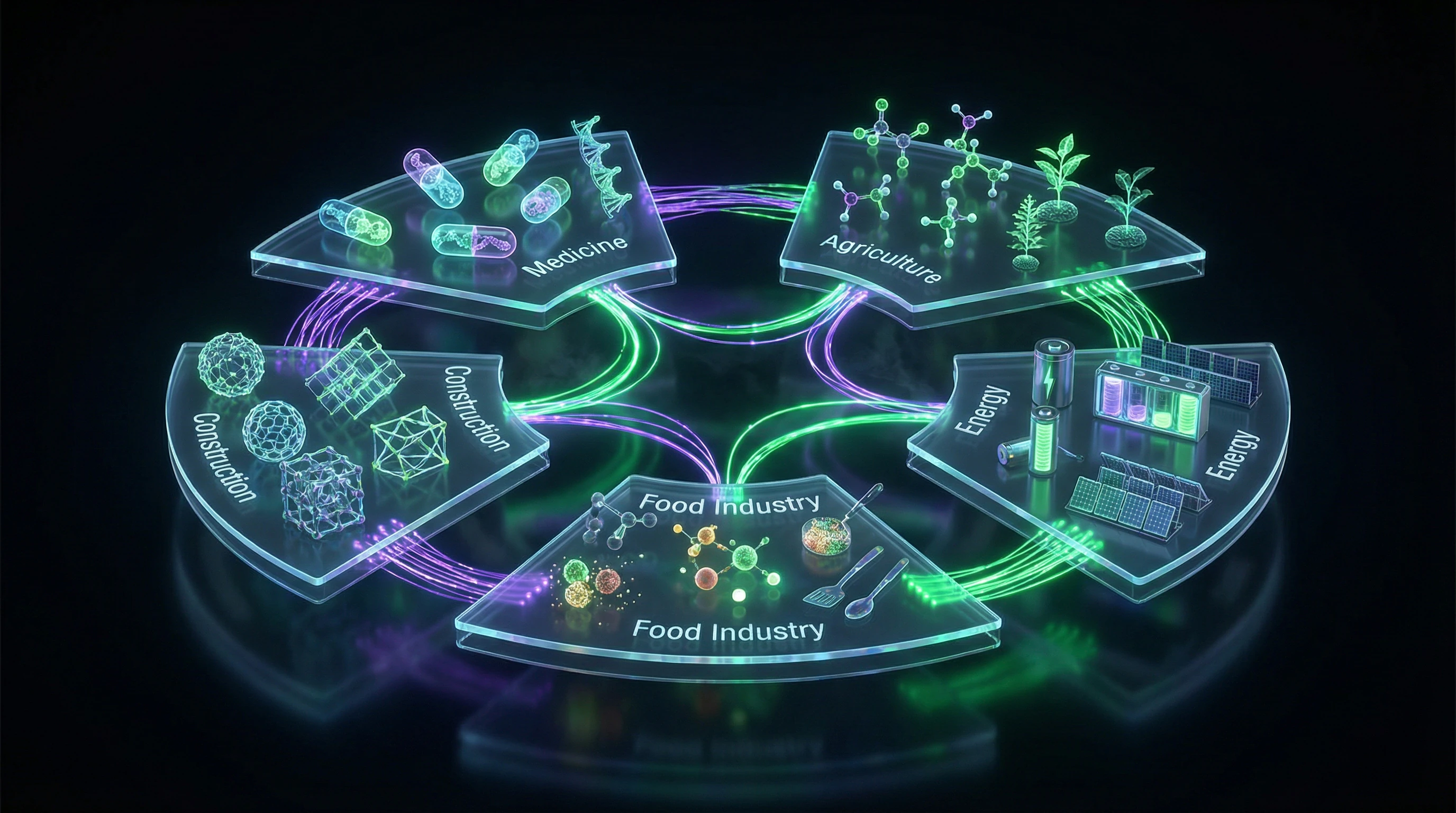
Chemical technologies permeate industry and agriculture, enabling the production of materials, energy, and food products. In construction, the chemistry of cement and composite materials determines structural strength, coating durability, and building energy efficiency.
Development of new composite materials opens possibilities for creating lighter and stronger structures, but requires understanding the chemical processes of degradation and component interactions.
Agrochemistry enables the production of fertilizers that replenish nutrient deficiencies in soil, and pesticides that protect plants from pests. Application of these substances requires careful control to minimize environmental risks.
The energy sector relies on the chemistry of fuels and energy storage systems. Development of more efficient batteries and fuel cells becomes critically important for the transition to renewable energy sources.
Scientific Methods in Chemistry: From Experiment to Computational Modeling
Experimental Approaches and Laboratory Research
Chemistry relies on rigorous methods of observation, measurement, and hypothesis testing that ensure reproducibility of results and accumulation of reliable knowledge about the properties of substances.
Quantitative analysis determines the precise composition of substances and component concentrations, using instrumental methods from titration to mass spectrometry and chromatography.
- Systematic variation of conditions (temperature, pressure, reagent concentration) to establish optimal process parameters
- Understanding transformation mechanisms at the molecular level
- Peer review and validation of results by independent researchers
- Prevention of erroneous data dissemination
Independent verification procedures constitute an integral part of the scientific method, guaranteeing the reliability of conclusions.
Theoretical Modeling and Computational Chemistry
Modern chemistry uses theoretical modeling to predict substance properties, plan synthesis of new compounds, and understand complex processes without costly experiments.
Quantum chemical calculations model the electronic structure of molecules, chemical bond energies, and reaction mechanisms, relying on the laws of quantum mechanics and supercomputers.
| Method | Purpose | Application |
|---|---|---|
| Quantum chemical calculations | Modeling molecular electronic structure | Predicting properties and reactivity |
| Molecular dynamics | Simulating atomic and molecular motion over time | Biochemical processes, polymer behavior, material properties |
| Data integration | Combining experimental and theoretical results | Catalysis, materials science, pharmaceuticals |
Experimental data and computational predictions work in tandem: theory guides experimental design, experiments refine models, and the cycle repeats until the desired accuracy is achieved.
Common Misconceptions About Chemistry: Separating Facts from Myths
Myths About Chemical Substances and Their Origins
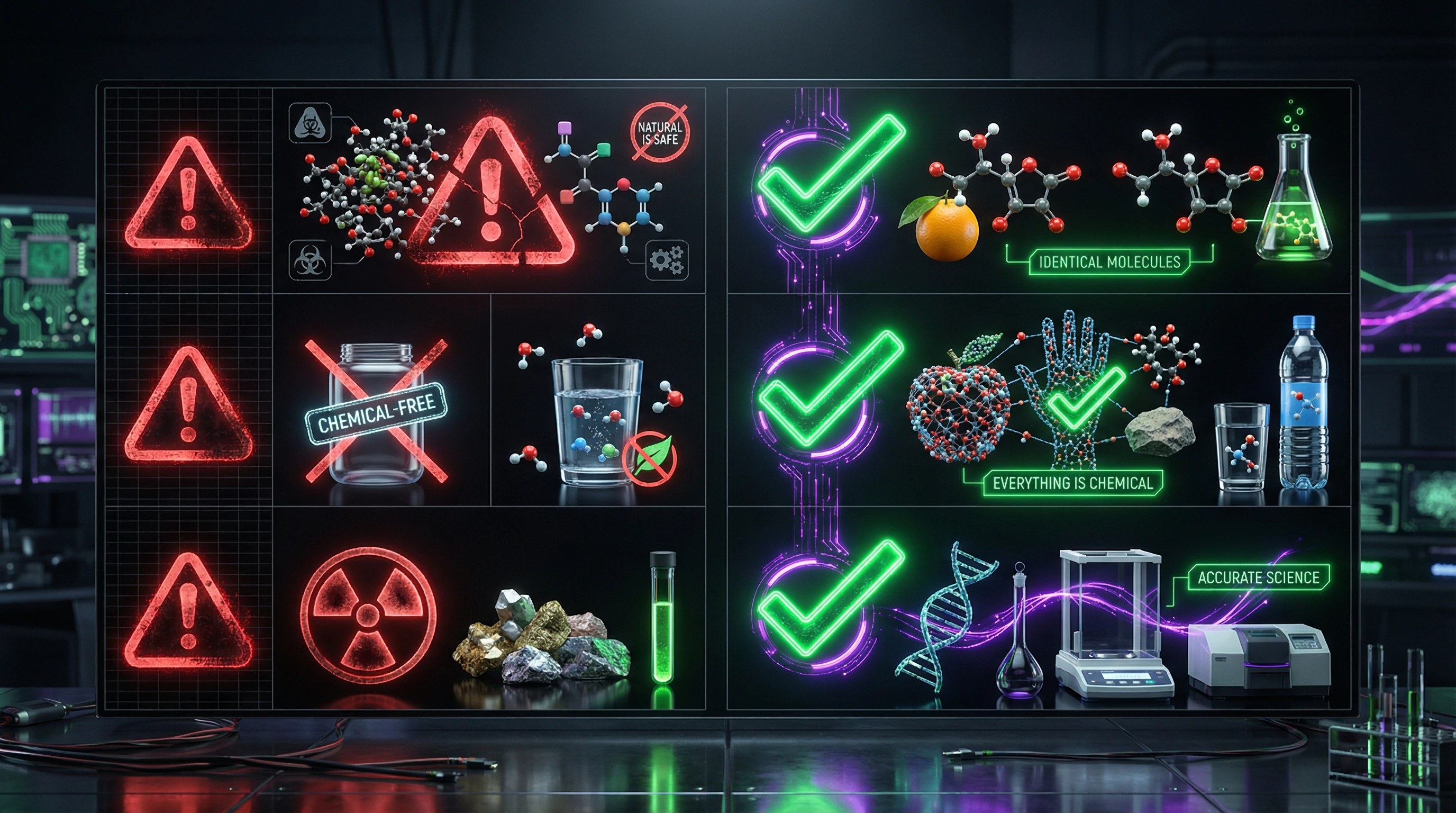
A persistent misconception: all chemical substances are dangerous and should be avoided. In reality, water, oxygen, and nutrients in food—all are chemical compounds.
The term "chemical substance" is neutral. Safety depends on the specific compound, its concentration, and context, not on the mere fact of its chemical nature.
Molecular structure determines properties, not origin. Vitamin C from a lemon and from a laboratory are identical molecules with the same properties and biological activity.
The myth of natural substances' superiority over synthetic ones doesn't withstand scrutiny: mushroom and snake poisons are natural, while laboratory vitamins are safe and necessary.
Safety and Proper Understanding of Chemical Information
Chemistry is not simply mixing liquids in laboratories. It encompasses theoretical work, computational modeling, materials science, and studying processes in nature.
The misconception that chemistry is memorizing facts ignores its essence: understanding patterns, relationships, and problem-solving.
| Verification Step | Action | Purpose |
|---|---|---|
| Hazard symbols | Read on packaging | Quick risk identification |
| Safety data sheet | Study MSDS | Complete substance information |
| Application conditions | Follow storage and use guidelines | Incident prevention |
| Protection | Use protective equipment | Minimize contact |
Critical thinking when evaluating chemical information requires distinguishing correlation from causation, verifying data sources, and understanding the role of dose in toxicity.
Even water is dangerous with excessive consumption, while many "scary" chemical names denote harmless substances.
Knowledge Access Protocol
FAQ
Frequently Asked Questions
Chemistry studies the composition, structure, and properties of substances, as well as their transformations and energy changes during chemical reactions. This science investigates matter at the atomic and molecular level, studying elements, compounds, and chemical bonds between atoms. Chemistry includes many branches: general, organic, inorganic, physical, analytical chemistry, and biochemistry.
The main branches of chemistry include general chemistry (fundamental laws), organic chemistry (carbon compounds), inorganic chemistry (inorganic substances), physical chemistry (application of physics), analytical chemistry (methods of analysis), and biochemistry (chemistry of living organisms). Each branch functions as an independent scientific discipline, but they are all interconnected and complement each other.
No, this is a common misconception. Everything around us consists of chemical substances, including water and oxygen, which are essential for life. Danger depends on the specific substance, its concentration, and conditions of use, not on the mere fact that it's 'chemistry.'
Atomic theory states that all matter consists of atoms, which can form molecules through chemical bonds. This is a fundamental concept of modern chemistry, explaining the structure of substances and mechanisms of chemical reactions. Atoms of different elements differ in structure and properties according to the periodic law.
Balancing equations is based on the law of conservation of mass: the number of atoms of each element must be the same on both sides of the equation. Adjust coefficients in front of substance formulas, starting with the most complex compounds. Verify that all elements are balanced and that coefficients are the smallest whole numbers.
The main types of chemical bonds are ionic, covalent, and metallic. Ionic bonds form through electron transfer between atoms, covalent bonds through sharing of electron pairs, and metallic bonds in metals through delocalized electrons. The type of bond determines the physical and chemical properties of a substance.
No, this is a myth. Many natural substances are toxic (such as snake venom or cyanide in apricot pits), while synthetic compounds can be safe and beneficial. What matters are the chemical properties of a substance, not its origin—whether natural or synthetic.
Chemistry is applied everywhere: in medicine (pharmaceuticals), agriculture (fertilizers), food industry (preservatives), construction (materials), energy (fuel), and household products (detergents). Virtually all modern technologies and products are based on chemical processes and developments.
The periodic law states that the properties of chemical elements repeat periodically depending on their atomic structure. Elements in the periodic table are arranged by increasing atomic number, and elements in the same group have similar chemical properties. This law is the foundation for systematizing chemical knowledge.
Safety requires following protocols: using protective goggles, gloves, and lab coats, working in a fume hood when necessary, knowing the properties of substances. Always study instructions before an experiment, have first aid supplies available, and never taste chemical substances. Proper waste disposal is also critically important.
Stoichiometry is a branch of chemistry that studies the quantitative relationships between reactants and products in chemical reactions. It allows you to calculate how much substance is needed for a reaction or how much product will be formed. Stoichiometric calculations are based on the law of conservation of mass and molar ratios.
No, that's a misconception. Chemistry requires understanding patterns, logical connections, and problem-solving, not simple memorization. What matters more is grasping the principles of molecular structure, reaction mechanisms, and learning to apply knowledge to predict the properties and behavior of compounds.
Chemical thermodynamics studies energy changes in chemical reactions and determines whether a reaction can occur spontaneously. It examines enthalpy, entropy, and Gibbs free energy. Thermodynamic principles allow us to predict the direction of reactions and the conditions for chemical equilibrium.
No, chemical methods cannot transform one element into another—this is only possible through nuclear reactions. Chemical reactions only change the bonds between atoms and the distribution of electrons, but do not affect atomic nuclei. Transmutation of elements requires changing the number of protons in the nucleus.
Theoretical modeling applies mathematical and computational methods to predict molecular structure, substance properties, and reaction mechanisms. Quantum chemistry and molecular dynamics enable the study of systems inaccessible to direct experimentation. This accelerates the development of new materials and drugs.
Catalysts accelerate chemical reactions by lowering the activation energy, but are not consumed in the process. They enable reactions to proceed under milder conditions and increase the selectivity of desired product formation. Catalysts are critically important in industry, biology, and environmental technologies.