What exactly does the "dopamine theory of love" claim — and where are the boundaries of this model
The popular version of the neurobiology of love boils down to this: when a person falls in love, their brain experiences a massive release of dopamine — the neurotransmitter of pleasure and motivation. This "dopamine storm" creates euphoria, obsessive thoughts about the partner, a need for closeness, and all the other hallmarks of romantic passion (S005).
The formula is simple: more dopamine — stronger love, less dopamine — feelings fade. Some sources go further: "no dopamine — no love" (S005).
- Soft version
- Dopamine is a key, but not the only player. "A surging stream of dopamine floods the brain, but it's not the only chemical substance actively produced during the period of falling in love" (S003). Room for serotonin, oxytocin, vasopressin, and other neurotransmitters.
- Moderate version
- Dopamine is the central element around which the entire neurochemistry of love is organized. Dopamine is described as "the main culprit behind the human feeling of pleasure or the feeling of anticipated pleasure" (S001), implying that without its activation, other systems don't engage.
- Radical version
- Complete identification: love is dopamine, dopamine is love, everything else is epiphenomena. Most vulnerable to criticism, but dominates in popular culture.
From an evolutionary neurobiology perspective, love is indeed "a product of brain activity — a complex neurobiological phenomenon that emerged during evolution" (S005). The dopamine reward system existed long before romantic love appeared in primates — it regulates motivation for food, sex, social status.
Romantic attachment "hijacked" the ancient dopamine system, using it to create stable pair bonds necessary for joint offspring rearing.
Source (S006) describes three mechanisms through which dopamine creates pair bonds: short-term bonds through direct dopamine stimulation (attraction, sex, status), medium-term mechanisms, and long-term attachment. However, details of the second and third mechanisms are not fully disclosed in available sources.
| What the dopamine model explains | What it doesn't explain |
|---|---|
| Euphoria and obsessive thoughts in the initial phase of falling in love | Why long-term relationships persist after euphoria fades |
| Intensity of new relationships (novelty stimulates dopamine more strongly) | Attachment to partners who don't trigger dopamine surges |
| "Dopamine withdrawal" during breakups: the brain craves familiar sensations (S004) | How attachment works with dopamine system dysfunction |
| Why antidepressants (increase serotonin, decrease dopamine) don't destroy existing relationships |
The dopamine model predicts behavior well in the initial phase of falling in love, but requires supplementation with more complex mechanisms to explain long-term attachment and relationship resilience to neurochemical changes. This points to the reductionism of the popular version: one molecule cannot be a complete explanation of a multilevel phenomenon.
The Steel Man Argument: Five Strongest Evidence Points for Dopamine's Role in Love
Before critiquing dopamine theory, we must present it in its most convincing form — this is the "steel man" principle, opposite of a straw man. Below are the five most compelling arguments for dopamine's central role in romantic love. More details in the Quantum Mechanics section.
🧪 Argument 1: Neuroimaging shows dopamine activation when viewing a loved one
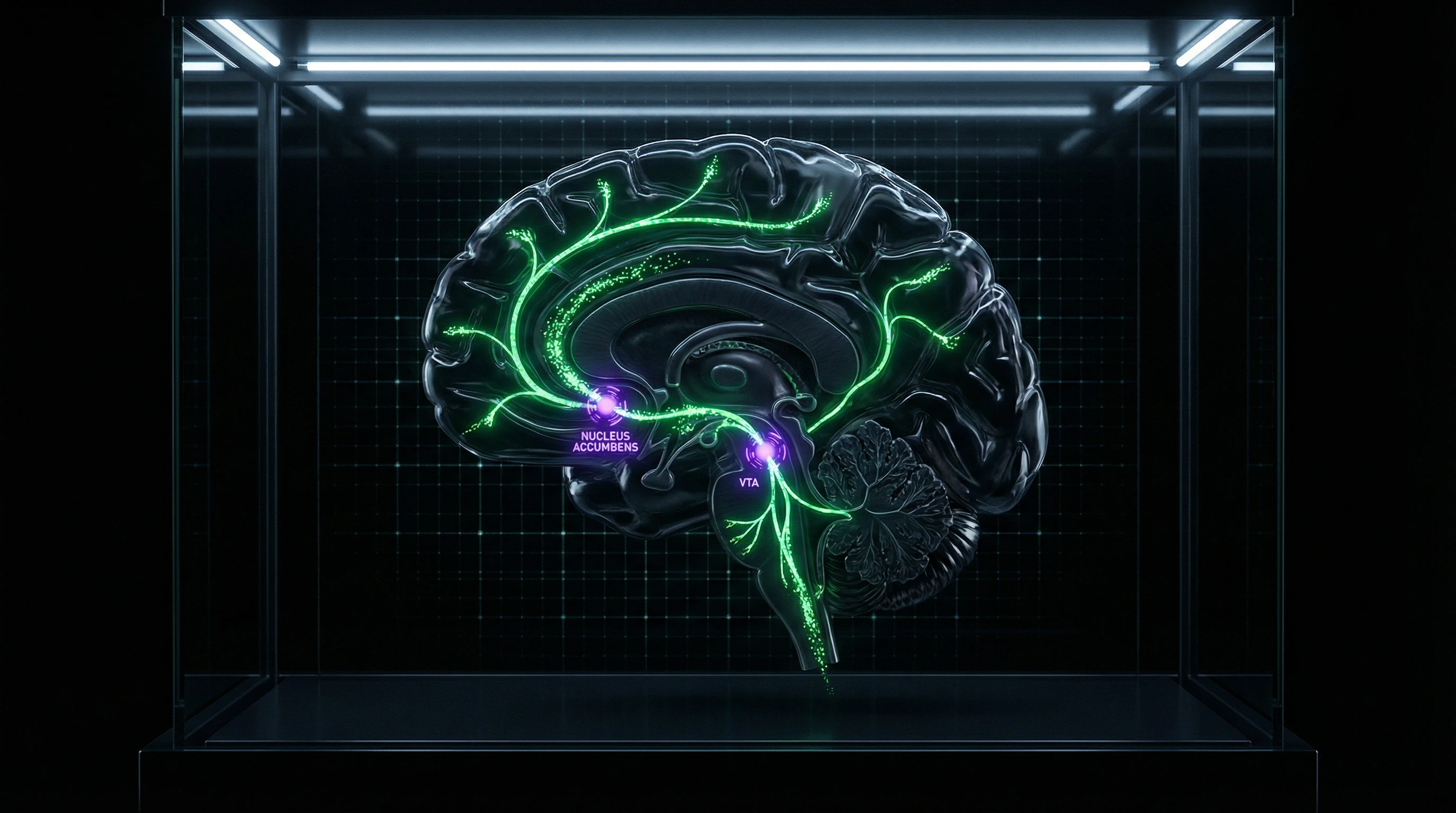
Functional MRI demonstrates that when presented with photographs of a romantic partner, brain regions rich in dopamine receptors activate: the ventral tegmental area (VTA) and nucleus accumbens (S004). These same regions activate during drug use, receiving monetary rewards, eating delicious food — anything the brain perceives as rewarding.
Activation intensity correlates with subjective strength of romantic feelings: the more intensely someone is in love, the brighter dopamine regions "light up" on MRI. This correlation reproduces across different cultures and age groups.
- Activation pattern when viewing a partner is indistinguishable from patterns when receiving other types of rewards
- Mechanism universality points to a common dopamine code
- Correlation between activation and subjective reports of feeling intensity is reproducible
🧬 Argument 2: Pharmacological interventions in the dopamine system alter romantic feelings
The most direct evidence of dopamine's causal role — effects of drugs influencing dopamine transmission. Source (S002) indicates a serotonin-dopamine balance: the higher the serotonin, the lower the dopamine and vice versa.
Patients on SSRIs (selective serotonin reuptake inhibitors) often report emotional flattening, decreased libido, and weakened romantic passion. Drugs that increase dopamine activity (bupropion, dopamine agonists for Parkinson's disease) intensify romantic and sexual impulses, sometimes to pathological levels.
| Drug / intervention | Effect on dopamine | Effect on romantic feelings |
|---|---|---|
| SSRIs (antidepressants) | Decrease | Flattening, reduced passion |
| Bupropion | Increase | Intensified impulses |
| Dopamine agonists | Increase | Hypersexuality (side effect) |
📊 Argument 3: "Dopamine withdrawal" during breakups has clinical signs of withdrawal syndrome
When breaking up, love doesn't disappear instantly. The brain, recently flooded with dopamine, craves familiar sensations (S004). Viewing photographs, listening to "your" music, visiting familiar places — all attempts by the brain to get a dopamine hit.
This behavioral pattern is identical to drug-dependent individuals during abstinence: seeking stimuli associated with reward, intrusive thoughts, compulsive checking of an ex-partner's social media. Dopamine pathways formed in relationships don't vanish instantly — synaptic connections remain active for weeks and months after breakup.
The brain continues to "expect" dopamine reinforcement when encountering triggers linked to the former partner, causing craving and emotional pain.
🔁 Argument 4: Dopamine encodes not just pleasure, but reward anticipation
Modern neuroscience shows that dopamine encodes not so much pleasure itself (that's the opioid system's function), but reward anticipation and motivation to obtain it (S001). This explains why people in love experience intrusive thoughts about their partner: the dopamine system constantly "reminds" the brain of potential reward.
Animal experiments show that dopamine neurons activate not when receiving reward, but when a signal appears predicting reward. In a person in love, any stimulus associated with their partner (message notification sound, familiar scent, meeting place) triggers dopamine release, creating an anticipation-seeking-obtaining cycle.
- Reward anticipation
- The dopamine system activates at signals predicting reward, creating motivation to seek it. In someone in love, this explains intrusive thoughts and "obsession" with their partner.
- Triggers and cycle
- Any stimulus linked to a partner triggers dopamine release, strengthening motivation for contact and creating a self-sustaining cycle.
🧾 Argument 5: Evolutionary conservation of the dopamine system in pair bonding
Research on prairie voles (Microtus ochrogaster) — one of the few monogamous rodent species — shows that pair bonding is regulated by the dopamine system in combination with oxytocin and vasopressin (S006). Blocking dopamine receptors in the nucleus accumbens prevents pair bond formation even after mating.
The evolutionary conservation of this mechanism (it works in rodents, primates, and humans) points to dopamine's fundamental role in pair bonding in mammals. If the mechanism has persisted through tens of millions of years of evolution, this testifies to its critical importance for reproductive success.
Stimulation of dopamine receptors accelerates attachment formation, while their blockade prevents it — even when other conditions for bonding are present.
Evidence Base: What Sources Say About the Neurochemistry of Love — and Where Contradictions Begin
Moving from the steel version of the argument to critical analysis, it's necessary to examine in detail what exactly the available sources claim, what data they provide, and where gaps or contradictions emerge. More details in the Scientific Databases section.
🔬 Three-Phase Model of Love: Different Neurochemistry at Different Stages
Source (S007) presents a model according to which love passes through three distinct phases, each with its own neurochemical basis: lust (testosterone and estrogen), attraction (dopamine-mediated phase of intense romantic feelings), and attachment (long-term bonding with oxytocin, vasopressin, and other systems).
Dopamine dominates only in the second phase — the attraction phase. The first phase is regulated by sex hormones, the third by other neurotransmitter systems. Reducing all love to dopamine conflates different neurobiological processes.
However, source S007 does not provide detailed data on the third phase. It mentions that it "involves other neurotransmitter systems," but which ones specifically and how they interact remains unexplained. This is a typical example of the incompleteness of popularized materials: they describe initial stages well but gloss over long-term mechanisms.
📊 Serotonin-Dopamine Balance: Antidepressants as a Natural Experiment
Source (S002) provides a specific claim: there exists a serotonin-dopamine balance in the brain, where increasing serotonin (through SSRIs) can reduce dopamine activity and the intensity of romantic experiences.
This has clinical confirmation: emotional blunting is a known side effect of SSRIs, affecting 40–60% of patients. People report reduced intensity of both negative and positive emotions, including romantic passion.
If dopamine is all of love, then why don't people on SSRIs lose the ability to love completely? They report reduced intensity of passion, but not complete disappearance of attachment to partners. This indicates that long-term attachment relies on non-dopaminergic mechanisms.
🧬 Multiplicity of Neurotransmitters: What Else Is Active During Falling in Love
Source (S003) directly points to the limitations of the dopamine model: dopamine is not the only chemical substance actively produced during the period of falling in love.
- Dopamine
- motivation, reward, partner-seeking
- Serotonin
- mood, obsessive thoughts about partner (paradoxically, decreases in early stages of falling in love)
- Noradrenaline
- arousal, attention, racing heart when seeing beloved
- Oxytocin
- attachment, trust, released during physical contact
- Vasopressin
- long-term bonding, jealousy, territoriality
- Endorphins
- pleasure, euphoria, pain relief
- Sex hormones
- testosterone and estrogen — sexual desire
- Cortisol
- stress, increases in early stages of falling in love
Each neurotransmitter performs a specific function. The decrease in serotonin in early stages of falling in love is associated with obsessive thoughts about the partner — a pattern similar to obsessive-compulsive disorder. Noradrenaline creates physiological arousal. Oxytocin creates a sense of closeness and trust, independent of dopamine reward.
🧾 Gender Differences: Is the Neurobiology of Love the Same in Men and Women
Source (S002) is devoted to the question of gender differences in the neurobiology of love, but specific data in the available fragment are not presented. This points to an important gap: popular sources often mention gender differences but rarely provide detailed data.
From general neurobiological knowledge, it's known that in women the oxytocin system is more sensitive, while in men the role of vasopressin is more pronounced. The dopamine system works in both sexes but may differ in receptor density. However, without access to primary research, it's impossible to assert how significant these differences are for the subjective experience of love.
🔁 Evolutionary Perspective: Love as an Adaptation for Cooperative Parenting
Source (S005) formulates an evolutionary framework: love is a complex neurobiological phenomenon that emerged in the course of evolution. This perspective is critically important for understanding why the dopamine system is connected to pair bonding at all.
In most mammals, females raise offspring alone. But in species with a long period of offspring dependency, cooperative parenting increases survival. Evolution "repurposed" the ancient dopamine reward system, linking it to a specific partner to motivate prolonged cohabitation.
| Aspect | Mechanism | Function |
|---|---|---|
| Dopamine activates upon seeing partner | Brain "rewards" for maintaining connection | Motivates prolonged cohabitation |
| Dopamine is a tool, not the goal | Reward system subordinated to evolutionary task | Long-term attachment and cooperative parenting |
| Reduction to dopamine ignores context | Popularization oversimplifies multilevel process | Creates illusion of complete explanation |
This explains why the dopamine system activates upon seeing a partner, but also shows that dopamine is one of the mechanisms for achieving long-term attachment, not its essence.
Mechanisms and Causality: Dopamine's Correlation with Love Doesn't Prove Dopamine Creates Love
The central problem with the dopamine theory of love is the conflation of correlation and causality. Dopamine-rich brain regions activate when viewing a loved one, and drugs affecting dopamine alter the intensity of romantic feelings. For more details, see the Physics section.
But does this mean dopamine creates love, or does it merely accompany it, being one of many components in a complex process (S001)?
🧩 The Problem of Reductionism: Why "Love = Dopamine" Is a Category Error
The claim "love is dopamine" commits a category error by conflating levels of description. Love is a subjective experience encompassing emotions, thoughts, motivations, behavior, and social interactions.
Dopamine is a molecule that transmits signals between neurons. These are different levels of analysis: psychological, social, and molecular (S002).
Finding dopamine in an active brain region during love is not an explanation of love. It's like saying a symphony is created by air vibrations. Air vibrations are necessary, but they don't explain the composition, performance, or listener's perception.
Causality vs. Correlation: Three Scenarios for One Observation
When we observe dopamine levels rising during love, three interpretations are possible:
- Dopamine causes love (one-way causality)
- Love causes dopamine release (reverse causality)
- A third factor (e.g., social recognition, security, attachment styles) causes both love and dopamine simultaneously
Neurobiology cannot distinguish between these scenarios based on correlation alone (S003). Blocking dopamine may weaken motivation to seek a partner, but this doesn't mean dopamine is love itself.
| Level of Description | What We Observe | What This Explains | What This Does NOT Explain |
|---|---|---|---|
| Molecular (dopamine) | D2 receptor activation in nucleus accumbens | Motivational component, reward-seeking | Why this specific person and not another; fidelity; self-sacrifice |
| Systems (brain) | Synchronization of prefrontal cortex and limbic system | Integration of emotions and rational choice | Cultural differences in love expression; long-term commitment |
| Psychological | Subjective experience of attachment and desire | Phenomenology of love | Neurochemical mechanisms |
| Social | Pair bonding, reproductive behavior, offspring care | Evolutionary function | Individual differences in emotional intensity |
Each level has its own logic and cannot be reduced to the level below. Dopamine is necessary but insufficient (S004).
The Paradox: Why People with Dopamine Deficiency Still Love
Patients with Parkinson's disease (degeneration of dopaminergic neurons) experience reduced motivation and pleasure, but don't lose the capacity to love. They may be apathetic, but attachment to loved ones persists (S005).
This indicates that dopamine modulates the intensity and motivational component of love, but is not its substrate. Love can exist without dopamine "fuel," albeit in a weakened form.
- Reductionism
- Explaining a complex phenomenon through a single component at a lower level. The trap: it seems scientific but loses the essence of the phenomenon.
- Necessary Condition vs. Sufficient Condition
- Dopamine is a necessary condition for full-fledged love (without it, love weakens), but not sufficient (its presence doesn't guarantee love). Confusing the two is the basis of the error.
- Levels of Description
- Molecule, neuron, system, psyche, society—each level has its own laws. Explanation at one level doesn't negate explanation at another.
Conclusion: dopamine is a tool, not the architect of love. It amplifies motivation, reward, and desire, but love itself is an integrative process involving oxytocin, vasopressin, cortisol, the prefrontal cortex, amygdala, hippocampus, and social context (S006), (S007).