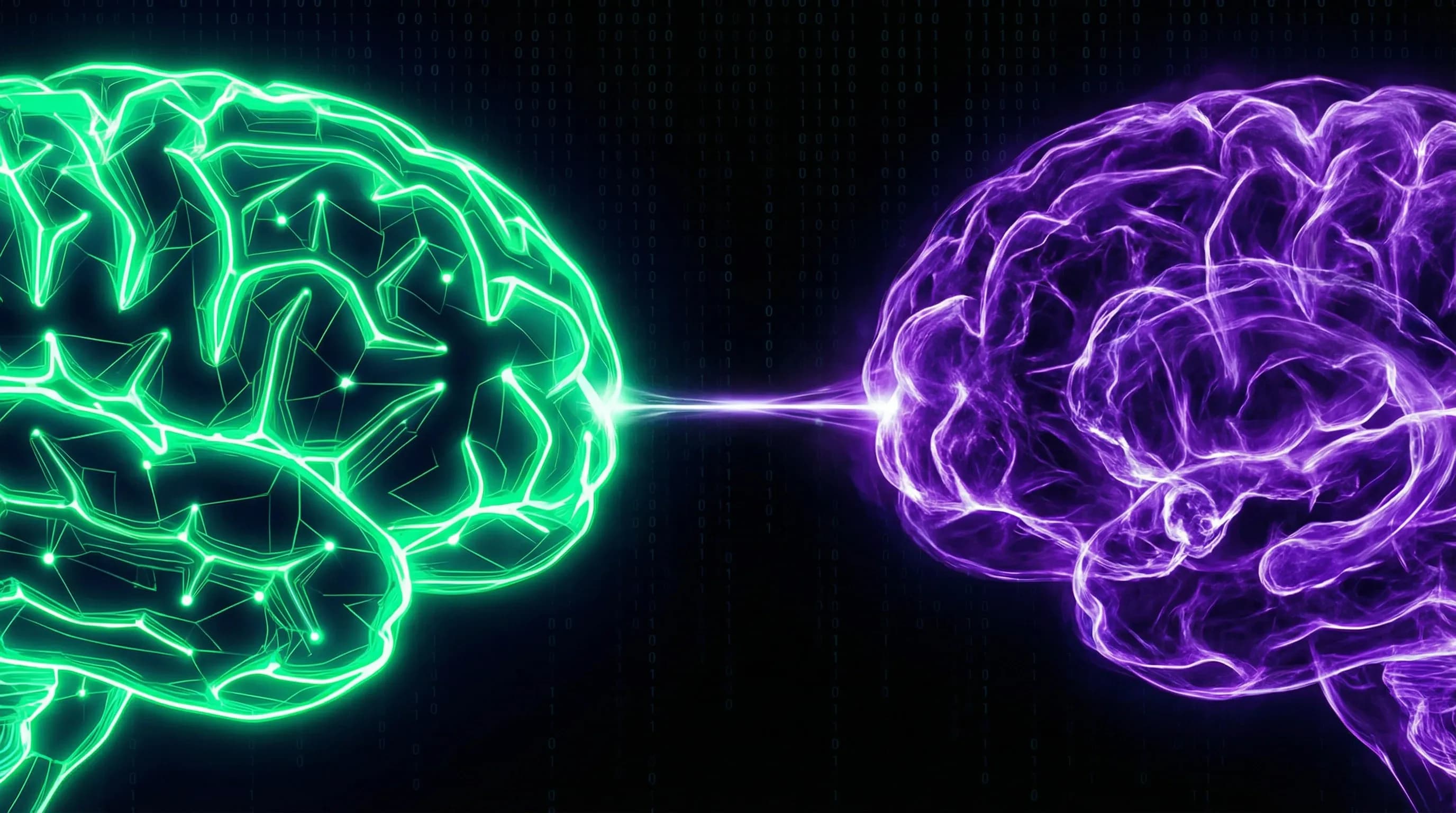
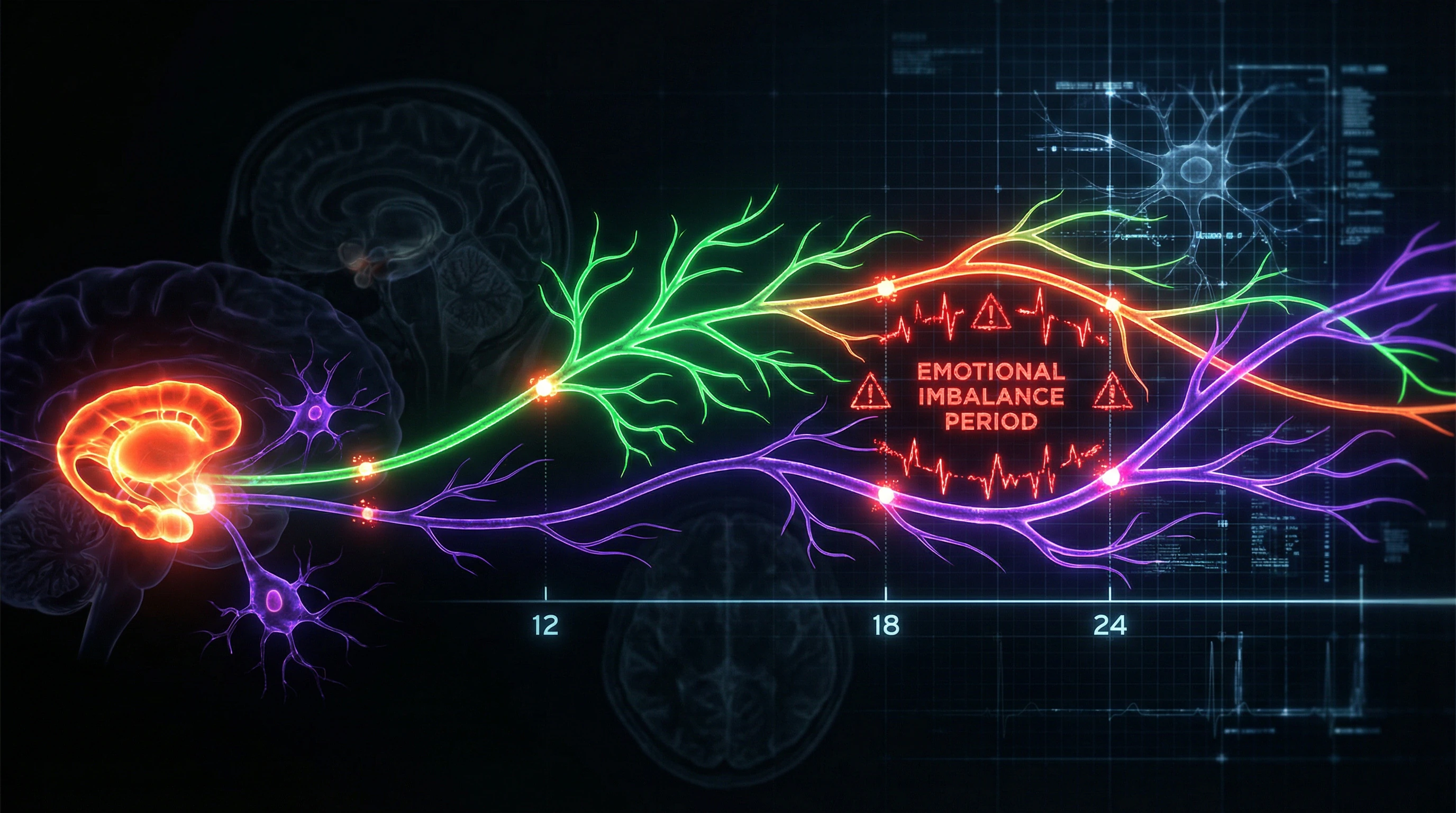
The prefrontal cortex (PFC) — the last brain region to reach maturity — controls impulse regulation, planning, and emotional control. Its development continues until age 25-30, passing through critical periods when experience shapes neural circuits permanently. This explains why early relationships are often impulsive and emotionally unstable: the amygdala (emotion center) matures before the PFC, creating an imbalance between feelings and control. Mature love requires a fully functional prefrontal cortex — the ability to see a partner realistically, manage conflict, and build long-term plans.
🖤 Have you ever wondered why relationships in your 20s feel like a roller coaster, while after 30 they feel like a conscious choice? Why first love seems all-consuming but rarely survives the test of time? The answer lies not in romantic clichés about "maturing souls," but in cold neurobiology: your brain is physically incapable of mature love until the prefrontal cortex completes its development. And that only happens around age 25-30.
What is the Prefrontal Cortex and Why It's Last in Line to Mature — A Neurobiological Map of Delayed Maturity
The prefrontal cortex (PFC) is the anterior part of the frontal lobes, located directly behind the forehead. It is responsible for planning, impulse control, risk assessment, emotional regulation, and anticipating consequences (S001, S006).
The PFC takes the longest to develop: its maturation is a gradual process that continues until age 25–30 and can extend to 35 years, passing through critical periods of plasticity when neural circuits are shaped by experience (S001, S006).
- Executive Functions
- The ability to plan, suppress impulses, assess risks — all of this requires the PFC. Without its maturity, a person acts under the influence of emotions rather than calculation.
- Critical Period
- A window of plasticity when relationship experiences literally rewire neural circuits. Trauma or healthy experience at age 20 leaves long-term traces.
🧠 Anatomy of Delayed Maturation: Why the PFC Develops Last
Brain development follows evolutionary logic: survival structures mature first (brainstem, basal ganglia), then emotional centers (amygdala, limbic system), and only last — areas of complex planning and self-control (S006).
The amygdala reaches functional maturity by ages 15–17, but its interaction with the PFC continues to develop until ages 25–30 (S008). This creates a critical imbalance: an adolescent possesses a fully functional emotional response system but an underdeveloped control system.
The young brain is a powerful engine without brakes. The amygdala screams, the PFC stays silent.
🔬 Parvalbumin Interneurons: Molecular Clocks of PFC Maturity
Parvalbumin interneurons are specialized inhibitory neurons that regulate the activity of neural networks (S001). They require specific neural activity during a postnatal sensitive period to achieve mature function.
If neural activity is disrupted during the critical developmental window (late adolescence and early adulthood), PFC function remains impaired for life (S001). Early experience — including first romantic relationships — literally shapes the neural architecture that determines the capacity for mature love.
| Brain Structure | Maturation Age | Function |
|---|---|---|
| Brainstem | Childhood | Survival, breathing, reflexes |
| Amygdala | 15–17 years | Emotions, threat, response |
| PFC | 25–35 years | Planning, control, foresight |
⚙️ Critical Periods: Windows of Opportunity and Vulnerability
Critical (sensitive) periods are temporal windows when the nervous system is especially plastic and receptive to external influences (S006). For the PFC, this period extends from late adolescence to the mid-third decade of life.
During this time, relationship experiences — positive or traumatic — leave long-term traces in neural circuits. Toxic relationships at age 20 can program dysfunctional patterns of emotional regulation, while healthy experience promotes the formation of mature attachment mechanisms (S006).
- Window of plasticity: late adolescence — 30 years
- Experience during this period: shapes neural architecture for life
- Trauma during critical period: can lock in dysfunction
- Healthy experience: strengthens mechanisms of self-regulation and attachment
The connection between attachment styles and neurobiology shows how childhood and adolescent experience reprograms the brain. This is not a sentence — it's a map you can navigate by.
Five Rock-Solid Arguments That Early Love Is Neurobiological Immaturity, Not Romantic Destiny
Before examining the evidence, it's necessary to present the most compelling arguments from proponents of the idea that the capacity for mature love truly depends on the completion of PFC development. This is not a straw man, but a steel structure built on five load-bearing beams. For more details, see the Systematic Reviews and Meta-Analyses section.
🎯 Argument One: Evolutionary Logic of Asynchronous Maturation
Evolution doesn't create random delays. If the PFC matures last, this means that early reproductive activity (which in Homo sapiens historically began during adolescence) didn't require complex planning and emotional control (S006). Strong emotional reactions (amygdala) and basic social skills were sufficient.
Mature love—with its demands for long-term planning, compromise, and conflict management—is an evolutionarily novel challenge that emerged with increased lifespan and more complex social structures. The PFC develops slowly precisely because its functions weren't critical for early reproductive success.
Early love is not destiny, but a byproduct of the brain's evolutionary architecture, optimized for survival rather than partnership.
🎯 Argument Two: Clinical Data on Adolescent Impulsivity
Adolescents and young adults demonstrate significantly higher rates of impulsive behavior, risky decisions, and emotional instability compared to people over 25 (S006). This manifests not only in relationships, but also in financial decisions, career choices, and substance use.
All these domains require PFC functions—and all show dramatic improvement after its maturation is complete. The age of 25 is used in the insurance industry as a risk-reduction threshold for good reason.
| Decision Domain | Peak Impulsivity | Stabilization | PFC Function |
|---|---|---|---|
| Partner Selection | 16–22 years | 25–30 years | Long-term planning, realistic assessment |
| Financial Decisions | 18–24 years | 26–32 years | Risk assessment, delayed gratification |
| Conflict Management | 15–23 years | 25–28 years | Emotional regulation, perspective-taking |
| Risk-Taking Behavior | 17–25 years | 27–35 years | Consequence evaluation, inhibition |
🎯 Argument Three: Neuroimaging Studies Show Structural Changes Until 25–30 Years
MRI studies consistently demonstrate that gray matter volume in the PFC continues to change until the mid-third decade of life, while myelination (the process of insulating neural pathways, which speeds signal transmission) completes even later (S001), (S006). These aren't abstract changes—this is physical reorganization of neural networks that directly affects the speed and quality of decision-making, including decisions in relationships.
🎯 Argument Four: Critical Periods for Parvalbumin Interneurons
Experimental data from animal models show that disruption of parvalbumin interneuron activity during critical periods leads to long-term deficits in PFC function that aren't compensated for in adulthood (S001). If we extrapolate these findings to humans, this means that relationship experiences during the 18–25 period literally shape the neural infrastructure for future capacity for mature love.
Early toxic relationships can create deficits that will require active therapeutic work to compensate. This isn't a life sentence—it's a mechanism that can be understood and changed. For more on how childhood experiences reprogram the brain, see the article on the neurobiology of attachment styles.
🎯 Argument Five: The Phenomenology of "Growing Up" in Relationships
The subjective experience of millions of people confirms it: relationships after 25–30 are qualitatively different from earlier ones. The ability emerges to see a partner realistically (rather than through the lens of idealization or projection), to manage conflicts without emotional explosions, to plan a shared future accounting for real constraints.
This isn't just "life experience"—it's the result of completed neurobiological maturation of control and planning systems. The distinction between limerence and mature love becomes tangible precisely at this age.
- Partner Idealization (before 25)
- The amygdala dominates; the PFC can't effectively process contradictory information. Result: we see what we want to see, ignoring red flags.
- Realistic Perception (after 25)
- The PFC integrates emotional signals with factual information. Result: we see the partner whole, including flaws, and consciously choose to stay or leave.
- Conflict Management (before 25)
- Emotional reactivity; no distance between feeling and action. Result: arguments escalate to breakups, reconciliations to tears.
- Constructive Resolution (after 25)
- The PFC allows pausing the emotion, seeing the partner's position, finding compromise. Result: conflicts become tools for connection rather than destruction.
Evidence Base: What Research Says About the PFC-Mature Relationship Connection — A Molecular and Synaptic Breakdown
Let's move from arguments to facts. Every claim about the link between PFC development and the capacity for mature love must be grounded in specific research, not pop psychology. For more details, see the Climate and Geology section.
📊 Critical Periods of Nervous System Development: Windows of Vulnerability and Opportunity
A foundational review systematized data on critical periods of nervous system development (S006). The prefrontal cortex undergoes an extended period of heightened plasticity, beginning in adolescence and continuing into the mid-twenties.
During this period, neural circuits are especially sensitive to experience: positive (forming adaptive patterns) and negative (creating long-term dysfunctions). Relationship experiences between ages 18–25 have a disproportionately large impact on shaping the neural architecture that determines future capacity for emotional regulation and long-term planning in partnerships.
The quality of emotional experience during ages 18–25 literally programs the neural mechanisms that will determine the capacity for emotional regulation in future partnerships.
📊 Parvalbumin Interneurons: Molecular Gatekeepers of PFC Maturity
Research published in eLife demonstrated that mature function of parvalbumin interneurons in the prefrontal cortex requires specific neural activity during a postnatal sensitive period (S001). Using optogenetic methods in mouse models, researchers showed that suppressing the activity of these interneurons during the critical developmental window leads to long-term deficits in PFC function that persist into adulthood even after normal activity is restored.
The editorial assessment emphasizes the significance of this discovery for understanding how early experience shapes the neural circuits underlying executive functions.
📊 Distributed Emotion Networks: Why Love Isn't Just the Amygdala
A meta-analytic review published in Behavioral and Brain Sciences analyzed hundreds of neuroimaging studies of emotions (S008). The conclusion: emotional states arise from distributed brain networks, not isolated "emotion centers."
While the amygdala plays an important role in processing emotionally salient stimuli (especially threats), mature emotional regulation requires integration between the amygdala and prefrontal cortex (S008). This explains why early relationships are characterized by intense emotional reactions without adequate control: the "gas" system is running at full throttle while the "brakes" system is still under construction.
| Component | Maturation Age | Function in Relationships |
|---|---|---|
| Amygdala | ~15 years | Emotional intensity, partner idealization |
| Prefrontal cortex | ~25 years | Impulse control, long-term planning |
| Network integration | ~25+ years | Mature emotional regulation |
📊 Molecular Mechanisms of Plasticity: How Experience Changes the Brain
Research published in the journal Neuron reveals the role of m6A RNA methylation in regulating stress responses and neural plasticity (S010). This epigenetic mechanism allows experience (including relationship experience) to literally alter gene expression in neurons, creating long-term changes in neural circuit function.
In the context of PFC development, this means: emotional experience during critical periods doesn't just "influence" the brain—it physically reprograms the molecular mechanisms that determine how neurons will respond to future stresses and emotional challenges (S010). Toxic relationships at 20 can create epigenetic "scars" that will affect emotional regulation decades later.
📊 Astrocytes: Underestimated Players in Neural Maturity
A review in Acta Neuropathologica emphasizes that astrocytes—star-shaped glial cells—play a far more active role in brain function than previously thought (S003). They regulate synaptic transmission, support neuronal metabolism, and participate in forming neural circuits.
Astrocyte maturation in the prefrontal cortex occurs in parallel with neuronal maturation and also continues into the mid-twenties. This adds another layer of complexity: the PFC matures not simply through neuronal growth, but through the formation of a complex ecosystem of supporting cells.
- Critical developmental period
- A window of heightened neural circuit plasticity when experience has maximum impact on brain formation. For the PFC, this is ages 15–25.
- Epigenetic changes
- Molecular modifications to DNA and RNA that alter gene expression without changing the sequence itself. Relationship experience can create long-term epigenetic "scars."
- Network integration
- The process by which different brain regions (amygdala, PFC, hippocampus) begin working as a unified system. This is the foundation of mature emotional regulation.
The connection between PFC development and the capacity for mature relationships rests on specific molecular and cellular mechanisms, not popular assumptions. Research shows: this isn't a matter of willpower or experience, but of neurobiological maturation that requires time and favorable conditions.
For a deeper understanding of how early experience programs the brain, see the neurobiology of attachment styles and the distinction between limerence and love.
Mechanisms of Causality: Why an Immature PFC Makes Mature Love Impossible — From Synapses to Behavior
The correlation between PFC maturation age and capacity for mature relationships is evident. But what exactly about an immature PFC makes mature love impossible? Let's examine the causal chains. More details in the Chemistry section.
🔁 Inhibitory Control Deficit: Why Young Relationships Are Emotionally Explosive
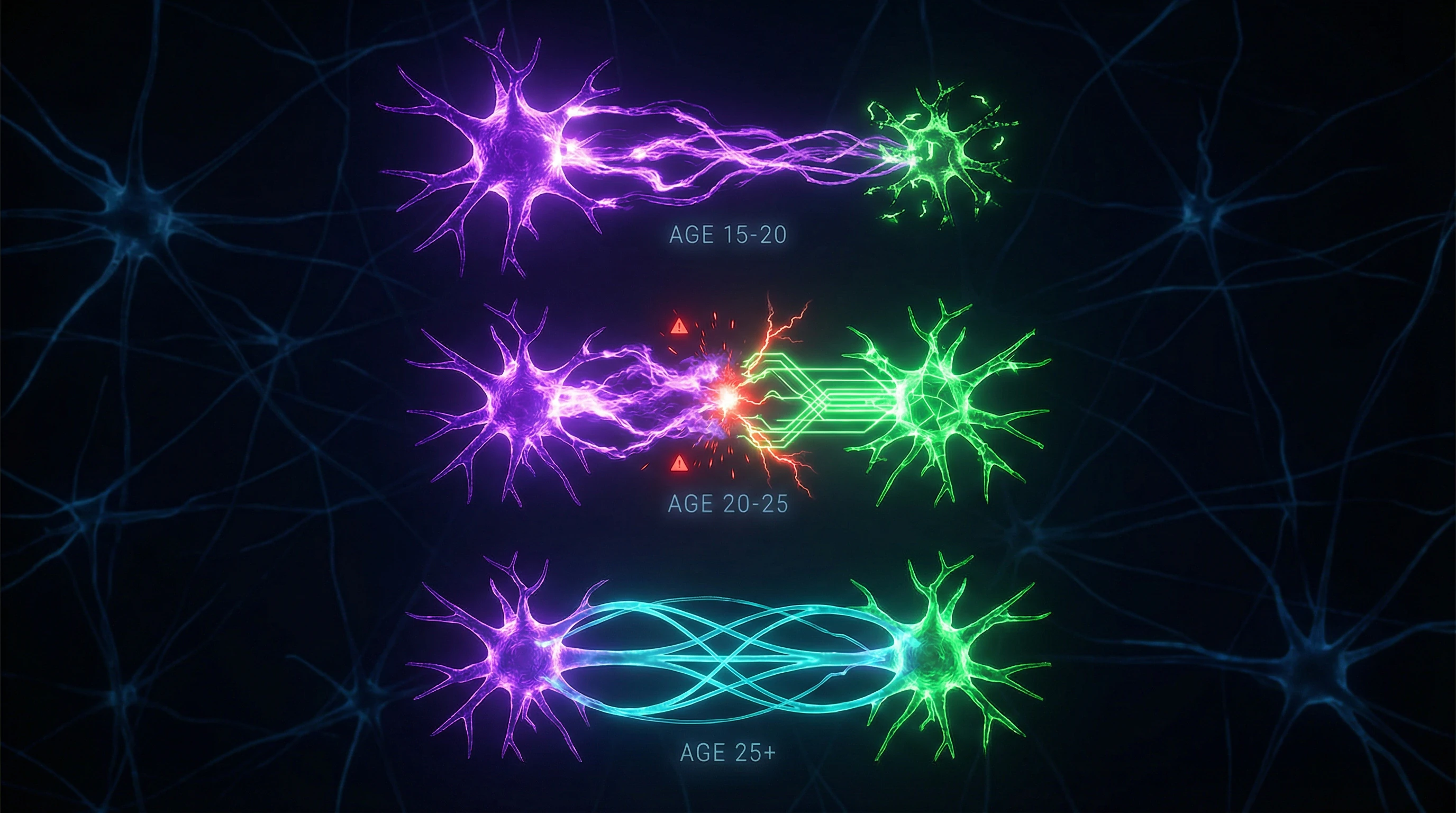
Parvalbumin interneurons, which mature in the PFC last, provide inhibitory control over excitatory neurons (S001). When these interneurons aren't yet fully functional, PFC neural networks are prone to excessive activation — they "overheat" under emotional signals from the amygdala (S001, S008).
In behavioral terms, this manifests as inability to "stop and think" during emotional conflict. A young person with an immature PFC physically cannot activate inhibitory mechanisms fast enough to prevent impulsive reactions — whether an angry outburst, rash breakup decision, or hasty reconciliation without addressing core issues.
Immature PFC = absence not of emotions, but of ability to modulate them. The amygdala screams, the prefrontal cortex stays silent.
🔁 Long-Term Planning Deficit: Why "Forever" at 20 and 30 Are Different Things
The ventromedial prefrontal cortex (vmPFC), part of the PFC, specializes in evaluating long-term consequences of decisions and integrating emotional information into planning (S004). Research shows this area continues developing and optimizing its computational strategies into the mid-third decade (S004).
An immature vmPFC means a young person literally cannot accurately simulate a long-term future with a partner — their brain lacks the computational power for this task. A promise of "forever" at 20 is based on emotional intensity of the present moment, not realistic assessment of compatibility over 10-20-30 years.
- Computational Immaturity of vmPFC
- Inability to model long-term relationship scenarios; decisions made based on current emotional state rather than forecasting.
- Behavioral Consequence
- Marriages at 20 often dissolve when reality doesn't match the emotional fantasy that was the only available "model" at decision time.
🔁 Imbalance Between Emotional Reactivity and Regulation
The key problem during ages 18-25 isn't absence of emotions (the amygdala works fine), but absence of adequate regulation of those emotions (the PFC is still under construction) (S008). Meta-analysis shows mature emotional regulation requires coordinated work of distributed networks including both limbic structures and prefrontal areas (S003).
When the PFC is immature, this coordination is disrupted: emotional signals from the amygdala dominate, while the PFC's modulating influence is insufficient. In relationships, this manifests as "emotional roller coasters": from euphoria of infatuation to despair at the slightest conflict, without ability to maintain stable, realistic perception of partner and relationship.
| Age / PFC State | Emotional Reactivity | Regulatory Capacity | Relationship Outcome |
|---|---|---|---|
| 18–22 years (immature PFC) | High, unstable | Low, fragmented | Roller coasters, impulsive decisions, instability |
| 25–30 years (maturing PFC) | High but modulatable | Growing, more consistent | Conflicts resolved, partner perceived more realistically |
| 30+ years (mature PFC) | Context-appropriate | Developed, flexible | Stability, long-term planning, compromise |
🔁 Critical Periods and "Imprinting" of Dysfunctional Patterns
The most alarming aspect of PFC immaturity is that relationship experience during the critical period can create long-term dysfunctional patterns (S001, S006). If during the period of maximum PFC plasticity (18-25 years) a person is in toxic relationships, their neural circuits literally "learn" dysfunctional strategies for emotional regulation and conflict management.
This explains why people often repeat the same relationship mistakes: their brain was "programmed" for these patterns during a critical developmental period. The connection to neurobiology of attachment styles is direct here — dysfunctional patterns learned at 20 become the brain's basic operating system for decades.
- A young person at 20 enters a relationship with a narcissist or emotionally unstable partner.
- Their immature PFC cannot adequately assess the situation or establish boundaries.
- Neural circuits learn: conflict → suppression of own needs → temporary relief → repetition.
- These patterns become reinforced at the molecular level through synaptic plasticity.
- At 35, the person repeats the same dynamic with a new partner, even though their PFC is now mature — because the pattern was "written" during the critical period.
The critical period of PFC development isn't just a window of opportunity. It's a window of vulnerability. Experience during this period can leave lifelong scars.
The connection to neurobiology of breakups shows that even relationship dissolution at a young age activates the same pain systems as death of a loved one, but without adequate prefrontal regulation — which compounds the trauma and reinforces dysfunctional patterns.
Data Conflicts and Zones of Uncertainty: Where the Science of the PFC and Love Acknowledges Its Limitations
Honesty requires acknowledging: the link between PFC maturation and the capacity for mature love is not an iron law, but a scientific hypothesis with substantial zones of uncertainty. More details in the Epistemology section.
🧩 The Problem of Transferring Data from Animal Models to Humans
Most detailed studies of critical periods in PFC development have been conducted on rodents (S001). While basic principles of neural development are conserved across mammals, direct transfer of temporal windows and mechanisms from mice to humans is problematic.
The human PFC is significantly larger and more complex than that of rodents, and its critical periods may have different temporal structures and sensitivity to experience (S006). The claim that "the PFC matures by age 25" is based on averaging population data, not on a universal biological marker.
| Data Source | Limitation | Implication for Conclusions |
|---|---|---|
| Animal models (rodents) | Different brain architecture, different developmental timelines | Temporal windows may not align with human ones |
| Neuroimaging (fMRI, PET) | Measures activity, not functional maturity | Activity ≠ capacity for mature behavior |
| Cross-sectional studies | Snapshot at one point in time, without individual trajectory | Group trends obscure within-age variability |
🔄 Brain Activity ≠ Functional Maturity
Neuroimaging shows where and when the PFC activates, but does not prove that this activity enables mature love (S003). An adolescent may display activation patterns similar to adults, yet still make impulsive decisions in relationships.
The reverse is also true: a person over 25 with PFC damage may retain the capacity for attachment despite structural impairment. Activity is a signal, not a guarantee.
📊 Individual Variability Hidden Behind Group Averages
Studies often work with averaged data: "on average, the PFC matures by age 25." But within this group, the variation is enormous. Some people show signs of mature decision-making at 18, others not even at 35.
Genetics, early attachment experience, trauma, education, and social environment create individual developmental trajectories that don't fit into a single timeline.
🔗 Circularity in Definitions
There's a risk of circular reasoning: we define "mature love" as a capacity that requires a developed PFC, then use the presence of mature love as proof of PFC development. This is a logical circle, not causation.
Cultural and social factors (partner expectations, family relationship models, economic stability) may explain differences in relationship behavior better than neurobiology. The psychology of belief often overestimates biological factors.
⚡ What Remains Unclear
- Is there a critical period for developing the capacity for mature love, or is it a continuum without clear boundaries?
- Can experience (therapy, education, healthy relationships) accelerate or compensate for delayed PFC development?
- How much does neurobiology explain partner choice and relationship quality compared to psychology, culture, and chance?
- Why do some people with signs of immature PFC build stable relationships, while others with developed PFC do not?
The science of the PFC and love is not a completed map, but a sketch with gaps. A useful sketch, but not an instruction manual.
Counter-Position Analysis
⚖️ Critical Counterpoint
The article relies on real neurobiological data, but makes several logical leaps that are worth examining. Here's where the argumentation may be vulnerable.
Overestimation of Age's Role
The article emphasizes the biological maturation of the prefrontal cortex by ages 25–30, but this may create the impression that mature relationships are impossible before this age and guaranteed after. Individual variability is enormous: some 20-year-olds demonstrate high emotional maturity through experience and practice, while some 40-year-olds remain impulsive due to deficient development during critical periods. Biological age is just one factor among many (experience, culture, mindfulness, therapy).
Brain = Behavior Reductionism
The article may create the impression that relationship quality is determined by neurobiology, which ignores the social, cultural, and existential dimensions of love. Explaining the mechanism (how the prefrontal cortex works) does not explain the meaning (why people choose to love, forgive, sacrifice). Mature love is not only a brain function, but also an ethical choice, a practice, a skill that can be developed independently of the biological substrate.
Insufficient Direct Evidence of PFC and Romantic Relationships Connection
Most sources study general prefrontal cortex functions (impulse control, working memory, stress response), but not romantic relationships directly. The connection between PFC maturation and love quality is a plausible extrapolation, but not proven by direct research. Longitudinal studies are needed that track PFC development and relationship quality in the same individuals over decades.
Ignoring Adaptive Functions of Young Love
The article focuses on the risks of impulsivity, but young passionate love has evolutionary advantages: it motivates exploration, pair formation, learning through mistakes. Early intense attachments could have been beneficial for reproduction. Critics might argue that mature love may be too rational, lacking the spontaneity and risk that make relationships alive.
Risk of Fatalistic Thinking
If a reader interprets the article as "my brain is underdeveloped, so I can't love maturely," this can become a self-fulfilling prophecy. Neuroplasticity means that changes are possible at any age, but the article may not sufficiently emphasize agency and responsibility. The brain is not a sentence, but a starting point.
FAQ
Frequently Asked Questions

Author of the Cognitive Immunology Hub project. Researches mechanisms of disinformation, pseudoscience, and cognitive biases. All materials are based on peer-reviewed sources.