What are pair bonds and why are they so rare among mammals — evolutionary anomaly or adaptive advantage
Pair bonding refers to stable, selective attachments between sexual partners, often leading to cooperative offspring rearing (S003). Biologists only began systematically studying this phenomenon in the 1940s.
This form of social organization occurs in less than 5% of all mammalian species, making it an evolutionary rarity (S001).
- Pair Bond
- A selective attachment between partners, often accompanied by cooperative parenting and potentially lifelong relationships. It's important to understand this isn't simply sexual attraction, but a complex social structure.
- Romantic Love
- Intense attraction between partners — one of the most powerful forces driving human social behavior. Often precedes the formation of stable attachments (S001).
🧬 Biological definition and criteria for pair bonds
The formation of stable relationships between adult partners is linked to both physical and psychological health (S001). This isn't merely a cultural phenomenon — such sociosexual attachments occur in virtually all human societies, regardless of subsistence strategy (pastoralism, agriculture) or mating system (polygamy, monogamy) (S001).
Due to the inherent complexity of pair bonds and their relative rarity in other mammalian species, we know surprisingly little about their neurobiological basis (S001).
⚠️ Why most mammals don't form pair bonds
The evolutionary rarity of pair bonds relates to reproductive strategies. For most mammalian species, a promiscuous mating system is more advantageous: males maximize offspring numbers through multiple matings, females select genetically superior partners.
| Mating Strategy | Male Advantage | Female Advantage | Frequency in Mammals |
|---|---|---|---|
| Promiscuity | Maximum offspring | Selection of best genes | Most species |
| Pair Bonding | Investment in offspring | Support in rearing | < 5% of species |
🔬 Prairie voles as a model organism for studying love
Early field studies showed that prairie voles form long-term bonds: pairs of males and females were repeatedly captured together in the wild (S001). Adaptation to a harsh habitat with limited food sources and scarce water supplies may have promoted the evolution of a socially monogamous life strategy in this species (S001).
Prairie voles became a key model organism for neurobiological research on pair bonding precisely because their behavior is amenable to laboratory study and replication. This allowed scientists to begin dissecting the mechanisms underlying what we call love. For more on how early experience shapes attachment capacity, see the neurobiology of attachment styles.
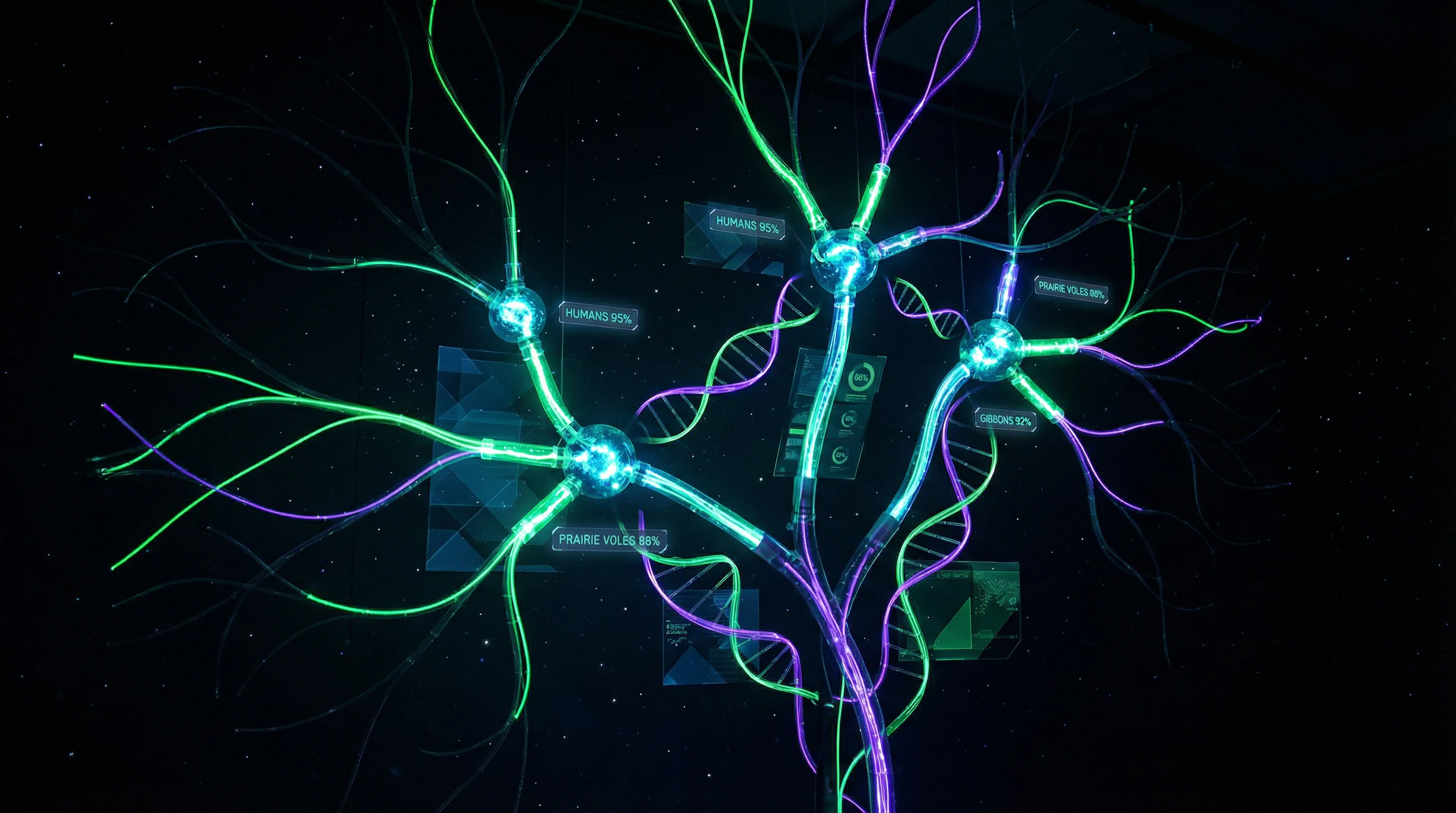
Seven Most Compelling Arguments for the Oxytocin Theory of Love — Why Scientists Believed in the "Bonding Hormone" for Three Decades
For more than thirty years, oxytocin was considered the key neurochemical mechanism underlying pair bond formation. This theory was supported by extensive experimental data obtained from studies on prairie voles and other species. More details in the section Theory of Relativity.
🔬 Correlation Between Oxytocin Receptor Levels and Monogamous Behavior
Monogamous vole species (prairie and montane) show significantly higher density of oxytocin receptors in specific brain regions compared to promiscuous species (S001). This correlation seemed like compelling evidence of a causal relationship between the oxytocin system and the ability to form pair bonds.
📊 Experimental Blocking of Oxytocin Receptors Disrupted Bond Formation
When researchers administered oxytocin receptor antagonists to prairie voles — substances that block oxytocin's action — the animals stopped forming partner preferences after mating (S003). This experimental intervention directly demonstrated the necessity of oxytocin for pair bond formation.
🧬 Oxytocin Administration Accelerated Attachment Formation
Oxytocin injections accelerated pair bond formation in prairie voles, allowing them to develop partner preferences even without mating or with reduced contact time (S001). This reinforced the notion of oxytocin as a sufficient condition for attachment formation.
- Oxytocin is activated during mating and social contact
- Neuroimaging shows activation of oxytocin-producing neurons in the hypothalamus (S002)
- Temporal correlation between social behavior and oxytocin system activity supported the hypothesis of its central role
🔁 Parallels with Maternal Behavior and Social Recognition
Oxytocin was already well known for its role in maternal behavior, childbirth, and lactation (S002). It was logical to assume that evolution could have co-opted the same neurochemical system for forming other types of social bonds, including pair bonds between adult individuals.
If oxytocin works for mother and infant, why wouldn't it work for partners? This logic seemed irrefutable — and that's precisely why the theory lasted three decades.
💊 Translational Potential for Human Relationships
Human studies showed that intranasal oxytocin administration could enhance trust, empathy, and social interaction (S005). This created an attractive prospect of using oxytocin for treating social interaction disorders and strengthening romantic relationships.
Such translational potential further stimulated research in this area and attracted funding.
🧾 Consistency of Results Across Multiple Laboratories
The oxytocin theory of pair bonding was confirmed by independent studies in various laboratories worldwide (S006). This gave it additional scientific credibility and made it the dominant paradigm in the neurobiology of social bonds.
Each argument individually appeared convincing. Together they created an impression of irrefutable consensus — until genetics showed that the consensus was built on an incomplete picture.
The 2023 Revolution: How Genetically Modified Voles Without Oxytocin Receptors Shattered Established Theory
In January 2023, a team of scientists used CRISPR to create prairie voles with completely nonfunctional oxytocin receptors (S009). The result was shocking: without oxytocin, the animals continued to form stable pair bonds and demonstrate monogamous behavior.
This discovery demolished a thirty-year consensus that oxytocin is a necessary condition for attachment. If the system can work without it, we've misunderstood the mechanism. More details in the Scientific Databases section.
🧪 Methodology: From Pharmacology to Genetics
Researchers chose CRISPR-Cas9 instead of pharmacological blocking. This is critical: drugs may act incompletely or trigger compensatory mechanisms. Complete gene knockout eliminates both problems.
Genetically modified voles were compared with wild types in standardized tests: time with partner versus stranger, aggression toward outsiders, and other pair bond markers.
📊 Results: Pair Bonds Without Oxytocin
| Parameter | Voles Without Oxytocin Receptors | Control Group (Wild Type) |
|---|---|---|
| Partner preference (females) | Statistically indistinguishable | Normal |
| Selective attachment formation (males) | Preserved | Normal |
| Some aspects of social behavior | Altered | Normal |
Genetically modified females showed indistinguishable partner preference scores. Males retained the ability for selective attachment, though some social behaviors changed (S009).
🧬 Compensatory Systems: Vasopressin and Parallel Pathways
Without oxytocin, other neurochemical systems activated. The leading candidate is vasopressin, structurally similar to oxytocin and binding to similar receptors.
Oxytocin may not be the initiator of attachment, but a modulator—a substance that amplifies the process but doesn't trigger it from scratch.
Mutations in vasopressin receptors are known to block stable pair bond formation in males (S004). It's logical to assume vasopressin can compensate for oxytocin's absence, but not completely—hence the changes in social behavior.
⚠️ Rethinking Causality
The 2023 study overturns our understanding of oxytocin's role. It's not an initiator but a modulator—an amplifier or facilitator of the process, but not its absolute requirement.
This distinction is critical. If the system can work without oxytocin, other pathways to attachment exist. The brain creates pair bonds through multiple parallel systems, not through a single hormonal switch. Oxytocin is one tool, but not the only one.
The result points to a more complex architecture: long-term relationships are sustained not by one mechanism, but by a network of interacting systems that can compensate for each other when necessary.
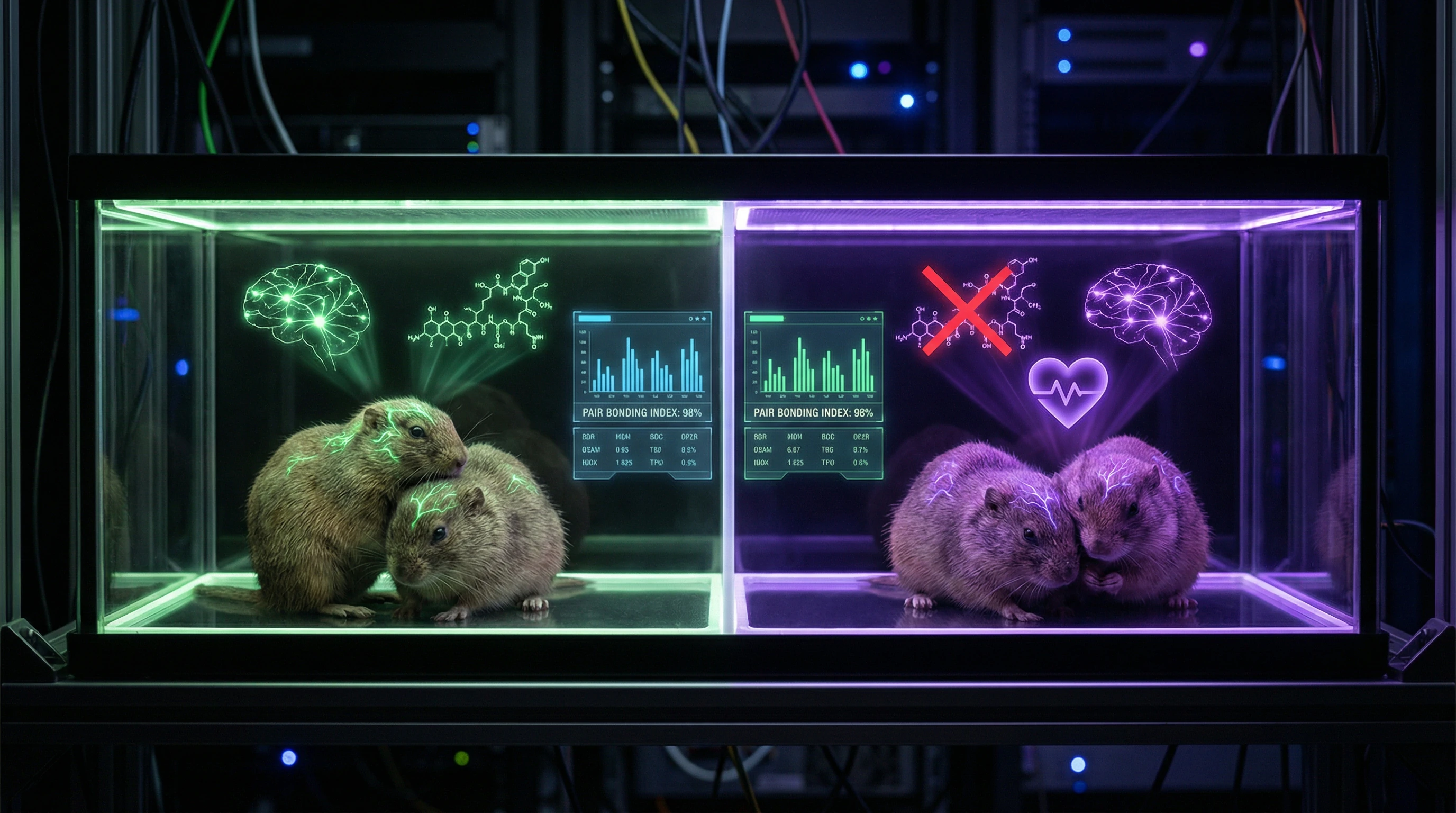
Neural Networks of Love: How the Brain Creates Attachment Through Multiple Parallel Systems
Love is one of our most powerful emotions, inspiring the creation of the greatest works of art, literature, and achievements in human history (S002). While aspects of love are unique to our species, human romantic relationships are manifestations of a mating system built on ancient fundamental neural mechanisms governing individual recognition, social reward, territorial behavior, and maternal care (S002).
Attachment is not a single system, but an orchestra of parallel neural networks, each contributing to the holistic experience of love. For more details, see the Systematic Reviews and Meta-Analyses section.
The brain doesn't create love through one hormone or one neurotransmitter. It creates it through the synchronization of multiple systems: reward, memory, emotion, social cognition, and bodily sensation.
🔁 Reward System and Dopaminergic Pathways
When a person falls in love, the brain launches a series of complex mechanisms involving multiple chemicals and hormones that strongly influence behavior (S004). The dopaminergic reward system plays a central role: the ventral tegmental area (VTA) and nucleus accumbens.
These structures activate during interaction with a romantic partner, creating a sense of pleasure and motivating the pursuit of closeness. Dopamine here works not as a "love hormone," but as a signal of salience: the brain marks the partner as an object worthy of attention and effort.
🧷 Prefrontal Cortex and Executive Control of Attachment
The prefrontal cortex, especially its medial and orbitofrontal regions, evaluates social information and makes decisions regarding the partner. These areas integrate sensory information, emotional signals, and memory to form a stable representation of the partner as a unique individual.
This is also where suppression of critical thinking occurs in the early stages of falling in love—the prefrontal cortex literally reduces activity in areas responsible for assessing risks and flaws.
🧬 Amygdala and Emotional Valence of Social Stimuli
The amygdala processes the emotional significance of social stimuli and participates in forming associations between the partner and positive emotional states. Since falling in love is often accompanied by uncertainty, which can be perceived as stressful, elevated cortisol as part of the stress response enhances the sense of awareness (S004).
🔬 Hippocampus and Consolidation of Partner Memory
The hippocampus is critically important for forming and consolidating memories of the partner. Episodic memories of time spent together, especially emotionally charged moments, strengthen the pair bond and create a unique relationship history.
| Brain Structure | Function in Attachment | Neurotransmitters |
|---|---|---|
| VTA + nucleus accumbens | Motivation, proximity seeking, reward | Dopamine |
| Prefrontal cortex | Partner evaluation, social decision-making, criticism suppression | Glutamate, GABA |
| Amygdala | Emotional significance, partner associations | Glutamate, GABA, neuropeptides |
| Hippocampus | Memory consolidation, relationship history | Glutamate, acetylcholine |
These systems don't work in isolation. They're connected through the brain's white matter, exchange signals via neurotransmitters, and are modulated by hormones circulating in the blood. Oxytocin and vasopressin (S001) act as modulators of these networks, but not as their foundation.
Disruption of one system doesn't completely destroy attachment—the brain finds workarounds. This is precisely why genetically modified voles without oxytocin receptors still form pair bonds, albeit with changes in behavioral details.
Attachment is a property of the network, not a property of one component. Removing one neurotransmitter is like turning off one instrument in an orchestra. The music will change, but the orchestra will continue to play.
This explains why people with different genetic variants of oxytocin and vasopressin receptors (S007) are still capable of loving and forming long-term relationships. It also explains why long-term relationships require constant activation of these systems—without regular interaction and new shared experiences, neural networks weaken.
Cognitive Traps of Oversimplification: Why We Want to Believe in the "Love Hormone" and What This Reveals About Science Communication
The story of oxytocin as the "love hormone" is a classic example of how scientific discoveries get oversimplified in popularization. This phenomenon reveals fundamental cognitive biases that affect how we perceive scientific information. Learn more in the Sources and Evidence section.
🧩 Essentialism and the Search for a Single Cause
The human brain is evolutionarily wired to seek simple cause-and-effect relationships. The idea that a complex phenomenon like love can be explained by a single molecule satisfies our cognitive need for simplicity and certainty.
Essentialist thinking drives us to search for the "essence" of a phenomenon—its single fundamental cause—while ignoring systemic complexity. This isn't a perceptual error but a built-in information processing strategy that typically conserves brain resources.
🕳️ Reductionism in Neurobiology
Neurobiology in recent decades has triumphed through its molecular approach—the ability to identify specific molecules, genes, and receptors linked to behavior (S001, S003). This success created a temptation for reductionist explanations, where complex behavior gets reduced to the action of individual molecules.
The oxytocin theory of love fell victim to this temptation: the molecule was discovered, its functions studied, but that didn't mean it explained the entire phenomenon.
⚠️ Media Amplification and Loss of Nuance
Scientific publications contain numerous caveats, limitations, and alternative interpretations. In the process of media translation, these nuances get lost.
- Scientific text
- "Oxytocin may modulate certain aspects of social behavior in specific contexts" (S005)
- Media version
- "Scientists discover the love hormone"
- Effect
- False sense of scientific certainty and universality of the conclusion
🧠 Neurochemical Determinism and the Illusion of Control
The idea that love is determined by a specific hormone creates an illusion of potential control. If love is "just oxytocin," then theoretically we can trigger, enhance, or suppress it pharmacologically.
This illusion of control is psychologically appealing, especially given the complexity and unpredictability of human relationships. It promises a solution where none exists—and that promise sells more easily than an honest answer about the multifactorial nature of attachment (S002).
- The brain seeks simple explanations for complex phenomena—this conserves cognitive resources
- Molecular explanations seem more "scientific" and concrete than systemic ones
- Media amplifies certainty by removing caveats and context
- The illusion of control over a phenomenon makes simplified explanations psychologically attractive
- Science communication often fails to account for these cognitive traps when translating results
Understanding these mechanisms isn't a criticism of science, but an acknowledgment of how human information perception works. Oxytocin does indeed participate in social behavior (S006), but this participation is part of a complex network, not the starring role in a play called "love."
Critical Evaluation Protocol for Neurobiological Claims About Love: Seven Questions That Will Dismantle Oversimplified Explanations in a Minute
Critical thinking about neurobiological explanations requires a systematic approach. The seven questions below are a tool for separating scientifically grounded claims from popularizations and marketing. For more details, see the Debunking and Prebunking section.
✅ Question 1: Does the Claim Distinguish Between Correlation and Causation?
Most research on human love shows that neurochemical changes accompany falling in love, but doesn't prove they cause it. Experimental manipulations (like oxytocin receptor knockout in voles) establish causation; correlational data does not.
If a source says "oxytocin causes love" but only cites correlational data in humans—that's a red flag.
✅ Question 2: Does the Explanation Account for Species Specificity?
Results from prairie voles don't automatically transfer to humans. Ask: is there direct evidence in humans, or is this extrapolation? What evolutionary and neuroanatomical differences limit applicability?
The human brain has a prefrontal cortex, developed culture, and language—factors absent in rodents. This doesn't mean animal research is useless, but it requires caution when transferring conclusions.
✅ Question 3: Does the Claim Acknowledge Multiple Mechanisms?
Complex behavior is rarely determined by a single mechanism. A 2023 study with oxytocin receptor knockout (S001) showed: voles without oxytocin receptors still formed pair bonds through alternative pathways.
- Red flag
- A claim that presents one hormone or neurotransmitter as the sole mechanism of attachment.
- Green flag
- Discussion of multiple systems: oxytocin, vasopressin (S007), dopamine, opioids, and their interactions.
⛔ Question 4: Does the Explanation Ignore Sociocultural Context?
Human love is embedded in culture, economics, and personal history. Biological reductionism often ignores these factors. Ask: how does biology interact with sociocultural context, rather than replace it?
Example: oxytocin may facilitate attachment, but cultural norms, economic dependence, and childhood trauma determine to whom and how a person attaches. Biology is a necessary but insufficient explanation.
✅ Question 5: Is the Claim Based on Replications or Single Studies?
The replication crisis has shown: many striking results don't reproduce independently. Critically important: has the result been replicated? How many labs confirm the claim? What's the effect size?
- Single study = hypothesis requiring verification.
- Multiple independent replications = preliminary evidence.
- Meta-analysis of multiple studies = reliable knowledge.
🔎 Question 6: Does the Source Acknowledge Limitations and Uncertainty?
Quality science communication always discusses limitations. If a source presents results as absolutely certain—that's a red flag. Reliable sources use cautious language: "may," "suggests," "under certain conditions."
A source that says "oxytocin is the love hormone" without qualifications is less reliable than one that says: "oxytocin may facilitate attachment in certain contexts, but it's not the only mechanism."
⛔ Question 7: Is There a Commercial Interest in Promoting a Simplified Explanation?
Simplified explanations are often used to promote products: oxytocin sprays, dating apps with "scientific" matching, books about the "love hormone." Ask: who benefits from this simplification? Is there a conflict of interest?
Marketing often uses scientific authority to legitimize products that lack an evidence base. Critical thinking requires separating scientific facts from commercial interests.
Applying this protocol to any neurobiological claim about love, attachment, or behavior allows you to quickly separate grounded conclusions from popularizations. This doesn't mean denying biology—it means understanding its real capabilities and limitations.