What Neuroscientists Actually Measure When They Talk About "Prayer in the Brain" — and Why That's Not the Same as Proof of Efficacy
When researchers claim that "prayer changes the brain," they're referring to specific, measurable patterns of neural activity captured through functional magnetic resonance imaging (fMRI), positron emission tomography (PET), or electroencephalography (EEG). These aren't abstract speculations — they're data about which brain regions consume more oxygen, where blood flow increases, which frequencies dominate in cortical electrical activity (S002, S003).
🔎 Three Types of Neural Changes Documented in Prayer Research
- Cortical Deactivation During Repetitive Speech
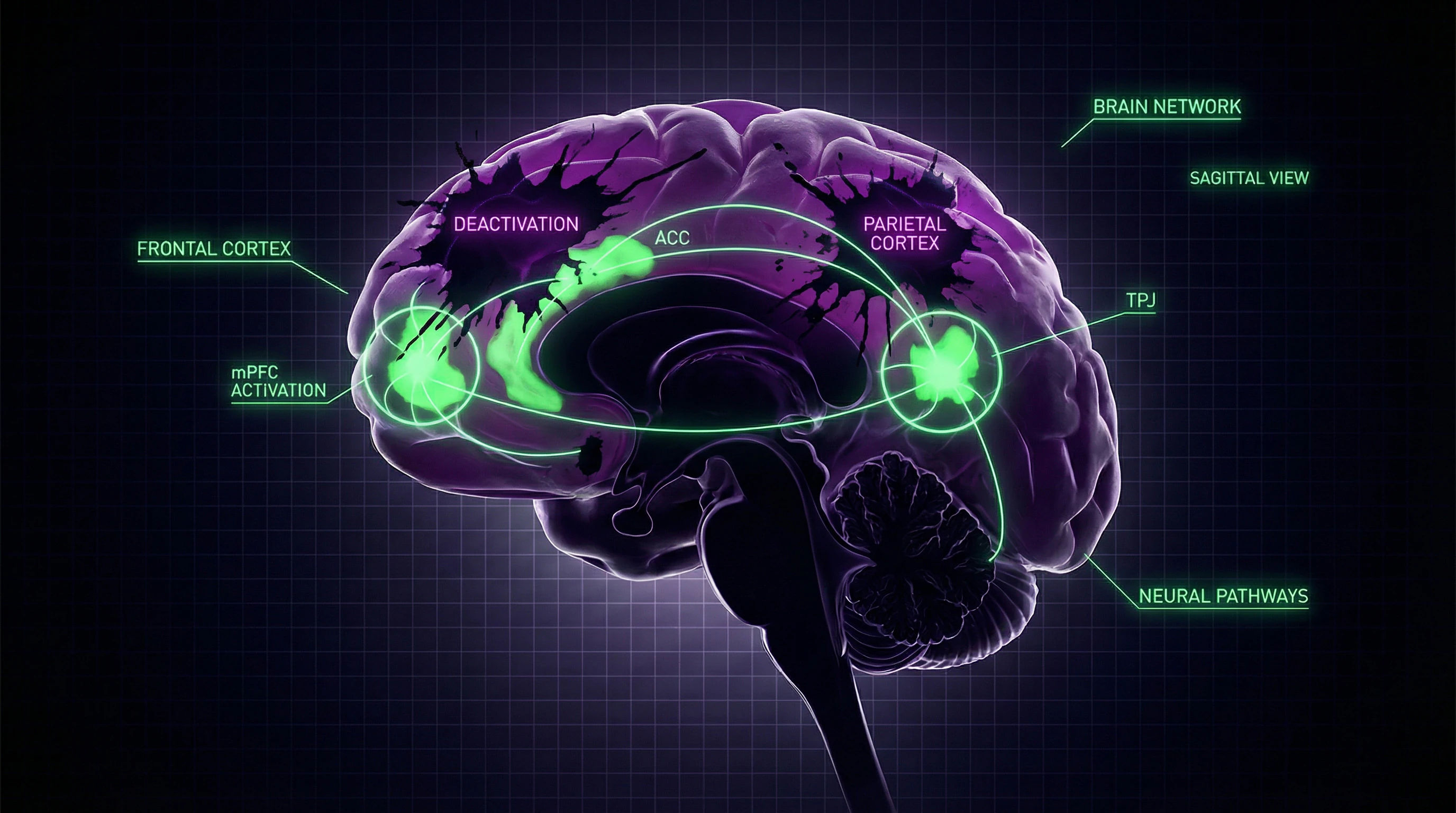
- When a person repeatedly recites the same phrase (mantra, prayer, affirmation), extensive areas of the cerebral cortex show decreased activity — a phenomenon termed the "mantra effect" (S008). This isn't "shutting down" the brain in a literal sense, but rather a transition to reduced metabolic mode in zones responsible for complex information processing, planning, and self-control.
- Activation of Attachment and Emotional Regulation Networks
- Studies show increased activity in the medial prefrontal cortex, anterior cingulate cortex, and temporoparietal junction — areas associated with theory of mind, empathy, and representing others' intentions (S001, S003). These same zones activate when a person thinks about loved ones or imagines social interaction.
- Changes in Default Mode and Self-Reference Networks
- Religious experiences often involve modulation of activity in the medial prefrontal cortex and posterior cingulate cortex — key nodes of the brain's default mode network, which is active when we're not engaged in external tasks and are immersed in internal experience (S002, S004).
⚠️ Why Neural Activity Doesn't Equal Proof of Causation
The critical error in interpreting these data is assuming that if prayer causes brain changes, it must "work" in the sense of influencing events outside the skull. This is a logical fallacy of category confusion: neural activity is a correlate of subjective experience, not proof of objective effect (S005).
When you watch a horror movie, your amygdala activates, your heart rate increases, cortisol is released. These are measurable physiological changes. But this doesn't mean the monster on screen is real or that your fear protects you from actual threat. Neural activity reflects the brain's information processing, but doesn't validate the content of that information.
🧱 The Boundary Between Phenomenology and Ontology
The neuroscience of prayer can answer questions of phenomenology — how subjective experience is structured, what mechanisms generate it, why it feels the way it does. It explains why prayer brings psychological relief, why repetitive practices are calming, why religious experiences feel deeply meaningful (S002, S003).
| Question | Neuroscience Can Answer | Requires Other Methods |
|---|---|---|
| How is the subjective experience of prayer structured? | ✓ Yes | — |
| What neural mechanisms generate it? | ✓ Yes | — |
| Does the object of prayer exist outside the brain? | ✗ No | Philosophy, theology |
| Does prayer influence events in the physical world? | ✗ No | RCTs, double-blind testing, placebo controls |
| Does prayer heal diseases through non-physical mechanisms? | ✗ No | Clinical trials, statistical analysis |
Neuroscience cannot answer questions of ontology — whether the object of prayer exists outside the brain, whether prayer influences events in the physical world, whether it heals diseases through non-physical mechanisms. That requires randomized controlled trials, double-blind testing, placebo effect controls (S005).
Steel Man: Seven Most Compelling Arguments That Prayer Has Measurable Neurobiological Effects
Before examining weaknesses in data interpretation, we must honestly present the strongest arguments from proponents of prayer's neurobiological significance. This is not a straw man, but a steel man — the most convincing version of the position we'll analyze. More details in the Systematic Reviews and Meta-Analyses section.
🔬 Argument One: Reproducibility of Cortical Deactivation During Repetitive Speech
Research on the "mantra effect" demonstrates that repetitive vocalization triggers widespread cortical deactivation — an effect reproduced across different laboratories and participants (S008). This is not a single observation, but a stable pattern that can be predicted and measured.
Critics may argue that deactivation is simply the result of a monotonous task, not specific to prayer. But proponents point out: this very deactivation may explain the subjective sensation of "transcending the self," "ego dissolution" that practitioners describe. The neural correlate matches the phenomenological report.
🔬 Argument Two: Specific Activation of Attachment Networks During Prayer to a Personal God
Research on Christian prayer shows that when believers pray to a personal God (as opposed to abstract meditation), the same neural networks activate as when thinking about loved ones — medial prefrontal cortex, anterior cingulate cortex, temporoparietal junction (S001). This is not coincidental: prayer to a personal God is neurobiologically similar to social interaction.
This explains why prayer can provide psychological comfort comparable to support from a loved one. The brain processes relationships with God through the same mechanisms as human attachments. This doesn't prove God's existence, but it proves that prayer is not empty abstraction, but a neurobiologically grounded practice.
🔬 Argument Three: Modulation of Self-Referential Networks and Altered Self-Perception
Religious and spiritual experiences are often accompanied by changes in default mode network activity, especially in medial prefrontal and posterior cingulate cortex (S002, S004). These regions are associated with self-reference, autobiographical memory, and constructing narratives about the self.
When these networks are modulated during prayer or meditation, a person may experience altered boundaries of "self," a sense of unity with something greater, transcendence of ordinary self-perception. This is not hallucination, but a real change in how the brain constructs its model of self in that moment.
- Cortical deactivation during repetitive speech — reproducible pattern
- Activation of attachment networks during prayer to a personal God
- Default mode network modulation and altered self-perception
- Evolutionary grounding in brain architecture
- Measurable psychological and physiological effects
- Complexity of multilevel neural changes
- Convergence of data from different methodologies
🔬 Argument Four: Evolutionary Grounding of Religious Experience in Brain Architecture
Neurobiological research shows that religious experiences engage ancient evolutionary systems — the limbic system (emotions), attachment systems (social bonds), reward systems (dopaminergic pathways) (S004). This is not a cultural artifact imposed on a neutral brain, but utilization of deeply embedded mechanisms.
If religious experience were purely a cultural construction without biological foundation, we wouldn't see such consistency in neural patterns across people from different cultures and religious traditions. The universality of neural correlates indicates that the brain is evolutionarily "prepared" for religious experience.
🔬 Argument Five: Measurable Psychological and Physiological Effects of Prayer
Even if prayer doesn't affect external events, it demonstrates measurable effects on the psychological state and physiology of the person praying: reduced anxiety, improved emotional regulation, decreased cortisol levels, improved immune markers (S002, S003). These effects don't require supernatural explanation, but they are real and clinically significant.
If prayer works as a form of emotional regulation, social support (even if the "interlocutor" is imaginary), and cognitive reappraisal, that's already sufficient grounds for its practical value. We don't need to prove miracles to acknowledge benefits.
Prayer is not just self-suggestion. It's a full-fledged cognitive practice that engages the same neural systems as music, language, and social cognition. Its effects are measurable and reproducible.
🔬 Argument Six: Complexity and Multilevel Nature of Neural Changes
Prayer doesn't activate one isolated brain region — it involves complex, distributed networks including cortex, subcortical structures, limbic system, attention and self-control systems (S002). This is not a primitive response, but a complex neurocognitive process requiring coordination of multiple systems.
Such complexity indicates that prayer is not simply "self-suggestion" or "placebo," but a full-fledged cognitive practice, comparable in neural involvement to the scientific method or analytical thinking. This deserves serious scientific study, not dismissive hand-waving.
🔬 Argument Seven: Convergence of Data from Different Methodologies
Neurobiological findings about prayer are obtained not from one method, but from convergence of data from fMRI, PET, EEG, neuropsychological tests, and phenomenological reports (S002, S003). When different methods point to the same patterns, this strengthens the reliability of conclusions.
This is not cherry-picking one convenient study, but a systematic picture emerging from multiple independent data sources. Such convergence is a sign that we're dealing with a real phenomenon, not an artifact of one methodology.
Evidence Base: What Research Actually Shows — and What It Doesn't, Despite the Headlines
Every claim about prayer and the brain requires verification against primary data, methodological rigor, and correct interpretation. More details in the Chemistry section.
📊 The Mantra Effect: What Happens in the Brain During Repetitive Prayer
During repeated recitation of a single phrase, fMRI registers widespread deactivation in frontal, parietal, and temporal cortical areas — zones of executive control, working memory, and language processing (S008).
Key point: this deactivation is not specific to religious content. It occurs with any repetitive vocalization — prayer, mantra, counting rhyme, or meaningless syllable. The mechanism is neural adaptation: when a task becomes automatic, the brain reduces metabolic expenditure in unnecessary areas.
Repetitive prayers do cause measurable brain changes, but these changes result from repetition, not religious content.
Prefrontal cortex deactivation reduces rumination and anxious thoughts — which is why such practices are calming. This explains the effectiveness of the rosary, the Jesus Prayer, and mantras without appealing to the supernatural.
📊 Prayer and Attachment Networks: The Neurobiology of Relationship with God
The Schjoedt et al. study compared brain activity during prayer to a personal God versus abstract meditation (S001). Prayer activated the medial prefrontal cortex, anterior cingulate cortex, and temporoparietal junction — the same areas active when thinking about close relationships.
The brain processes relationship with God through social cognition mechanisms used for interacting with an imagined (or invisible) interlocutor. This isn't metaphor — it's literal repurposing of attachment systems.
Critical question: does this prove God's existence? No. It shows the brain constructs the experience of relationship with an inaccessible object using the same mechanisms as for real relationships. Analogy: reading a novel activates the same emotional systems as real empathy, but this doesn't prove the character's reality.
- The brain uses social cognition systems for prayer
- These systems evolved for interaction with real people
- Their activation during prayer doesn't confirm God's existence
- It confirms the flexibility of neural attachment mechanisms
📊 Religious Experiences and the Default Mode Network
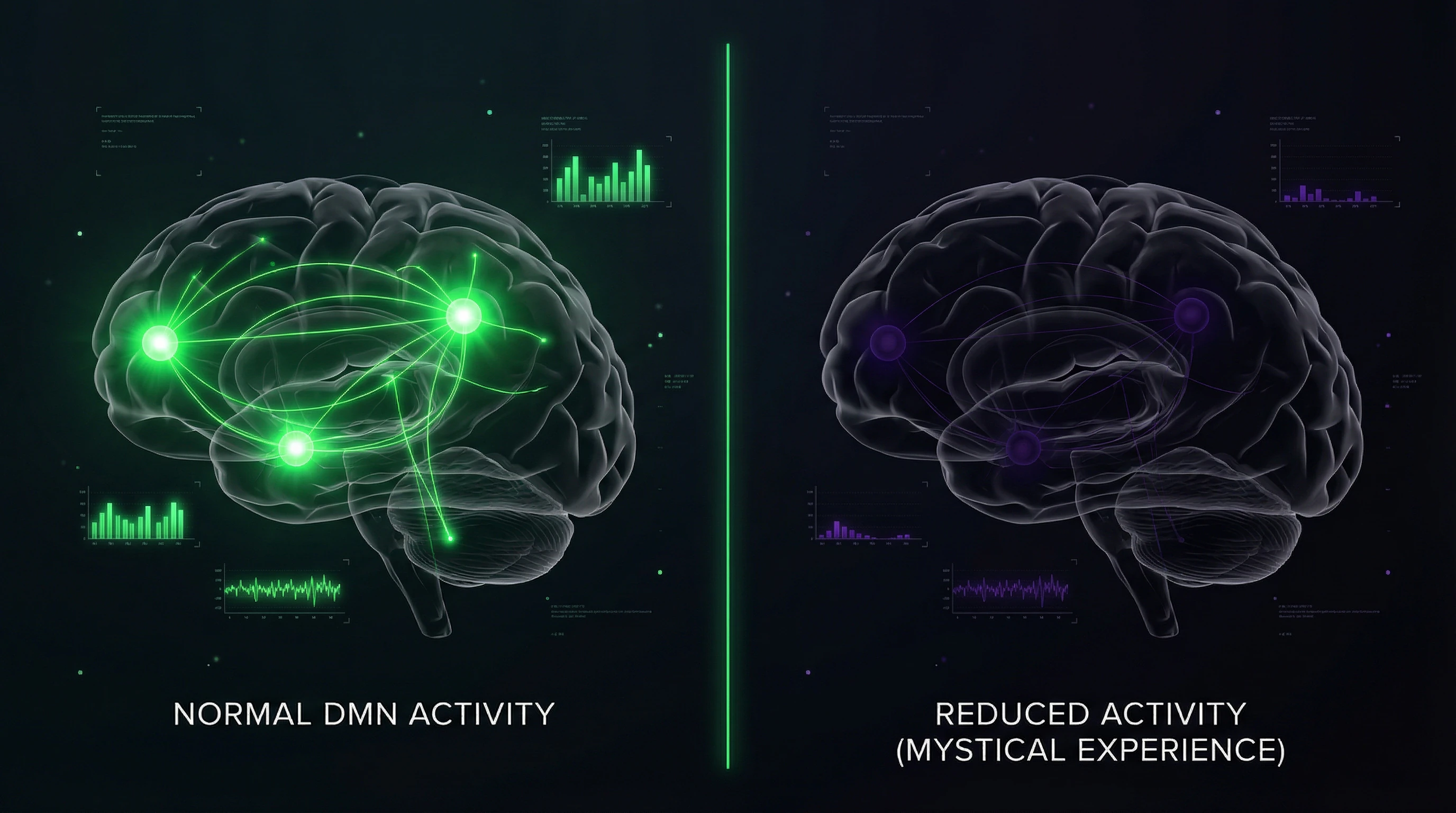
Intense religious experiences (mystical states, sense of unity, transcendence) are often accompanied by decreased activity in the default mode network (DMN), especially in the posterior cingulate cortex and medial prefrontal cortex (S002).
The DMN is linked to constructing self-narrative and maintaining "I" boundaries. When its activity decreases, the sense of a separate, isolated "self" weakens. This explains subjective reports of "ego dissolution" and "unity with everything" — these describe an altered DMN operating mode, not proof of transcendence (S004).
| State | DMN Activity | Subjective Experience | Mechanism |
|---|---|---|---|
| Ordinary consciousness | High | Clear sense of "I" | Active narrative construction |
| Mystical experience | Low | "Dissolution into the whole" | Weakening of self-boundaries |
| Deep sleep | Low | Absence of experience | Consciousness shutdown |
📊 Intercessory Prayer Efficacy Studies: Methodological Failure
The Leibovici study in the British Medical Journal examined "retroactive intercessory prayer" — prayer for patients who had already recovered or died in the past (S005). Researchers took medical records of sepsis patients from 1990-1996, randomly divided them into two groups, and in 2000 prayed for one group.
Result: statistically significant improvement in the group prayed for — retroactively. This was a parody designed to demonstrate the absurdity of the methodology: if prayer in 2000 can change outcomes in the 1990s, it violates causality. The statistically significant result is an artifact of multiple comparisons and random noise (S005).
Even in a prestigious journal, you can publish a study with a "positive" result if you don't control for methodological errors. Statistical significance without a causal mechanism is empty noise.
📊 Why Most Prayer Studies Fail Basic Methodological Checks
Systematic reviews show: most intercessory prayer studies suffer from critical flaws — inadequate randomization, lack of double-blinding, small samples, multiple comparisons without correction, publication bias (S005).
When methodologically rigorous studies are conducted (large samples, double-blind testing, preregistered hypotheses), the prayer effect disappears. This is the classic pattern of a pseudoscientific phenomenon: the stricter the methodology, the weaker the effect, until it vanishes completely at maximum rigor.
- Publication bias
- Studies with "positive" results are published more often than those with negative results, creating an illusion of effect in the literature.
- P-hacking
- Multiple analyses of the same data with selection of only statistically significant results.
- Small samples
- High probability of random results that don't replicate in larger samples.
- Lack of preregistration
- Researchers can change hypotheses after data analysis, presenting post-hoc conclusions as a priori.
Mechanism or Illusion: Why Neural Activity Doesn't Prove Causal Connection to Reality
The central error in interpreting neurobiological data about prayer is conflating two different questions: "What happens in the brain?" and "What happens in the world?" The first question concerns the mechanism of subjective experience, the second concerns causal relationships in physical reality. More details in the Electromagnetism section.
🧬 Correlation in the Brain vs. Causality in the World: Why They're Not the Same Thing
When fMRI shows activation of certain brain regions during prayer, it tells us that the brain is processing information in a particular way. But it doesn't tell us whether this processing corresponds to something real beyond the skull (S002, S003).
Analogy: when you dream, your brain generates vivid visual images, emotions, narratives. Neural activity during sleep is real and measurable. But this doesn't mean that events in the dream are occurring in the physical world.
Neural activity is the substrate of experience, but not validation of its content.
The same applies to prayer: the fact that prayer activates attachment networks doesn't prove that the object of attachment (God) exists. The fact that prayer reduces DMN activity and produces feelings of transcendence doesn't prove that a person actually transcends themselves in an ontological sense. It only proves that the brain can generate such experiences.
🧬 Confounders: What Else Could Explain the Observed Effects
Even if prayer correlates with improved psychological state or health, this doesn't mean prayer is the cause of improvement. Possible confounders (S002, S003):
- Social Support
- People who pray often belong to religious communities that provide emotional and practical support. The effect may result from social connections rather than prayer itself. This is particularly relevant for understanding how social bonds reprogram neurobiology.
- Emotional Regulation
- Prayer may function as a form of cognitive reappraisal, distraction from rumination, or meditative practice. Improvement may result from any of these mechanisms, independent of prayer content.
- Placebo Effect
- If a person believes prayer will help, their expectation can activate endogenous pain relief and stress regulation systems. This doesn't require the existence of a supernatural agent.
- Sample Selection
- People who pray regularly may differ from non-prayers across multiple parameters: lifestyle, diet, physical activity, genetics, socioeconomic status. These differences, not prayer itself, may explain observed effects.
- Temporal Dynamics
- The correlation between prayer and health may be reversed: healthy people pray more often because they have energy and motivation. Illness may reduce both prayer and overall well-being.
🔍 Why Neurobiology of Prayer Cannot Answer Metaphysical Questions
Neurobiology can describe how the brain creates the experience of prayer. But it cannot answer the question: "Does God exist?" or "Does prayer actually affect the external world?".
This isn't a limitation of neurobiology—it's its nature. Science studies patterns in observable data. Metaphysical questions lie outside its competence by definition.
| Question | Can Neurobiology Answer? | Why |
|---|---|---|
| Which brain regions are active during prayer? | Yes | This is a question about mechanism, amenable to measurement |
| Why does prayer produce feelings of transcendence? | Yes (partially) | Neural correlates can be described, but subjective experience cannot be fully explained |
| Does God exist? | No | This is a metaphysical question, not amenable to empirical testing |
| Does prayer actually change the external world? | No (directly) | Neurobiology can only show that prayer changes the brain, not external reality |
This doesn't mean prayer is useless or that religious experience has no significance. It means neurobiology is the wrong tool for answering these questions. As philosopher Ludwig Wittgenstein said: "Whereof one cannot speak, thereof one must be silent." Or, in our case, acknowledge the boundaries of the method.
🎯 Practical Takeaway: How to Read Prayer Research Without Errors
- Distinguish between describing mechanism and proving effectiveness. "Prayer activates attachment networks" is a description of mechanism. "Prayer cures diseases" is a claim about effectiveness requiring different evidence.
- Check whether confounders were controlled. If a study didn't control for social support, placebo, or sample selection, results may be artifacts rather than effects of prayer.
- Remember the scientific method: correlation requires verification through randomized controlled trials, not just observational studies.
- Don't confuse neurobiology with philosophy. Neurobiology can explain how the brain creates experience. Philosophy must answer what that experience means.