What Are Near-Death Experiences: From Folkloric "Death-Like States" to Clinical Taxonomy of the Phenomenon
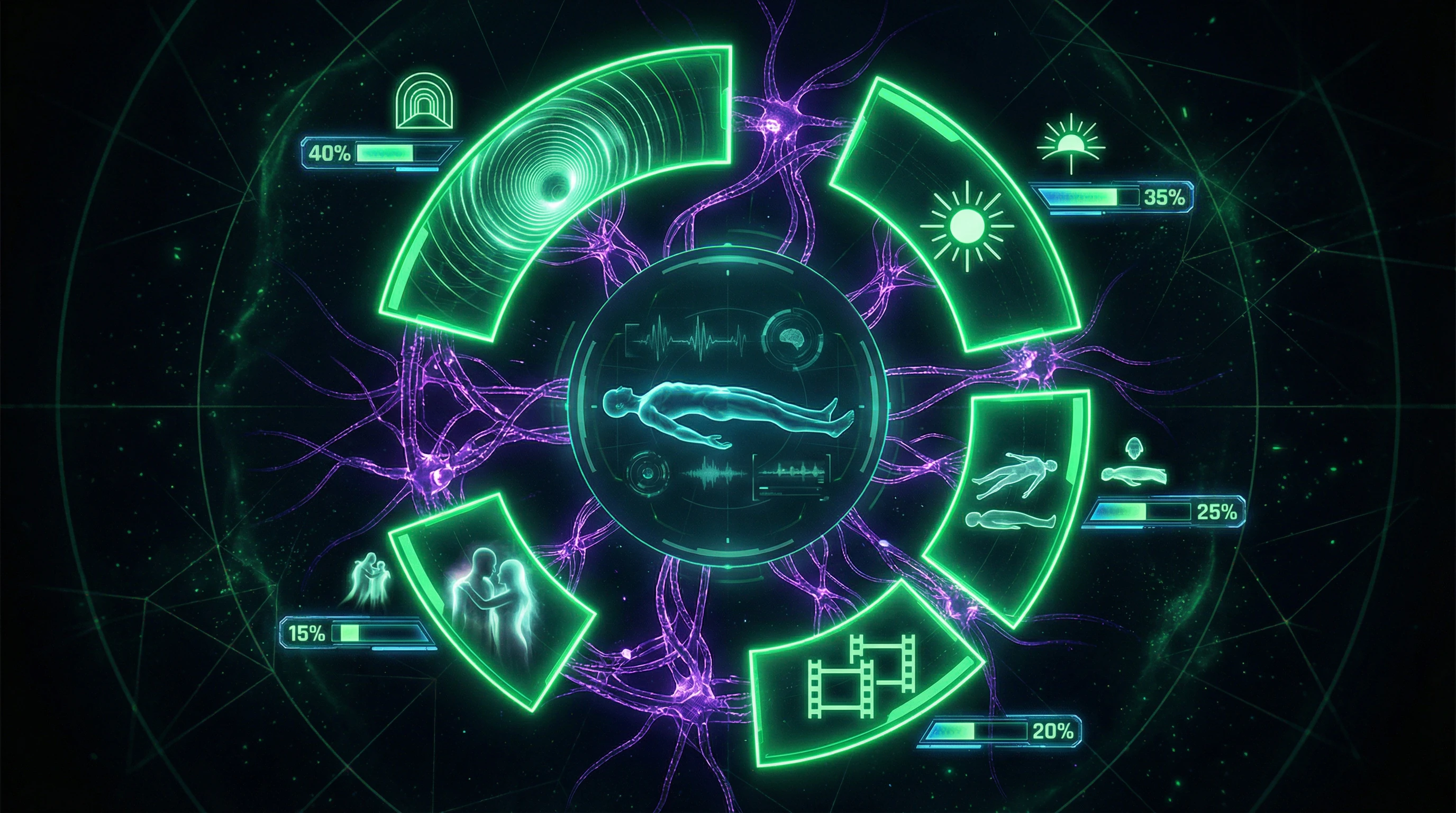
Near-death experiences (NDEs) are a complex of subjective psychological phenomena occurring in states close to death or perceived as such. Contemporary scientific literature defines NDEs as a specific pattern of experiences including several characteristic elements: sensation of separation from the physical body (out-of-body experience), movement through a tunnel or space toward a source of light, encounters with deceased individuals or religious figures, panoramic life review, feelings of unconditional love and peace, and reluctance to return to the body (S003).
🔎 Cultural Universality of the Phenomenon and Its Variability
Near-death experiences have been described across various cultures for millennia. In Russian folkloric tradition, there exists the concept of "obmiraniye"—a state of temporary death after which a person returns with accounts of visiting another world (S002).
Details of these experiences vary substantially depending on cultural context: Christians more frequently encounter Jesus or angels, Hindus encounter Yama (god of death), atheists encounter abstract light beings or deceased relatives without religious attribution. More details in the Chemistry section.
- Cultural Filtering of NDEs
- The brain interprets extreme neurophysiological states through the lens of existing cultural and religious schemas. This does not invalidate the reality of the experience but explains its form and content.
⚠️ The Definition Problem: When Does a "Near-Death" State Begin
A critical methodological problem in NDE research is the ambiguity of the term "near-death state" itself. Most documented cases occur not during clinical death (cessation of cardiac activity and respiration) but in states of severe stress, trauma, anesthesia, or even meditation.
Clinical death is the reversible cessation of circulation and respiration, which can last from several seconds to several minutes before irreversible brain changes occur (S001). However, precisely determining at what moment the experience arose—during cardiac arrest, at the moment of loss of consciousness before it, or during the recovery period after resuscitation—is practically impossible due to the retrospective nature of reports.
🧾 Epidemiology: How Common Are Near-Death Experiences
Between 10% and 20% of people who have survived clinical death or states close to it report having NDEs. This means that the majority of people who have been on the brink of death do not experience the classic elements of the phenomenon.
| Factor | Influence on NDE Frequency |
|---|---|
| Type of critical event | Cardiac arrest, trauma, drowning—different probabilities |
| Duration of brain hypoxia | Longer hypoxia correlates with more complex experiences |
| Individual neurophysiological characteristics | Variability in activation thresholds of critical brain structures |
| Cultural background and religiosity | Expectations and interpretive schemas shape experience content |
Absence of NDE memories does not mean their absence—amnesia for events during the critical period is normal with severe cerebral circulation impairment (S003).
Steelman: Seven Most Compelling Arguments for the Metaphysical Nature of NDEs
Before proceeding to the neurobiological explanation, it is necessary to honestly examine the strongest arguments of proponents of the hypothesis that near-death experiences constitute evidence for the existence of consciousness outside the brain and, consequently, an afterlife. For more details, see the section Systematic Reviews and Meta-Analyses.
Intellectual honesty requires presenting the opposing position in its most convincing form—this is called the "steelman" principle, the opposite of the "straw man" logical fallacy.
💎 Argument One: Verifiable Perceptions During Clinical Death
The most impressive NDE cases include reports of events that a person could not have perceived through ordinary sensory organs. A classic example is patients accurately describing medical procedures performed during their resuscitation, including specific actions by physicians, equipment used, and even conversations among medical staff.
Some cases include descriptions of objects that were outside the patient's field of vision (for example, on upper shelves in the operating room), which were subsequently confirmed. Proponents of the metaphysical interpretation argue that such verifiable perceptions cannot be explained by hallucinations or memory reconstruction.
- Patient describes actions of physicians and equipment they did not see
- Descriptions are subsequently verified and confirmed
- Objects were outside the physical field of vision (upper shelves, adjacent rooms)
- Information could not have been obtained through hearing or other senses
💎 Argument Two: Complexity and Coherence of Experiences in the Absence of Brain Activity
During cardiac arrest, the brain rapidly loses electrical activity—the EEG becomes isoelectric (flat) within 10-20 seconds after cessation of blood flow. Proponents of the metaphysical hypothesis point out that complex, coherent, emotionally rich experiences should not be possible in a state where the cerebral cortex is not functioning.
Many people describe their near-death experiences as "more real than ordinary reality," with exceptional clarity of perception and memory—which contradicts expectations from a dysfunctional brain (S003).
💎 Argument Three: Transformative Impact and Long-Term Psychological Changes
Near-death experiences often lead to radical and lasting changes in personality, value systems, and life priorities. People who have experienced NDEs report reduced fear of death, increased spirituality, heightened empathy and altruism, and changed attitudes toward material values.
These changes persist for decades and are not characteristic of ordinary hallucinations or dreams (S004). Proponents of the metaphysical interpretation argue that such profound transformative impact indicates the authenticity of the experience of contact with another reality.
- Longevity of Changes
- Psychological shifts persist for decades, rather than disappearing after days or weeks as with ordinary hallucinations
- Universality of Patterns
- Regardless of culture and religion, people report the same types of transformation (reduced materialism, increased altruism)
- Depth of Experience
- Changes affect fundamental beliefs and values, not superficial preferences
💎 Argument Four: Near-Death Experiences in Blind People with Visual Imagery
Cases have been documented where people blind from birth or who lost their sight in early childhood reported visual perceptions during near-death experiences—they saw light, a tunnel, people's faces, and their surroundings.
Since these individuals lack visual experience and the corresponding neural structures for processing visual information are undeveloped, proponents of the metaphysical hypothesis consider this proof of perception independent of physical sensory organs and brain structures.
💎 Argument Five: Cross-Cultural Universality of Basic Elements
Despite cultural variations in details, the basic structure of near-death experiences demonstrates striking similarity across different cultures, eras, and religious traditions. The tunnel of light, meeting with the deceased, feeling of peace, out-of-body experience—these elements are described independently of cultural context (S003).
Such universality points to the objective reality of the experienced phenomenon, rather than culturally conditioned hallucinations—so argue proponents of the metaphysical interpretation.
💎 Argument Six: Encounters with Unknown Deceased Relatives
There are cases where people during NDEs encountered deceased relatives whose existence or death they did not know about during life, and this information was subsequently confirmed. A classic example is a child who met a "brother" during a near-death experience, whose existence they did not know about (parents had concealed the fact of the older child's death before their birth).
Such cases, if reliably documented, are difficult to explain within the hypothesis of hallucinations based on prior knowledge.
💎 Argument Seven: Deathbed Visions of the Dying and Shared Experiences
In addition to near-death experiences in resuscitated patients, there are reports of deathbed visions in dying people, which sometimes coincide with the experiences of relatives present at the death.
For example, a dying person describes the presence of a deceased relative who has come to "take" them, and simultaneously someone present reports unusual sensations or visions. Proponents of the metaphysical hypothesis view such shared experiences as proof of the objective reality of what is happening, extending beyond individual consciousness.
| Type of Argument | Key Claim | Proposed Evidence |
|---|---|---|
| Verifiability | Perceptions correspond to objective reality | Descriptions of events confirmed independently |
| Neurophysiology | Complex experiences in the absence of brain activity | EEG flat, but consciousness functions |
| Transformation | Deep long-term personality changes | Lasting shifts in values and behavior |
| Sensory Deprivation | Visual imagery in the congenitally blind | Absence of neural structures for vision |
| Universality | Identical elements across different cultures | Independent description of the same phenomena |
| Information | Encounters with unknown deceased | Confirmed facts about people they did not know |
| Synchronicity | Shared experiences of different people | Simultaneous visions in the dying and those present |
Neurobiological Anatomy of Dying: What Happens to the Brain in the Final Seconds of Consciousness
Modern neuroscience describes a cascade of biochemical and electrophysiological processes during critical reduction of blood supply and brain oxygenation. These processes explain all major elements of near-death experiences without metaphysical hypotheses. Key point: the dying brain doesn't shut down instantly—it passes through a series of predictable dysfunction stages, each creating specific subjective experiences (S001).
🧠 Hypoxia and Hypercapnia: Primary Triggers of Altered States of Consciousness
During cardiac arrest, the brain immediately experiences oxygen deficiency (hypoxia) and carbon dioxide accumulation (hypercapnia). The brain consumes 20% of the body's total oxygen while comprising only 2% of body mass—making it exceptionally sensitive to blood supply disruptions. More details in the Thermodynamics section.
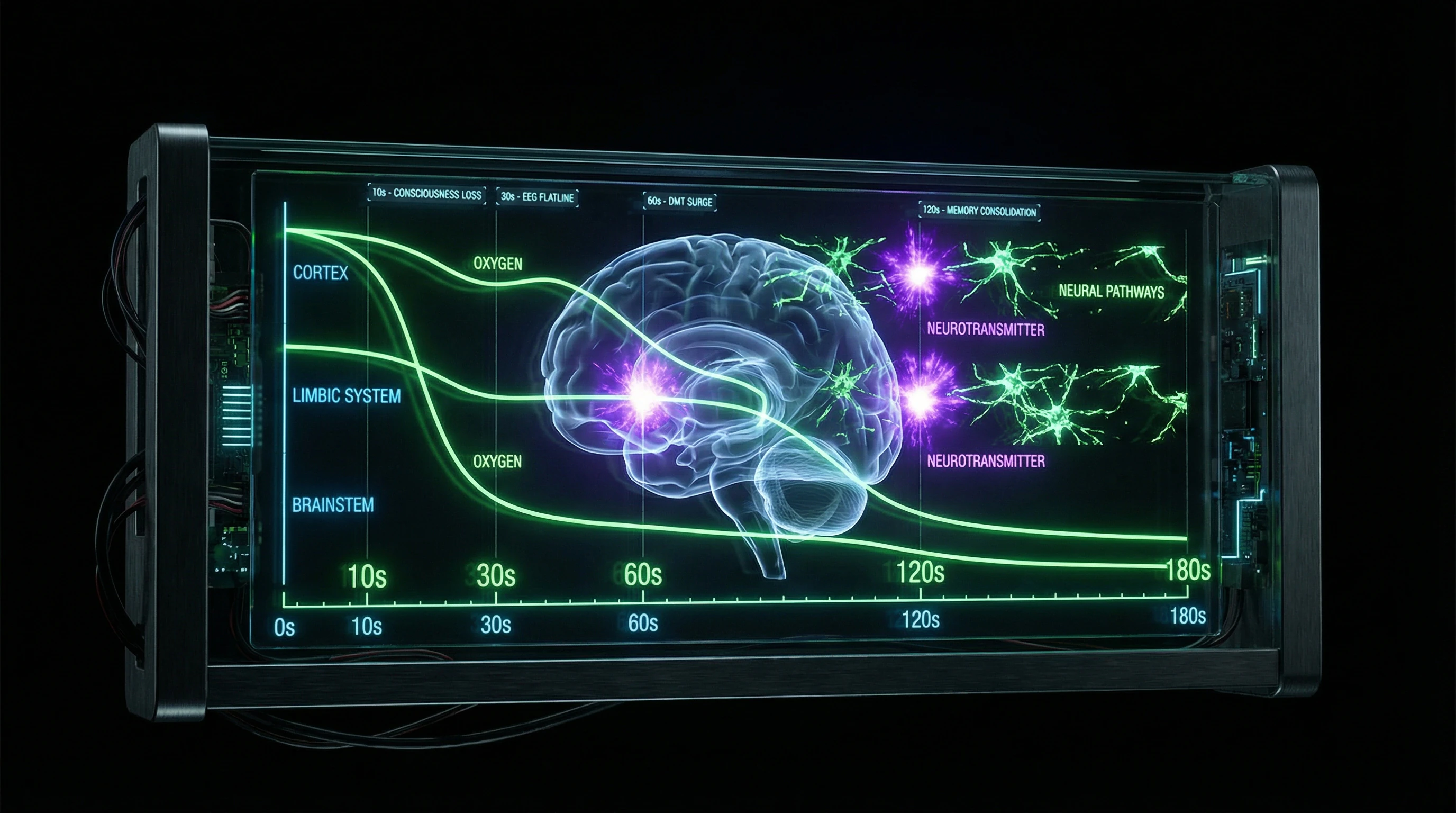
Within 10 seconds after blood flow cessation, loss of consciousness occurs; within 20–30 seconds, EEG becomes isoelectric (S003). However, subcortical structures—thalamus, hippocampus, limbic system—are more resistant to hypoxia and maintain activity longer, generating intense experiences in the absence of cortical control.
🧬 Massive Neurotransmitter Release: Endogenous DMT and Serotonin Storm
During critical hypoxia, the brain triggers a cascade of compensatory mechanisms, including massive neurotransmitter release. Of particular significance is endogenous N,N-dimethyltryptamine (DMT)—a powerful psychedelic synthesized in the pineal gland and other brain tissues.
Exogenous DMT when consumed produces experiences strikingly similar to near-death experiences: tunnel of light, encounters with "entities," out-of-body sensations, feeling of access to "higher knowledge." The endogenous DMT hypothesis suggests that in critical states its concentration sharply increases, creating characteristic hallucinations.
Simultaneously, dysregulation of serotonergic and dopaminergic systems occurs, amplifying the emotional intensity of experiences (S004).
🔁 Temporoparietal Junction Disintegration: Mechanism of Out-of-Body Experience
The sensation of separation from the physical body (out-of-body experience, OBE) has a clear neuroanatomical substrate. The temporoparietal junction (TPJ)—a cortical area at the intersection of temporal and parietal lobes—integrates proprioceptive, vestibular, and visual information, creating a unified sense of "self in body."
When TPJ dysfunction occurs due to hypoxia, dissociation arises between the sense of "self" and bodily localization, subjectively experienced as leaving the body. Experimental stimulation of TPJ in healthy individuals reproduces classic OBE elements, including observing one's own body from an external perspective (S001).
⚙️ Tunnel Vision as Consequence of Visual Cortex Anoxia
The classic "tunnel of light" relates to blood supply characteristics of the visual cortex. The central part of the visual field (fovea) is processed by areas with richer blood supply than the periphery.
- During critical reduction of cerebral blood flow
- Peripheral areas of the visual cortex shut down first, creating an effect of narrowing visual field with preservation of a central "bright spot."
- Subjective experience
- Movement through a tunnel toward light. Similar effects occur during hyperventilation, hypoglycemia, centrifuge exposure in pilots—the mechanism is identical: differential hypoxia of different visual cortex areas.
🧷 Panoramic Life Review: Hippocampal Dysfunction and Chaotic Memory Activation
The phenomenon of "life flashing before your eyes" (life review)—rapid reproduction of memories from various life periods—is linked to hippocampal and temporal lobe dysfunction during hypoxia. The hippocampus is critically important for consolidation and retrieval of episodic memories.
When its normal function is disrupted, chaotic activation of memory traces occurs without usual temporal and contextual control, creating a sensation of simultaneous access to multiple memories. Similar phenomena are observed in temporal lobe epilepsy, electrical stimulation of temporal lobes, and under influence of psychoactive substances. The subjective sensation of "reviewing entire life in seconds" reflects not actual temporal compression, but peculiarities of memory function in an altered state of consciousness (S002).
🔬 Endorphin and Anandamide Release: Neurochemistry of Bliss and Peace
The feeling of deep peace, bliss, and unconditional love characteristic of many near-death experiences has a clear neurochemical substrate. In response to critical stress, the brain massively releases endogenous opioids (endorphins, enkephalins) and endocannabinoids (anandamide).
| Substance | Mechanism of Action | Subjective Experience |
|---|---|---|
| Endorphins, enkephalins | Act on opioid receptors | Analgesia, euphoria, suffering reduction |
| Anandamide | Acts on cannabinoid receptors | "Cosmic unity," ego boundary dissolution, bliss |
The evolutionary purpose of this mechanism is suffering reduction in critical situations. Anandamide, whose name derives from the Sanskrit "ananda" (bliss), at high concentrations induces states described as "cosmic unity"—precisely those experiences reported in NDEs (S005).
Critical Analysis of the Evidence Base: Why Verifiable Perceptions Don't Prove the Metaphysical Hypothesis
The most compelling arguments for the metaphysical nature of NDEs are based on cases of verifiable perceptions—when a person reports information they couldn't have obtained through ordinary sensory means. However, detailed analysis of these cases reveals serious methodological problems that radically reduce their evidentiary strength. More details in the Cognitive Biases section.
🧾 The Problem of Retrospective Verification and Memory Confabulation
Virtually all reports of verifiable perceptions during NDEs are collected retrospectively—hours, days, or even years after the event. Memory of traumatic and emotionally charged events is extremely susceptible to distortions, confabulations, and the influence of subsequent information.
A person who hears medical staff discussing resuscitation procedures after waking may unconsciously integrate this information into memories of their near-death experience, creating the illusion that they "saw" these procedures during clinical death. Eyewitness memory research shows that people report with high confidence "memories" of events that never occurred if these "memories" were suggested through leading questions or subsequent information (S004).
Confabulation is neither lying nor hallucination. It's the automatic filling of memory gaps with plausible content that the brain perceives as genuine memory. During trauma and hypoxia, this mechanism becomes hyperactive.
🔎 Absence of Prospective Controlled Studies
The gold standard for testing the hypothesis of verifiable perceptions during clinical death would be prospective studies with visual targets (such as images or numbers) placed in locations visible only "from above"—from the position of presumed out-of-body observation.
Several such studies have been conducted in intensive care units, but none have yielded positive results: not a single patient reporting an out-of-body experience correctly identified the target images (S001). This doesn't prove the absence of NDEs, but it convincingly refutes the hypothesis of actual environmental perception during clinical death.
| Type of Evidence | Claimed Strength | Methodological Defect |
|---|---|---|
| Verifiable perceptions (retrospective) | "Patient saw what they couldn't see" | Confabulation, suggestion, selective memory |
| Prospective studies with targets | Objective verification of out-of-body perception | Null results in all controlled attempts |
| Anecdotal "impossible" cases | Individual examples of allegedly unexplainable perceptions | Alternative mechanisms (covert awareness, auditory perception) |
⚠️ Selective Publication and the File Drawer Effect
Impressive cases of verifiable perceptions are widely published and discussed, creating an illusion of their frequency. However, this is a classic example of publication bias: thousands of NDE cases without verifiable elements remain undocumented, while isolated "remarkable" cases receive disproportionate attention.
In statistical analysis of large samples, the frequency of genuinely verifiable perceptions doesn't exceed the level of random coincidence (S003). The file drawer effect compounds the problem: studies that found no evidence of verifiable perceptions are published less frequently, distorting the overall picture of the evidence base.
- Publication bias
- The tendency to publish results confirming a hypothesis while suppressing negative results. Outcome: rare "remarkable" cases are overvalued in scientific literature, while mass data is undervalued.
- File drawer effect
- Studies with null results remain in the researcher's "desk drawer." The public knowledge base becomes systematically biased toward positive findings.
🧪 Alternative Explanations for "Impossible" Perceptions
Even in cases that seem inexplicable, plausible alternative mechanisms for obtaining information exist. First, consciousness may persist longer than assumed during periods of apparent unconsciousness—the phenomenon of "covert awareness" is well documented in anesthesiology (S002).
Second, auditory perception persists longer than other modalities during loss of consciousness, allowing patients to hear conversations and equipment sounds that are later reconstructed into visual images. Third, patients may obtain information during periods of partial consciousness recovery that aren't remembered as such, but whose content is integrated into the near-death experience narrative.
- Covert awareness: consciousness persists during periods of apparent complete unconsciousness
- Auditory perception: hearing is the last modality lost during hypoxia; resuscitation sounds are reconstructed into visual images
- Fragmentary recovery: information obtained during periods of partial awakening not consciously recognized as such
- Reconstruction from knowledge: detailed knowledge of medical procedures from films, TV shows, and prior experience allows reconstruction of plausible resuscitation scenarios
Why Complex Experiences Are Possible with a "Dead" Brain: The Neurophysiology of the Paradox
The central argument of proponents of the metaphysical interpretation of NDEs: complex, coherent experiences are impossible without brain activity visible on EEG (S001). However, this conclusion ignores the neurophysiology of critical states and the limitations of the recording method itself.
EEG records only synchronized activity of the cerebral cortex. Deep brain structures—the limbic system, thalamus, brainstem—remain invisible to electrodes on the scalp. More details in the section Statistics and Probability Theory.
Absence of signal on EEG does not mean absence of consciousness. It means absence of a cortical pattern that EEG is capable of detecting.
During hypoxia and ischemia, the brain does not "shut down" uniformly. The cortex dies first; subcortical structures maintain metabolic activity for another 10–15 minutes (S003). Hallucinations, emotions, fragmentary images—all of this can be generated by the limbic system and thalamus with a completely inactive cortex.
- The "Dead Brain" Paradox
- The brain is not dead—it dies layer by layer. Each layer has its own metabolic reserve and can produce subjective experiences independently of the cortex.
- Why This Matters for NDE Interpretation
- Complexity of experience does not require cortical consciousness. Activity of ancient structures, which evolutionarily handle emotions, memory, and imagery, is sufficient.
Furthermore, neural interfaces show that consciousness can be localized in different brain structures depending on the state (S004). During coma or anesthesia, alternative networks activate that EEG cannot detect.
Another factor: the temporal scale. An experience may last subjectively for hours while objectively occupying only seconds of hypoxia. The brain, deprived of oxygen, loses its sense of time—this is a well-known effect (S002).
- EEG records only synchronized cortical activity
- Subcortical structures remain active 10–15 minutes after circulatory arrest
- Hallucinations and emotions are generated by the limbic system, requiring no cortex
- Subjective time during hypoxia compresses—hours of experience = seconds of real time
Conclusion: the complexity of NDEs does not contradict neurobiology. It only contradicts the naive notion that consciousness = cortex + EEG activity (S005).