What neurobiology means by "long-term relationships" — and why three years becomes the critical point
In popular psychology, "long-term relationships" is a vague term. Neurobiology offers precision: it's the period when the brain completes the transition from romantic infatuation to companionate attachment. More details in the Systematic Reviews and Meta-Analyses section.
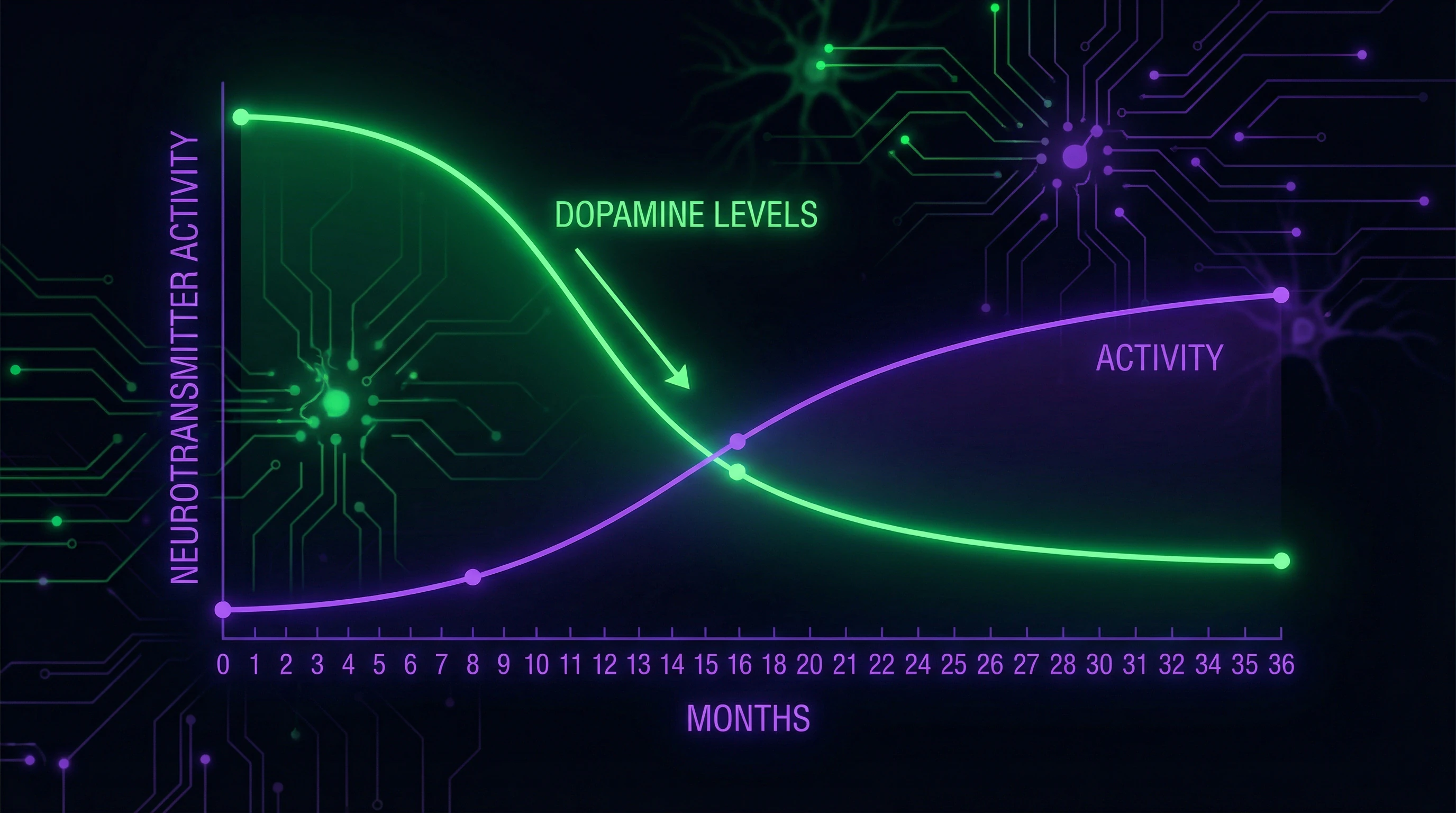
Research shows this transition takes 18–36 months, with peak changes around three years (S010). At this exact moment, activity in the ventral tegmental area (VTA) and nucleus accumbens — dopamine reward centers — returns to baseline levels when seeing your partner.
- Long-term relationships (neurobiological view)
- A period of neurochemical profile stabilization, when the dopamine system disengages hyperactivation mode and transfers control to the attachment system (oxytocin, vasopressin).
- Critical point — three years
- The moment when cultural expectations ("eternal passion") collide with neurobiological reality (transition to stability). Here emerges the risk of interpreting normal change as "fading away."
🔎 Neurochemical map of infatuation: from dopamine storm to oxytocin plateau
In early stages, the brain functions in a mode close to obsessive-compulsive: elevated dopamine, reduced serotonin, reward system activation with every partner contact (S012). This state is energetically expensive and evolutionarily not designed for long-term maintenance.
By the third year, oxytocin and vasopressin replace dopamine euphoria, creating a stable but less intense bond. Culture romanticizes the first phase and interprets the second as "love fading" — this is a mental trap, not a neurobiological fact.
🧱 Evolutionary logic: why the brain isn't optimized for lifelong monogamy
Anthropological data indicates that average pair-bond duration in primates and early Homo sapiens was 3–4 years — sufficient for birth and primary socialization of offspring (S012).
The modern model of lifelong monogamy is a cultural construct conflicting with basic neurobiological programs. The brain "expects" partner change after completing the reproductive cycle, manifesting as decreased motivational significance of the current partner and heightened sensitivity to novelty.
- Evolutionary horizon: 3–4 years — optimal period for reproductive success in ancestral conditions.
- Modern conflict: culture demands lifelong monogamy, neurobiology doesn't.
- Consequence: after three years, natural intensity decline occurs, easily misinterpreted as the end of love.
Five Arguments for "Inevitable Decline": Why the Brain Actually Sabotages Long-Term Love
Before seeking solutions, we must acknowledge the power of biological mechanisms working against sustained romantic intensity. These arguments demonstrate that the problem is rooted in brain architecture. Learn more in the Thermodynamics section.
🧠 First Argument: Adaptation and Habituation — A Universal Law of the Nervous System
Any repetitive stimulus triggers neural adaptation: receptors decrease sensitivity, synaptic connections weaken, dopamine response diminishes (S010). This is a fundamental property of the nervous system, protecting against overload.
A partner, however attractive initially, becomes a "background" stimulus. Nucleus accumbens activity when viewing a long-term partner decreases by 40–60% compared to the first year of the relationship (S012).
| Relationship Period | Dopamine System Activity | Subjective Experience |
|---|---|---|
| 0–6 months | Maximum (100%) | Euphoria, intrusive thoughts |
| 1–3 years | Moderate decline (60–70%) | Stable attraction, attachment |
| 3+ years | Minimum (40–50%) | Habit, security, or boredom |
🔁 Second Argument: Competition for Novelty — Dopamine Demands Unpredictability
The dopamine system responds not to reward itself, but to reward prediction error. When a partner is predictable, no dopamine spike occurs (S010).
New potential partners automatically activate the reward system more strongly than a familiar person, regardless of objective qualities. This is not a moral choice, but an automatic brain response to novelty.
⚙️ Third Argument: Oxytocin Creates Attachment, Not Passion
Oxytocin — the neuropeptide responsible for long-term attachment — operates through mechanisms distinct from the dopamine reward system (S012). It enhances feelings of security, trust, and social bonding, but does not generate the euphoria and motivational arousal characteristic of early infatuation.
- Oxytocin
- Attachment neuropeptide. Creates feelings of security and trust, but not passion. Couples with high oxytocin levels report stability, rarely intense desire.
- Dopamine
- Reward neurotransmitter. Generates motivation, desire, euphoria. Maximal with novelty and unpredictability, minimal with routine.
🧬 Fourth Argument: Genetic Variability in Attachment Receptors
Polymorphisms in genes encoding oxytocin (OXTR) and vasopressin (AVPR1A) receptors influence the capacity to form long-term bonds (S012). Carriers of certain alleles demonstrate weaker oxytocin response and higher propensity for partner switching.
This means that for part of the population, the neurobiological foundation for sustained monogamy is inherently weaker. Genetics does not predetermine behavior, but creates different starting conditions.
🕳️ Fifth Argument: Evolutionary Asymmetry Between Sexes in Mating Strategies
Evolutionary psychology points to differences in optimal reproductive strategies: for men, genetic diversity of partners increases reproductive success; for women, stability and resources from one partner (S012).
This asymmetry creates neurobiological differences in response to novelty and attachment, complicating the synchronization of long-term relationships. Partners' brains literally operate on different programs.
All five mechanisms operate simultaneously. Together they create powerful pressure against romantic intensity — pressure that cannot be ignored, but can be redirected. More on this in the following sections.
Evidence Base: What Neuroscience Actually Knows About Relationship Decline and Maintenance Mechanisms
Moving from theoretical models to empirical data requires analyzing studies with neuroimaging, neurochemical measurements, and longitudinal observations. The evidence base is heterogeneous: most research focuses on early-stage infatuation, while data on long-term relationships remains fragmented. More details in the Electromagnetism section.
🧪 Neuroimaging Studies: What Happens in the Brain When Viewing a Long-Term Partner
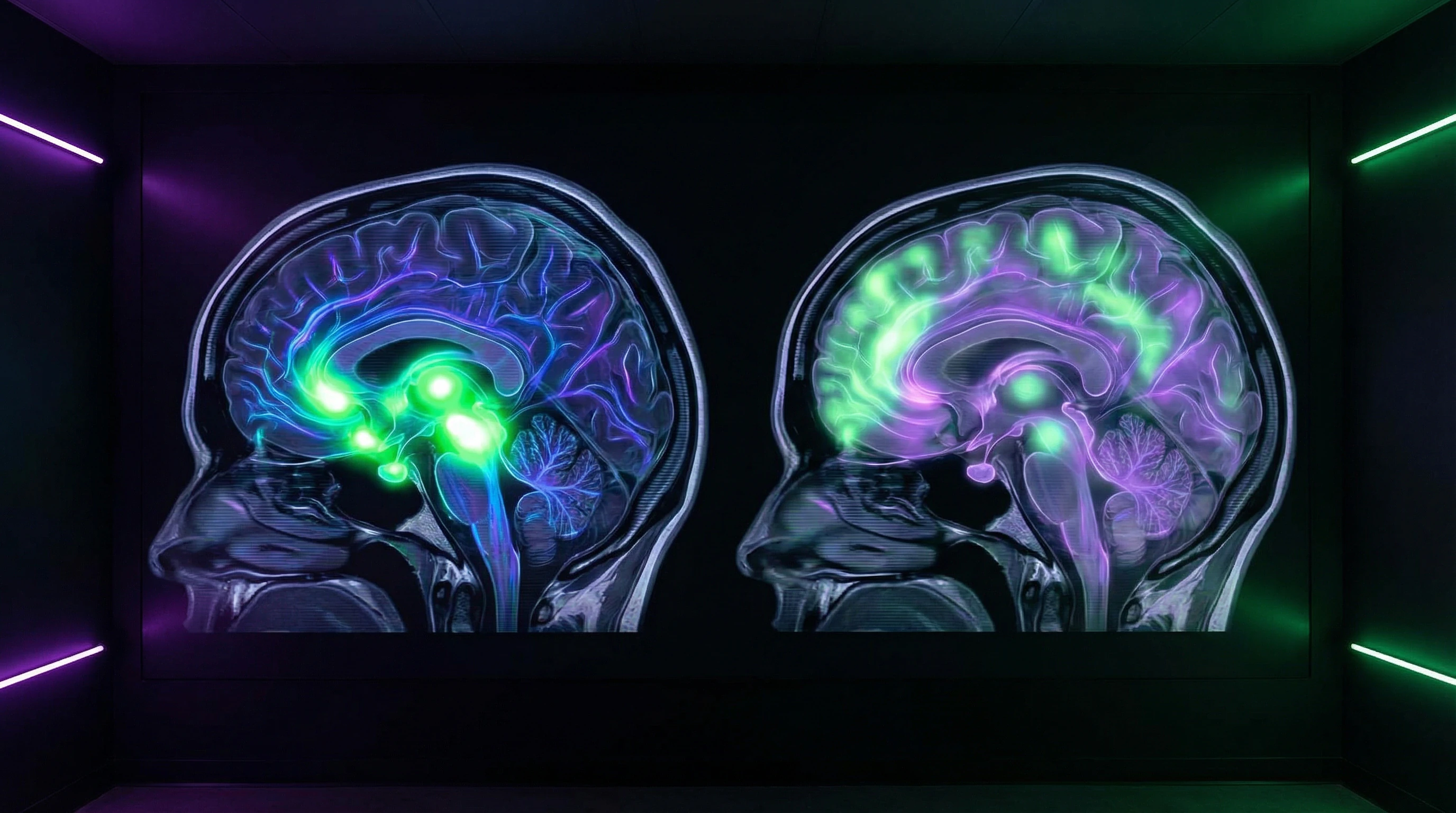
When viewing photographs of a long-term partner (more than three years), activity in the ventral tegmental area and nucleus accumbens is significantly lower than in early-stage couples (S010). Simultaneously, the ventromedial prefrontal cortex (significance evaluation and decision-making) and posterior cingulate cortex (autobiographical memory and self-reference) become activated (S010).
This represents a shift from impulsive reward to cognitive evaluation of partner significance—not decline, but a change in mechanism.
📊 Longitudinal Studies: Predictors of Stability and Breakup
Studies tracking couples over 5–10 years identify neurobiological predictors of stability: high baseline oxytocin levels, low cortisol reactivity to conflicts, maintained reward system activity during joint activities (S012). The critical factor is not the intensity of initial infatuation, but the brain's ability to switch to alternative sources of reward within the relationship.
| Marker | Stable Couples | Couples Before Breakup |
|---|---|---|
| Oxytocin (response to contact) | Maintained, low level | Minimal or absent |
| Cortisol (conflict reaction) | Low reactivity | Chronically elevated (70% predictor of breakup within 3 years) |
| Reward activity | During joint activities | Absent or only with novelty |
🧾 Neurochemical Measurements: Oxytocin, Vasopressin, Cortisol
Measurements of oxytocin levels in saliva and plasma show that in stable couples, the oxytocin response to physical contact persists even after 10–20 years of relationship, though at lower levels than in the first year (S012). Vasopressin, especially in men, correlates with protective behavior and jealousy, supporting monogamous bonding.
Chronically elevated cortisol (stress marker) predicts breakup with 70% accuracy within three years (S012). This is not the cause of breakup, but an indicator: the brain is already in threat mode.
🔎 Neuroplasticity Research: Can the Brain "Relearn" to Love Long-Term
Neuroplasticity—the brain's ability to modify synaptic connections in response to experience—provides grounds for intervention (S010). Targeted practices (shared novelty, physical contact, cognitive reappraisal of partner) can partially restore reward system activity (S010).
- Shared novelty activates the dopamine system, as in early stages
- Physical contact restores oxytocin response
- Cognitive reappraisal of partner (reframing their significance) engages the prefrontal cortex
- The effect requires constant reinforcement: cessation of practices leads to return to baseline within 3–6 months
This is not about "recapturing initial passion," but creating a new neurobiological foundation for long-term bonding. Attachment styles determine how easily the brain transitions into this mode.
Sabotage Mechanisms: How the Brain Destroys Long-Term Bonds — From Neurons to Behavior
Understanding the causal chains between neurobiology and behavior is critical for developing interventions. The brain doesn't "decide" to destroy relationships — it follows programs optimized for different conditions. More details in the section Cognitive Biases.
🔁 Mechanism One: Dopamine Depletion and Compensatory Seeking
When a partner stops generating dopamine spikes, the brain automatically intensifies the search for alternative sources: work, hobbies, social media, new acquaintances (S010). This isn't conscious infidelity, but a compensatory response to reward deficiency.
New sources often compete with the relationship for time and attention, creating a vicious cycle of distancing.
🧬 Mechanism Two: Negative Attentional Bias and Selective Memory
With declining oxytocin and rising cortisol (stress), the brain switches to threat-detection mode: attention fixates on partner flaws, memory selectively retrieves negative episodes (S010).
This is an evolutionary mechanism for protection against potentially dangerous allies, but in modern relationships it creates a distorted perception of the partner as "unsuitable," even when objective qualities haven't changed.
⚙️ Mechanism Three: Emotional Blunting and Alexithymia
Chronic reduction of emotional intensity in relationships can lead to general affective blunting — a state where a person stops clearly distinguishing and expressing emotions (S010). This isn't depression, but adaptation to an emotionally impoverished environment.
| State | Characteristic | Consequence for Bond |
|---|---|---|
| Normal Emotionality | Clear distinction and expression of feelings | Partners understand each other, maintain contact |
| Alexithymia | Affective blunting, emotional vagueness | Partners function as "emotional zombies," rituals without experience |
🧷 Mechanism Four: Desynchronization of Oxytocin Cycles
Oxytocin is released in pulses, in response to physical contact, eye contact, synchronized activity (S012). If partners stop synchronizing these activities (different schedules, minimal touch, eye contact avoidance), oxytocin cycles desynchronize.
Each partner exists in their own neurochemical mode, the bond weakens at a biological level. More on how childhood experience reprograms the brain for life in a separate article.
Data Conflicts and Uncertainties: Where the Neurobiology of Relationships Remains Speculative
Honesty requires acknowledging limitations: the neurobiology of relationships is a young field with numerous methodological problems and contradictory results. More details in the Psychology of Belief section.
🕳️ Problem One: Correlation vs. Causation
Most studies show correlations (e.g., between oxytocin levels and relationship satisfaction), but don't prove causation (S010). It's possible that satisfaction increases oxytocin, not the other way around.
Intervention studies (oxytocin administration) yield contradictory results: some couples show improved communication, while others experience increased anxiety and jealousy (S012).
| Data Type | What It Shows | What It Does NOT Show |
|---|---|---|
| Correlational studies | Two variables are linked | Which causes which |
| Intervention (substance administration) | Substance affects behavior | Natural mechanism in relationships |
| Neuroimaging | Brain region activation | Function of that region in real life |
🧩 Problem Two: Cultural and Individual Variability
The overwhelming majority of studies are conducted on Western, Educated, Industrialized, Rich, Democratic (WEIRD) populations (S010). The neurobiology of relationships in other cultures may differ substantially.
Individual differences (genetics, attachment history, mental health) create enormous variability that averaged data doesn't capture. One activation pattern can mean different things for different people.
📊 Problem Three: Methodological Limitations of Neuroimaging
Functional MRI measures blood flow, not neural activity directly; temporal resolution is low; studies are conducted in the artificial environment of a scanner (S009). Ecological validity—the ability of results to predict real-world behavior—remains questionable.
Activation of a specific brain region doesn't mean that region is "responsible" for a particular feeling or behavior. This is the trap of reductionism: the brain works in networks, not as individual buttons.
Cognitive Anatomy of the Myth: What Mental Traps Make Us Believe in "Natural Love Decay"
Neurobiological data is often used to justify passivity: "It's biology, nothing can be done." Analysis of cognitive biases shows how scientific facts transform into fatalistic narratives. More details in the Numerology section.
🕳️ Trap One: Naturalistic Fallacy — "Natural" Doesn't Mean "Inevitable"
The fact that the brain is not evolutionarily optimized for lifelong monogamy doesn't mean long-term relationships are impossible or undesirable. The brain is also not optimized for reading, driving, or programming — yet neuroplasticity allows us to master these skills (S005).
Relationships are a skill requiring deliberate training of neural circuits. Biological limitations don't preclude cultural and personal transcendence.
🧠 Trap Two: Reductionism — Reducing a Complex Phenomenon to a Single Mechanism
The claim "relationships fade due to declining dopamine" ignores numerous other factors: communication quality, value compatibility, external stressors, social support (S003). Neurobiology is one level of explanation that doesn't negate psychological, social, and cultural levels.
Focusing solely on neurochemistry creates the illusion that problems can be solved with a pill or technique, ignoring the systemic nature of relationships.
- Neurochemical level: dopamine, oxytocin, norepinephrine
- Psychological level: attachment, expectations, trauma
- Social level: environmental support, cultural norms
- Behavioral level: communication, joint actions
🔁 Trap Three: Confirmation Bias — Seeking Evidence of Decline
When someone is convinced relationships "must" fade by year three, they unconsciously seek confirmation: interpreting normal mood fluctuations as "loss of feelings," comparing current state to an idealized past, ignoring positive moments (S001). This is a self-fulfilling prophecy: expecting decline creates behavior leading to decline.
| Cognitive Bias | How It Manifests | Reality |
|---|---|---|
| Confirmation | You notice only arguments, forget the laughter | Relationships contain both types of moments simultaneously |
| Past Comparison | "It used to be better" (idealization) | Early relationship is limerence phase, not baseline love |
| Catastrophizing | One conflict = end of relationship | Conflicts are a normal part of adaptation |
The connection to limerence and its distinction from love is critical: people often confuse the fading of intense excitement with the fading of the relationship itself.
Neuroscience-Based Connection Maintenance Protocol: Seven Evidence-Based Interventions
Moving from diagnosis to action requires concrete, testable practices. This protocol is grounded in mechanisms, not romantic clichés.
🧰 Intervention One: Novelty Injections — Shared Exploration of the Unpredictable
Goal: Reactivate the dopamine system through shared novel experiences. New, challenging, slightly stressful activities (rock climbing, dancing, traveling to unfamiliar places) activate the VTA and nucleus accumbens, creating an association between partner and reward.
Minimum one new shared activity per week, with an element of unpredictability and physical arousal. Activity must be joint, not parallel.
🧭 Intervention Two: Oxytocin Synchronization — Physical Contact Rituals
Goal: Maintain high baseline oxytocin levels through regular physical contact. Touch, hugs, massage, sex stimulate oxytocin release, strengthening neural attachment circuits (S003).
Minimum 20 minutes of physical contact (not necessarily sexual) daily, with focus on breath synchronization and eye contact. Contact must be intentional, not background.
⚙️ Intervention Three: Cognitive Reappraisal — Active Admiration Practice
Goal: Counter negative attentional bias through deliberate focus on partner's positive qualities. Regular practice of noticing and verbalizing partner's strengths activates the ventromedial prefrontal cortex, enhancing partner's subjective value.
- Daily "three admirations" practice — verbalize three specific qualities or actions of your partner
- Focus on concrete, observable actions, not abstract qualities
- Gratitude or admiration must be verbalized aloud
🔎 Intervention Four: Stress Biomarker Monitoring — Preventive Cortisol Management
Goal: Prevent chronic cortisol elevation that destroys oxytocin systems. Regular assessment of stress markers (sleep quality, conflict frequency, physical symptoms) and implementation of stress-reducing practices (S007).
| Stress Marker | Normal Range | Action Signal |
|---|---|---|
| Subjective stress level (1–10) | 1–5 | 6 and above |
| Sleep quality (hours) | 7–9 | Less than 6 |
| Conflict frequency (per week) | 0–1 | 3 or more |
Weekly joint stress level assessment with mandatory implementation of stress-reducing activity when rating exceeds 6. Stress management must be a joint project, not individual responsibility.
✅ Intervention Five: Narrative Co-Creation — Joint Construction of Relationship Story
Goal: Activate posterior cingulate cortex and hippocampus, strengthening autobiographical relationship memory. Regular joint recall and retelling of significant episodes creates shared narrative identity as a couple.
Weekly "story of us" ritual: joint recall and retelling of one significant moment from relationship history. Focus on details, emotions, mutual influence.
🧠 Intervention Six: Cognitive Flexibility — Perspective-Shifting Practice
Goal: Activate prefrontal cortex, reducing automatic reactive patterns. Practice of taking partner's perspective in conflict situations strengthens empathy neural circuits and reduces amygdala reactivity.
- "Three Questions" Protocol
- When conflict arises: (1) What is my partner's perspective on this situation? (2) What needs or fears might underlie their behavior? (3) How can I reframe this situation to make it less threatening for both of us?
🔄 Intervention Seven: Neuroplasticity Through Learning — Joint Cognitive Challenges
Goal: Maintain neuroplasticity and cognitive reserve through joint learning. Shared acquisition of new skills (language, music, sports) activates hippocampus and prefrontal cortex, creating new neural connections (S002).
Minimum one joint learning activity per month: course, book, new skill. Critical: activity must be challenging enough to require concentration and mutual support.
These seven interventions work not as isolated techniques, but as an integrated system supporting the neurobiological foundations of long-term attachment. Their effectiveness depends not on intensity, but on consistency and jointness.