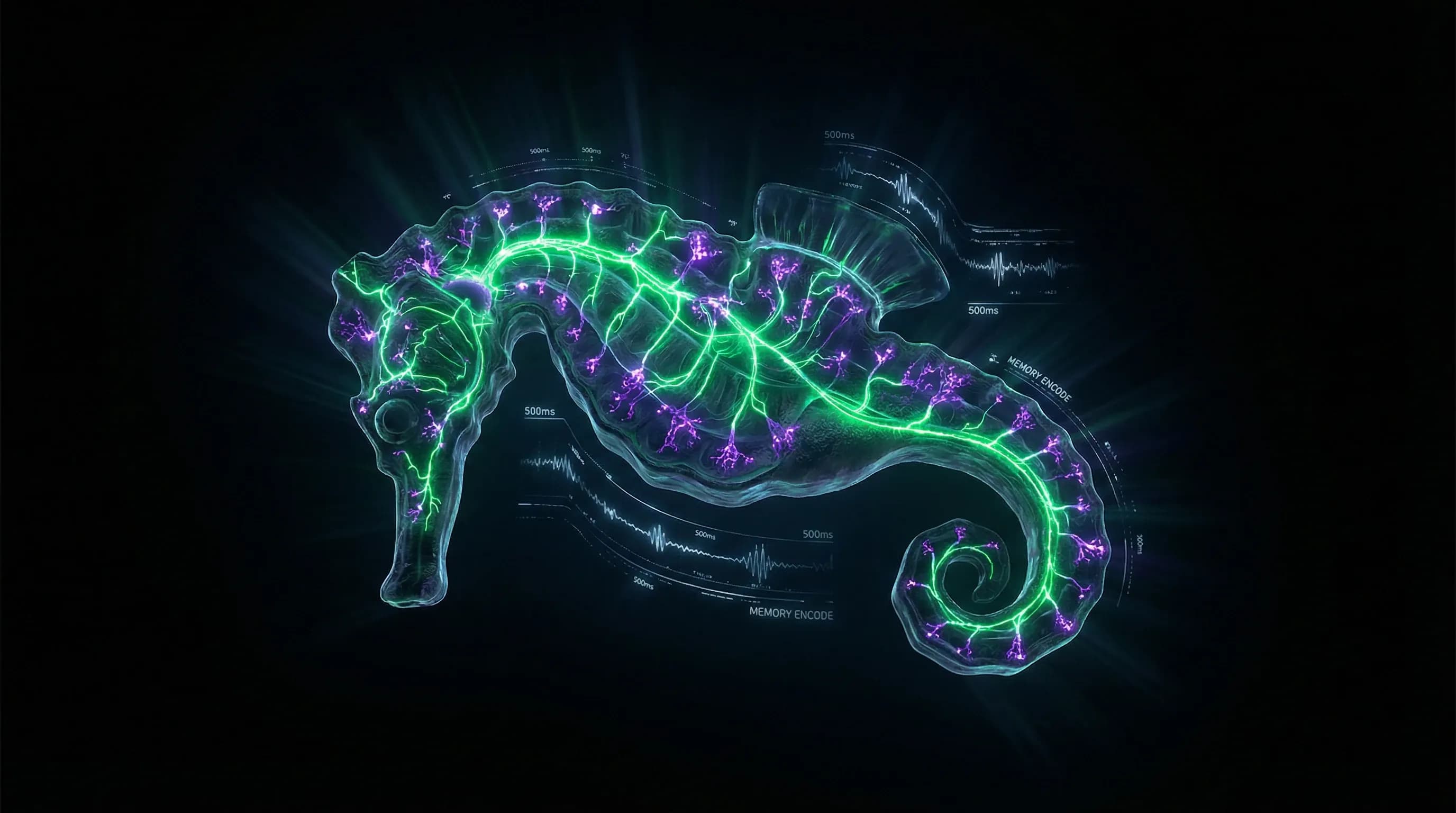
What the hippocampus is and why we've misunderstood its role in memory for the past 50 years
The hippocampus is a paired structure in the medial temporal lobe, named for its resemblance to a seahorse. For decades it was considered a memory storage vault, but current research reveals a fundamental misconception: (S005) the hippocampus doesn't store memory—it coordinates the encoding, consolidation, and retrieval of information, acting as a dispatcher between perception and memory. (S003)
🔎 Defining key concepts
- Episodic memory
- Memory of specific events with their temporal and spatial context. This is the type traditionally associated with the hippocampus. (S005)
- Encoding
- The transformation of sensory information into a form suitable for storage.
- Consolidation
- Stabilization of memory traces after initial acquisition. (S002)
- Place cells
- Hippocampal neurons that activate at specific locations in space. Their discovery earned a Nobel Prize and was long considered proof of the hippocampus's specialization in navigation. However, these same neurons encode other types of information depending on context.
- Ensemble fluidity
- Dynamic recruitment of neuronal populations based on excitability and functional connectivity, rather than fixed roles. (S001) The same neuron participates in encoding different memories at different times.
🧱 Boundaries of analysis: consensus and debates
Strong consensus exists regarding the hippocampus's critical role in episodic memory formation—confirmed by studies with over 3,000 citations. (S005) It's also established that the hippocampus is necessary for spatial memory and navigation.
Encoding mechanisms remain the subject of active debate. (S003)
Two competing theories explain information encoding in the hippocampus:
| Theory | Assumption | Status |
|---|---|---|
| Concept neurons | Individual neurons represent specific elements of episodes | Partially confirmed |
| Conjunctive index neurons | Neurons encode entire episodes as unified representations | Partially confirmed |
Current evidence suggests the truth lies in between. Encoding is context-dependent and represents a continuum rather than discrete types. More details in the Physics section.
Seven Arguments for the Unique Role of the Hippocampus: Why This Structure Is Truly Special
⚡ Argument One: Clinical Cases with Hippocampal Damage Demonstrate Specific Memory Deficits
Patient H.M., who had his hippocampus removed in 1953 to treat epilepsy, retained short-term memory and procedural learning but completely lost the ability to form new long-term episodic memories—anterograde amnesia (S005). The hippocampus is necessary for consolidating new memories, but not for storing them or retrieving old ones.
🔬 Argument Two: Neuroimaging Shows Specific Hippocampal Activation During Memory Formation
Functional MRI consistently demonstrates hippocampal activation during encoding of new information. The level of hippocampal activation during learning predicts subsequent retrieval success (S006).
Hippocampal activity during learning is not a correlation, but a causal predictor of memory success.
📊 Argument Three: Temporal Dynamics at 500 Milliseconds Mark the Transition from Perception to Memory
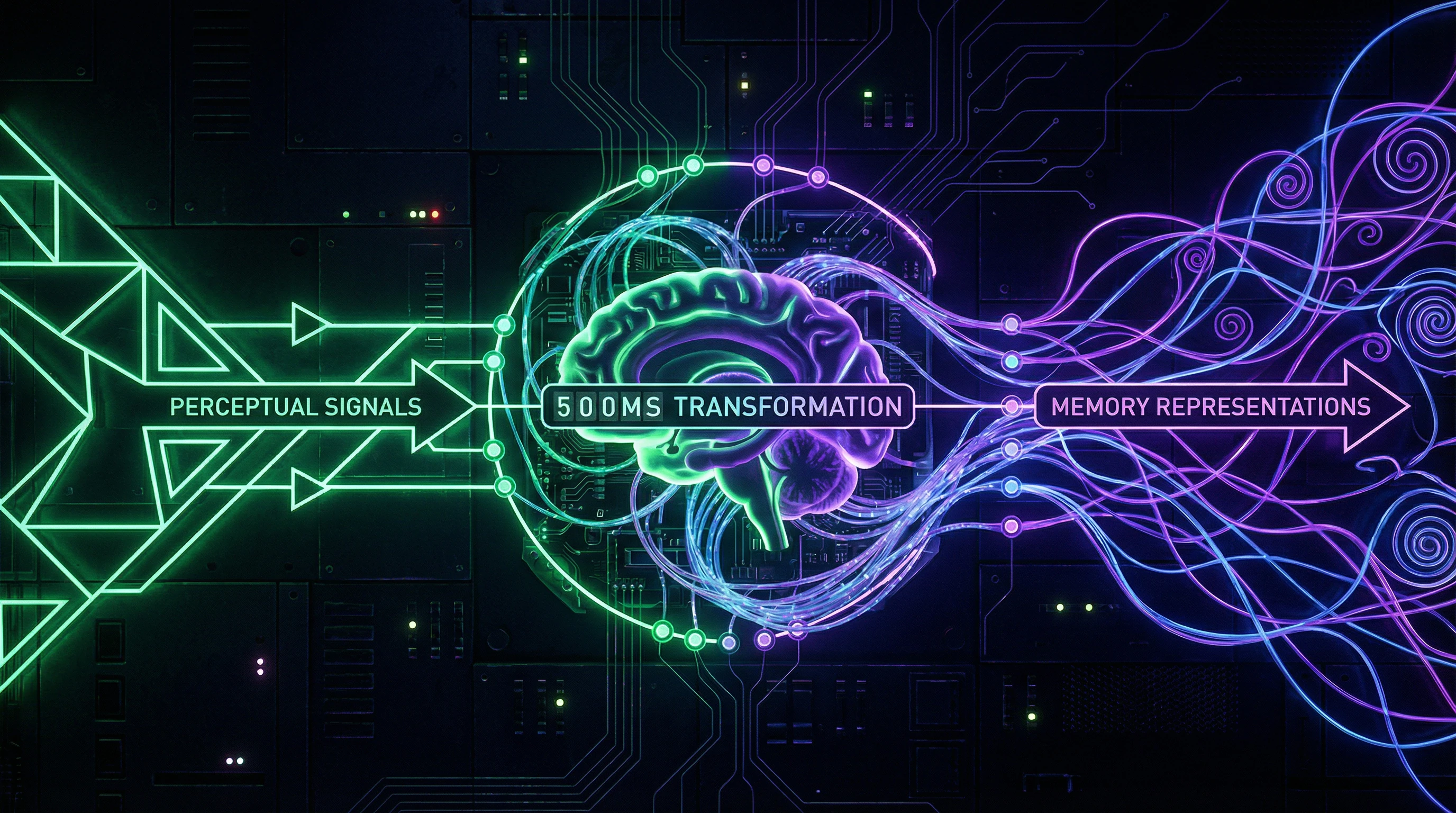
Magnetoencephalography has identified a critical point: approximately 500 milliseconds after stimulus presentation, the hippocampal signal marks the transformation of perceptual representations into internal mnemonic ones (S003). The hippocampus acts as a switch, actively transforming sensory information into a format for long-term storage.
🧬 Argument Four: Synaptic Plasticity in the Hippocampus Provides the Mechanism for Learning
The hippocampus is a critical site of synaptic plasticity for encoding declarative memories (S007). Long-term potentiation (LTP) and long-term depression (LTD)—strengthening or weakening of connections between neurons in response to activity—are most pronounced in the hippocampus.
🔁 Argument Five: Dual Coding Supports Learning of World States and Transitions Between Them
The hippocampus supports two modes of activity: associative coding for learning world states and predictive coding for learning transitions between states (S004). This duality allows not only remembering what happened, but also predicting what might happen next.
- Associative mode: encoding facts and events
- Predictive mode: modeling future transitions
- Result: adaptive behavior based on experience
🧠 Argument Six: Population Coordination Ensures Separation of Encoding and Retrieval Processes
The hippocampus dynamically coordinates representations for memory encoding and retrieval at the population level (S002). Neural activity patterns during encoding differ from patterns during retrieval, preventing interference between these processes.
Different neural codes for encoding and retrieval are not a bug, but a fundamental mechanism protecting memory from overwriting.
🧭 Argument Seven: Evolutionary Conservation of Structure Indicates Fundamental Importance
The hippocampus is present in all mammals and demonstrates high evolutionary conservation in structure and function. Basic principles of hippocampal operation are preserved from rodents to primates (S001).
| Species | Hippocampus Present | Memory Function |
|---|---|---|
| Rodents | Yes | Spatial and episodic memory |
| Primates | Yes | Spatial and episodic memory |
| Humans | Yes | Spatial and episodic memory |
Evidence Base: What 10,000+ Citations Tell Us About the Hippocampus's Role in Memory
📊 High-Level Consensus: Episodic and Spatial Memory
Scientific consensus: the hippocampus is critical for episodic memory (S005). Hippocampal damage, neuroimaging, and electrophysiology consistently confirm its role in forming new memories of events.
Spatial memory is the second area of consensus. Place cells in the rodent hippocampus and analogous neurons in humans show that the hippocampus constructs a cognitive map of space (S005). This function operates not only for physical navigation but also for abstract "spaces" of concepts and relationships.
🧪 Encoding Mechanisms: From Synaptic Plasticity to Ensemble Dynamics
The hippocampus is a critical site of synaptic plasticity for encoding declarative memories (S007). Long-term potentiation (LTP), discovered in 1973, remains one of the most studied mechanisms of cellular learning: sustained strengthening of synaptic transmission following high-frequency stimulation provides the cellular basis for associations between stimuli.
But current understanding extends beyond individual synapses. Research has shown that memory representations are updated through dynamic recruitment of neuronal ensembles based on excitability and functional connectivity (S001). Neurons don't have fixed roles—they're recruited into different ensembles depending on current excitability state and connectivity patterns.
| Level of Analysis | Mechanism | Function |
|---|---|---|
| Synaptic | Long-term potentiation (LTP) | Strengthening connections between neurons |
| Cellular | Dendritic spines | Physical substrate of synaptic changes (S004), (S006) |
| Population | Ensemble dynamics | Coordination of neurons for unified memory code |
| Systems | Oscillations and synchronization | Linking hippocampus with cortex (S008) |
🔎 Temporal Dynamics: The 500-Millisecond Transformation Window
Magnetoencephalography (MEG) has revealed a precise temporal window: a hippocampal signal approximately 500 milliseconds after perceptual stimulus marks the transformation of external (perceptual) representations into internal (mnemonic) ones (S003). Multivariate pattern decoding tracked representations in real time.
This transition isn't passive—the hippocampus actively transforms information. Before 500 milliseconds, decoders distinguished stimuli by sensory cortex activity. After this mark, discrimination became possible through hippocampal activity, indicating transfer of representation from the perceptual system to the mnemonic one (S003).
The hippocampus doesn't store a copy of perception—it translates it into another format suitable for long-term storage and retrieval. This reformatting takes half a second and is an irreversible step in turning an event into a memory.
🧾 Dual Coding: Associative and Predictive Codes
The dual-mode hypothesis: the hippocampus supports learning about world states and transitions between them (S004). Associative codes link the current state with its features and context; predictive codes encode probable future states.
Maze experiments revealed division of labor: some neuronal populations encoded current location and rewards (associative), others encoded likely next locations (predictive) (S004). Both modes work together, providing understanding of the current situation and action planning.
🧬 Population Coordination: Separating Encoding and Retrieval
Intracranial recordings in epilepsy patients during naturalistic memory tasks revealed that population activity patterns differ between encoding and retrieval (S002). This solves a fundamental problem: how the brain simultaneously forms new memories and retrieves old ones without confusion.
- Encoding
- High variability in hippocampal population activity patterns—creating unique representations for each new experience.
- Retrieval
- Stable and specific patterns, allowing precise reproduction of encoded information without interference with new memory formation (S002).
- Result
- Population coordination prevents conflict between plasticity (needed for new memories) and stability (needed for old ones).
This architecture explains why the hippocampus remains critical for memory: it doesn't simply store information but manages the dynamic balance between openness to the new and preservation of the old. Without this separation, the brain would either forget everything with each new experience or be unable to form new memories.
Mechanisms of Causality: How the Hippocampus Transforms Perception into Memory
⚙️ From Correlation to Causality: Experimental Manipulations of the Hippocampus
Causality in neurobiology requires more than correlation. Classic studies with hippocampal lesions in animals and clinical cases in humans have shown: removal or damage to the hippocampus leads to specific memory deficits (S005).
Optogenetic methods allow manipulation of hippocampal activity with microsecond precision. Activation of specific neuronal ensembles triggers recall of associated memories even without external stimuli; inhibition of these ensembles during encoding prevents memory formation (S003).
The hippocampus is not merely a storage facility. It's a dispatcher that decides which signals are worthy of transformation into long-term memory, and which remain noise.
🔁 Feedback Loops: How the Hippocampus Interacts with the Cortex
The hippocampus is embedded in a network: entorhinal cortex → hippocampus (CA3 → CA1 → subiculum) → cortical areas. Information circulates rather than simply passing through. More details in the Theory of Relativity section.
This architecture creates feedback loops critical for consolidation. According to systems consolidation theory, the hippocampus temporarily stores new memories and gradually "trains" cortical networks through repeated reactivation during sleep (S006). Over time, memories become independent of the hippocampus and fully integrate into cortical networks.
| Consolidation Stage | Hippocampal Role | Cortical Role |
|---|---|---|
| Encoding (0–30 min) | Active binding of elements, rapid encoding | Passive perception, primary processing |
| Early Consolidation (hours–days) | Reactivation, strengthening synaptic connections | Gradual strengthening of representations |
| Systems Consolidation (weeks–months) | Information transfer, gradual disengagement | Integration into long-term networks |
🧷 Confounders and Alternative Explanations: What Else Can Influence Memory
Hippocampal damage often affects surrounding medial temporal lobe structures, making it difficult to determine the specific contribution of the hippocampus (S006). The hippocampus is closely connected with the prefrontal cortex (working memory, control) and amygdala (emotional modulation).
Functional boundaries between memory systems are less clear-cut than previously assumed. Semantic memory, long considered independent of the hippocampus, requires its involvement in early stages of formation (S006).
- Verify whether neighboring structures (entorhinal cortex, perirhinal cortex) are affected in hippocampal damage.
- Separate the contribution of the hippocampus from other systems (prefrontal cortex, amygdala) using selective manipulations.
- Distinguish the hippocampus's role in encoding, consolidation, and retrieval through temporal manipulations.
- Account for brain plasticity: other structures may compensate for functions of a damaged hippocampus, especially with gradual damage.
Conflicts and Uncertainties: Where Scientists Still Debate How the Hippocampus Works
🧩 Concept Neurons vs. Index Neurons: A Fundamental Dispute About Encoding
A central debate in hippocampal neuroscience concerns the mechanism of episode encoding. The concept neuron theory proposes that individual neurons represent specific elements of episodes—people, places, objects (S011). The discovery of so-called "Jennifer Aniston neurons"—cells that selectively activate to images of a specific celebrity—supports this hypothesis.
The alternative conjunctive index neuron theory argues that neurons encode entire episodes as unified representations (S011). Each episode is represented by a unique pattern of ensemble activity, serving as an "index" for retrieving the full representation from cortical networks.
Current evidence suggests the truth lies somewhere in between. The same neuron may function as a concept cell in one context and as part of an index ensemble in another.
A 2024 study showed that spatial and mnemonic properties of hippocampal neurons represent a context-dependent continuum rather than discrete types (S012). This indicates encoding flexibility rather than rigid specialization.
🔎 Semantic Memory: Does the Hippocampus Participate or Not
The traditional model divided functions clearly: hippocampus for episodic memory, other structures for semantic memory (general knowledge). However, evidence challenges this division (S006).
A review with 250 citations presents evidence that the hippocampus and medial temporal lobe are critical for encoding semantic memory (S006). Patients with hippocampal damage demonstrate deficits not only in episodic but also in semantic memory, especially when acquiring new concepts. Neuroimaging shows hippocampal activation during semantic memory tasks.
| Position | Hippocampal Role in Semantics | Evidence |
|---|---|---|
| Early Dependence | Required only in initial stages of knowledge formation | Semantic knowledge becomes independent after consolidation |
| Extended Role | Participates in organizing and retrieving semantic knowledge | Hippocampal activation when accessing semantic information |
The extent and duration of semantic memory's dependence on the hippocampus remain subjects of debate (S006). Researchers diverge in interpreting the same data.
🧠 Working Memory: Is It Embedded in Place Cells or a Separate System
A 2024 study showed that working memory signatures are embedded in hippocampal place cells (S012). This challenges the traditional view that working memory is exclusively a prefrontal cortex function.
Researchers found that during working memory tasks, place cells encode not only the animal's current location but also information that needs to be held in memory for several seconds. This suggests the hippocampus may serve as a temporary buffer for information requiring active maintenance. More details in the Chemistry section.
The question remains open: is this an intrinsic hippocampal function or the result of interaction with the prefrontal cortex, which coordinates working memory through the hippocampus.
If the hippocampus truly participates in working memory, this redefines its functional architecture. The traditional division between the hippocampus's "long-term" memory and other structures' "short-term" memory becomes less clear.
⏱️ Memory Consolidation: Active or Passive
Classical theory proposed that memory consolidation is a passive process: the hippocampus encodes an episode, then information is slowly "transferred" to the cortex. However, new evidence suggests a more active mechanism.
- Active Consolidation
- The hippocampus doesn't simply transfer information but actively restructures and reintegrates it with existing knowledge. This process may involve replaying episodes and reprocessing them (S003).
- Passive Consolidation
- Information gradually becomes independent of the hippocampus through slow synaptic changes in the cortex, without active hippocampal participation in restructuring.
- Hybrid Model
- Consolidation involves both active reprocessing and passive synaptic changes working in parallel.
Evidence of multiple repressive mechanisms in the hippocampus during memory formation (S003) suggests the process is more complex than simple information transfer. The hippocampus actively suppresses certain signals and amplifies others, indicating selective reprocessing.
🔗 Interaction with Other Structures: Hierarchy or Network
The traditional model portrayed the hippocampus as a "master controller" coordinating memory through a hierarchical system. However, current evidence suggests a more complex network organization.
The hippocampus interacts with the prefrontal cortex, amygdala, entorhinal cortex, and other structures not in a "boss-subordinate" mode but as equal partners exchanging information bidirectionally. This means memory is formed not in the hippocampus but through coordinated activity of the entire network.
The question remains: which structure initiates consolidation, and can this role shift between structures depending on memory type and context.
Research shows that the epistemological foundations of our understanding of memory require rethinking. We're accustomed to seeking a "control center," but the brain may operate through distributed networks without a single controller.
📊 Why These Debates Matter
These conflicts aren't academic. They determine how we interpret data on memory disorders, develop treatments for amnesia, and understand how the brain organizes experience. Each theory implies different recovery mechanisms and different intervention points.
Moreover, these debates reflect a fundamental problem in neuroscience: we observe correlations (a neuron is active when an animal remembers), but causality remains unclear. Is the neuron active because it encodes memory, or because it coordinates other processes that encode memory.