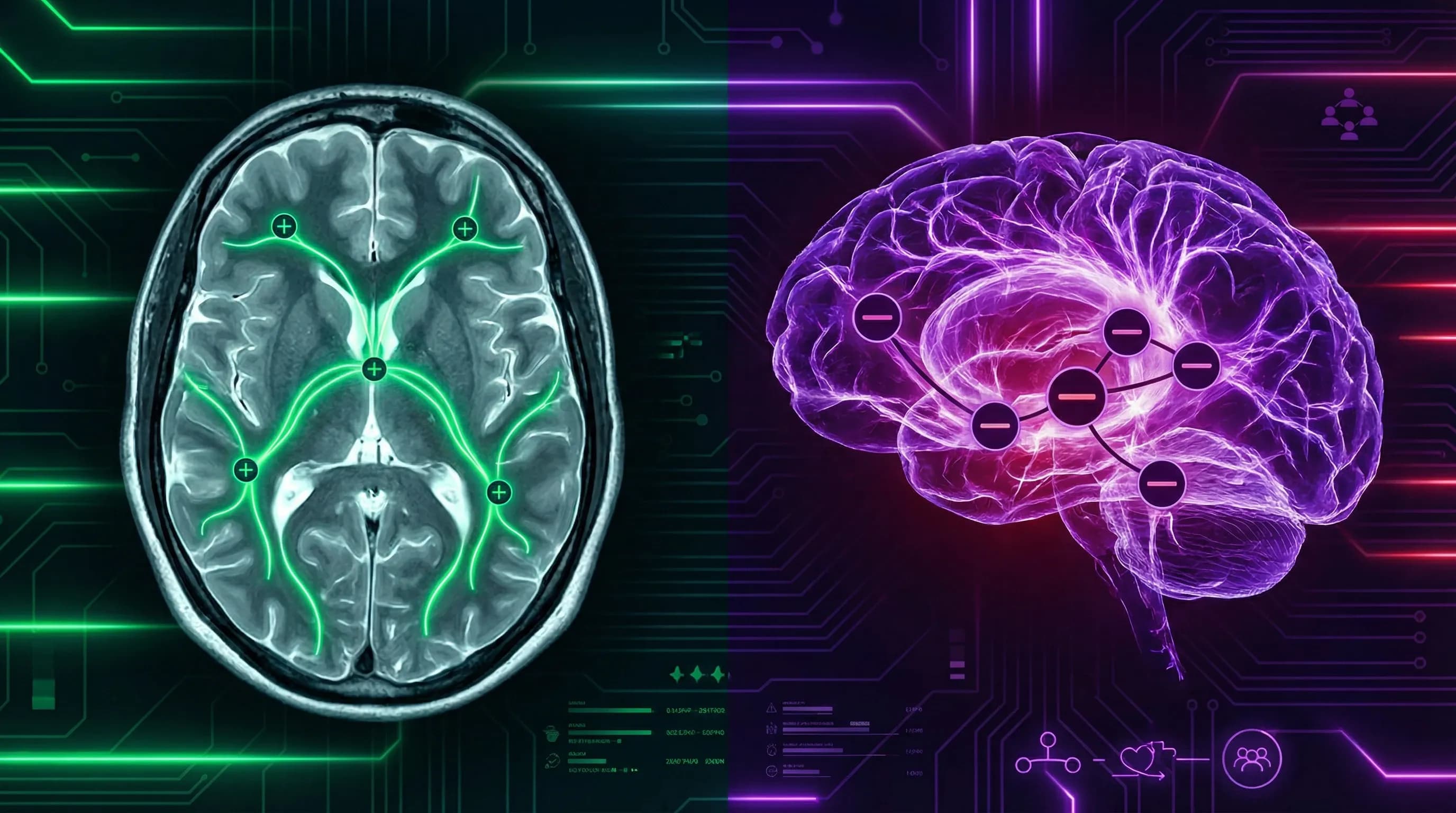
What is Gottman's 5:1 Ratio — and Why It's Not Just a Pretty Metaphor for Instagram Psychologists
The 5:1 ratio, known as the "magic ratio," is an empirically established proportion between positive and negative interactions in a couple, necessary for long-term relationship health. John Gottman, a psychologist at the University of Washington, formulated this rule based on years of observations of married couples in laboratory experiments, where participants discussed conflict topics while researchers recorded not only verbal content but also physiological responses — heart rate, skin conductance, facial microexpressions (S009), (S011).
The rule states: for every negative interaction — criticism, contempt, defensiveness, stonewalling — there must be at least five positive ones: expressions of affection, humor, support, active listening, validation of partner's feelings. More details in the section Quantum Mechanics.
Operational Definitions: What Counts as Positive and Negative
- Positive Interactions
- Specific observable behaviors: verbal expressions of gratitude and appreciation, physical displays of affection (touch, hugs), humor without sarcasm or put-downs, active listening with eye contact and nodding, validation of partner's emotions even when disagreeing with their position, offering help and support in stressful situations (S001), (S012).
- Negative Interactions
- Four categories Gottman called the "Four Horsemen of the Apocalypse": criticism (attacking partner's character rather than specific behavior), contempt (sarcasm, mockery, eye-rolling, position of moral superiority), defensiveness (denying responsibility, counter-accusations), stonewalling (emotional shutdown, refusal to engage in dialogue) (S001), (S005).
The "Emotional Bank Account" Metaphor and Its Neurobiological Basis
Gottman uses the metaphor of an "emotional bank account": each positive interaction makes a deposit, each negative one makes a withdrawal (S001). But this isn't symmetrical accounting.
Due to the phenomenon of negativity bias, the brain processes and remembers negative events significantly more intensely than positive ones — approximately five times more powerfully (S008), which explains the necessity of precisely this proportion.
Evolutionarily this makes sense: for survival it's critically more important to remember a threat (predator, poisonous plant, aggressive tribe member) than a pleasant event. In the context of relationships, this means that one insult or display of contempt leaves a deeper emotional trace than one compliment, and requires multiple positive interactions to restore balance. For more on how the brain encodes emotional events, see the article on the hippocampus as memory dispatcher.
Boundaries of Applicability: When the Rule Works and When It Doesn't
The 5:1 rule is especially critical during conflict interactions — precisely in these situations Gottman observed couples and recorded the ratio (S001), (S011). However, it also applies to the general pattern of interactions in daily life: couples who maintain a high level of positive interactions during calm periods create a "reserve" in the emotional account that helps weather inevitable conflicts (S006).
| Condition | Applicability of 5:1 Rule |
|---|---|
| Active conflict, discussing disagreements | Maximum — this is where the ratio is critical for couple survival |
| Daily interactions during calm periods | High — creates emotional reserve for the future |
| Crisis situations (illness, loss, external stress) | Medium — requires adaptation to context, not mechanical application |
It's important to understand that 5:1 is a minimum threshold, not an optimal value: successful couples often demonstrate ratios significantly higher than this level (S002), (S003). The rule doesn't work mechanically — five superficial compliments don't compensate for deep humiliation or displays of contempt; the quality, sincerity, and timing of interactions matter no less than their quantity (S012).

Steel Version of the Argument: Five Reasons Why the 5:1 Rule May Be a Valid Discovery, Not a Psychological Fad
Before examining limitations and criticisms, it's necessary to present the strongest version of the argument in favor of Gottman's rule — this is the intellectual honesty that distinguishes scientific analysis from ideological polemic. The steel version (steelman) assumes we take the best evidence and most convincing interpretations of the data, even if we later critique them. More details in the Abiogenesis section.
🔬 First Argument: Methodological Rigor of Longitudinal Observations with Physiological Measurements
Gottman didn't rely on self-reports or retrospective surveys — he observed real couple interactions in laboratory conditions, where participants discussed conflict topics while researchers recorded not only conversation content but also physiological reactions: heart rate, skin conductance, facial microexpressions. Levenson and Gottman were pioneers in using this method, measuring physiological indicators of married couples during disagreements.
This allowed objective assessment of participants' emotional states, bypassing problems of social desirability and memory distortions. The studies were longitudinal: couples were observed over many years, allowing tracking of real outcomes — marriage preservation or divorce — and correlating them with interaction patterns recorded at early stages (S001), (S011).
- Objective physiological markers instead of subjective assessments
- Multi-year tracking of real outcomes (divorce/marriage preservation)
- Laboratory conditions with controlled variables
- Replication of methodology across different research centers
📊 Second Argument: 94% Predictive Accuracy Is Not Chance or Data Fitting
Gottman claimed he could predict which couples would divorce and which would stay together with up to 94% accuracy, based on observing their interactions during conflict (S011), (S019). Such high predictive accuracy in social sciences is rare, and it indicates that the ratio of positive to negative interactions is indeed a powerful indicator of relationship health.
Critics might argue this results from model overfitting, but replications of studies in different laboratories and with different samples confirmed the general pattern: couples with low positive-to-negative ratios demonstrate significantly higher rates of distress and relationship dissolution (S003), (S005).
🧬 Third Argument: Neurobiological Foundation Through the Negativity Bias Phenomenon
The 5:1 rule is not an arbitrary number — it correlates with the well-established neurobiological phenomenon of negativity bias. Research shows that negative stimuli trigger stronger activation of the amygdala and other brain structures associated with threat processing, compared to positive stimuli of equivalent intensity (S012).
Negative memories are encoded more firmly and retrieved more easily than positive ones. This means that achieving emotional balance truly requires an asymmetric ratio of positive to negative events — approximately five times more positivity to compensate for the brain's enhanced processing of negativity (S012), (S008).
Negativity bias isn't an evolutionary bug, but a feature: threats require immediate response, while rewards can wait. That's why the brain "weighs" losses five times heavier than gains.
🧾 Fourth Argument: Convergent Validity — Independent Studies Confirm the Importance of Positive-Negative Balance
The 5:1 rule is not an isolated discovery of one research group. Independent studies in relationship psychology confirm that successful couples maintain a high ratio of positive to negative interactions, though the exact number may vary (S003).
Work on emotional expression in couples, compassion training, and cognitive reappraisal also points to the critical importance of balance between positive and negative emotional displays for reducing conflict behavior (S005). This convergent validity strengthens confidence in Gottman's core idea, even if the specific 5:1 number may be approximate.
| Evidence Source | What It Confirms | Reliability Level |
|---|---|---|
| Gottman's longitudinal observations | 94% predictive accuracy | High (replication across different labs) |
| Neurobiology of negativity bias | Asymmetric processing of threats vs. rewards | High (consensus in neuroscience) |
| Independent relationship psychology studies | Importance of positive-negative balance | Medium (variability in exact numbers) |
🛡️ Fifth Argument: Clinical Utility — The Rule Gives Couples a Concrete, Measurable Guideline for Working on Their Relationship
Regardless of whether 5:1 is an absolutely precise number, this rule possesses high clinical utility: it gives couples and therapists a concrete, understandable, and measurable guideline for assessing and improving interaction quality (S002), (S011).
Instead of abstract appeals to "love more" or "fight less," the 5:1 rule offers an operational criterion: track the ratio of positive to negative interactions, especially during conflicts, and strive to maintain it above a minimum threshold. This makes relationship work more structured and purposeful, which may explain the effectiveness of therapeutic approaches based on the Gottman method (S004).
- Operationality
- The rule provides a measurable criterion instead of vague recommendations. Couples can track the actual ratio of interactions and see progress.
- Validation in Clinical Practice
- Therapists using the Gottman method report improvements in clients' relationship quality, confirming the practical value of the approach.
- Reduced Cognitive Load
- Instead of analyzing complex psychological dynamics, couples receive a simple, memorable guideline for self-reflection.
Evidence Base: What We Know About the 5:1 Rule from Peer-Reviewed Research — and Where Speculation Begins
Let's turn to the empirical data that supports or challenges Gottman's rule. Each claim is accompanied by a source reference for verification of the evidence chain. For more details, see the Physics and Meta-Analysis section.
📊 Gottman's Original Research: Design, Sample, and Key Findings
John Gottman conducted a series of longitudinal studies beginning in the 1980s, observing married couples during discussions of conflict topics in laboratory settings. Participants were invited to the "Love Lab," where their conversations were videotaped and physiological measures (heart rate, skin conductance) were recorded in real time.
Gottman coded each interaction as positive, negative, or neutral, using a detailed category system. Couples were tracked over several years, and researchers recorded who remained married and who divorced. Based on this data, Gottman (1993) formulated the 5:1 rule — the ratio of positive to negative behaviors during conflict interactions (S009), claiming 94% predictive accuracy (S011).
Key point: the 5:1 rule emerged not from theory, but from observation of real couples. But observation is not the same as causation.
🧪 Replications and Extensions: What Independent Studies Have Shown
Independent research confirms the importance of balance between positive and negative interactions, though the precise 5:1 figure is not always reproduced with the same rigor. Successful couples maintain a five-to-one ratio of positive to negative interactions as a key indicator of relationship health (S003).
Feldman's (2019) work comparing compassion training and cognitive reappraisal for couples showed that emotional expression and the balance of positive and negative emotions are critically important for reducing conflict behavior (S005). However, not all studies focus specifically on the 5:1 ratio — many examine more general patterns of positive and negative interactions without tying them to a specific number.
| Study Type | Main Finding | Limitation |
|---|---|---|
| Gottman's Original Studies (1980s–1990s) | 5:1 ratio predicts divorce with 94% accuracy | Limited sample, laboratory conditions, no control for cultural differences |
| Independent Replications | Balance of positive and negative interactions matters | Precise 5:1 figure not always reproduced |
| Interaction Quality Studies | Depth and sincerity matter more than quantity | Harder to measure, requires subjective assessment |
🧾 Limitations and Criticism: Post-Therapy Relapse and the Problem of Long-Term Maintenance
One of the most significant limitations of the 5:1 rule relates to the long-term effectiveness of therapeutic interventions. Research by Baucom and colleagues showed that 30% of couples who recovered through therapy returned to problems within 2 years, and by 4 years this figure rose to 38% (S004).
This indicates that achieving the right ratio of positive to negative interactions is not a one-time task, but a process requiring constant effort. Couples can learn to improve their interactions in the short term, but without ongoing practice they tend to revert to old patterns.
Speculation begins here: popular versions of the 5:1 rule often ignore that it requires continuous work, not a one-time "fix."
🔎 Quality vs. Quantity: Why Not All Positive Interactions Are Equal
A critically important nuance often missed in popularizations of the 5:1 rule is the quality of interactions. Research by Kugler and colleagues (2020) showed that higher levels of cognitive, emotional, and behavioral complexity in conversations are associated with more constructive interactions (S008).
This means that not just any five compliments compensate for one insult — the depth, sincerity, and emotional engagement in positive interactions matter. Superficial, mechanical displays of positivity (a perfunctory "thanks" or formulaic compliment) don't create the emotional reserve necessary to overcome negative interactions.
- Context matters: attempting to "compensate" for an insult with five compliments immediately after a conflict can be perceived as manipulation.
- Timing is critical: positive interactions distributed over time create a more stable emotional reserve than concentrated "bursts."
- Sincerity isn't measured by quantity: one deep, vulnerable conversation can "weigh" more than ten superficial compliments.

Mechanism of Action: Why Negative Interactions "Weigh" More — Neurobiology of Emotional Memory and Threat
To understand why the 5:1 ratio has neurobiological validity, we need to examine the asymmetry in how the brain processes positive versus negative stimuli. For more detail, see the section on Epistemology Basics.
🧬 Negativity Bias: Evolutionary Legacy of the Threat Detection System
Negativity bias is the brain's tendency to pay more attention to, process more intensely, and remember more durably negative stimuli (S008). Evolutionarily, this makes sense: for survival, it's more critical to quickly detect a threat (predator, poisonous food, aggressive tribe member) than a pleasant event.
A Type I error — missing a threat — can cost your life. A Type II error — false alarm — costs only energy expenditure. Natural selection favored organisms with more sensitive threat detection systems.
In the context of relationships: one insult, contempt, or dismissal activates the brain's threat system far more powerfully than one compliment activates the reward system.
🔁 Amygdala and Hippocampus: Encoding into Long-Term Memory
The amygdala processes emotionally significant stimuli, especially those related to threat. During a negative interaction — insult, criticism, contempt — it activates, triggering a cascade of reactions: increased heart rate, elevated cortisol, enhanced encoding of the event into long-term memory through interaction with the hippocampus (S008).
Positive events activate emotional centers more weakly, leaving a less durable memory trace. Negative memories are retrieved faster and in greater detail than positive ones — people "get stuck" on grievances, even when relationships contained many good moments.
| Parameter | Negative Event | Positive Event |
|---|---|---|
| Amygdala Activation Intensity | High | Moderate |
| Memory Durability | Long-term, detailed | Short-term, diffuse |
| Memory Retrieval Speed | Fast | Slow |
| Physiological Response | Cortisol, adrenaline | Dopamine, oxytocin |
⚙️ Emotional Flooding and Physiological Dysregulation
Gottman introduced the concept of "emotional flooding" — a state where the intensity of negative emotions during conflict becomes so high that a person loses the capacity for rational thinking (S009). Physiologically: sharp increase in heart rate (above 100 beats per minute at rest), elevated stress hormones, narrowed cognitive focus.
The person shifts into "fight or flight" mode — any attempts to resolve the conflict become counterproductive. Levenson and Gottman measured heart rate and skin conductance in married couples during disagreements: couples with high physiological activation had worse long-term outcomes (S009).
Negative interactions during conflicts are especially destructive: they leave a deep emotional trace and trigger physiological reactions that make constructive resolution virtually impossible.
🧷 Irreversibility of Emotional Damage
The 5:1 ratio describes the minimum ratio for maintaining relationship health, but doesn't mean five compliments "cancel out" one insult. Emotional damage doesn't disappear completely — it can be compensated for, softened, balanced by positive interactions, but the memory trace remains (S008).
Some types of negative interactions — especially contempt, which Gottman considers the most destructive of the "Four Horsemen" — inflict such deep damage that they require not just a quantitative preponderance of positivity, but qualitative restoration of trust and relationship reevaluation.
- Negative events are encoded into long-term memory with high detail
- Positive events activate the brain more weakly and are forgotten faster
- Physiological dysregulation during conflict blocks constructive resolution
- Recovery requires not only quantity of positivity, but qualitative change in interaction patterns
This explains why in the neurobiology of attachment, early negative experiences leave such a deep imprint, and why relationship breakup activates the same grief mechanisms as losing a loved one.