Free will is one of the most persistent illusions of human consciousness. Neuroscience shows that decisions are made before we become aware of them, and the sense of control is a post-hoc construction by the brain. Philosophers are divided between determinism, compatibilism, and libertarianism, but there's no consensus. This article examines the evidence base, explains the cognitive mechanisms behind the illusion, and shows why abandoning belief in free will doesn't make life meaningless.
🖤 Every morning you wake up and "decide" what to wear, what to eat, which task to tackle first. This sense of choice feels so fundamental that doubting it seems like doubting your own existence. But what if this sensation is merely a narrative the brain constructs after the fact to create an illusion of coherence and control? What if the neural processes determining your actions fire hundreds of milliseconds before you "consciously" register your decision? Neuroscience over recent decades has accumulated a body of evidence that challenges the very concept of libertarian free will—the idea that we are independent agents capable of making choices not determined by prior causes. This article explores the scientific foundations of the free will illusion, the philosophical positions in this debate, and the practical consequences of accepting determinism.
What exactly we mean by "free will" — and why the definition decides everything in this debate
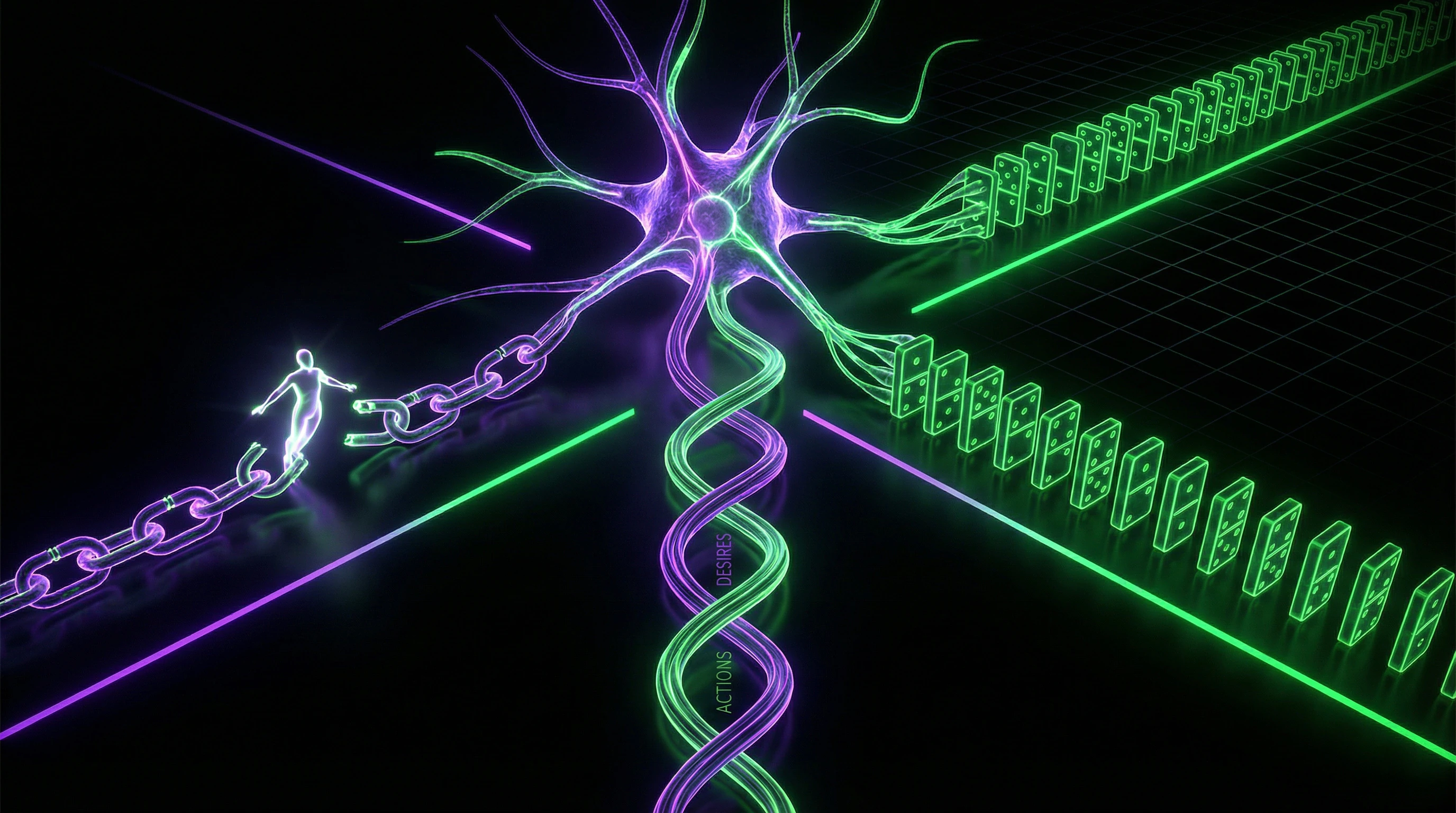
Before assessing whether free will is an illusion, we need to define which freedom we're talking about. Philosophical tradition distinguishes several concepts, and confusion between them is the source of most misunderstandings in debates (S001, S005).
- Libertarian free will
- The ability to initiate actions outside the deterministic chain — to be a source of causation not fully determined by prior brain states, genetics, or environment. Requires a break in the causal chain: some "self" standing outside physical laws (S001).
- Compatibilism
- Free will is compatible with determinism if redefined as the ability to act according to one's desires and beliefs without external coercion. You're free if your actions flow from your own motives, even if those motives themselves are determined (S001, S005).
- Hard determinism
- All events — including human thoughts and actions — are inevitable consequences of prior causes. The sensation of free choice is an illusion generated by the brain to create a coherent narrative of selfhood (S002, S003).
Libertarian freedom: why neuroscience rejects it
The libertarian concept faces the greatest pressure from neuroscience. If every mental state supervenes on a physical brain state, and physical processes obey causal laws, then there's no room left for libertarian freedom.
Quantum indeterminacy, cited by free will defenders, doesn't solve the problem: randomness at the quantum level isn't equivalent to meaningful agency. Randomness isn't freedom.
Compatibilism: redefinition instead of solution
Compatibilists offer a pragmatic compromise: preserve the concept of moral responsibility by redefining freedom as absence of external coercion. But critics point to question-begging. More details in the Thermodynamics section.
| Compatibilist answer | Critical objection |
|---|---|
| You're free if you act according to your desires | But where do the desires themselves come from? If they're determined by genetics and upbringing, in what sense are they "yours"? |
| This is sufficient for moral responsibility | This describes freedom from external coercion, but doesn't solve the metaphysical problem of the source of agency |
Hard determinism: illusion as brain function
Hard determinism denies libertarian freedom and rejects compatibilist compromises. All events — including human thoughts and actions — are inevitable consequences of prior causes (S002, S003, S006).
The sensation of free choice isn't an error, but a function: the brain constructs a narrative of selfhood to coordinate behavior. This position doesn't lead to fatalism. Determinism doesn't mean choices don't matter — it means the choices themselves are determined, and the system of punishments and rewards remains functional because it's part of the causal chain (S006, S008).
Key insight: the free will debate is often conducted in different languages. The libertarian speaks of metaphysical independence, the compatibilist of psychological autonomy, the determinist of causal structure. Without clarifying definitions, debates become a dialogue of the deaf.
Steelman Arguments: Seven Strongest Cases for the Reality of Free Will
Before examining evidence for the illusory nature of free will, we must present the most compelling arguments from the opposing side. Intellectual honesty requires considering the steelman version of the opponent's position—that is, its strongest rather than caricatured form. More details in the Cosmology and Astronomy section.
🧠 Phenomenology of Choice: Direct Experience of Agency as Primary Given
The most fundamental argument for free will is the direct subjective experience of decision-making. When you face a choice, you experience the sensation of weighing alternatives, considering consequences, and consciously selecting one option over another. This phenomenological experience is so compelling that denying it seems absurd—like denying the existence of pain or color (S003).
Defenders of free will argue that any theory denying the reality of this experience must bear the burden of proof. Why should we trust indirect scientific interpretations more than direct experience? If science says the conscious experience of choice is illusory, perhaps the problem lies with scientific models, not with experience.
🧬 Emergence and Irreducible Complexity of Consciousness
Even if individual neurons obey deterministic laws, this doesn't mean consciousness as an emergent property of neural networks is also fully determined. Complex systems exhibit properties that cannot be predicted from the behavior of their components. Perhaps at the level of integrated neural activity, forms of causality emerge that cannot be reduced to the physics of individual synapses (S001).
This argument doesn't require dualism or violation of physical laws. It suggests that causality can operate at different levels of organization, and high-level mental states can exert top-down causal influence on neural processes through feedback mechanisms.
📊 Quantum Indeterminacy as Source of Ontological Randomness
Some researchers, including Danko Georgiev, suggest that quantum effects in neural processes may provide a source of true randomness that breaks classical determinism (S012). If quantum indeterminacy plays a functional role in decision-making, then the future is not completely predetermined by the past.
Georgiev offers an evolutionary explanation for belief in free will: we evolved to believe in it because it makes us more socially cooperative and morally responsible beings. If this belief is adaptive, perhaps it reflects a real feature of our cognitive architecture rather than mere illusion (S012).
🧷 Libet Experiments Don't Refute Free Will, They Only Show the Temporal Structure of Decisions
Benjamin Libet's famous experiments, which showed that readiness potential in the brain emerges 300-500 milliseconds before conscious intention to act, are often interpreted as proof that free will is illusory. However, critics point to methodological problems with these experiments (S001, S011).
First, readiness potential may reflect not the decision itself but preparatory processes. Second, subjects in Libet's experiments performed arbitrary, meaningless actions (pressing a button at a random moment), which isn't representative of real, motivated decisions. Third, there's the problem of accurately determining the moment of conscious intention—subjects had to recall the position of a dot on a clock face, which introduces uncertainty.
🔁 Practical Necessity of Free Will Concept for Society's Functioning
Daniel Wegner and other psychologists argue that belief in free will is functionally necessary for maintaining social order, moral responsibility, and interpersonal relationships (S008). If people stop believing in free will, it could lead to decreased prosocial behavior, increased aggression, and breakdown of justice systems.
This argument doesn't prove the metaphysical reality of free will, but suggests the illusion may be adaptively useful. Perhaps evolution built this illusion into our cognitive architecture precisely because it promotes survival and cooperation (S002, S007).
🧭 Alternative Interpretations of Neuroscientific Data
Not all neuroscientists agree with interpretations of data as refuting free will. Some researchers argue that neuroscience studies the mechanisms of decision implementation but cannot answer whether agency exists at a higher level of description (S001, S013).
Analogy: studying transistor physics doesn't explain how software works. Perhaps free will is a property that exists at the level of psychological description but isn't visible at the level of neural activity. The reductionist approach may be methodologically limited for understanding phenomena like consciousness and agency.
⚙️ Compatibilist Redefinition as Philosophically Sound Position
Many philosophers consider compatibilism not an evasion of the problem but its correct solution. Daniel Dennett and other compatibilists argue that libertarian free will is a conceptual confusion requiring the impossible (S005). Real freedom is the ability to act based on rational deliberation without being subject to coercion or manipulation.
By this logic, the question isn't whether our decisions are determined, but whether they're determined in the right way—by our own values, beliefs, and rational processes rather than external coercion or pathology. This definition preserves moral responsibility and the practical significance of choice.
Neuroscientific Evidence Base: What Experiments Show About the Temporal Structure of Decisions
Empirical data from recent decades challenges the libertarian concept of free will. Neuroscience has accumulated a significant body of research demonstrating that the conscious sensation of making a decision arises after the brain has already initiated the corresponding processes. More details in the Scientific Databases section.
🧪 Libet's Experiments and Readiness Potential: Decisions Made Before Awareness
In the 1980s, Benjamin Libet conducted a series of experiments that became a cornerstone of free will debates. Subjects were asked to perform a simple voluntary action (flex a finger or press a button) at any moment of their choosing and mark the position of a dot on a rotating clock face at the moment they became aware of their intention to act (S001).
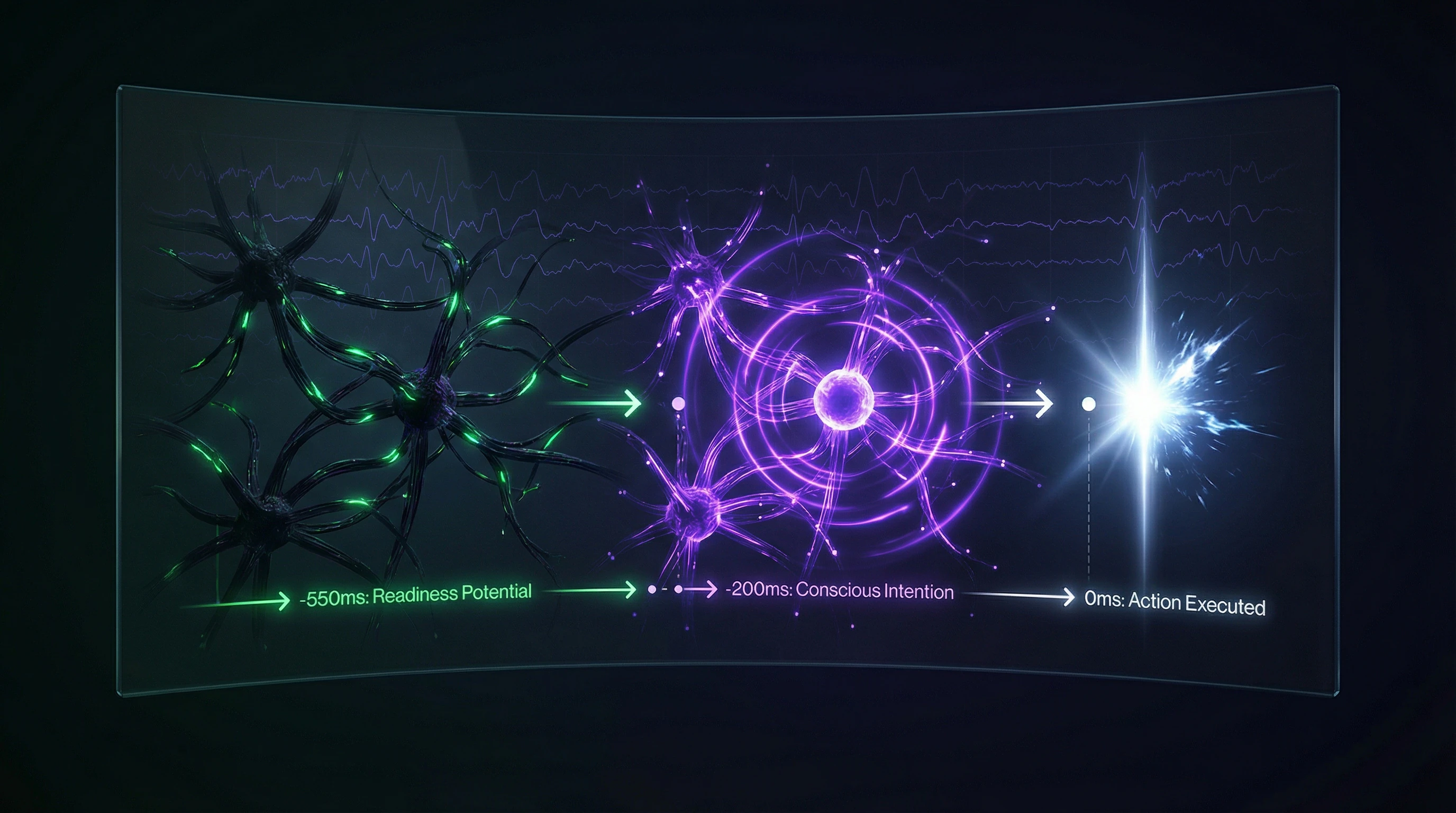
Simultaneously, the brain's electrical activity (EEG) was recorded. The results showed that the readiness potential (Bereitschaftspotential)—a characteristic pattern of neural activity preceding voluntary movements—began approximately 550 milliseconds before the action itself, but 350–400 milliseconds before the moment when subjects reported conscious intention (S001).
- The brain initiates a neural pattern (readiness potential)
- After 150–200 milliseconds, the conscious sensation of intention arises
- Another 150–200 milliseconds later, the action itself is executed
Libet's interpretation: the brain "decides" to act before consciousness registers this decision. Conscious intention is not the cause of action, but a post-hoc awareness of a process already launched by unconscious mechanisms.
Libet suggested that consciousness might possess a "veto right," stopping an already initiated action in the final 100–200 milliseconds. However, even this veto may be an illusion if it's itself determined by preceding neural processes.
📊 Modern Neuroimaging Studies: Predicting Decisions Seconds Before Awareness
Studies using functional magnetic resonance imaging (fMRI) have expanded the temporal window between neural activity and conscious decision. In experiments by John-Dylan Haynes, subjects had to freely choose whether to press a left or right button and report their decision (S001).
Analysis of activity patterns in the prefrontal and parietal cortex allowed prediction of subjects' choices 7–10 seconds before they reported a conscious decision. Prediction accuracy was around 60%—significantly above chance level (50%).
| Parameter | Value | Interpretation |
|---|---|---|
| Prediction time window | 7–10 seconds | Information about choice is encoded in the brain long before awareness |
| Prediction accuracy | ~60% | Above chance level (50%), but not absolute |
| Activation area | Prefrontal and parietal cortex | Regions associated with planning and information integration |
Critics point out that these experiments use artificial, meaningless tasks. It's unclear how applicable the results are to real, motivated decisions involving weighing values, rational deliberation, and emotional assessment. Nevertheless, the data demonstrate that—at least for some types of decisions—the conscious sensation of choice lags behind the neural processes determining that choice (S001).
🧠 Predictive Brain Model: Consciousness as Post-Hoc Narrative
Dirk De Ridder and colleagues proposed a "predictive brain" model explaining the illusion of free will through mechanisms of Bayesian inference and prediction error minimization (S001). The brain constantly generates predictions about sensory inputs and its own actions, comparing them with reality and updating internal models.
Conscious experience is not direct perception of reality, but a construction based on these predictions. The sensation of free choice arises when the brain generates a narrative explaining why a particular action was performed. This narrative is created post-hoc to maintain a coherent sense of self and agency.
- Predictive Brain
- A system that doesn't wait for conscious decision but acts based on unconscious predictions and only then constructs a conscious explanation. Consciousness is not a source of causality in the libertarian sense, but plays a role in learning, updating models, and social communication.
- Post-Hoc Narrative
- The story about one's choice that the brain creates after the action has already been initiated. This explains why we feel free even though neural processes precede awareness.
🧬 Neurochemistry and Genetics: How Much Are Decisions Determined by Biology
Beyond the temporal structure of decisions, neuroscience demonstrates that our choices depend deeply on neurochemical states and genetic factors we don't control. Levels of dopamine, serotonin, noradrenaline, and other neurotransmitters influence impulsivity, risk-taking, mood, and motivation (S001).
Genetic variations explain a significant portion of individual differences in personality traits, cognitive abilities, and propensity for certain behavioral patterns. Twin studies show that heritability of many psychological characteristics is 40–60%. This doesn't mean complete genetic predetermination—environment also plays a critical role. But it does mean that a significant part of what we consider "our" preferences and decisions is conditioned by factors we didn't choose (S001).
If your tendency toward impulsive decisions is determined by genetic variants in the dopaminergic system, and your mood depends on serotonin levels fluctuating based on sleep, diet, and stress, then in what sense do you "freely" choose your actions?
You might object: "you" are your brain with all its neurochemical peculiarities. But this is a compatibilist answer that doesn't solve the problem of libertarian free will. It redefines freedom to be compatible with determinism, but doesn't answer why you should be considered responsible for decisions determined by your biology and history.
If free will is an illusion, why is this illusion so convincing and universal? Neuroscience and evolutionary psychology offer explanations for the functional role of this illusion in human cognitive architecture.
🧠 Bignetti's Model: Functional Role of the Free Will Illusion in Cognition
Enrico Bignetti proposed a model according to which the illusion of free will performs adaptive functions despite its illusory nature (S002, S007). The brain constructs a sense of agency and control to create a coherent sense of self necessary for planning, learning, and social interaction.
Four key functions of the free will illusion (S002):
- Experience integration. The sensation of an "I" that makes decisions connects disparate cognitive processes into a unified narrative. Without this, experience would be a fragmented stream of unrelated events.
- Motivation and goal-setting. Belief that your actions matter and influence the future is necessary for maintaining goal-directed behavior. Perceiving yourself as a passive observer of determined processes would undermine motivation.
- Social coordination. The concept of moral responsibility based on free will is necessary for social systems to function. Punishment and reward work because people perceive themselves as agents responsible for their actions (S003).
- Learning through counterfactual thinking. The ability to imagine alternative scenarios ("I could have acted differently") is critically important for learning from mistakes and planning the future.
The illusion of free will is not an evolutionary error, but an engineering solution: the brain sacrifices accuracy of self-knowledge for behavioral functionality.
🔄 Predictive Brain and Construction of Post-Hoc Narrative
According to the predictive brain model (S001), the central nervous system constantly generates predictions about what will happen next and compares them with sensory information. This explains why the sensation of free choice arises precisely when it does.
The mechanism works like this: the brain initiates action based on unconscious processes (S002), then creates a post-hoc narrative that interprets this action as the result of a conscious decision. Consciousness doesn't make the decision—it tells the story that a decision was made.
| Process Stage | What Happens | Role of Consciousness |
|---|---|---|
| Unconscious preparation | Brain activates motor programs based on context, memory, stimuli | Absent |
| Action | Muscles contract, behavior is initiated | Absent |
| Post-hoc interpretation | Brain generates narrative: "I decided to do this" | Creates illusion of control |
This model explains why people often can't explain their decisions logically, but can always come up with a convincing explanation post-hoc. Consciousness is not the director, but the commentator who narrates an already filmed movie.
🎯 Why the Illusion Is Universal: Evolutionary Expediency
If the illusion of free will is a brain construction, why did it arise in all humans and even in some animals? The answer lies in evolutionary logic: agents who perceive themselves as active participants in their lives, rather than passive victims of circumstances, survive and reproduce better.
An organism that believes in its ability to influence events will more actively seek solutions, more persistently overcome obstacles, and better adapt to environmental changes. This doesn't require free will to be real—it only requires the organism to believe in it.
- Learned helplessness
- When an animal or human loses faith in their ability to influence events, they fall into depression and stop trying. The illusion of free will is protection against this state, which would be evolutionarily catastrophic.
- Social reputation
- In groups where people believe in moral responsibility, those perceived as agents of their actions receive higher status and better access to resources. The illusion of free will is social currency.
- Planning and foresight
- Counterfactual thinking ("what if I do X?") requires the sensation that the future is open and depends on my actions. Without this sensation, planning becomes meaningless.
The illusion of free will is not a bug in brain architecture, but a feature: it allows the organism to function as if it were free, even if physically it's completely determined.
🧬 Neurobiological Substrate: Where in the Brain the Illusion Is Born
Research shows that the sensation of agency and control is associated with activity in the prefrontal cortex, posterior cingulate gyrus, and parietal cortex (S005, S006). These areas integrate information about intentions, actions, and their consequences, creating a unified narrative about who I am and what I'm doing.
When these areas are damaged or disintegrated, people lose the sensation of agency. They may perform actions but don't feel they're performing them. This state is called action alienation and demonstrates that the sensation of free will is a specific neurobiological phenomenon, not a metaphysical property.
Consciousness doesn't create action. Consciousness creates the story that the action was created by me, consciously and freely.
This story is so convincing that we believe it even when we know about its mechanisms. And that's fine: the illusion works not because we're ignorant, but because it's functionally necessary for the brain to manage complex behavior in a social environment.
Counter-Position Analysis
⚖️ Critical Counterpoint
The article's arguments rely on an interpretation of neuroscientific data that permits alternative readings. Below are the main directions of criticism, which do not invalidate the conclusions but require clarification of their boundaries.
Extrapolation of Libet's Experiments Beyond Their Validity
Libet's classical experiments concern only simple motor acts—pressing a button in laboratory conditions. Methodological critics rightly point out that extrapolating these results to complex moral decisions, strategic planning, or creative choice may be unwarranted. The neural mechanisms governing reflexive movement may fundamentally differ from the mechanisms underlying reflective choice.
Underestimation of Philosophical Arguments for Emergent Agency
The article leans toward the position of libertarian illusion, but pays insufficient attention to strong philosophical arguments of non-reductive physicalism and emergent causality. These approaches suggest that determinism at the neuronal level is compatible with the real causal power of consciousness at the personal level—a reconciliation that requires denying neither physics nor the subjective experience of choice.
Mixed Empirical Data on Practical Consequences
The claim that accepting determinism changes practically nothing contradicts some research. Data indicate a decrease in motivation, prosocial behavior, and an increase in aggression when belief in free will weakens—effects that may have real social consequences, even if free will itself is illusory.
Predictive Brain Model as Theoretical Framework, Not Fact
While the predictive model is popular in neuroscience, it remains one of several competing theoretical frameworks. Alternative models—global workspace theory, integrated information theory—may provide different interpretations of the same experimental data and do not necessarily lead to the conclusion that free will is illusory.
Reinterpretation of Readiness Potential in New Research
New work (Schurman, Bode, 2020s) calls into question the classical interpretation of readiness potential, suggesting that it reflects not a decision but fluctuations in neural noise. If these data receive independent confirmation, the central argument against libertarian free will will be substantially weakened.
Resilience of Neuroscientific Conclusions to Revision
The history of neuroscience shows that conclusions that seemed established are often revised with the emergence of new methods and data. Relying on the current state of science as definitive proof of the illusory nature of free will may be premature—especially given that the interpretation of neural correlations itself remains philosophically loaded.
FAQ
Frequently Asked Questions

Author of the Cognitive Immunology Hub project. Researches mechanisms of disinformation, pseudoscience, and cognitive biases. All materials are based on peer-reviewed sources.