Three Independent Mating Systems: What Helen Fisher Actually Proposed and Why It Changes Our Understanding of Human Relationships
Helen Fisher's model asserts that mammals, including humans, possess three functionally independent neurobiological systems regulating mating, reproduction, and parental behavior (S010). Each system has its own neurochemical basis, evolutionary function, and behavioral manifestations.
These systems — lust, romantic love (attraction), and attachment — can activate independently of each other, simultaneously, or in any combination. More details in the Cellular Biology section.
| System | Neurochemistry | Evolutionary Function |
|---|---|---|
| Lust | Androgens, estrogens | Motivation for sexual contact, genetic diversity |
| Romantic Love (Attraction) | Dopamine ↑, norepinephrine ↑, serotonin ↓ | Selective focus on optimal partner |
| Attachment | Oxytocin, vasopressin | Long-term cooperation and cooperative parenting |
Lust: The Sexual Desire System
Lust is the primary motivational system, the craving for sexual gratification (S010). It requires no emotional connection or selectivity — the goal is genetic diversity and maximization of reproductive opportunities.
Romantic Love: The Selective Focus System
Romantic love is characterized by focused attention on a preferred partner, elevated energy, intrusive thoughts about the beloved, and emotional dependency (S010). Its evolutionary function is concentrating reproductive energy on optimal partners.
Attachment: The Long-Term Bonding System
Attachment allows individuals to remain together long enough to fulfill parental duties (S010). It manifests as feelings of calm, security, and emotional unity with a long-term partner.
The three systems can function independently. This explains phenomena that culture often pathologizes — sexual desire without love, romantic obsession without sexual interest, deep attachment with faded passion. These aren't anomalies but normal activation patterns of independent neurobiological circuits.
Traditional cultural narratives present love as a single, indivisible emotion. Fisher's model is radically different: each system can activate separately, which changes our understanding of what's considered normal in relationships.
- Why This Matters for Cognitive Immunology
- Understanding the independence of the three systems protects against the cognitive trap of "the one true love" — a myth that makes people ignore incompatibility signals or mistakenly interpret the absence of one system as the absence of all three. It also explains why attachment styles may not align with romantic attraction or sexual desire.
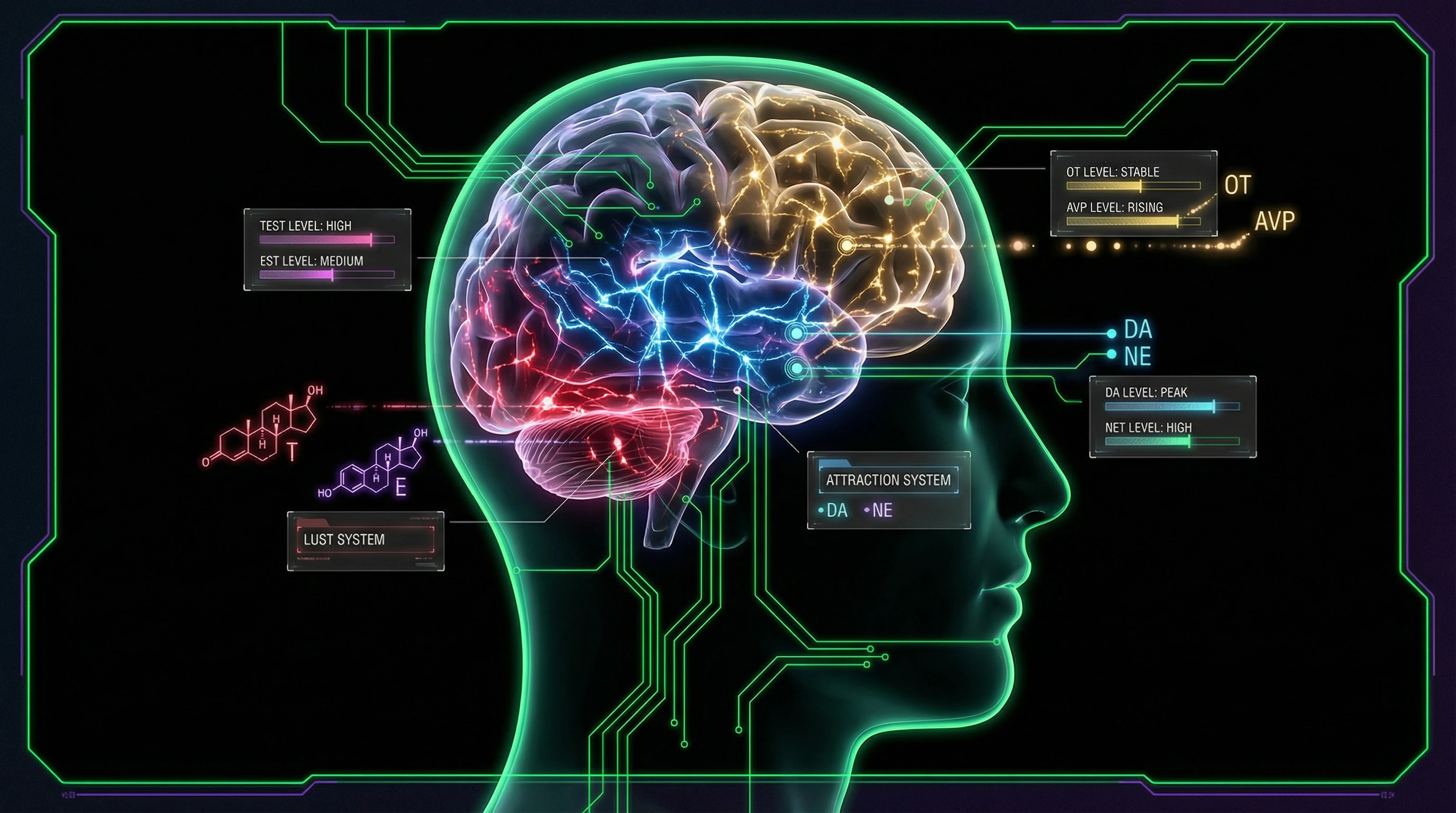
Seven Arguments for the Three-System Model: Why Neurobiology Supports the Division of Love into Independent Circuits
🔬 Argument 1: Distinct Neurochemical Substrates for Each System
Each of the three systems is mediated by different neurotransmitters and hormones. Lust is regulated by sex hormones (testosterone, estrogen), romantic love by dopaminergic and noradrenergic pathways, and attachment by oxytocin and vasopressin (S010).
These neurochemical systems are anatomically and functionally distinct: drugs affecting one system do not necessarily impact the others. This fundamental separation of chemical mechanisms is the first sign of independence. More details in the Physics and Meta-Analysis section.
🔬 Argument 2: Independent System Activation in Clinical Observations
Clinical data demonstrate that systems can activate independently (S010). Patients with low libido maintain deep emotional attachment to their partner. People experiencing romantic obsession may feel no sexual desire for the object of their passion.
Long-term partners often report strong attachment alongside declining romantic passion—this is not pathology, but the norm. If the systems were unified, such dissociations would be impossible.
🔬 Argument 3: Cross-Cultural Universality of Patterns
Anthropological research shows that the phenomena of lust, romantic love, and attachment are observed in all studied cultures, despite differences in social norms and marriage practices (S010). This points to the biological, rather than cultural, nature of the three systems.
Even in societies with strict monogamy norms, people report sexual attraction to others, confirming the independence of the lust system from attachment.
🔬 Argument 4: Evolutionary Logic of Functional Separation
From an evolutionary perspective, the separation of three systems is adaptive (S010). Lust motivates the search for genetic diversity, romantic love focuses energy on optimal partners for conception, and attachment ensures stability for raising offspring.
- Lust: maximizing genetic diversity
- Romantic love: concentrating resources on one partner
- Attachment: long-term cooperation in parenting
These goals conflict: maximizing diversity contradicts long-term monogamy. The independence of systems allows flexible balancing between strategies.
🔬 Argument 5: Neuroimaging Data on Distinct Brain Activation Patterns
fMRI studies show that romantic love activates specific brain regions associated with the reward system (ventral tegmental area, caudate nucleus), which differ from areas activated during sexual arousal or long-term attachment (S010).
Neuroanatomical separation confirms functional independence: different brain regions—different systems.
🔬 Argument 6: Temporal Dynamics of Systems in Long-Term Relationships
Longitudinal studies of couples show that the intensity of romantic love typically declines in the first 1–3 years of a relationship, while attachment may strengthen or remain stable over decades (S010).
This differential temporal dynamic indicates independent regulatory mechanisms. If love were a unified system, all its components would change synchronously.
🔬 Argument 7: Comparative Data from Other Mammalian Species
Similar mating systems are observed in other mammals. In prairie voles (Microtus ochrogaster), the attachment system mediated by oxytocin and vasopressin functions independently of the sexual desire system (S010).
This points to deep evolutionary roots of the three-system model, predating the emergence of humans. If the mechanism has been preserved in other species, it is not accidental.
Evidence Base for Fisher's Model: What 723 Citations Tell Us and Why Neurobiology Confirms the Separation of Love
Citation Count as a Marker of Scientific Impact
Helen Fisher's work Lust, Attraction, and Attachment in Mammalian Reproduction (S010) has accumulated 723 citations in peer-reviewed literature. This doesn't guarantee truth, but it indicates passage through scientific community scrutiny and use as a theoretical foundation for further research.
Three Neurochemical Signatures
Lust is mediated by androgens (testosterone) and estrogens, acting through the hypothalamus and limbic system (S010). Blocking androgen receptors reduces libido without affecting emotional attachment — direct proof of the system's independence.
Romantic love is associated with elevated dopamine and norepinephrine in the mesolimbic reward system and simultaneous serotonin reduction (S010). Result: euphoria, focused attention on partner, intrusive thoughts (similar to OCD). This neurochemical signature doesn't appear with pure sexual desire or long-term attachment.
Attachment is regulated by oxytocin and vasopressin through specific receptors, distinct from sex hormones or dopamine (S010). Oxytocin is released during physical contact and orgasm; vasopressin is linked to long-term pair bonding in monogamous species.
| System | Primary Hormone/Neurotransmitter | Brain Structures | Behavioral Outcome |
|---|---|---|---|
| Lust | Testosterone, estrogen | Hypothalamus, limbic system | Sexual desire, multiple partners |
| Love | Dopamine ↑, serotonin ↓ | VTA, caudate nucleus | Euphoria, focused attention, obsessiveness |
| Attachment | Oxytocin, vasopressin | Ventral pallidum, posterior cingulate cortex | Closeness, trust, long-term stability |
Evolutionary Logic of Conflict
Lust maximizes genetic diversity of offspring through multiple mating. Romantic love concentrates effort on partners of high genetic value. Attachment ensures stability for raising offspring that require extended parental investment (S010).
These functions are incompatible: a diversity strategy conflicts with strict monogamy. System independence allows flexible switching between strategies — short-term mating in youth, long-term pair bonding when raising children. More details in the Space and Earth section.
The three systems don't compete for one resource — they solve different evolutionary problems. Their independence isn't a bug, it's a feature of adaptive flexibility.
Cross-Species Evidence
In prairie voles (monogamous species), high density of oxytocin and vasopressin receptors in the nucleus accumbens correlates with pair bond formation; in montane voles (promiscuous species), density is lower (S010). The genetic basis of the attachment system varies between species depending on mating strategy.
Primates demonstrate all three systems with varying intensity. Chimpanzees: high lust with multiple partners, selective preferences, mother-infant attachment, but weak pair bonding. Gibbons: strong pair attachment between adults (S010). This shows the three systems can have different relative strengths.
Neuroimaging: Activation Map
fMRI of humans in romantic love shows specific activation of the ventral tegmental area (VTA) and caudate nucleus — regions rich in dopaminergic neurons (S010). These areas aren't activated during sexual arousal or when interacting with long-term partners without romantic passion.
During long-term attachment, the ventral pallidum and posterior cingulate cortex activate, linked to the oxytocinergic system (S010). Neuroanatomical separation confirms: romantic love and attachment are distinct neurobiological states, not points on a single continuum.
Model Extension: Attachment Fertility Theory
Contemporary research integrates Fisher's three systems with broader understanding of reproductive strategies (S005). Attachment fertility theory examines how evolved mechanisms influence mate choice, conception timing, and parental investment in men and women.
This extension doesn't refute Fisher's model but embeds it in a more complex system of factors affecting reproductive behavior. The three systems remain the core, but their interaction with context (age, status, resources, social environment) becomes subject to more detailed analysis.
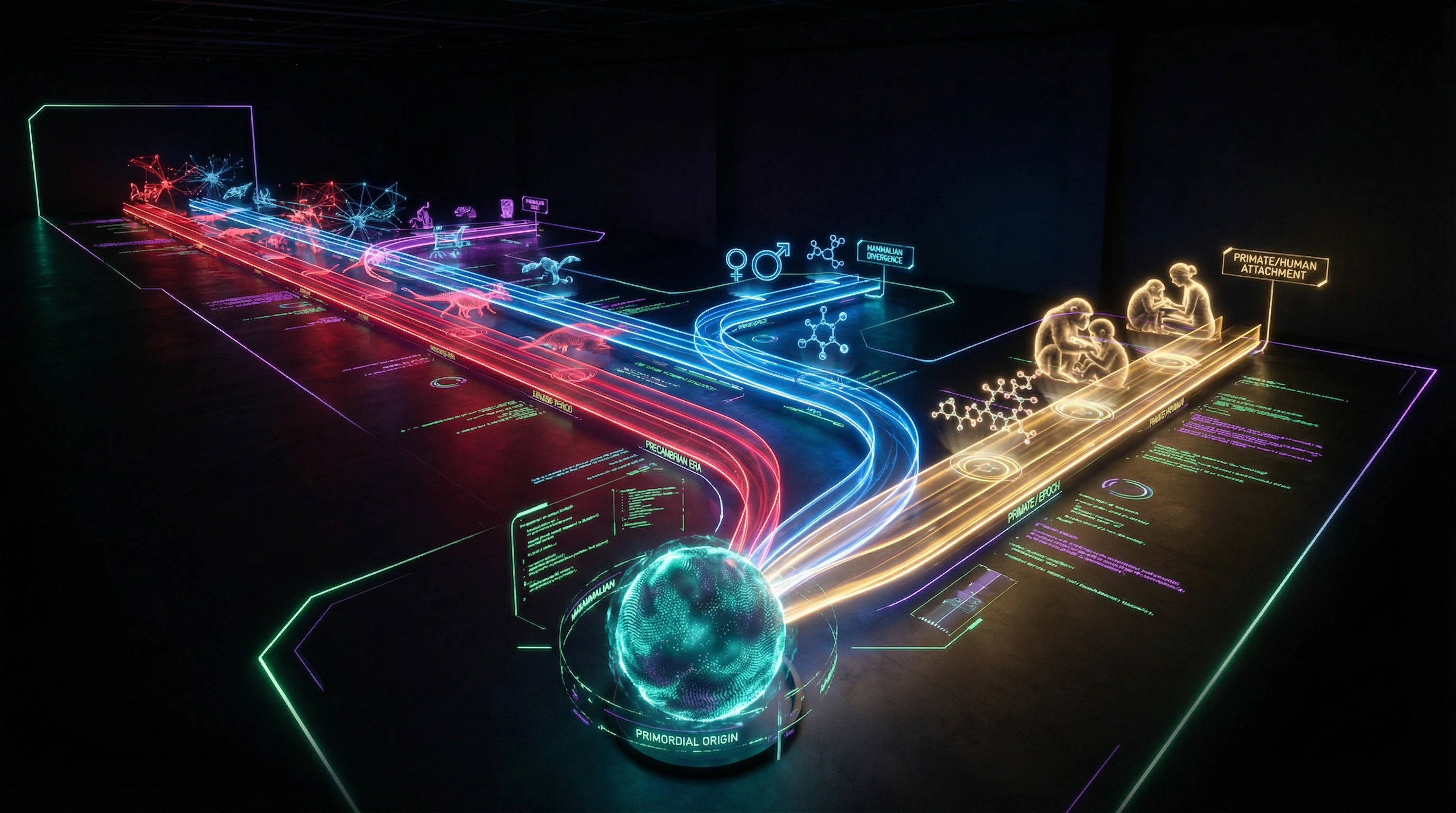
Interaction Mechanisms of the Three Systems: Why Lust Can Trigger Love, and Love Can Disrupt Attachment
🔁 Bidirectional Links Between Systems
The three systems are functionally independent but interact through bidirectional connections. Sexual activity can stimulate oxytocin release, facilitating attachment formation (S010).
This explains why casual sexual encounters sometimes develop into emotional intimacy. However, this connection is not deterministic—many people experience sexual attraction without subsequent attachment. More details in the Logic and Probability section.
| Connection Direction | Mechanism | Outcome |
|---|---|---|
| Lust → Attachment | Oxytocin during sexual activity | Casual encounter can become intimacy |
| Love → Lust | Dopaminergic activation focuses desire on partner | Romantic love intensifies libido toward specific person |
| Lust → Love | Positive reinforcement through sexual satisfaction | Physical intimacy can strengthen romantic feelings |
🔁 Conflicts Between Systems: When Biology Contradicts Culture
Systems conflict when activated simultaneously in opposite directions. High activation of the lust system can suppress attachment formation if an individual constantly seeks new partners (S010).
This explains why promiscuity can hinder long-term bonds—not for moral reasons, but due to neurobiological competition between systems.
Romantic love for one person can coexist with attachment to another. Culture interprets this as a moral dilemma, but it has a neurobiological basis: two independent systems activated simultaneously toward different objects (S010).
🔁 Temporal Dynamics: Why Passion Fades While Attachment Grows
Romantic love is characterized by high intensity but limited duration—typically 12–18 months, rarely more than 3 years (S010). This relates to dopaminergic system adaptation: constant stimulation leads to receptor desensitization.
Evolutionarily, this is adaptive: intense romantic love motivates pair formation and conception, but maintaining it is energetically costly and unnecessary after bond establishment.
- Dopamine Receptor Desensitization
- Constant stimulation leads to reduced sensitivity. Evolutionary logic: intense passion is needed to initiate pairing, but not to maintain it.
- Oxytocin Attachment System
- Strengthens over time through accumulation of shared experience. Explains the phenomenon of "companionate love" in long-term relationships: passion declines, but deep emotional connection remains or intensifies (S010).
🔁 Individual Differences in System Balance
Genetic and hormonal factors influence the relative strength of the three systems. People with high testosterone levels may have a more active lust system, while individuals with high oxytocin receptor density form attachments more easily (S010).
This explains why some people gravitate toward short-term connections while others prefer long-term monogamous relationships, not only due to cultural factors but also neurobiological differences. Understanding these mechanisms helps clarify one's own behavioral patterns without moralization—see also the neurobiology of attachment styles and the neurobiology of breakups.
Five Cognitive Traps That Make Us Believe in "The One" Despite Neurobiology
Cultural narratives present love as a single, indivisible entity — either it exists or it doesn't. This essentialist thinking ignores the complexity of neurobiological systems (S010).
People ask "Do I love this person?" expecting a binary answer, but reality is more complex: you can experience attachment without romantic passion, or passion without desire for long-term commitment.
Essentialism creates a false dichotomy and forces people to ignore the nuances of their own emotions. Culture moralizes the independence of the three systems: sexual attraction to others while having a partner is interpreted as "mental infidelity" or moral failure, though this is normal activation of the lust system, which is evolutionarily independent from attachment (S010).
This moral attribution creates guilt and shame over biological processes that individuals don't directly control. Romantic narratives in literature, film, and music emphasize cases where all three systems are activated simultaneously toward one person, ignoring the more frequent cases of misalignment (S010).
| Trap | Mechanism | Consequence |
|---|---|---|
| Essentialism | Binary thinking about love | Ignoring nuances of one's own emotions |
| Moral attribution | Shame over biological processes | Guilt over independent system activation |
| Confirmation bias | Remembering "perfect" stories | Unrealistic relationship standards |
| Ignoring temporal dynamics | Expecting eternal romantic intensity | Disappointment when passion naturally fades |
| Reverse naturalistic fallacy | Inferring necessity of promiscuity from biology | Conflating description with prescription |
This creates confirmation bias: people remember stories of "perfect love" and consider them the norm, while statistically more common are situations where systems are activated independently. The cultural myth of "eternal love" ignores the natural temporal dynamics of romantic love, which typically fades after 1–3 years (S010).
When passion declines, people interpret this as "the end of love" and break up relationships, not understanding that attachment can remain strong and that this is a normal evolutionary trajectory. Expecting constant romantic intensity creates unrealistic standards and disappointment. More details in the Epistemology section.
Neurobiology describes how systems work, but doesn't prescribe how we should structure relationships. The independence of systems means we have a choice in how to regulate them — through monogamy, polyamory, or other structures — but this choice remains ethical and cultural, not biologically determined.
Some critics of Fisher's model commit the reverse naturalistic fallacy: "If three systems are biologically independent, then monogamy is unnatural and we must accept promiscuity." This is a logical error (S010). Understanding this distinction is critical for building an epistemologically honest approach to one's own relationships.