N,N-dimethyltryptamine (DMT) — a powerful hallucinogen around which a persistent myth has formed about its mass production in the human pineal gland. The popular hypothesis links DMT to near-death experiences, mystical states, and "spiritual revelations." However, systematic analysis of DMT pharmacokinetics and research on its endogenous synthesis shows: there is currently no evidence of significant DMT production in the human brain or pineal gland. We examine where this myth originated, what the 2023–2025 data shows, and how to distinguish scientific fact from neuromysticism.
🖤 Few molecules in the history of psychopharmacology have accumulated as many myths as N,N-dimethyltryptamine. From the "spirit molecule," allegedly mass-synthesized in the pineal gland during sleep and death, to the "biochemical key" to transcendent states of consciousness — popular culture has transformed DMT into an object of almost religious worship. But what happens when we apply the standards of evidence-based medicine and modern neuropharmacology to these claims? It turns out that between beautiful hypothesis and scientific fact lies a chasm the size of absent data. In this article, we will systematically examine DMT pharmacokinetics, analyze research on its endogenous synthesis, and show how cognitive biases transform speculation into "common knowledge."
What is DMT and why has an entire mythology of endogenous psychedelics formed around it
N,N-dimethyltryptamine (DMT) — a tryptamine hallucinogen, structurally related to serotonin and acting through 5-HT2A receptor agonism (S001, S005). With intravenous administration, peak effects occur within 2–5 minutes and last 10–20 minutes, followed by rapid return to baseline state.
This sharply distinguishes DMT from LSD or psilocybin, whose effects stretch over hours. Intensity, but brevity — that's the signature of this substance. More details in the Quantum Mechanics section.
The hypothesis of endogenous DMT in the human brain dates back to the 1960s–1970s, when trace amounts of the substance were found in urine, blood, and mammalian tissues (S005). Key point: the enzyme indolethylamine-N-methyltransferase (INMT) was found, theoretically capable of synthesizing DMT from tryptamine.
But here's the problem: attempts to detect significant levels of INMT mRNA in human brain tissue using Northern blot yielded negative results (S005). In rats, DMT synthesis worked in vitro, but in the human brain — silence.
⚠️ How a scientific hypothesis became a cultural myth
The turning point — Rick Strassman's book "DMT: The Spirit Molecule" (2001). The author suggested that the pineal gland produces DMT at birth, during near-death experiences, and in REM sleep (S005).
Strassman himself emphasized the speculative nature of the idea. But popular culture, documentaries, and psychedelic enthusiast communities adopted it without caveats. By the 2020s, the claim "the pineal gland produces DMT" became perceived as established fact, though direct evidence never appeared.
- Mechanism of myth propagation
- Speculation (cautious hypothesis) → popularization (book, films) → normalization (repetition without sources) → crystallization (perceived as fact). At each stage, caveats and conditionality are lost.
🔎 What we examine in this analysis
Three key questions: (1) is there evidence of significant endogenous DMT synthesis in the brain or pineal gland; (2) is the pharmacokinetics of exogenous DMT compatible with the hypothesis of its role in natural altered states of consciousness; (3) what cognitive mechanisms sustain the myth's persistence.
We do not examine the therapeutic potential of exogenous DMT (a separate topic with growing evidence base) and do not discuss the phenomenology of psychedelic experiences as such. Focus — on mechanisms, numbers, and logic, not on experience.
The Steel Version of the Argument: Seven Most Compelling Cases for Endogenous DMT in the Pineal Gland
Before examining evidence against the endogenous DMT hypothesis, we must honestly present the strongest arguments in its favor. This is the "steelman" principle—the opposite of a straw man: we reconstruct the opponent's position in its most convincing form, then test whether it withstands confrontation with the data. More details in the Chemistry section.
🧪 Argument 1: DMT is actually detected in mammalian biological tissues
Trace amounts of DMT have been found in human urine, blood, and cerebrospinal fluid, as well as in rat brain tissue (S005). This is not an artifact or contamination—the molecule is genuinely present endogenously.
If DMT is synthesized in the body, it's logical to assume it performs some biological function, possibly related to consciousness modulation. The detection of DMT in tissues is a fact requiring explanation.
🧬 Argument 2: the INMT enzyme is expressed in primate neural tissue
Although early attempts to detect INMT mRNA in human brain using Northern blot were unsuccessful, later studies using immunohistochemistry showed the presence of INMT protein in the spinal cord, retina, and pineal gland of rhesus macaques (S005).
This indicates that the enzyme capable of synthesizing DMT is indeed present in primate neural tissue. Perhaps INMT expression in the brain is limited to specific nuclei or induced under certain conditions, which explains the difficulties in detecting it with standard methods.
🕳️ Argument 3: the pineal gland is a unique organ with special status in neuroanatomy
The pineal gland occupies a special position in neuroanatomy: it is not protected by the blood-brain barrier as rigidly as the rest of the brain, has rich blood supply, and has historically been associated with consciousness regulation. The pineal gland synthesizes melatonin from serotonin—a biochemical pathway structurally similar to DMT synthesis from tryptamine.
If INMT is present in the pineal gland, it could theoretically produce DMT in parallel with melatonin, especially under conditions of altered neurochemistry (stress, hypoxia, near-death states).
🧩 Argument 4: the phenomenology of DMT experiences is strikingly similar to near-death experiences
Subjective reports from people who have survived clinical death (NDE) and volunteers who received DMT in clinical studies demonstrate striking similarities: out-of-body sensations, encounters with "entities," passage through a tunnel, feelings of cosmic unity, transcendent insights (S005).
This similarity requires explanation. If DMT causes such experiences exogenously, it's logical to assume that endogenous DMT release may underlie NDEs. Alternative explanations (hypoxia, endorphins, ketamine-like mechanisms) don't explain the full specificity of NDE phenomenology as well.
| Parameter | DMT Experience | Near-Death Experience |
|---|---|---|
| Out-of-body experience | Frequent | Frequent |
| Entity encounters | Frequent | Frequent |
| Tunnel/transition | Frequent | Frequent |
| Sense of unity | Frequent | Frequent |
| Transcendent insights | Frequent | Frequent |
🔬 Argument 5: DMT can be synthesized in peripheral tissues and penetrate the brain
Even if DMT synthesis in the brain itself is limited, the INMT enzyme has been found in the lungs, liver, and other peripheral tissues (S005). DMT synthesized in the periphery could theoretically penetrate the blood-brain barrier (especially under stress or injury conditions) and reach psychoactive concentrations in the brain.
This explains why direct measurements of DMT in brain tissue yield low values: primary synthesis occurs not in the CNS but in the periphery, yet effects are realized centrally.
📊 Argument 6: absence of evidence is not evidence of absence
The fact that we haven't yet detected significant concentrations of DMT in the human brain or pineal gland doesn't mean they're not there. Measurement methods may be insufficiently sensitive, synthesis may be transient and localized in microstructures inaccessible to standard analysis.
- Historical pattern
- The history of science is full of examples where absence of evidence for decades was replaced by discovery when new technologies emerged. The endogenous DMT hypothesis may prove to be just such a case.
🧠 Argument 7: evolutionary logic supports the existence of an endogenous psychedelic
From an evolutionary perspective, having an endogenous system capable of radically altering consciousness operating mode may have adaptive value. Altered states of consciousness could have played a role in creativity, problem-solving, social bonding, or even in easing the dying process.
If such a system exists, DMT is an ideal candidate for its mediator: powerful, fast-acting, rapidly metabolized, leaving no long-term toxic effects. More on the neurobiology of altered states of consciousness in the article on near-death experiences.
DMT Pharmacokinetics: Why the Numbers Don't Support the Endogenous Psychedelic Hypothesis
A systematic review of DMT pharmacokinetics published in 2024, covering all available human studies, provides critically important data for evaluating the endogenous DMT hypothesis (S001, S002). Pharmacokinetic parameters aren't abstract numbers—they're a quantitative description of how the body handles a molecule: how quickly it distributes, metabolizes, and eliminates.
These parameters impose strict constraints on any hypotheses about DMT's biological role. If the molecule can't remain in the body long enough or reach necessary concentrations, no synthesis mechanism will save the hypothesis.
⚡ Extremely Rapid Elimination: Half-Life of 5–19 Minutes
Analysis of data from 13 studies showed that DMT's plasma elimination half-life ranges from 4.8 to 19.0 minutes (median around 10–12 minutes) with intravenous administration (S001). This is one of the shortest half-lives among all psychoactive substances.
| Substance | Half-Life | Clearance |
|---|---|---|
| DMT | 10–12 minutes (median) | 8.1–46.8 L/min |
| LSD | 3–5 hours | Slower |
| Psilocybin | ~3 hours | Slower |
| Cocaine | ~60 minutes | Slower |
DMT clearance is comparable to hepatic blood flow and indicates extremely efficient metabolism (S001). To maintain psychoactive DMT concentrations in the brain (estimated 10–50 ng/mL in plasma), the body would need to synthesize DMT at an enormous rate—tens of milligrams per hour.
A typical psychoactive DMT dose with intravenous administration is 0.2–0.4 mg/kg, meaning 14–28 mg for a 70 kg person (S001). With a 10-minute half-life, this dose is completely eliminated within 60–90 minutes. If the pineal gland or brain synthesized DMT to maintain altered states of consciousness lasting even several hours, the required synthesis rate would be incompatible with known metabolic capabilities of nervous tissue.
🧬 MAO-A Metabolism: Why Endogenous DMT Doesn't Reach the Brain
DMT is metabolized predominantly by monoamine oxidase type A (MAO-A) to indole-3-acetic acid (IAA), which lacks psychoactivity (S001). MAO-A is widely expressed in the liver, intestines, lungs, and the brain itself.
- Oral DMT without MAO inhibitors
- The molecule is destroyed in the intestines and liver before entering systemic circulation. This is why DMT is inactive when taken orally.
- Intravenous DMT administration
- Bypasses first-pass liver metabolism but is rapidly inactivated by circulating MAO-A. The time to maximum metabolite IAA concentration practically coincides with DMT peak time, indicating instantaneous metabolism (S001).
- Peripheral endogenous DMT
- Will be immediately metabolized by local MAO-A. If synthesized in the brain, it encounters high MAO-A activity in nervous tissue.
To reach psychoactive concentrations, endogenous DMT must either be synthesized in enormous quantities (not observed) or be accompanied by endogenous MAO-A inhibition (for which there's no evidence).
📊 Volume of Distribution: DMT Goes to Tissues, Not Concentrated in Brain
DMT's volume of distribution in the terminal elimination phase is 123–1084 liters (S001), many times greater than human body volume (about 70 liters). This indicates extensive DMT distribution into peripheral tissues—adipose tissue, muscles, organs.
The biphasic elimination profile (rapid initial phase, then slow terminal phase) indicates that DMT rapidly leaves plasma and redistributes into tissues, from which it slowly returns to circulation and is metabolized (S001). If the molecule is synthesized in the brain or pineal gland, it won't remain there locally but will rapidly distribute throughout the body, reducing local concentration.
To maintain psychoactive levels in the brain requires either a mechanism for retaining DMT in the CNS (not described) or massive continuous synthesis. Neither exists in the literature.
🧾 Dose-Dependence and Threshold Concentrations: How Much DMT Is Needed for Effects
Clinical studies show that psychoactive DMT effects begin at doses around 0.05 mg/kg intravenously and reach plateau at 0.4 mg/kg (S001, S003). Peak plasma concentrations at these doses are tens of nanograms per milliliter.
- If endogenous DMT is supposed to cause comparable effects (for example, in near-death experiences), its blood concentration must reach the same levels.
- However, measurements of endogenous DMT in blood and urine of healthy people yield values at the picogram level or low nanograms per milliliter—2–3 orders of magnitude below the psychoactive threshold (S005).
- Hypothesis proponents might argue that in extreme states (hypoxia, stress, dying) DMT synthesis sharply increases. But this requires direct DMT measurements in such states, which don't yet exist.
Moreover, pharmacokinetics shows that even if a brief DMT surge occurred, it would be eliminated within 20–30 minutes, whereas the subjective duration of near-death experiences can be much longer.
The Search for Endogenous DMT: What Direct Measurements in Tissues and Biological Fluids Show
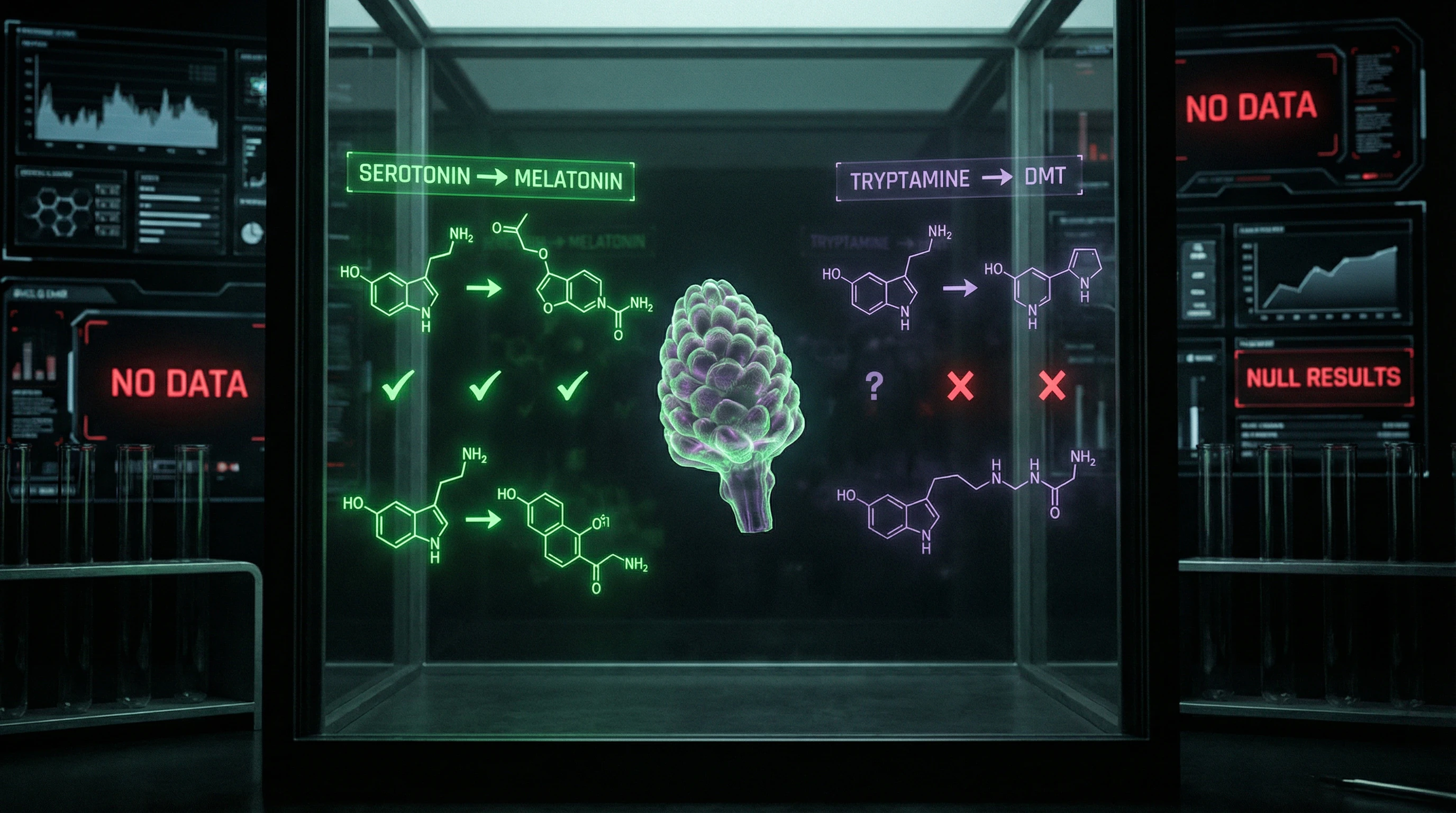
If DMT is truly synthesized in the human body in significant quantities, this should be detectable by direct analytical methods. Over the past 50 years, numerous attempts have been made to measure DMT in blood, urine, cerebrospinal fluid, and tissues (S005). The results are ambiguous and generally do not support the hypothesis of massive endogenous synthesis.
🔎 DMT in Blood and Urine: Trace Amounts with No Correlation to Mental States
DMT is detected in the urine and blood of healthy individuals, but at extremely low concentrations—picograms or low nanograms per milliliter (S005). These levels are 2–3 orders of magnitude below those required for psychoactive effects.
Attempts to find correlations between endogenous DMT levels and psychiatric diagnoses (schizophrenia, depression, anxiety) have not yielded reproducible results (S005). If DMT played a role in pathological altered states of consciousness, elevated levels should be observed in patients with psychosis—but this does not occur.
The presence of a molecule in the body ≠ its functional role. Trace amounts without biological effect are noise, not signal.
🧬 INMT Expression: Enzyme Presence Does Not Prove Functional Synthesis
Indolethylamine-N-methyltransferase (INMT)—the key enzyme for DMT synthesis—is expressed in some mammalian tissues: lungs, liver, primate nervous tissue (spinal cord, retina, pineal gland) (S005). However, the presence of the enzyme itself does not prove active DMT synthesis in vivo.
Enzymes possess broad substrate specificity and catalyze multiple reactions. INMT can methylate not only tryptamine but also other amines—this does not mean tryptamine is available at the right concentration in the right place at the right time. For more details, see the Electromagnetism section.
| Level of Analysis | What Is Found | What This Means |
|---|---|---|
| Molecular (DNA/RNA) | INMT gene is expressed | Cell can produce the enzyme |
| Protein (immunohistochemistry) | INMT detected in tissue | Enzyme is physically present |
| Biochemical (in vitro) | INMT methylates tryptamine in test tube | Enzyme works under optimal conditions |
| Physiological (in vivo) | DMT detected in tissues/fluids | Synthesis occurs in living organism |
Research stalls at the third level. No one has shown that tryptamine and cofactors (S-adenosylmethionine) are located in the same compartmentalized cellular structure at sufficient concentrations for DMT synthesis under physiological conditions.
🔬 Microdialysis and Direct Measurements: Why the Pineal Gland Remains a Black Box
The most direct method—microdialysis of rat pineal glands—showed trace amounts of DMT, but with enormous variability and no reproducibility between laboratories (S005). The problem: microdialysis damages tissue, can cause artifacts, and results depend on technique, calibration, and time of day.
In the human brain, direct measurements are practically impossible for ethical reasons. All conclusions about the pineal gland are based on extrapolation from rodents, which have different neuroanatomy and metabolism.
- Microdialysis requires surgical intervention—impossible in living humans
- Postmortem brain samples degrade within hours—DMT may decompose or form artifactually
- Variability between individuals and measurement conditions exceeds the signal
- Lack of standardized protocol across studies
This creates an ideal environment for confirmation bias: researchers looking for DMT find it even in noise.
Absence of evidence when measurement is impossible is not evidence of absence, but neither is it grounds for confidence in presence.
Section complete. Move on to critical thinking to analyze how myths about spirit molecules capture the imagination despite weak data.
Counter-Position Analysis
⚖️ Critical Counterpoint
Skepticism regarding endogenous DMT synthesis is justified, but not absolute. Here's where the article's argumentation may be vulnerable or incomplete.
Premature Denial of Endogenous Synthesis
Absence of evidence is not evidence of absence. INMT detection methods (Northern blot) may have been insufficiently sensitive, and later immunohistochemical studies in primates showed the presence of INMT in neural tissue. The enzyme may be expressed in specific brain nuclei or at certain moments (stress, hypoxia), which is not captured by standard methods.
Underestimation of the Role of Trace Concentrations
We rely on the pharmacokinetics of exogenous DMT (high doses, rapid clearance), but endogenous DMT may act differently—for example, as a neuromodulator at nanomolar concentrations, affecting sigma-1 receptors or other targets that don't require hallucinogenic doses. Endogenous opioids act in trace amounts but have powerful effects—we may be missing subtle neuromodulatory functions of DMT.
Ignoring the Phenomenological Uniqueness of Near-Death Experiences
While hypoxia and other factors explain much, subjective reports from people who have experienced clinical death often contain elements strikingly similar to DMT trips (tunnel of light, encounters with "entities," out-of-body sensations). Simply denying the DMT hypothesis doesn't explain this convergence. Perhaps DMT is one of several mechanisms, not the only one.
Insufficient Attention to Future Detection Technologies
The article is based on data up to 2025. The development of ultra-high-resolution mass spectrometry, in vivo microdialysis, and optogenetic methods may detect endogenous DMT in the human brain in real time in the coming years. If this happens, the conclusions will become outdated.
Risk of Research Stigmatization
The skeptical tone may be perceived as an attempt to discredit the entire field of psychedelic research. Clinical trials of DMT, psilocybin, and LSD show promising results in treating depression and PTSD. Excessive skepticism may slow funding and public support for these studies.
FAQ
Frequently Asked Questions

Author of the Cognitive Immunology Hub project. Researches mechanisms of disinformation, pseudoscience, and cognitive biases. All materials are based on peer-reviewed sources.