🖤 Sexual selection is an evolutionary mechanism that shapes traits not for survival, but for reproductive success. In humans, its role remains one of the most contentious topics in biology: some scientists argue that sexual selection created our brain, humor, and social intelligence, while others point to the impossibility of separating it from natural selection and culture. This article examines evidence from both sides, reveals conflicting data, and explains why there is still no definitive answer—and may never be.
📌 What is sexual selection and why is it so difficult to study in humans: definitions, boundaries, and methodological traps
Sexual selection is an evolutionary mechanism in which traits are shaped not for survival, but to increase reproductive success (S009). Charles Darwin introduced this concept as an element of natural selection theory.
The distinction from natural selection is fundamental: natural selection filters out the less adapted, while sexual selection operates through mate choice. One sex (usually females) selects members of the other sex (usually males) based on size, coloration, behavior, vocalization (S009).
Two mechanisms of sexual selection
- Intrasexual competition (intrasexual selection)
- Members of one sex compete with each other for access to mates—physical combat, displays of strength, territorial behavior.
- Intersexual selection (intersexual selection)
- One sex (more often females) chooses mates based on specific traits (S009). In many species, this leads to extravagant features: peacock tails, deer antlers, bright coloration.
Why everything is more complex in humans
Studying sexual selection in humans faces fundamental methodological problems. Humans experience less evolutionary pressure to reproduce and can easily reject potential partners (S009).
The main trap: it's impossible to separate biological factors from cultural, social, and psychological ones (S009). This isn't just a methodological difficulty—it's a fundamental boundary between what we can measure and what we can explain.
The role of sexual selection in human evolution has not been definitively established. Neoteny (retention of juvenile features in adults) has been proposed as a result of human sexual selection (S009), but this remains a hypothesis, not a fact.
Fisher's principle and parental investment asymmetry
According to Fisher's principle, both sexes should have equal parental investment, which determines the intensity of sexual selection (S001). But in mammals, including humans, investment is asymmetric.
| Factor | Females | Males |
|---|---|---|
| Parental investment | Pregnancy, lactation, care | Minimal (genetic material) |
| Reproductive strategy | Selectivity in choice | Competition for access |
| Conflict of interests | Offspring quality | Offspring quantity |
This asymmetry creates parent-offspring conflict (S001), as well as conflict between the sexes in optimal reproductive strategies.
When a trait can result from multiple pressures simultaneously
The role of sexual selection in human evolution cannot be definitively established because traits are often the result of equilibrium between competing selective pressures (S009). Some are linked to sexual selection, others to natural selection, still others to pleiotropy.
Pleiotropy is when one gene influences multiple traits simultaneously. The characteristic you've identified as a result of sexual selection may not be the one that matters (S009).
The human brain illustrates this problem perfectly. It may be a result of sexual selection (attractiveness of intelligence), but simultaneously provides enormous survival advantages: planning, social cooperation, knowledge transmission. Separating these causes is impossible.
The Strongest Arguments for Sexual Selection in Humans: What Proponents Say and Why Their Claims Sound Convincing
🧬 Geoffrey Miller's Hypothesis: The Human Brain as a Peacock's Tail — Expensive, Useless for Survival, but Attractive
The human brain consumes one-fifth to one-quarter of all the body's energy and oxygen — an enormous price for an organ that, by the logic of natural selection, should be more economical (S009). Evolutionary psychologist Geoffrey Miller proposed that brain structures responsible for social intelligence evolved not for survival, but as sexual ornaments — courtship tools.
Miller drew on Fisher's runaway selection model: if females begin preferring males with more developed intelligence, selection reinforces itself, regardless of whether these abilities provide real advantages in the struggle for survival (S009). Fisher argued that sexual selection was "more favorable" specifically in humans — meaning it had a stronger influence on evolution.
If the brain is a peacock's tail, then its size and complexity are honest signals of genetic quality, not of the ability to hunt or build shelter.
🎭 Humor, Creativity, and Art: Traits Unnecessary for Survival but Attractive to Partners
Humor, musicality, artistic abilities — all these traits require significant cognitive resources but provide no direct survival advantages (S005). If women value humor, then men who joke well gain a reproductive advantage.
Evolutionary psychologists have confirmed in modern humans that sense of humor is indeed a sexually attractive trait (S005). Similar arguments apply to poetic talent, musicality, capacity for abstract thinking — all signal cognitive power, but not physical strength or endurance.
- The trait requires significant resources to develop and maintain
- The trait does not directly improve survival
- The trait correlates with potential partners' preferences
- The trait varies among individuals enough to be subject to selection
📏 Sexual Dimorphism in Humans: Height, Muscle Mass, Fat Distribution, and Secondary Sexual Characteristics
Sexual dimorphism — differences between sexes in size, shape, or coloration — is considered a reliable indicator of sexual selection (S009). In humans it is pronounced: men are on average taller and more muscular, women have more pronounced fat deposits in certain areas.
Fat tissue is not just an energy reserve, but also a storage site for estrogens, critically important for reproduction (S005). Female-pattern fat distribution signals hormonal health and fertility. Male hairiness, in Darwin's view, is also a result of sexual selection, though alternative explanations exist — for example, hair loss facilitated sweating and thermoregulation (S009).
| Trait | Degree of Dimorphism | Interpretation |
|---|---|---|
| Height | Men taller by ~10% | Possibly sexual selection + natural selection |
| Muscle mass | Men more massive by ~30% | Sexual selection or male competition |
| Fat distribution | Female: breasts, hips, buttocks | Signal of fertility and health |
| Body hair | Men hairier | Debatable: sexual selection or thermoregulation |
🗣️ Partner Preferences: Height, Masculinity, Symmetry, and Other Measurable Traits
In mate choice studies, women consistently prefer tall, strong men with deep voices and symmetrical facial features (S009). These preferences are interpreted as seeking "good genes" — traits correlating with immunity, health, and viability.
Important nuance: preference for masculinity does not mean desire for a partner capable of violence (S004). Women choose masculine features as indicators of genetic quality, but often prefer long-term relationships with men possessing feminine traits as well — indicating multiple evolutionary strategies (S009).
🔄 Cyclical Preference Changes: How Hormones Influence Partner Choice at Different Cycle Phases
During fertile days of the menstrual cycle, women show enhanced preference for masculinity — in voice, body size, facial shape, and dominant behavior (S009). This preference weakens during non-fertile days, suggesting hormonal regulation of mate choice.
Masculine traits correlate with fertility and health, so it makes sense that the female body "switches" to seeking them precisely during the conception window (S009). Simultaneously, women do not exclude men with feminine traits from long-term choice — femininity may signal readiness to invest in offspring and partnership.
Cyclical shifts in preferences are not a contradiction, but evidence that women use different criteria for short-term and long-term mate selection.
🧪 The Handicap Principle: Costly Signals as Indicators of Genetic Quality
A peacock's tail impedes flight, makes the bird visible to predators, requires energy to grow — and precisely for this reason it is an honest signal of quality (S002). Only a truly healthy peacock can afford such a handicap. Biologists call this the handicap principle: a trait is so costly that only individuals with genuinely good genes and high viability can maintain it.
In humans, candidates for handicaps include the large brain, sense of humor, creativity, musical talent (S002). All require significant resources but provide no direct advantage in the struggle for survival. This is precisely what makes them honest signals: a weak or unhealthy person simply cannot develop and maintain such abilities at a high level.
- Handicap
- A trait that reduces survival but increases attractiveness to potential partners. An honest signal of genetic quality because only healthy individuals can afford it.
- Fisherian Runaway Selection
- A process whereby female preference for a certain trait intensifies selection for that trait, even if it provides no survival advantages. The preference becomes self-reinforcing.
- Masculinity as Signal
- High testosterone levels correlate with immunity and genetic quality, but also suppress the immune system. Only healthy males can afford to be masculine.
Evidence Base: What We Actually Know About Sexual Selection in Humans from Empirical Research and Where Speculation Begins
📊 Partner Preference Studies: Methodology, Samples, and Reproducibility of Results
Several studies suggest a link between hormone levels and partner choice (S009). One study found a connection between the Human Development Index and female preferences for male facial appearance.
Women from the United Kingdom preferred faces of men with low cortisol levels, while women from Latvia did not distinguish between men with high or low cortisol (S009). This points to the critical role of socioeconomic context: in more prosperous societies, women can afford to choose partners based on signs of low stress and good health, while in less prosperous ones—priorities differ.
If preferences vary strongly between cultures, it's difficult to claim they result from biological evolution rather than cultural construction.
🧬 Genetic Research: Can We Find Traces of Sexual Selection in the Human Genome?
Modern genomic analysis methods allow us to search for traces of recent positive selection in human populations. If sexual selection was a strong factor in recent human evolution, we should find genetic signatures—regions of the genome that changed rapidly in the last tens of thousands of years. More details in the Science Base section.
Interpreting such data is complex: the same genes may be linked to natural selection. Genes affecting height could have been selected either due to partner preferences or advantages in obtaining food or defense against predators.
| Scenario | Genetic Signal | Interpretation Problem |
|---|---|---|
| Sexual selection (female preferences) | Rapid spread of alleles affecting the trait | Indistinguishable from natural selection without additional data |
| Natural selection (survival) | Same distribution pattern | Requires analysis of phenotypic data and ecological context |
| Coevolution of trait and preference | Complex pattern with multiple loci | Practically impossible to separate without experimental data |
🌍 Cross-Cultural Studies: Are Preferences Universal or Culturally Specific?
Partner choice is affected by social factors: cultures of arranged marriages, value of certain cultural traits, social status, and local notions of the ideal partner (S009). This creates a fundamental problem for evolutionary hypotheses.
Some preferences (symmetrical faces, healthy skin) appear universal, but their interpretation is ambiguous: they may be biological adaptations or the result of convergent cultural development in different societies. Evolutionary psychology often confuses correlation with adaptation, especially when data is collected in a limited number of cultures.
⚖️ The Problem of Causal Direction: Does Sexual Selection Shape the Trait or Does the Trait Shape Preferences?
A key methodological trap: discovering a correlation between preference and trait doesn't reveal causality. Women prefer tall men, and men are on average taller than women—but what follows from this?
- Scenario 1: preferences → trait
- Female preferences led to increased male height through sexual selection. Test: requires data on selection strength and evolutionary time.
- Scenario 2: trait → preferences
- Men became taller for other reasons (hunting, intergroup conflicts), female preferences formed as an adaptation to this fact. Test: requires data on height advantages in survival.
- Scenario 3: coevolution
- Both processes occurred simultaneously, reinforcing each other. Test: requires modeling and paleoanthropological data.
🧾 Anatomical Traits: Penis Size, Breast Shape, and Other Controversial Examples
Homo has a thicker penis than other great apes, though on average not longer than chimpanzees (S009). It has been suggested that the evolution of the human penis toward larger size was the result of female choice rather than sperm competition.
However, penis size may have been subject to natural selection due to efficiency in displacing competing males' sperm (S009). A modeling study showed that semen displacement was directly proportional to the depth of pelvic thrusts—a mechanism that doesn't require female choice for explanation.
Speculation begins where we choose one explanation from several possible ones, relying on intuition rather than data about selection strength, evolutionary time, and alternative mechanisms.
Scientific progress requires not just a plausible story, but the ability to distinguish it from competing hypotheses. In the case of sexual selection in humans, this ability remains limited.
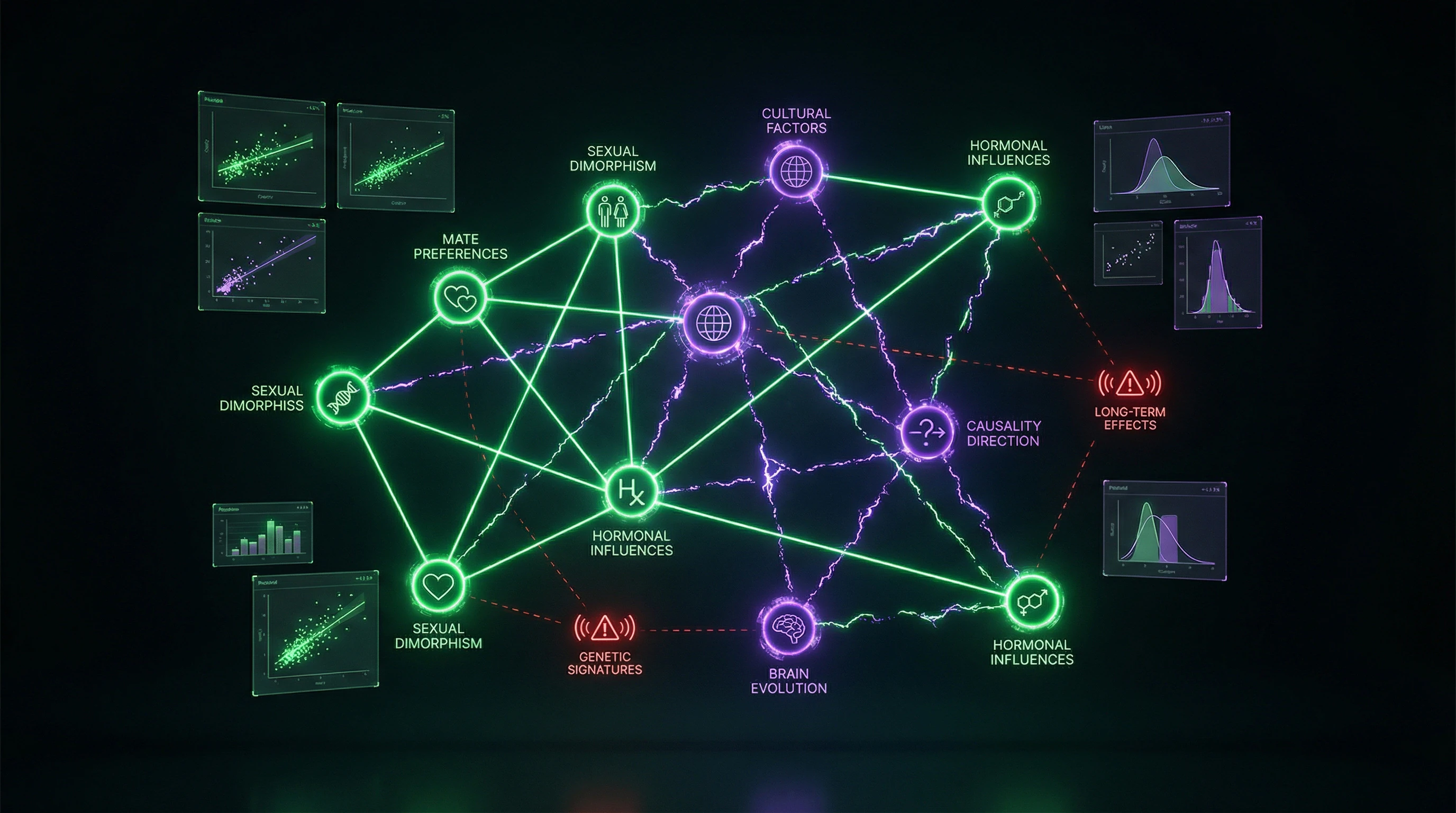
Mechanisms and Causality: How to Distinguish Sexual Selection from Natural Selection, Cultural Factors, and Random Genetic Drift
🔁 Coevolution of Traits and Preferences: Fisher's Runaway Selection Model and Its Applicability to Humans
Fisher's runaway selection model describes a positive feedback loop between preference for a trait and the trait itself (S009). If females prefer males with long tails, their sons inherit long tails and their daughters inherit the preference for them. Each generation amplifies both parameters until natural selection halts the process (when the tail becomes a survival hindrance).
Some researchers suggest that human intelligence evolved through this scenario (S009). However, in humans this model faces a problem: cultural evolution operates faster than biological evolution, and preferences are transmitted not only genetically.
Fisher's runaway selection requires stability of preferences across many generations. In humans, cultural standards shift within decades, not millennia.
🧷 Pleiotropy and Linked Traits: Why Correlation Does Not Mean Causation
One gene often influences multiple traits simultaneously—this is pleiotropy (S009). Genes that increase testosterone levels simultaneously affect muscle mass, aggression, beard growth, voice pitch, and immune function.
| Trait | Possible Selection Source | Interpretation Problem |
|---|---|---|
| Deep voice | Sexual selection (attractiveness) | May be a side effect of high testosterone selected for muscle mass (natural selection) |
| High intelligence | Sexual selection (smart partners) | May result from natural selection for survival ability in complex environments |
| Facial symmetry | Sexual selection (beauty) | May reflect general health and absence of parasites (natural selection) |
If sexual selection favors a deep voice, it automatically favors all testosterone-linked traits, even if they are not inherently attractive. This makes separating causes impossible without experimental control. More details in the Abiogenesis section.
🌐 The Role of Culture and Social Learning: Where Does Biology End and Culture Begin?
Current consensus recognizes sexual selection as a potential factor in human brain evolution, but emphasizes that the cultural capacity to store and transmit knowledge had high survival value (S009). In humans, cultural evolution occurs orders of magnitude faster than biological evolution.
Mate choice preferences are transmitted culturally—through imitation, learning, media—not genetically. Standards of female beauty have changed radically: from plumpness as a sign of wealth in medieval times to thinness as a sign of self-control in the 20th century. These shifts occurred within decades, which cannot be explained by genetic changes.
- Cultural Selection
- Transmission of preferences through learning and imitation, without genetic inheritance. Can mimic sexual selection but operates independently of biology.
- Genetic Selection
- Transmission of traits through genes. Requires many generations for noticeable changes in trait frequencies within a population.
⚙️ Natural Selection vs Sexual Selection: Can They Be Separated in a Social Species?
In social species, the boundary between natural and sexual selection blurs. Traits that aid in social competition (intelligence, communication skills, cooperation) simultaneously increase survival chances and attractiveness as a mate.
Prehistoric women could protect each other from harassment and rape, as females of other primate species do (S004). Social alliances among women influenced reproductive success, but this is no longer pure sexual selection in the classical sense—it is an interaction of natural selection for cooperation with sexual selection for social status.
When a trait simultaneously increases survival and attractiveness, it is impossible to determine which type of selection was dominant without isolating variables.
🎲 Genetic Drift and Founder Effect: Randomness in Human Population Evolution
Not all differences between populations result from selection. Genetic drift—random changes in gene frequencies, especially strong in small populations. The founder effect occurs when a new population is established by a small group carrying only part of the genetic diversity of the source population.
The Ainu population today numbers around 200,000 people by unofficial estimates (25,000 by official counts) (S005). Small populations are subject to strong drift, and many of their characteristics may result from chance rather than selection. This means that correlation between a trait and reproductive success may be an artifact of drift, not evidence of selection.
- Verify population size at the time the trait emerged
- Assess how strongly the trait correlates with reproductive success under current conditions
- Rule out the possibility of drift through modeling of random processes
- Compare trait frequency across different populations with different drift histories