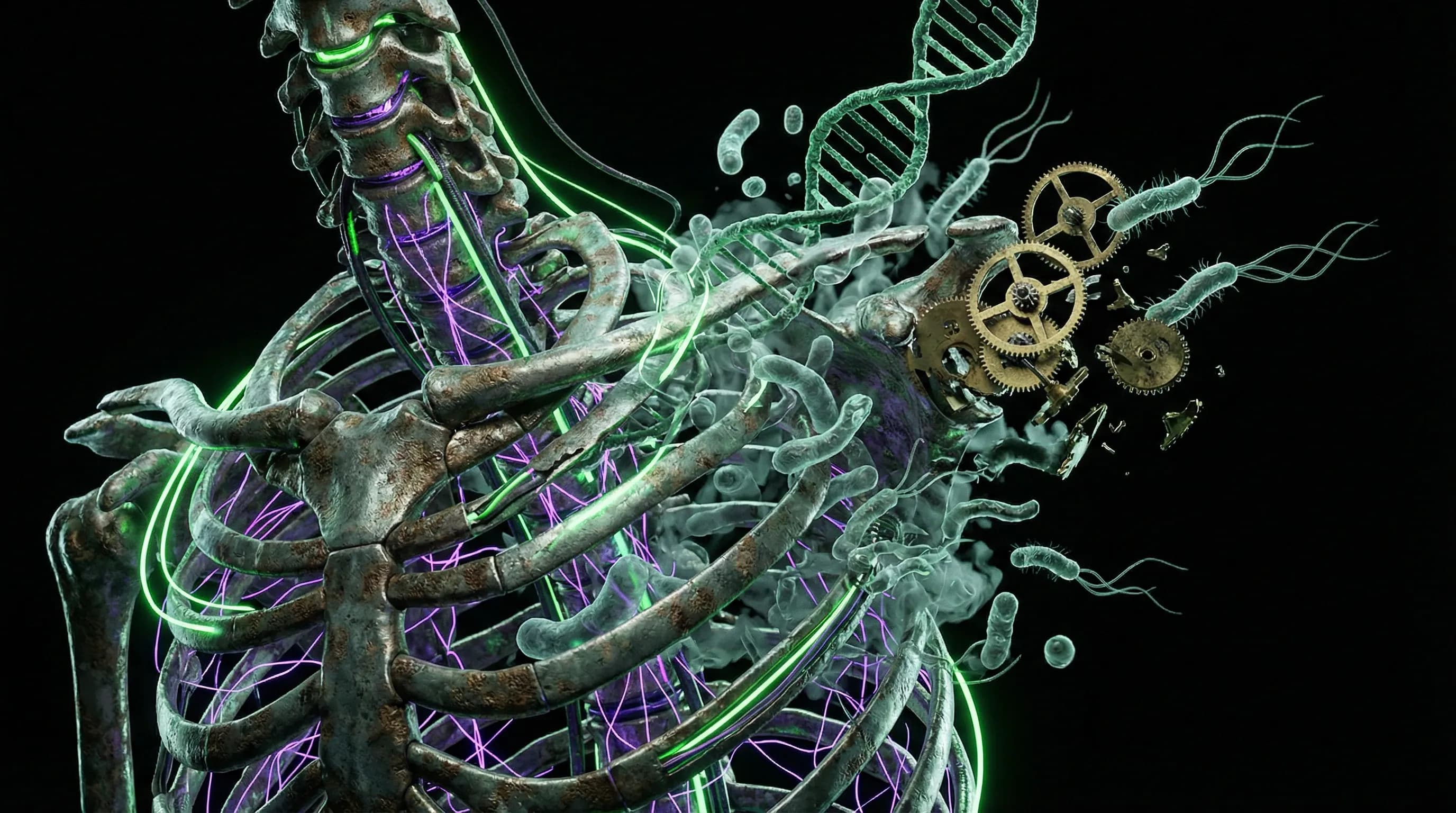
What is "irreducible complexity" — and why it's not just creationism repackaged
The Intelligent Design movement positions itself as a scientific alternative to evolutionary biology, distancing itself from religious creationism through formal methodology. As noted in academic analysis, ID arguments are united by a relatively modest goal — to establish the existence of a non-human designer without attempting to establish any characteristics of that designer (S005).
This methodological restraint is a strategic move: instead of appealing to a specific deity, ID proposes a formal criterion for detecting intelligent intervention in biological systems. More details in the section Theory of Relativity.
🧩 Behe's definition of irreducible complexity
The central concept of ID — irreducible complexity — is defined as a property of a biological system consisting of several interacting parts, where removal of any part leads to complete loss of function.
If a system doesn't work without all components, natural selection couldn't have favored intermediate forms, since they would provide no advantage. This is the core of the ID argument.
Behe formulates this as a criterion for the impossibility of gradual evolution. Within ID there are two dominant lines of argumentation, each appealing to different features of organisms to infer design — the first being arguments appealing to irreducible complexity, a term introduced by Michael Behe (S005).
⚙️ Canonical examples: from flagella to clotting cascades
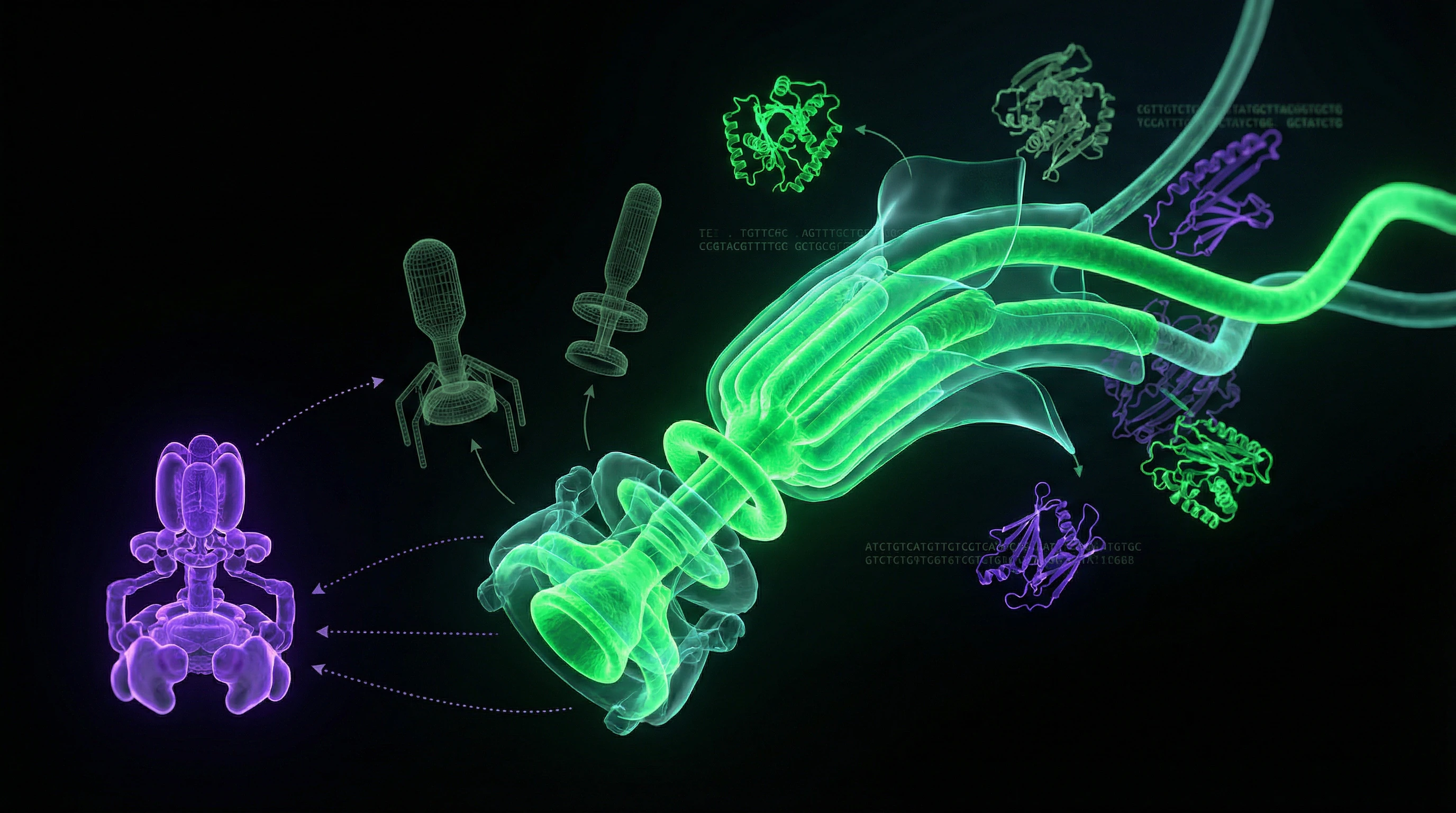
Behe proposed several biological systems as evidence of irreducible complexity. The bacterial flagellum — a molecular motor that rotates the bacterial tail — consists of approximately 40 protein components forming a structure resembling an outboard motor.
- Blood clotting system
- A cascade of dozens of proteins, where each activates the next. Remove one component — the system stops working.
- Vertebrate immune system
- Requires coordination of multiple cell types and molecular signals. In all cases, Behe claims: the system could not have arisen through accumulation of small changes.
🔍 Distinction from classical creationism: methodological naturalism as camouflage
The critically important distinction of ID from religious creationism is the rejection of explicit references to sacred texts and the use of scientific methodology language. ID doesn't claim the designer is a specific deity, but proposes a formal criterion for detecting design through exclusion of natural mechanisms.
| Aspect | Creationism | Intelligent Design |
|---|---|---|
| Source of argument | Sacred texts, revelation | Analysis of biological systems, logic |
| Designer characteristics | Specific deity with attributes | Undefined "designer" |
| Position in education | Religious teaching | Positioned as scientific controversy |
This strategy allowed the ID movement to penetrate educational discussions, presenting itself as a scientific alternative. However, court cases established that ID is religious doctrine disguised as science. The mechanism works through cognitive vulnerability: formal language creates an illusion of scientificity, even when the logic of the argument remains the same as in classical creationism.
To understand how this argument captures even skeptics, we need to examine not its truth, but its persuasiveness — why it seems logical upon superficial analysis.
The Steel-Man Version: Why Irreducible Complexity Seems Convincing Even to Skeptics
To honestly evaluate the ID argument, it's necessary to formulate it in its strongest form — a steel-man version, free from obvious logical errors. Even critics acknowledge that the intuition behind irreducible complexity possesses a certain force, especially for systems where functional integration of components is genuinely high. More details in the Cosmology and Astronomy section.
🎯 The Argument from Functional Integration
The strongest version of the argument doesn't claim that components of a complex system couldn't exist separately, but rather that their specific integration into the current function requires simultaneous coordination of multiple changes. The blood clotting system includes positive and negative feedback loops: too little clotting — the organism bleeds out, too much — clots block vessels.
Evolution critics point out: how could natural selection "tune" this balance if intermediate states would be lethal? This creates the appearance of a system that cannot be assembled gradually.
⚡ The Problem of Non-Functional Intermediate Forms
A second strong argument concerns the adaptive value of intermediate structures. If the bacterial flagellum evolved from a simpler system, each intermediate step must have provided a selective advantage. But why would a bacterium need "half a flagellum" or "a flagellum without a motor"?
If an intermediate form provides no advantage, natural selection won't fix it in the population. This creates the appearance of a "valley of unfitness" in the adaptive landscape — a region that evolution cannot cross through gradual steps.
- The system requires multiple components simultaneously
- Each intermediate step must be functional
- Non-functional intermediate forms aren't fixed by selection
- Result: the appearance of an insurmountable barrier to evolution
🧮 The Mathematical Argument from Probability
ID proponents appeal to combinatorial complexity: if a system requires a specific sequence of N amino acids in a protein, and each position can be occupied by one of 20 amino acids, the probability of randomly generating a functional protein is 1/20^N (S002). For a protein 150 amino acids long, this yields approximately 10^-195.
Even accounting for all organisms throughout Earth's history, ID proponents argue, there isn't enough time for random search through such a possibility space.
🔬 The Argument from Molecular Machines
The discovery of complex molecular structures — ATP synthase (a molecular turbine), kinesin (a molecular transporter), the ribosome (a molecular protein factory) — strengthened the design intuition (S003). These structures demonstrate engineering principles: rotors, stators, bearings, levers.
ID proponents point out: when we see similar structures in human artifacts, we immediately infer intelligent design. Why should biological "machines" be an exception?
📊 The Argument from Information Content
Some ID theorists formalize the argument through information theory: biological systems contain "specified complexity" — information that is simultaneously improbable and corresponds to an independent pattern (S006). Random processes can create complexity (white noise is complex but not specified) or simple patterns (crystals are specified but not complex), but not both simultaneously.
The genome, they argue, contains precisely such information — therefore requiring an intelligent source. This makes the argument appealing even to those skeptical of creationism in its traditional form.
Evidence Base: What the Data Shows About Each "Irreducibly Complex" Example
Critical examination of the irreducible complexity concept requires detailed analysis of specific biological systems proposed as evidence. Over two decades of research, every canonical example has received an evolutionary explanation based on comparative genomics, structural biology, and experimental evolution. More details in the Thermodynamics section.
🧬 Bacterial Flagellum: From "ID Icon" to Textbook Example of Evolution
The bacterial flagellum was Behe's central example, but proved most vulnerable to empirical testing. Research has shown that flagella have evolutionary precursors in simpler systems (S010).
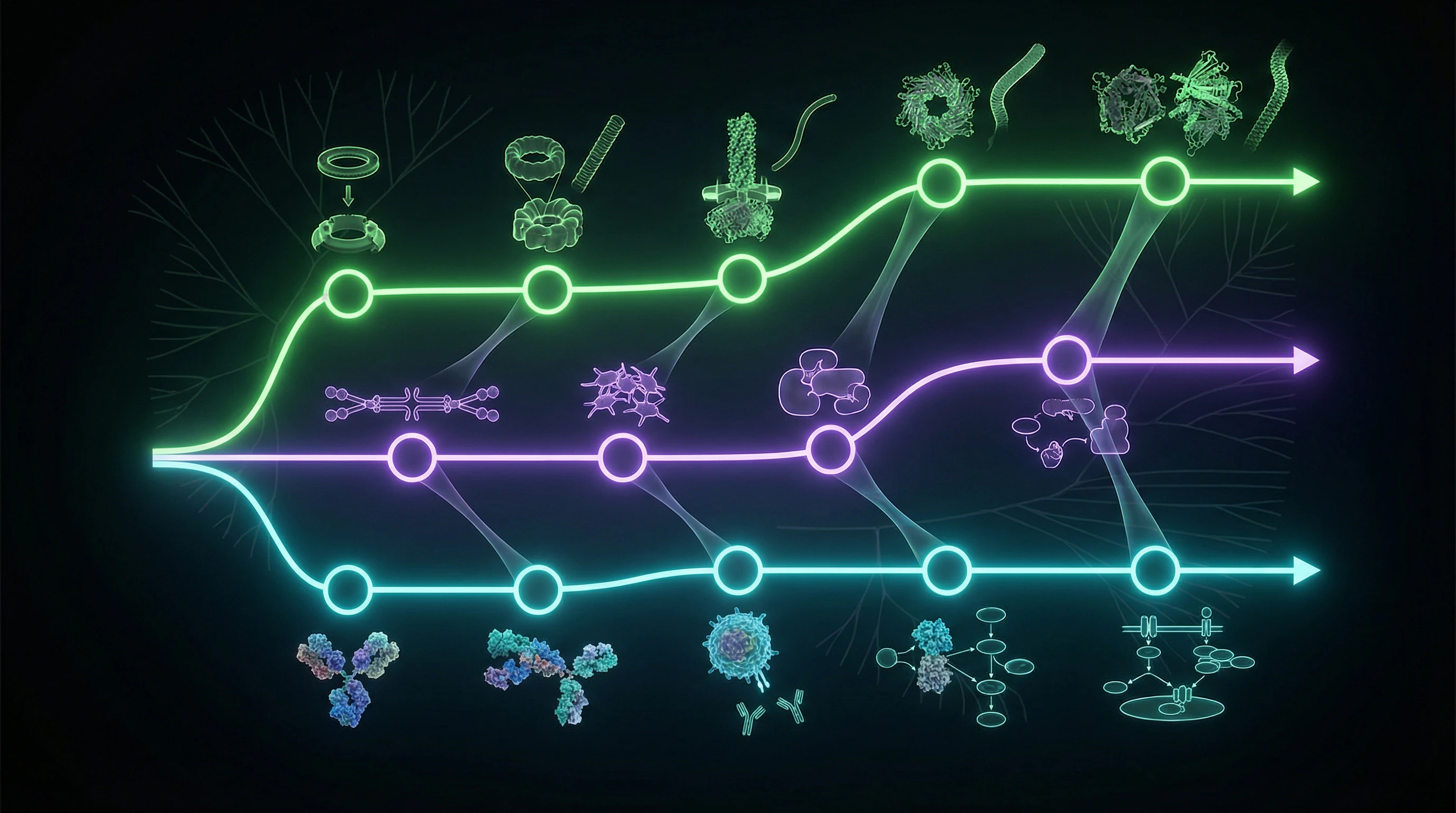
Key discovery: approximately 40 flagellar proteins are homologous to proteins in the Type III Secretion System (T3SS)—a molecular "syringe" that bacteria use to inject toxins into host cells. T3SS is functional on its own and simpler than the flagellum, indicating a possible evolutionary pathway: secretion system → primitive flagellum → modern flagellum.
Comparative genomics has revealed intermediate forms of flagella across different bacterial species, varying in component count. Some bacteria have flagella with 30 proteins, others with 50. This directly contradicts claims of "irreducibility": if the system works with 30 components, it doesn't require all 40 simultaneously (S010).
🩸 Blood Clotting Cascade: Modular Evolution and Gene Duplications
The mammalian blood clotting system involves approximately 20 proteins in a complex activation cascade. Behe claimed that removing any component renders the system nonfunctional. However, research has shown the system arose through a series of gene duplications and modifications, not through simultaneous appearance of all components (S007).
Comparative analysis of vertebrates revealed an evolutionary trajectory:
| Organism Group | Number of Clotting Factors | Functionality |
|---|---|---|
| Primitive fish | 3–5 | Adequate for their physiology |
| Cartilaginous fish (sharks) | 10–12 | Intermediate system |
| Mammals | 20+ | Full cascade |
Each intermediate system is functional. Fish with simple clotting systems don't bleed out—their system is adequate for their lifestyle. Gene duplications explain how additional factors arose without loss of function in the original system (S007).
🦠 Immune System: Recombination and Adaptive Evolution
The adaptive immune system of vertebrates, capable of recognizing millions of different antigens, seemed irreducibly complex to Behe. Molecular research has shown that the key mechanism—V(D)J recombination, which creates antibody diversity—arose from transposons (mobile genetic elements).
In primitive vertebrates (lampreys, hagfish), intermediate forms of immune systems have been discovered using alternative mechanisms for generating diversity. The system evolved modularly: first innate immunity (ancient, present in all animals), then primitive adaptive system, then full system with antibodies.
📊 Experimental Evolution: Observing the Emergence of Complexity in Real Time
The most direct refutation of irreducible complexity comes from experiments where researchers observe the evolution of new functions under laboratory conditions. Richard Lenski's long-term experiment with E. coli (begun in 1988, ongoing) documented the evolution of citrate metabolism capability—a function requiring coordination of multiple genetic changes.
Analysis showed evolution proceeded through intermediate stages: first arose weak ability to transport citrate (provided no advantage under initial conditions), then a mutation in a regulatory gene activated the transporter under aerobic conditions, then additional mutations amplified the effect.
"Nonfunctional" intermediate forms can become fixed in populations through genetic drift or pleiotropy (when a mutation affects multiple traits), then become the foundation for new function when environmental conditions change.
🧪 Molecular Phylogenetics: Reconstructing Evolutionary Pathways
Modern comparative genomics methods allow reconstruction of the evolutionary history of protein families with high precision. Research shows that most "complex" proteins arose through combination of domains—modular functional units that can exist independently.
- Domain
- A modular functional unit of a protein that can exist independently and appears in different proteins with various functions.
- Domain Recombination
- An evolutionary mechanism where domains combine to create new functional combinations. Each combination can be functional, though performing a different task than the final system.
Proteins in the complement system (part of the immune system) contain domains found in dozens of other proteins with different functions. This indicates an evolutionary mechanism through modular recombination, where each step preserves functionality.
The Mechanism of Delusion: Why "We Don't Know" Becomes "It's Impossible"
The argument from irreducible complexity is a classic example of argument from ignorance (argumentum ad ignorantiam): the absence of a known explanation is interpreted as proof of the impossibility of a natural explanation. Understanding the cognitive mechanisms that make this argument convincing is critically important for evaluating any claims about "the impossibility of evolution." More details in the section Cognitive Biases.
🧩 The Cognitive Illusion of Teleology: The Brain Sees Design Everywhere
The human brain evolved to detect agency and intentions—this was critically important for survival (better to mistakenly attribute rustling in the bushes to a predator than to miss a real threat). This cognitive predisposition creates a teleological illusion: we intuitively perceive complex structures as created "for" a specific purpose.
When Behe describes the flagellum as an "outboard motor," he exploits this illusion—the metaphor of an engineered artifact activates design intuition, even though functional similarity doesn't prove common origin. This same mechanism operates in evolutionary psychology, where compelling stories about the past often seem more convincing than data.
⚠️ The Inverse Probability Fallacy: Confusing P(A|B) and P(B|A)
The mathematical argument of ID contains a classic statistical error. ID proponents calculate the probability of random emergence of a specific protein sequence—P(sequence | randomness)—and find it astronomically small. But the relevant question is: what is the probability of emergence of any functional sequence—P(function | randomness)?
The space of functional sequences is enormous: for most proteins, multiple different sequences perform the same function. Random mutagenesis experiments show that up to 30–50% of positions in a typical protein can be replaced without loss of function (S002).
Evolution doesn't work through "random trial" of all possible sequences. Natural selection is a cumulative process: each small improvement is retained, creating a platform for the next change. This radically reduces the effective search space.
🔁 The Retrospective Illusion of Inevitability: The Path Seems Singular in Hindsight
When we look at a modern complex system, it's easy to fall into the illusion that it could only have arisen through its current path. But evolution has no foresight—it doesn't "know" that a flagellum will be useful when creating a secretion system.
Intermediate forms performed other functions, and only retrospectively can we arrange them in a linear sequence. This creates an illusion of evolution's "directionality" toward the current state, even though at each stage there were multiple alternative paths (S003).
- A system arises for function A (e.g., toxin secretion)
- A mutation creates a side effect—components begin working as a motor
- Selection retains this function if it increases fitness
- In hindsight, we see only the final result and mistakenly consider it the only possibility
🕳️ The "Missing Transitional Forms" Trap: Demanding a Continuous Record
Critics of evolution often demand a "complete" sequence of intermediate forms, but this requirement is unrealistic. The paleontological record is incomplete (most organisms don't leave fossils), and molecular evolution leaves no direct traces of intermediate states (we see only modern genomes).
The absence of a complete reconstruction doesn't mean the absence of an evolutionary path—it only means limitations in our data. Each new discovery of an intermediate form fills a gap but simultaneously creates two new gaps (before and after the found form), creating the illusion that the problem is worsening, when in fact our understanding is improving in the context of the long-standing debate between creationism and evolution.
- Cognitive Trap
- The demand for a "complete record" is a moving target: each answer generates a new question, creating the impression that science is always incomplete.
- Data Reality
- Molecular data (genome comparisons) provide independent evidence of evolutionary pathways without requiring fossils.
Conflicts and Uncertainties: Where Data Are Genuinely Incomplete or Contradictory
Honest analysis requires acknowledging areas where evolutionary explanations remain incomplete or controversial. This doesn't confirm ID, but shows the boundaries of current knowledge and directions for future research. More details in the Mental Bugs section.
🧬 Origin of the Genetic Code: An Unsolved Problem
The origin of the genetic code itself (the correspondence between nucleotide triplets and amino acids) remains one of biology's deepest mysteries (S002). Multiple hypotheses exist (stereochemical, coevolutionary, adaptive), but there's no consensus and little direct evidence.
"We don't know" is an honest answer. However, the absence of a natural explanation doesn't prove the impossibility of a natural explanation, but merely indicates the need for further research.
🔬 Speed of Complex System Evolution: The Time Problem
Some evolutionary transitions occurred relatively quickly by geological standards (for example, the Cambrian explosion—the appearance of most animal phyla in 20–30 million years). Critics ask: is this enough time for complex systems to evolve?
Population genetic models show that with sufficiently large population sizes and strong selection—yes, it's enough (S003). But precise parameters (population sizes, selection intensity) for ancient organisms are unknown, creating uncertainty in calculations.
📊 Pleiotropy and Genetic Constraints: Not Everything Is Evolutionarily Possible
Evolution is indeed constrained by genetic architecture: some changes may be impossible without destroying existing functions due to pleiotropy (when one gene affects multiple traits) (S006). This creates "valleys of unfitness" in the adaptive landscape—regions that evolution cannot cross in small steps.
- Genetic drift in small populations can overcome local maxima.
- Compensatory mutations restore function after a destructive change.
- Environmental change makes intermediate forms adaptive.
- The question isn't whether constraints exist (they do), but whether they're absolute (there's no evidence of this).
🧪 Experimental Limitations: We Cannot Reproduce All of Evolution
Critics rightly note that we cannot experimentally reproduce the evolution of, say, an eye from a photosensitive cell to a complex visual organ—this would take millions of years. We're limited to indirect evidence: comparative anatomy, molecular phylogenetics, computer modeling.
This doesn't make evolutionary explanation less well-founded—most historical sciences work with indirect evidence and have their own epistemological standards. But it acknowledges real methodological limitations.
Anatomy of Persuasion: Which Cognitive Vulnerabilities Does the ID Argument Exploit
The irreducible complexity argument works not because it's true, but because it exploits fundamental limitations of human thinking. More details in the section Karma and Reincarnation.
When we see a complex system—a bacterial flagellum, blood clotting, an eye—our brain automatically searches for intention. This isn't a mistake: in social environments, such searching often saves lives. But in biology, it becomes a trap.
Teleology—attributing purpose where there is none—is not a bug in our perception, but a feature that evolved for survival in a world full of agents.
The ID argument exploits four cognitive vulnerabilities:
- Illusion of knowledge incompleteness. "We don't know how this arose" is experienced as "this cannot be explained." But the absence of an explanation in a textbook is not the absence of a mechanism in nature (S002).
- Hyperactive agent detection. Complexity → design. This heuristic works in the social world, but in evolution complexity arises through selection, not through design.
- Default skepticism toward abstract processes. People more easily believe in a concrete agent than in millions of iterations of selection. Millions of years aren't intuitive, even if logically comprehensible.
- Social validation through authority. If a biochemist (even without evolutionary training) says "this is impossible," it sounds more convincing than a popular account of paleontology.
Each of these vulnerabilities is not a personal defect, but a universal feature of human cognition in the context of epistemology.
| Vulnerability | How ID Uses It | Reality |
|---|---|---|
| Search for intention | "Complexity → design" | Complexity → selection + time |
| Distrust of scale | "Millions of years is fantasy" | Geology and paleontology confirm the scales |
| Authority without context | "A scientist said it's impossible" | The scientist may be outside their area of expertise (S005) |
| Illusion of incompleteness | "Textbook doesn't explain → it's inexplicable" | Textbook is not the completeness of science, but its simplification |
Why this matters for the creationism vs. evolution debate: ID isn't defeated by facts head-on. It's defeated when we recognize that our intuition about complexity and design is a tool, not truth.
A person who understands why it seems to them that the flagellum couldn't have arisen without a designer is already halfway to seeing how it arose through selection.