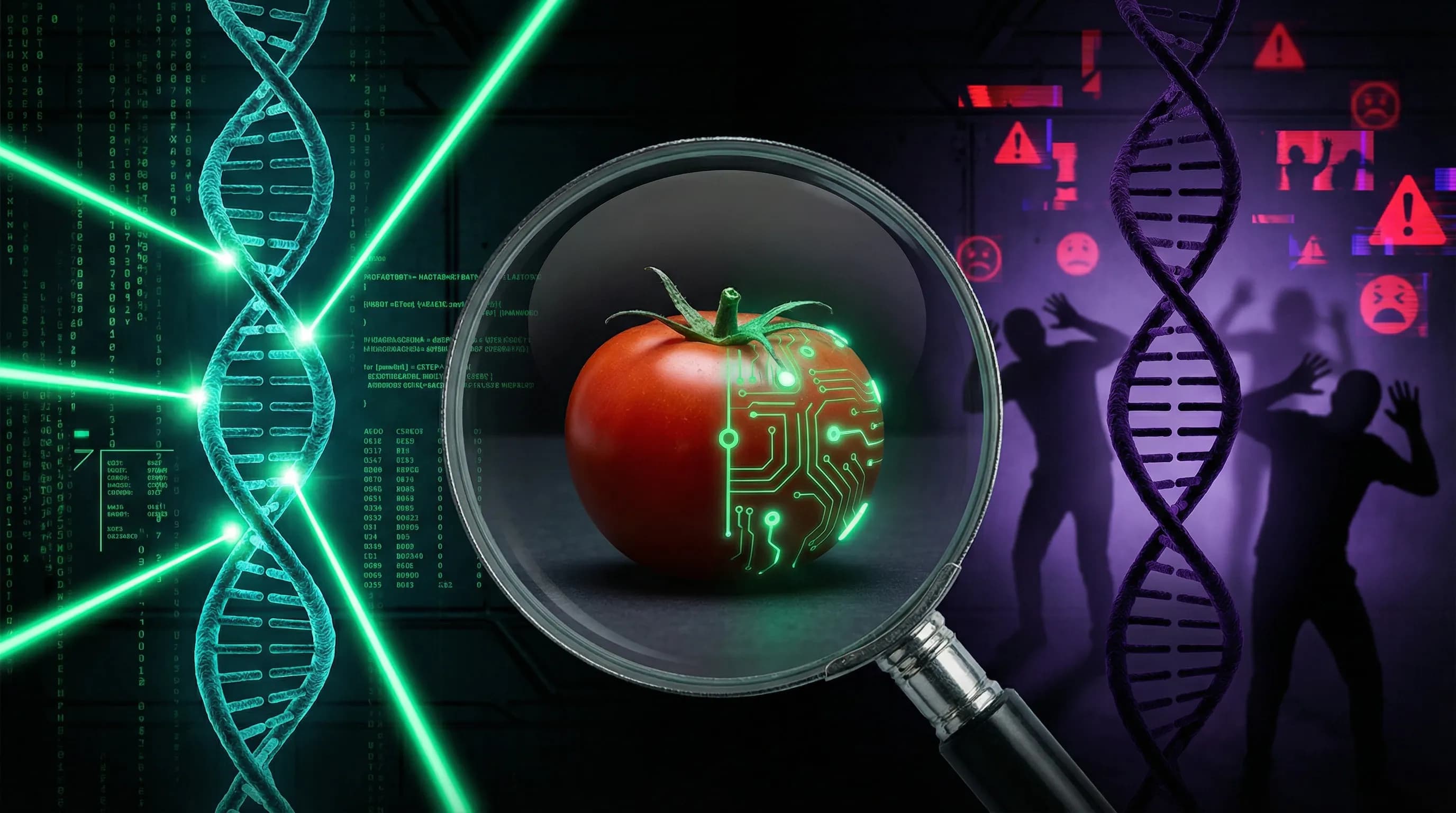
Anatomy of the Fallacy: How Technology Origin Substitutes for Characteristic Assessment in Anti-GMO Discourse
The genetic fallacy in the GMO context manifests in a specific form: opponents of the technology build their arguments not around measurable safety parameters of specific modified organisms, but around the very fact of laboratory origin of genetic changes. More details in the Quantum Mechanics section.
This substitution creates an illusion of logical connection between the method of product creation and its potential danger, although such a connection has not been established empirically.
- Genetic fallacy
- Substituting evaluation of an object's properties with evaluation of its origin. Conclusions about quality/safety are made based on the source rather than on measurable characteristics.
Structure of Faulty Reasoning: From Origin to Properties
The classic form looks like this: (1) GMOs are created through artificial gene transfer under laboratory conditions; (2) artificial intervention in the genome is "unnatural"; (3) therefore, GMOs are dangerous or suspicious.
The logical gap emerges between premises and conclusion: from the fact of laboratory origin, neither danger nor safety of the product automatically follows.
Research shows that genetically modified organisms represent intellectual property with clearly defined characteristics (S009), which implies the possibility of their objective evaluation independent of the creation method.
Emotional Loading of the Term as Distortion Amplifier
The term "genetic modification" itself carries significant emotional weight, activating the heuristic of fear of the unknown. When consumers hear about "DNA intervention," it triggers a cascade of associations with science fiction, uncontrolled mutations, and violation of the "natural order."
This emotional reaction overshadows rational analysis: people don't ask which specific gene was transferred, what function it performs, and what safety studies were conducted. Instead, the word "modified" itself becomes a stop signal, blocking further consideration of facts (S002).
| Perception | Traditional Breeding | Genetic Engineering |
|---|---|---|
| Status in consciousness | "Natural," time-tested | "Unnatural," dangerous |
| Scale of genome changes | Often greater (radiation mutagenesis, hybridization) | Precise transfer of a single gene with known function |
| Control over outcome | Random, unpredictable | Targeted, reproducible |
Double Standards in Assessing "Naturalness"
Virtually all modern agricultural crops are the result of millennia of artificial selection and hybridization, including methods of radiation and chemical mutagenesis that cause random changes in the genome. However, these products are perceived as "natural."
Comparative biochemical analysis of soybean varieties, including genetically modified ones, demonstrates that differences between GM and traditional varieties are often smaller than differences between different traditional varieties (S012).
The paradox: precise transfer of a single gene with known function is labeled as "dangerous intervention," while random mutations from radiation exposure remain invisible to criticism.
This asymmetry in evaluation reflects not a difference in actual risks, but a difference in psychological availability of information. Traditional breeding is a slow and historically familiar process; genetic engineering is new, visible, human-controlled. Novelty and visibility activate cognitive biases related to uncertainty and control.

Steel-manning the anti-GMO position: seven arguments that cannot be ignored when analyzing the technology
Intellectually honest analysis requires examining the strongest versions of opposing positions. GMO critics advance several arguments that don't reduce to simple genetic fallacies and deserve serious consideration, even if they ultimately don't withstand evidential scrutiny. More details in the Chemistry section.
🔬 The long-term uncertainty argument: insufficient research time horizons
Mass commercial use of GMOs began in the 1990s—we lack data on impacts to human health and ecosystems across multiple generations. This argument appeals to the precautionary principle: absence of evidence of harm is not equivalent to evidence of safety, especially when dealing with fundamental changes to the food chain.
Indeed, some negative effects may only manifest after decades or in specific populations with genetic predispositions. The question remains open: are three decades of observation sufficient to conclude the safety of a technology that potentially affects organismal biochemistry at levels inaccessible to traditional breeding.
🧬 The pleiotropic unpredictability argument: one gene—multiple functions
Genes rarely perform a single isolated function. Pleiotropy—the phenomenon where one gene influences multiple phenotypic traits—means that transferring a gene to achieve one goal (such as pest resistance) may unintentionally alter other characteristics of the organism.
- Complete mapping of all effects of genetic modification is technically impossible
- Risk of unforeseen biochemical changes always remains
- Standard safety tests may not detect such effects
⚙️ The corporate control argument: concentration of power over the food system
A significant portion of GMO technologies are patented by large agrochemical corporations, creating unprecedented concentration of control over seed stock. Genetically modified organisms as intellectual property become instruments of farmers' economic dependence on seed producers.
This argument doesn't directly address biological safety, but points to systemic risk: when a few corporations control the foundation of food security, commercial interests may not align with public health interests.
🌾 The ecological externalities argument: horizontal gene transfer and superweeds
Cases of herbicide-resistance gene transfer from GM crops to wild relatives have been documented, leading to "superweeds" resistant to standard control methods. This is not a theoretical risk, but an observed phenomenon in several regions of intensive GMO use.
Safety assessment cannot be limited to laboratory conditions—complex ecological interactions in real agroecosystems must be considered, where control over genetic material spread is fundamentally limited.
🧪 The testing methodology limitations argument: short-term and narrow protocols
Standard GMO safety assessment protocols typically include 90-day rodent studies and compositional equivalence analysis. Critics argue these methods are insufficient to detect subtle toxicological effects, allergenic potential, or impacts on gut microbiome (S005).
Studies are often funded by GMO producers themselves, creating potential conflicts of interest and limiting independent data verification. The question of who funds safety research remains critically important for assessing the reliability of conclusions.
📊 The epidemiological complexity argument: impossibility of clean population experiments
Unlike pharmaceutical drugs that can be tested in randomized controlled trials, food products are consumed in complex combinations within diverse diets. This makes it practically impossible to isolate the effect of a specific GM product on population health.
| Factor | Pharmaceuticals | Food Products |
|---|---|---|
| Dosage control | Precise | Variable |
| Variable isolation | Possible | Impossible |
| Randomized trials | Standard | Rarely applicable |
| Detecting subtle effects | Realistic | Difficult |
🛡️ The precautionary principle argument: risk asymmetry and irreversibility
The most philosophically grounded argument appeals to asymmetry between potential benefits and risks. If GMOs prove safe, we gain some increase in crop yields and reduction in pesticide use.
If they prove harmful, consequences may be irreversible and global, since genetic material once released into the environment cannot be fully recalled. With such asymmetry, rational strategy requires extreme caution, even in the absence of direct evidence of harm.
Evidence Base: What Three Decades of Research Show About Genetically Modified Organism Safety
Scientific assessment of GMOs relies on one of the most extensive data sets in the history of food toxicology. More than 3,000 studies conducted by independent research groups across different countries form the empirical foundation for conclusions about the safety of commercially available GM crops. Learn more in the Climate and Geology section.
📊 Meta-Analyses and Systematic Reviews: Scientific Community Consensus
Systematic reviews combining results from hundreds of individual studies consistently fail to identify specific health risks associated with consumption of approved GM products.
The U.S. National Academies of Sciences, the European Commission, the World Health Organization, and dozens of other authoritative scientific organizations have concluded that GMOs that have undergone regulatory assessment are no more dangerous than their conventional counterparts. Assessment should be based on the characteristics of the final product, not on the method used to obtain it (S002).
The scientific consensus on the safety of approved GMO crops is based not on isolated studies, but on systematic analysis of thousands of independent works conducted across different countries and institutions.
🧬 Compositional Analysis: Biochemical Equivalence of GM and Conventional Crops
Detailed biochemical studies show that genetically modified crops demonstrate compositional equivalence to their conventional counterparts in terms of macronutrient, vitamin, mineral, and secondary metabolite content.
Variability in biochemical composition within GM varieties does not exceed natural variability between conventional varieties. This refutes the assumption that genetic modification causes large-scale unpredictable changes in plant metabolism.
| Assessment Parameter | GM Crops | Conventional Varieties |
|---|---|---|
| Within-group compositional variability | Natural | Natural |
| Macronutrients | Equivalent | Equivalent |
| Secondary metabolites | Within normal range | Within normal range |
| Unpredictable effects | Not detected | Not detected |
🔎 Long-Term Animal Studies: Absence of Toxicological Signals
Numerous multigenerational studies in laboratory animals consuming GM feed have revealed no reproductive disorders, carcinogenic effects, or systemic toxicity.
Genetically modified animals are used in biomedical research precisely because the effects of genetic changes are predictable and controllable. If genetic modification per se caused chaotic biological effects, such models would be useless for science.
The fact that genetically modified animals serve as standard models in biomedicine demonstrates the predictability and controllability of genetic changes—the opposite of what the anti-GMO narrative claims.
🌍 Epidemiological Data: Absence of Population Effects in Countries with Mass GMO Consumption
The United States, Canada, Brazil, and Argentina have consumed GM products in significant quantities for more than two decades. Epidemiological monitoring in these countries has not revealed any increase in disease incidence that could be linked to the introduction of GMOs into the food system.
The absence of a population signal with billions of person-years of exposure represents powerful evidence against the hypothesis of substantial health risks.
- More than 20 years of mass GMO consumption in developed countries
- Billions of person-years of exposure without detected population effects
- No correlation between GMO introduction and increased disease incidence
- Epidemiological monitoring covers countries with different healthcare and registration systems
⚖️ Comparative Risk Analysis: GMOs versus Traditional Breeding Methods
GMO safety assessment should be conducted not in absolute terms, but in comparison with alternatives. Traditional breeding, including radiation and chemical mutagenesis, causes thousands of random mutations in the genome, most of which remain uncharacterized.
Genetic engineering allows for targeted changes with known function. From this perspective, GMOs represent a more controlled and predictable approach to crop improvement than many "traditional" methods. For more on the mechanisms of scientific consensus, see the article on GMO safety biology.
- Genetic Engineering
- Targeted, predictable changes with known function; complete characterization of introduced mutations.
- Radiation Mutagenesis
- Thousands of random mutations; most remain uncharacterized; historically considered a "natural" method.
- Chemical Mutagenesis
- Multiple unpredictable changes; low specificity; also not subject to modern regulatory assessment.

The Mechanism of Misconception: Why Intuition About "Naturalness" Systematically Misleads Regarding Risks
The genetic fallacy in GMO perception is not a random thinking error—it relies on deeply rooted cognitive mechanisms that serve adaptive purposes in other contexts but lead to systematic distortions when evaluating modern technologies. More details in the section Epistemology Basics.
🧩 The Naturalness Heuristic: Evolutionary Roots of "Natural" Preference
The human brain evolved in an environment where "natural" often correlated with safe (familiar plants, traditional food), while "artificial" or unfamiliar could signal danger. This heuristic—a quick decision-making rule—was adaptive under conditions of limited information.
However, in the modern world it creates a systematic error: many "natural" substances are extremely toxic (aflatoxins in moldy nuts, solanine in green potatoes), while many "artificial" products (synthetic vitamins) are molecularly identical to natural analogs.
| Category | Examples | Actual Risk |
|---|---|---|
| "Natural"—toxic | Aflatoxins, solanine, cyanides in seeds | Documented |
| "Artificial"—safe | Synthetic vitamins, insulin from GM bacteria | Molecularly identical to natural |
| Origin | Does not determine safety | Structure and context determine safety |
🔁 Availability Cascade: Media Coverage Amplifies Risk Perception
The availability heuristic causes people to assess the probability of an event by the ease with which examples come to mind. Sensational headlines about "GMO monsters" or "frankenfoods" create vivid, easily memorable images that dominate perception, even when the actual frequency of problems is negligible.
Millions of safe GMO product consumptions generate no news and remain "invisible" to the cognitive system. Asymmetric information flow systematically distorts risk assessment toward overestimating danger.
⚠️ Omission Bias: Preference for Inaction Over Action Under Uncertainty
People tend to perceive harm from action (consuming GMOs) as more serious than equivalent harm from inaction (nutrient deficiency due to rejecting fortified GM crops). This creates asymmetry in risk assessment: potential harm from new technology psychologically "weighs" more than actual harm from maintaining the status quo.
In the GMO context, hypothetical risks of genetic engineering are perceived as more significant than documented problems of traditional agriculture (toxic pesticides, soil erosion, low yields).
- Potential risk (GMOs) → perceived as high
- Actual risk (pesticides, hunger) → perceived as normal
- Result: rejection of technology that reduces actual risks
🧬 Illusion of Understanding: Simplified Mental Models of Genetics
Most people operate with a simplified model of genetics in which genes are viewed as discrete "instructions" for specific traits, and the genome as a sacred "blueprint" of an organism, any alteration of which leads to unpredictable consequences.
- Simplified model
- Genome = static, perfect blueprint; any intervention = disruption of balance
- Reality
- Natural mutations occur constantly; horizontal gene transfer is documented in nature; part of the human genome consists of sequences of viral origin
- Consequence
- Illusion that "natural" genome is protected from changes, while "artificial" is vulnerable
This mental model ignores the fundamental plasticity of genomes and creates a false sense that human intervention is qualitatively different from natural processes. The connection to intelligent design concepts here is not coincidental: both rely on intuition about "perfection of natural design."
Conflicts and Uncertainties: Where Scientific Consensus Meets the Boundaries of Knowledge and Social Contradictions
Despite broad consensus regarding the safety of approved GMOs, there are areas where data is incomplete, methodologies are contested, and scientific conclusions clash with social and ethical considerations. Learn more in the Cognitive Biases section.
🔬 Methodological Disputes: Adequacy of Testing Protocols
Part of the scientific community criticizes standard GMO safety assessment protocols as insufficiently rigorous.
| Point of Disagreement | Current Standard | Criticism |
|---|---|---|
| Duration of animal studies | 90 days | Insufficient to detect chronic effects |
| Control groups | Isogenic lines | Do not reflect real diversity of commercial varieties |
| Statistical power | Standard thresholds | May miss subtle but significant effects |
| Allergenic potential | In silico modeling | Requires confirmation through clinical trials |
These disputes do not invalidate the general conclusion about safety, but point to areas where methodological improvements could enhance the reliability of assessments.
🌾 Ecological Effects: The Gap Between Laboratory and Field
The greatest uncertainty concerns the long-term ecological consequences of large-scale cultivation of GM crops. Cases of pest resistance to Bt toxins and weed resistance to herbicides have been documented, requiring constant adaptation of management strategies.
Agroecosystems are complex systems with nonlinear interactions. Long-term effects may only manifest after decades of intensive use.
Impacts on non-target organisms (beneficial insects, soil microorganisms) have been studied unevenly. Critics rightly point out that current monitoring protocols are often inadequate for detecting slow, cumulative changes in ecosystems.
💼 Conflict of Interest: Research Funding and Regulatory Capture
A significant portion of GMO safety research is funded by biotechnology manufacturers, creating a potential conflict of interest (S001).
- Systematic reviews have found no correlation between funding source and conclusions of health safety studies
- The very fact of financial dependence undermines public trust regardless of results
- The regulatory approval process in some jurisdictions is criticized for excessive reliance on manufacturer data without independent verification
The problem is not that manufacturers falsify data, but that the funding structure creates asymmetry: critical research requires more resources and often fails to find funding (S006). This leads to a systematic shortage of independent long-term studies, especially on ecological effects.
Cognitive Anatomy of the Anti-GMO Narrative: Which Psychological Triggers Are Exploited to Maintain the Misconception
The persistence of anti-GMO positions despite contradictory evidence is explained not only by the genetic fallacy, but also by a complex of cognitive biases and social mechanisms that mutually reinforce each other. More details in the Epistemology section.
⚠️ Motivated Reasoning: Defending Identity Through Evidence Rejection
For many people, their position on GMOs has become part of their social identity, linked to environmental consciousness, corporate criticism, or commitment to a "natural" lifestyle. When a belief is integrated into identity, contradictory evidence is perceived not as information requiring belief updating, but as a threat to self-definition.
Research shows (S004): people with high identification with a position demonstrate active rejection of facts that undermine it. This isn't lazy thinking—it's a defense mechanism. Updating a belief means reconsidering oneself.
When a fact threatens identity, the brain chooses identity. Evidence becomes the enemy, not information.
🎯 Moral Substitution: Why Safety Gets Confused with Ethics
The anti-GMO narrative often conflates two different questions: "Are GMOs safe?" and "Is corporate monopoly on seeds ethical?" The second question is legitimate. The first is empirical.
But in public perception, they've merged. Criticism of corporate practices gets transferred to the technology itself. Scientists defending GMO safety are perceived as defending corporations (S006), even though these are different levels of analysis.
- Moral Substitution
- Transferring criticism of a social system onto an object that system uses. Result: technology is condemned for the sins of its application, not for its properties.
- Cognitive Effect
- A person criticizing Monsanto feels morally righteous. This feeling becomes proof of the position's correctness, independent of safety data.
📡 Social Proof and Echo Chambers
The anti-GMO position is widely prevalent in certain social networks, communities, and media. A person sees that "everyone around them" is against GMOs, and this is perceived as indirect proof of correctness.
Digital platforms amplify the effect: algorithms show content the user already supports. Contradictory data remains invisible. Consensus within the echo chamber appears to be consensus of reality.
- Person sees anti-GMO post on social media → feels social approval
- Algorithm shows more similar content → illusion of consensus grows
- Contradictory data doesn't appear in feed → perceived as non-existent
- Position strengthens not through arguments, but through repetition
🔄 Narrative Inertia: Why Myths Outlive Refutations
The anti-GMO narrative has a simple structure: "A corporation created an unnatural product to make money and is hiding the harm." This story is easily memorable, emotionally resonant, and requires no specialized knowledge.
Refutation requires understanding molecular biology, statistics, and research history. It's more complex, more boring, and has no villain. Therefore, the myth wins not because it's true, but because it's better designed for human perception (S001).
A simple lie with a villain always beats a complex truth without a hero. This isn't people's fault—it's narrative architecture.
🌍 Cultural and Political Layers
In different countries, the anti-GMO position has different roots. In Europe, it's linked to the history of industrial pollution and distrust of corporations. In India—to the history of colonialism and control over seeds (S008). In China—to state control over information (S007).
This means the anti-GMO position isn't monolithic. It's locally adapted to cultural traumas and political conflicts. A refutation that works in one context may be ineffective in another because it doesn't account for the social layer of the belief.
Understanding these mechanisms doesn't mean contempt for people subject to them. It means recognizing that beliefs aren't simply the result of logic, but the result of interaction between data, identity, social environment, and narrative architecture. Changing beliefs requires working with all these levels simultaneously.