 🧬 Evolution and Genetics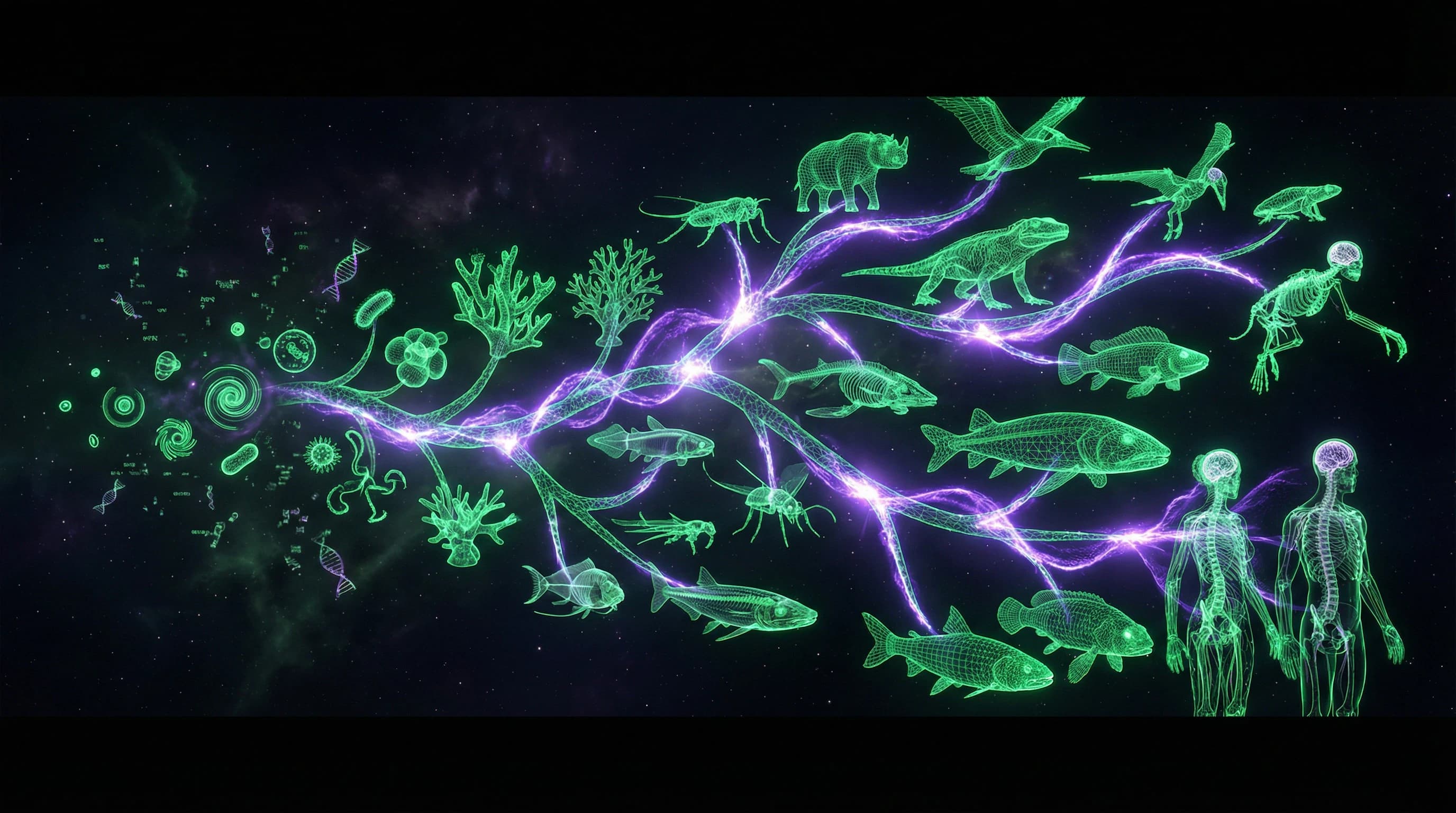
Evolution: The Process of Gradual Change in Living Organisms on Earthλ
Biological evolution is the process of development and change in living nature over millions of years, through which all the diversity of life on our planet emerged.
Overview
Evolution is the process that explains how, over billions of years, all the diversity of organisms on Earth arose from the simplest forms of life. The mechanism: random mutations 🧬 create variations, natural selection preserves beneficial changes, accumulation of changes leads to the emergence of new species. This is not a theory in the colloquial sense ("maybe so, maybe not"), but a scientific model with predictive power—paleontology, genetics, embryology provide independent confirmation of the same patterns.
🛡️
Laplace Protocol: Evolution is a scientifically proven process, confirmed by multiple independent lines of evidence from paleontology, genetics, embryology, and comparative anatomy. This is not a theory in the everyday sense of "guess," but a fundamental scientific concept with an enormous body of evidence.
Reference Protocol
Scientific Foundation
Evidence-based framework for critical analysis
Protocol: Evaluation
Test Yourself
Quizzes on this topic coming soon
Sector L1
Articles
Research materials, essays, and deep dives into critical thinking mechanisms.
🧬 Evolution and Genetics 🧬 Evolution and Genetics
 🧬 Evolution and Genetics
 🧬 Evolution and Genetics
 🧬 Evolution and Genetics
 🧬 Evolution and Genetics
 🧬 Evolution and Genetics
 🧬 Evolution and Genetics
 🧬 Evolution and Genetics
 🧬 Evolution and Genetics
⚡
Deep Dive
What is Evolution: From Unrolling a Scroll to the Mechanism of Biodiversity
The term "evolution" today is associated with Darwin and the origin of species, but its journey into science began long before the 19th century. Understanding this history is critically important to distinguish between the everyday use of the word "development" and the strict scientific concept of biological evolution—a process that explains all the diversity of life on Earth.
Etymology of the Word "Evolution"
The Latin word evolutio literally meant "unrolling a scroll"—a physical action when reading a book in antiquity. In the 17th–18th centuries, European philosophers began using it metaphorically to describe any processes of development and increasing complexity, from cosmological to social.
Even then, evolution did not necessarily imply biological changes—it was a general concept for any progressive movement from simple to complex.
Evolution of the Term's Meaning in Science
The term acquired biological content only in the 19th century, when empirical data from paleontology and comparative anatomy accumulated.
- Modern Scientific Definition of Evolution
- The process of gradual change in living organisms over millions of years, leading to the formation of new species, genera, and larger taxonomic groups.
- Key Clarification
- Evolution has no predetermined goal or direction—it is not a "ladder of progress," but a branching tree where each branch adapts to its own conditions.
The term encompasses both microscopic changes in populations (microevolution) and the emergence of fundamentally new types of living organization (macroevolution), with both levels connected by a continuous process.
Mechanisms of the Evolutionary Process: How Nature's "Blind Watchmaker" Works
Evolution is not an abstract philosophical concept, but a set of concrete mechanisms operating at the level of genes, organisms, and populations. Two fundamental processes—natural selection and genetic variation—work in tandem: the first filters out unsuccessful variants, the second constantly generates new ones.
Understanding these mechanisms dismantles the myth of evolution's "randomness": yes, mutations are random, but selection is a strictly deterministic filter, determined by environmental conditions.
| Component | Nature of Process | Role in Evolution |
|---|---|---|
| Mutations | Random | Generate variability |
| Natural Selection | Deterministic | Filter by environmental conditions |
| Recombination | Random reshuffling | Create new gene combinations |
Natural Selection and Adaptation
Natural selection is the differential survival and reproduction of organisms depending on how well their traits match current environmental conditions. Organisms with traits that increase chances of survival and reproduction pass these traits to the next generation with greater probability.
Adaptation is the result of many generations of selection, when a population accumulates traits optimal for a specific ecological niche. Critical point: adaptations do not arise "in response" to need—they are selected from already existing random variations, which explains why evolution cannot anticipate future environmental changes.
Evolution works with what already exists, not with what might be needed. An organism cannot "develop" wings because it needs them; wings become established because they already arose by chance and proved useful.
Genetic Variation and Mutations
Genetic variation is the raw material of evolution, without which selection is powerless. Mutations—random changes in DNA sequence—constantly create new gene alleles, most of which are neutral or harmful, but rare ones prove beneficial under specific conditions.
Recombination during sexual reproduction reshuffles existing alleles, creating unique gene combinations in each offspring. The mutation rate is relatively constant and low (approximately 10⁻⁸ per nucleotide per generation in humans), which explains why evolutionary changes require millions of years—each beneficial change must first arise randomly, then become established in the population through many generations.
- A mutation arises randomly in an organism's genotype
- If the trait increases fitness, the organism survives and reproduces more often
- The allele spreads through the population across generations
- When environmental conditions change, selection may switch to other variants
Microevolution and Macroevolution: Two Scales of One Process
The division of evolution into micro- and macro-levels does not indicate different mechanisms, but rather differences in observational scale and timeframes. Microevolution describes changes in allele frequencies within populations across generations—a process that can be observed in real time.
Macroevolution encompasses the emergence of new species, genera, families, and organizational types, requiring millions of years and reconstructed through the fossil record. The key understanding: macroevolution is accumulated microevolution plus reproductive isolation that breaks genetic exchange between populations.
Population-Level Changes
Microevolution occurs when allele frequencies in a population change from generation to generation under the influence of selection, genetic drift, migration, or mutations. A classic example is the color change in peppered moths in 19th-century England: within several decades of industrialization, the dark form became dominant in polluted areas where light-colored moths were more visible to predators.
The population is the minimal unit of evolution. An individual organism does not evolve: its genotype is fixed at conception. Only the composition of the gene pool of reproducing individuals changes.
The rate of microevolution depends on selection intensity, population size, and generation turnover rate—in bacteria it can be observed over days, in elephants over millennia.
Formation of New Taxa and Organizational Types
Macroevolution begins with speciation—the moment when two populations of one species stop interbreeding and accumulate independent genetic changes. Geographic isolation (allopatric speciation) is the most common scenario: a population is divided by a barrier, each part adapts to its own conditions, and after hundreds of thousands of years their genomes become incompatible.
The emergence of new organizational types—chordates, arthropods, flowering plants—requires millions of years of accumulated changes in regulatory genes that control body plan development.
| Transition | Intermediate Form | Significance |
|---|---|---|
| Fish → Amphibians | Tiktaalik | Development of limbs from fins |
| Reptiles → Mammals | Cynodonts | Formation of jaw apparatus |
| Dinosaurs → Birds | Archaeopteryx | Emergence of feathers and flight |
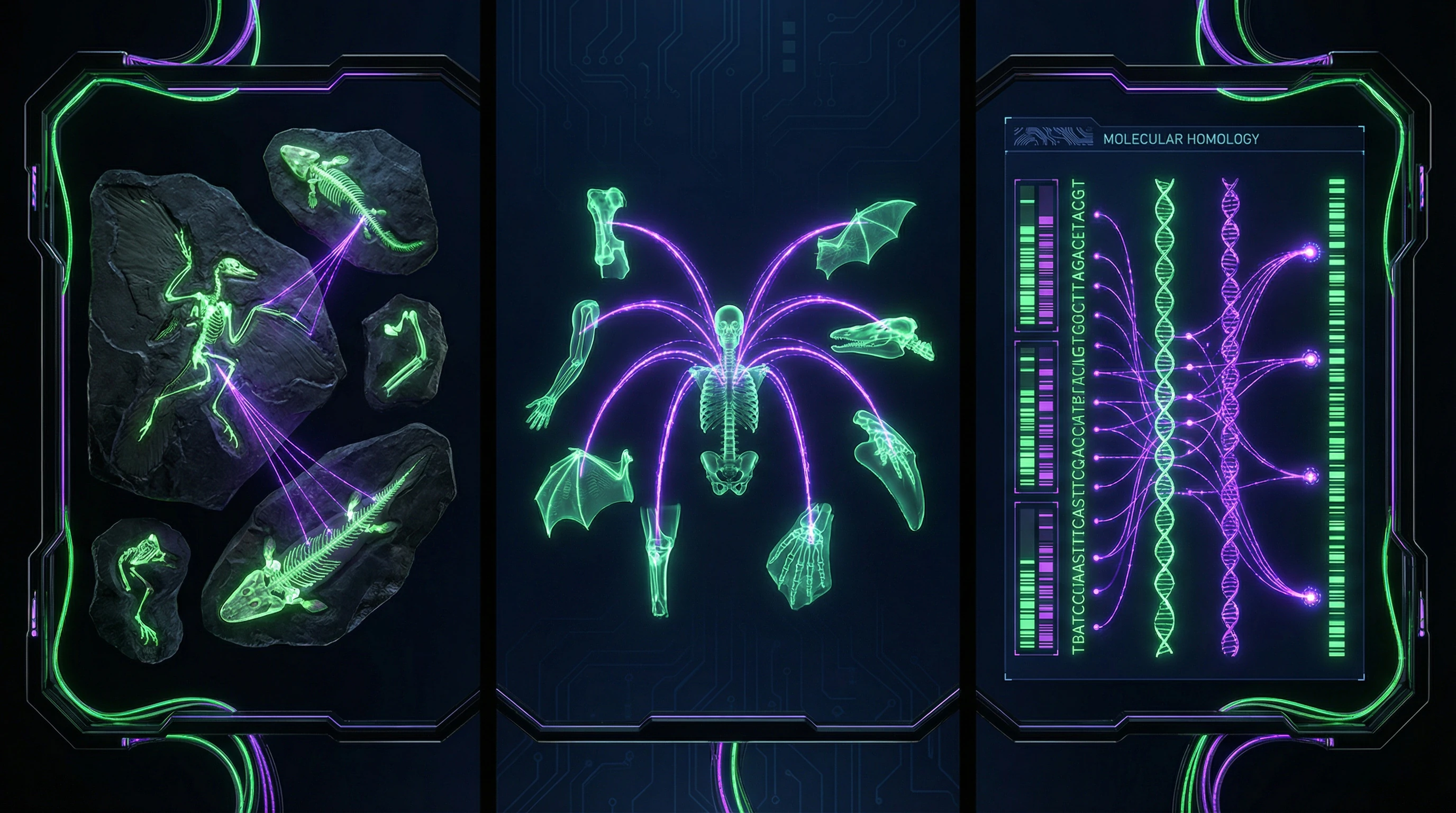
The fossil record documents these transitions through series of intermediate forms. Each discovery fills gaps and confirms the continuity of the evolutionary process.
Evidence for Evolution: Three Independent Lines of Confirmation
Paleontological Evidence of Transitional Forms
Fossil remains document sequences of morphological changes across geological epochs. Tiktaalik—a transitional form between fish and amphibians (375 million years ago)—possesses fish gills and scales, but also a mobile neck and limbs with joints for movement in shallow water.
Archaeopteryx combines reptilian features (teeth, claws on wings, long tail) and avian features (feathers, wishbone). Cynodonts—a group of therapsids—demonstrate gradual formation of mammalian characteristics: tooth differentiation, development of secondary palate, changes in jaw articulation.
Transitional forms don't fill gaps in the fossil record—they demonstrate that gaps never existed. The morphological continuum between major groups of organisms is preserved in stone.
Embryological and Anatomical Data
Similarities in early stages of embryonic development among vertebrates indicate common ancestry: embryos of fish, amphibians, reptiles, birds, and mammals pass through stages with pharyngeal arches, notochord, and segmented muscles.
| Type of Evidence | Example | What It Indicates |
|---|---|---|
| Homologous organs | Forelimb of whale (flipper), bat (wing), mole (paw), human (arm) | Modification of a single structural plan |
| Vestigial organs | Pelvic bones in whales and snakes, third eyelid in humans, appendix | Historical legacy, loss of function |
| Atavisms | Tail appendage in humans, extra digits in horses | Retention of genetic information about ancestral structures |
Molecular-Genetic Confirmations
The universality of the genetic code—use of the same nucleotide triplets to encode amino acids in bacteria, plants, and animals—points to a single common ancestor of all life forms.
The degree of differences in DNA sequences correlates with the time of species divergence: humans and chimpanzees differ by 1.2% of genomic DNA (divergence 6–7 million years ago), humans and mice by 15% (90 million years), humans and yeast by 50% (over 1 billion years).
- Pseudogenes
- Nonfunctional gene copies with identical mutations in related species. The vitamin C synthesis gene is inactive in humans, chimpanzees, and macaques due to the same deletion inherited from a common ancestor. Molecular "fossils" in the genome.
- Endogenous retroviruses
- Fragments of viral DNA integrated into the genome and occupying identical positions in chromosomes of related species. Confirm descent from a common ancestor into whose genome integration occurred.
Three independent lines of evidence—paleontology, anatomy, molecular genetics—converge on a single conclusion. This is not coincidence: this is the signal of truth, amplified through different channels of information transmission.
Evolutionary Timescales: From Micromutations to New Body Plans
Millions of Years of Gradual Change
Evolution operates on timescales incomparable to human lifespans: the formation of new species requires hundreds of thousands of years, genera—millions, body plans—tens of millions.
Microevolutionary changes (mutations, recombination, genetic drift, natural selection) occur in every generation, but their accumulation to reproductive isolation requires 100,000–500,000 years at typical rates. Macroevolution—the emergence of new families, orders, classes—is the extrapolation of microevolutionary processes onto geological timescales: the transition from reptiles to mammals took approximately 100 million years (from early synapsids of the Permian period to the first true mammals of the Jurassic period).
The rate of evolution varies depending on selection intensity and population size: "living fossils" (coelacanth, ginkgo) preserve their morphology for hundreds of millions of years in stable conditions, while adaptive radiations (Darwin's finches, African lake cichlids) generate dozens of species in 1–2 million years when colonizing new ecological niches.
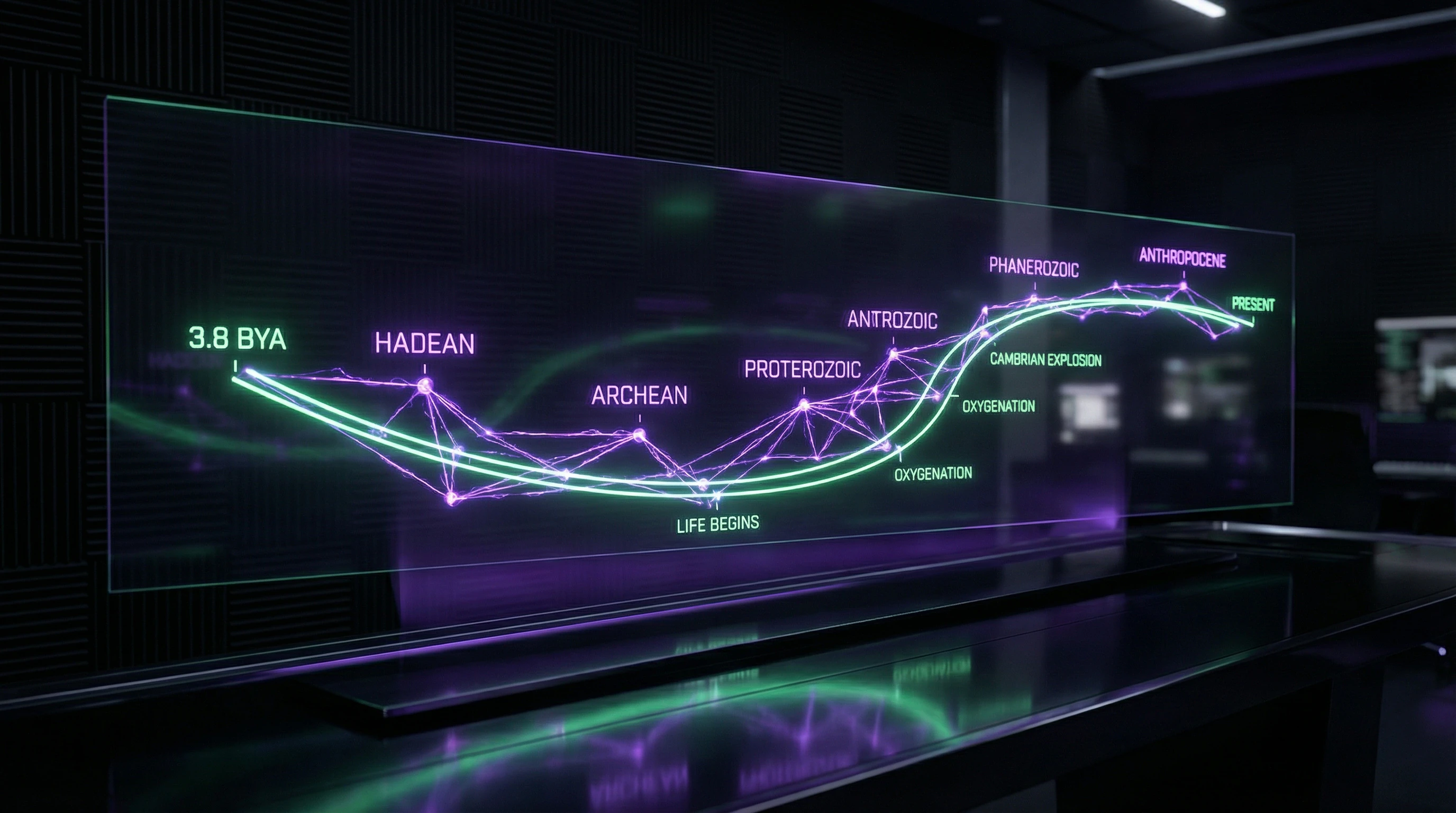
Timeline of Evolutionary Events
The geochronological scale documents the sequence of appearance of major organismal groups:
| Event | Time Ago |
|---|---|
| First prokaryotes | 3.8 billion years |
| Eukaryotes | 2.1 billion years |
| Multicellular animals | 600 million years |
| Vertebrates | 530 million years |
| Land plants | 470 million years |
| Insects | 400 million years |
| Reptiles | 320 million years |
| Mammals | 220 million years |
| Flowering plants | 140 million years |
| Primates | 65 million years |
The Cambrian explosion (541–530 million years ago)—a period of rapid diversification when all modern animal phyla emerged—demonstrates accelerated evolution when new ecological opportunities appear: predation, mineralized skeletons, complex sensory organs.
Mass extinctions freed ecological niches and triggered adaptive radiations of surviving groups. The Permian-Triassic extinction (252 million years ago) eliminated 96% of marine species. The Cretaceous-Paleogene extinction (66 million years ago) wiped out non-avian dinosaurs, allowing mammals to diversify and occupy the vacated niches of large terrestrial animals.
Molecular clocks—a dating method based on the rate of accumulation of neutral mutations—allow estimation of species divergence times even in the absence of paleontological data, calibrating the rate against known reference points.
Evolution of Humans and Other Organisms: An Ongoing Process
Human Origins and Development
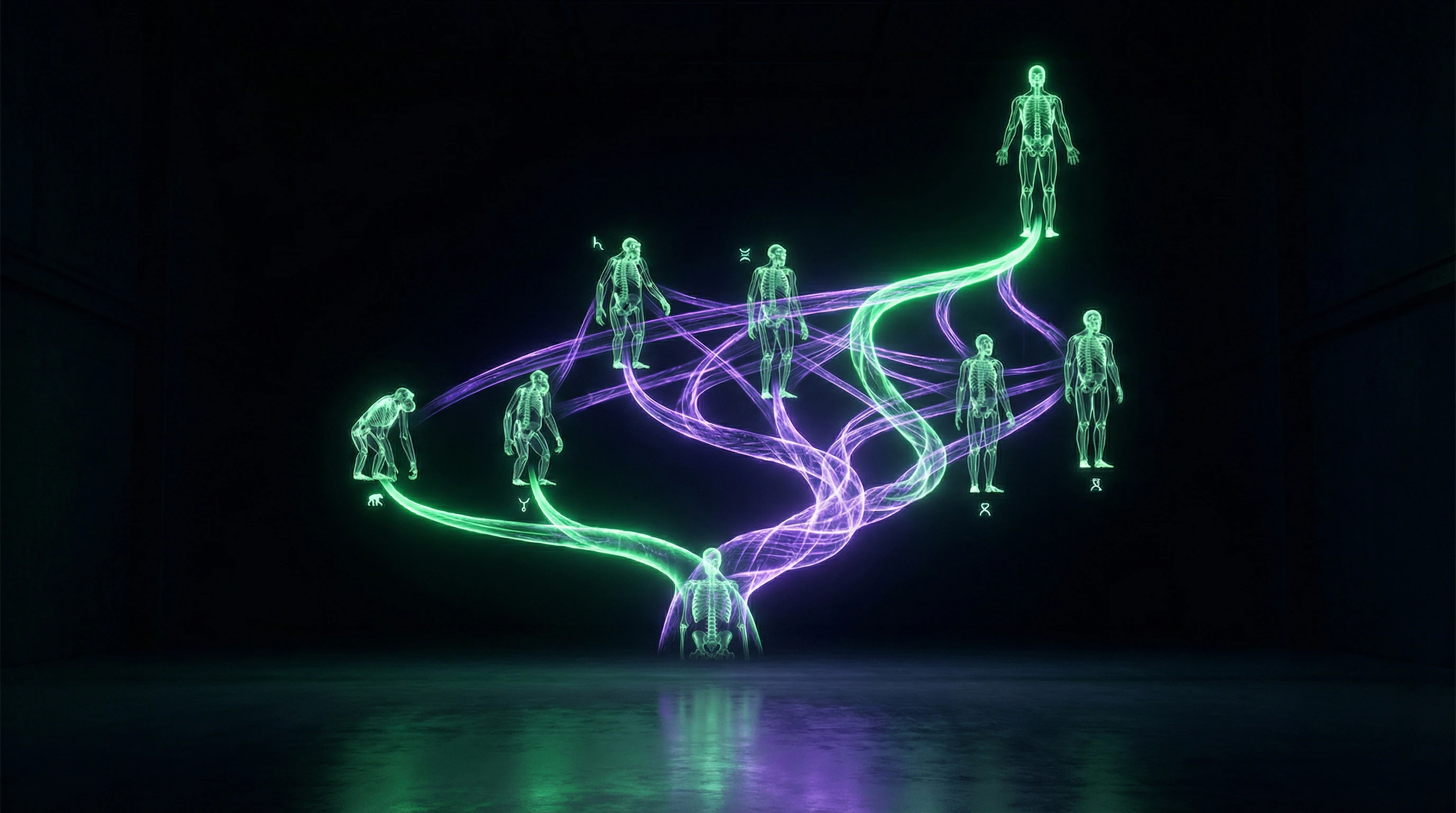
Human evolution began approximately 7 million years ago with the divergence of human and chimpanzee lineages. The path progressed through Sahelanthropus (7 million years), Australopithecines (4–2 million years, bipedalism), Homo habilis (2.4 million years, first tools), Homo erectus (1.9 million years, fire and migration out of Africa), Homo heidelbergensis (600 thousand years) to Homo neanderthalensis and Homo sapiens (300 thousand years).
Key changes: brain volume increased from 400 cm³ in Australopithecines to 1350 cm³ in modern humans, pelvis and spine reorganized for upright walking, jaws and teeth reduced in size, vocal apparatus developed, childhood lengthened to allow learning of complex skills.
| Species | Period | Key Feature |
|---|---|---|
| Sahelanthropus | 7 million years | First signs of bipedalism |
| Australopithecines | 4–2 million years | Upright walking |
| Homo habilis | 2.4 million years | Stone tools |
| Homo erectus | 1.9 million years | Fire, migration |
| Homo sapiens | 300 thousand years | Language, culture |
Genetic data confirms African origins: greatest genetic diversity in African populations, non-African populations represent a subset of African diversity. The out-of-Africa migration occurred 70–50 thousand years ago.
Interspecies hybridization left its mark: 1–4% of the genome of modern non-Africans comes from Neanderthals, up to 5% in Melanesians from Denisovans. This demonstrates the complexity of hominin evolutionary history.
Evolution of Plants and Animals
Plants transitioned from aquatic to terrestrial forms 470 million years ago. They developed cuticles (protection from desiccation), stomata (gas exchange), vascular systems (water transport), and roots (anchoring and nutrition).
Seeds (360 million years ago in gymnosperms) protected the embryo and provided nutrient reserves. Flowers and fruits in angiosperms (140 million years ago) revolutionized reproduction through coevolution with insect pollinators and animal dispersers.
Convergent evolution — the independent emergence of similar traits in unrelated groups — confirms the role of natural selection in adaptation to similar conditions.
Animals evolved from radial symmetry (cnidarians) to bilateral symmetry (worms, arthropods, chordates), from acoelomate to coelomate body plans, from external to internal skeletons, from gills to lungs, from poikilothermy to homeothermy.
Wings arose independently in insects, pterosaurs, birds, and bats. Streamlined body forms developed in fish, ichthyosaurs, and dolphins. Each time — a response to identical environmental conditions.
Contemporary Evolutionary Processes
Evolution continues now and is directly observable. Bacteria develop antibiotic resistance within years through mutations and horizontal gene transfer. Insects adapt to pesticides within decades. Darwin's finches in the Galápagos change beak shape across generations in response to climate and food availability.
- Urban birds sing at higher frequencies to overcome noise
- Fish in polluted waters develop resistance to toxins
- Plants near roads flower earlier
- Humans develop lactose tolerance in populations with dairy farming
- Sickle cell trait in heterozygous state protects against malaria in endemic regions
- Tibetans adapted to high altitude through efficient oxygen utilization
The modern synthesis unites Darwinian natural selection with Mendelian genetics, population genetics, and molecular biology. This provides a quantitative foundation for predicting evolutionary changes and understanding mechanisms of adaptation.
Knowledge Access Protocol
FAQ
Frequently Asked Questions
Evolution is the gradual change in living organisms over millions of years, resulting in the diversity of life on Earth. The term comes from the Latin "evolutio," meaning "unrolling of a scroll." Evolution explains how all modern species of plants, animals, and microorganisms arose from common ancestors (S1, S2, S7).
Natural selection is a mechanism where organisms with beneficial traits survive and reproduce more often than others. These traits are passed to offspring, gradually spreading through the population. The process repeats over millions of years, shaping adaptations to the environment (S3, S7).
Evolutionary changes occur over millions of years through gradual transformations. Microevolution in populations can be observed over hundreds of generations, while the formation of new major taxa requires millions of years. Detailed chronologies of evolutionary events exist for different groups of organisms (S3, S7, S9).
This is an oversimplification—humans and modern apes share a common ancestor that lived millions of years ago. Human evolution followed a separate path, developing unique traits: upright walking, advanced brain, speech. Similarities in early embryonic development confirm common evolutionary origins (S3, S7).
Microevolution refers to changes within populations and species, while macroevolution involves the formation of new major taxa and organizational types. Microevolutionary processes accumulate, leading to macroevolutionary outcomes. Both processes are connected and represent different scales of the same phenomenon (S3, S7).
Key evidence includes: fossil remains showing transitional forms, embryos of different species appearing similar in early stages, and DNA confirming relationships between organisms. Anatomical similarities (vestigial structures, atavisms) and geographic distribution of species also support evolution. Molecular genetics allows precise determination of relatedness (S3, S7, S9).
Begin with basic concepts: natural selection, variation, heredity, and adaptation. Study Darwin's classic works and modern evolutionary biology textbooks. Educational platforms offer accessible lectures from leading scientists (S5, S7).
Yes, evolution continues and is observed in real time. Examples include: bacterial resistance to antibiotics, insect adaptation to pesticides, and population changes due to climate. Evolution is not just a past phenomenon but an ongoing one (S3, S7).
Genetic variation refers to differences in DNA between individuals in a population, arising from mutations and gene recombination. It provides the raw material for natural selection, allowing populations to adapt. Without variation, evolution would be impossible (S3, S7).
No, evolution has no predetermined goal or direction—this is a common misconception. Changes occur randomly through mutations, and selection depends on current environmental conditions. Evolution doesn't strive for "perfection," only adaptation to specific circumstances (S3, S7).
Embryonic similarity in early stages indicates common evolutionary ancestors. Basic structures develop identically in related groups, then species-specific features emerge. This embryological evidence of evolution demonstrates the unity of life's origins (S3, S7).
In science, "theory" means a well-tested explanation of facts, not a guess. Evolution is confirmed by multiple independent lines of evidence from paleontology, genetics, and anatomy. It represents scientific consensus based on observable and documented data (S3, S7, S9).
Mutations are random DNA changes that create new gene variants. Most are neutral or harmful, but rare beneficial mutations provide advantages and spread through selection. Accumulation of mutations over millions of years leads to significant evolutionary changes (S3, S7).
Transitional forms are fossil organisms with features of two different groups, showing evolutionary transition. Examples: Archaeopteryx (dinosaur-bird), Tiktaalik (fish-amphibian). They fill gaps in evolutionary history and confirm gradual change (S3, S7).
Evolution is irreversible in the strict sense—lost complex structures don't restore to their original form (Dollo's law). However, organ reduction or return to simpler forms is possible when conditions change. This isn't "reverse evolution" but a new evolutionary path (S3, S7).
By comparing DNA and protein sequences across organisms—greater similarity indicates closer relationship. Molecular clocks estimate species divergence time based on accumulated mutations. Genomics has opened new possibilities for precise study of evolutionary relationships (S3, S7, S9).