
Religion as Analytical Lens: From Temples to Shopping Malls and Party Congresses
The classical definition of religion — a system of beliefs and practices connected to the sacred — ceased to satisfy researchers confronted with phenomena functionally indistinguishable from religious ones but formally denying connection to the transcendent (S006). Hans-Jürgen Greschat proposes a phenomenological approach: religion is not a set of dogmas, but a specific type of human experience characterized by encountering the absolute, ritualization of behavior, and formation of community around shared symbols.
This definition opens the door to analyzing secular phenomena through a religious studies lens. Tourism, political ideologies, belief in the paranormal — all can be broken down into the same components. More details in the Religions section.
- Cognitive Dimension
- A system of beliefs explaining the world and human place within it, often including unprovable assertions accepted on faith.
- Behavioral Dimension
- Rituals and practices that structure time, space, and social relations, creating a sense of order and meaning.
- Social Dimension
- Formation of identity through belonging to a community of believers sharing common symbols and narratives.
⚙️ Methodological Shift: From Theology to Comparative Studies
The key turning point occurred in the mid-20th century when religious studies definitively separated from theology and began applying tools from sociology, anthropology, and psychology (S004). While theology studies religion from within, accepting its truth claims, religious studies analyzes it as a cultural phenomenon, comparing structures and functions of different belief systems without evaluating their truth.
This shift enabled applying the same analytical categories to Christianity, Buddhism, Melanesian cargo cults — and to tourism, Marxism, belief in the paranormal.
🧩 Boundaries of Metaphor: When Comparison Becomes Identity
The critical question: is the claim "tourism is religion" a productive metaphor revealing hidden structural similarities, or reductionist oversimplification? Researchers diverge in their answers.
| Position | Argument | Source |
|---|---|---|
| Literal Reading | Tourism functionally replaces religion for a significant portion of the population, providing the same psychological and social services | (S003) |
| Ideological Construction | Communist ideology was consciously constructed as secular religion with all necessary attributes | (S005) |
| Category Separation | Belief in the supernatural can exist independently of organized religious systems | (S002) |
Each position points to different mechanisms: psychological substitution, political construction, cognitive autonomy. The question is not whether these observations are correct, but which explain more facts and predict behavior more accurately.

The Steel Man of Tourism: Seven Arguments for the Religious Nature of Travel
Before critiquing the thesis about the religious nature of tourism, it's necessary to present it in its most convincing form—the "steel man" method, opposite of a strawman. Borzykh S.V. constructs a systematic argument based on structural parallels between tourist practices and classical religious phenomena (S003). Let's examine seven key arguments that make this analogy not merely a clever metaphor, but a serious research hypothesis.
🧭 Pilgrimage and Sacred Geography: From Mecca to Machu Picchu
Tourist routes are structurally identical to pilgrimages (S003). There exist "mandatory" places that a "real traveler" must visit—the Eiffel Tower, Taj Mahal, Grand Canyon. These locations are endowed with special status; visiting them becomes an act of communion with something greater than just a geographic point.
The tourist, like the pilgrim, overcomes distance and inconvenience not for a practical purpose, but for the very act of being present in a "sacred" place. A selfie in front of a landmark is functionally equivalent to touching a holy relic—material confirmation of a completed ritual. More details in the Indigenous and Ethnic Identity section.
- Route selection is determined not by convenience, but by the prestige of the location
- Visiting the place becomes a mandatory element of traveler identity
- Physical presence at the site matters more than the information obtained
- Proof of visitation (photo, souvenir) has greater value than the experience itself
⏰ Ritualization of Time: Vacation as Liturgical Calendar
The tourist season divides the year into sacred time (vacation, holidays) and profane time (working days) (S003). Preparation for travel is a period of anticipation and accumulation, analogous to Advent or Lent.
The journey itself is an intense period of "other" time, when ordinary rules are suspended. Return is a ritual of reintegration, accompanied by displaying "relics" (souvenirs) and recounting "miracles" (impressions).
This cyclical structure reproduces the religious calendar with its alternation of ordinary and festive. Vacation functions as sacred time, separated from the profane, with its own rules and expectations.
📿 Material Culture: Souvenirs as Relics and Icons
A souvenir is not simply a memory of a place, but a material carrier of "grace" received during travel (S003). A refrigerator magnet functions as an icon—a reminder of transcendent experience, a point of contact with the "other."
Collecting souvenirs from different countries creates a personal "iconostasis," visualizing an individual's spiritual geography. Giving souvenirs is an act of transmitting grace, bringing others into one's experience.
👥 Community of Believers: Tourist Identity and Hierarchy of the Initiated
Tourists form a community with its own hierarchy: "seasoned travelers" possess authority, novices undergo initiation (S003). There exists tourist jargon, inside jokes, common symbols.
Belonging to the tourist community becomes part of identity: "I am someone who travels"—a statement not about action, but about essence. Travel forums and blogs function as congregations, where fellow believers exchange experiences and confirm to each other the correctness of their chosen path.
- Hierarchy of Experience
- Number of countries visited, exoticism of routes, willingness to endure discomfort—criteria for status in the tourist community
- Novice Initiation
- First trip, first flight, first solo journey—transitional rituals marked by the community
- Common Language
- Tourist jargon, travel memes, common enemies (tourist newbies, organized tours) create group identity
🌟 Personal Transformation: Travel as Initiation
Travel promises transformation: "you'll return a different person" (S003). This promise is structurally identical to religious conversion or initiation. Departure from familiar surroundings, encounter with the "other" (different culture, nature, oneself), return renewed—the classic schema of the hero's journey.
Tourism secularizes this schema but preserves its structure and promise of spiritual growth. The traveler returns with new perspectives, expanded horizons, an altered worldview—signs of initiation.
💰 Economics of Sacrifice: Tourist Spending as Offering
Tourist expenditures are often irrational from a utilitarian logic perspective: people spend a significant portion of their annual income on a few days in another place (S003). This irrationality is explicable if we view tourist spending as sacrifice—an investment in intangible goods, in transcendent experience.
The greater the sacrifice (more expensive the trip), the more significant the expected spiritual return. People are willing to deny themselves everyday comforts for one expensive journey, just as believers sacrifice material well-being for spiritual salvation.
📖 Sacred Texts: Guidebooks as Scripture and Revelation
Guidebooks function as sacred texts: they don't merely inform, but prescribe the correct way to perceive a place (S003). "Lonely Planet" or "Rough Guide" possess authority comparable to religious canon.
Travel blogs and reviews create apocryphal literature—alternative interpretations, personal revelations. Debates about the "right" way to travel (organized tour vs. independent travel, popular vs. authentic places) reproduce theological discussions about correct faith and practice.
Evidence Base: What the Data Says About the Religious Nature of Secular Phenomena
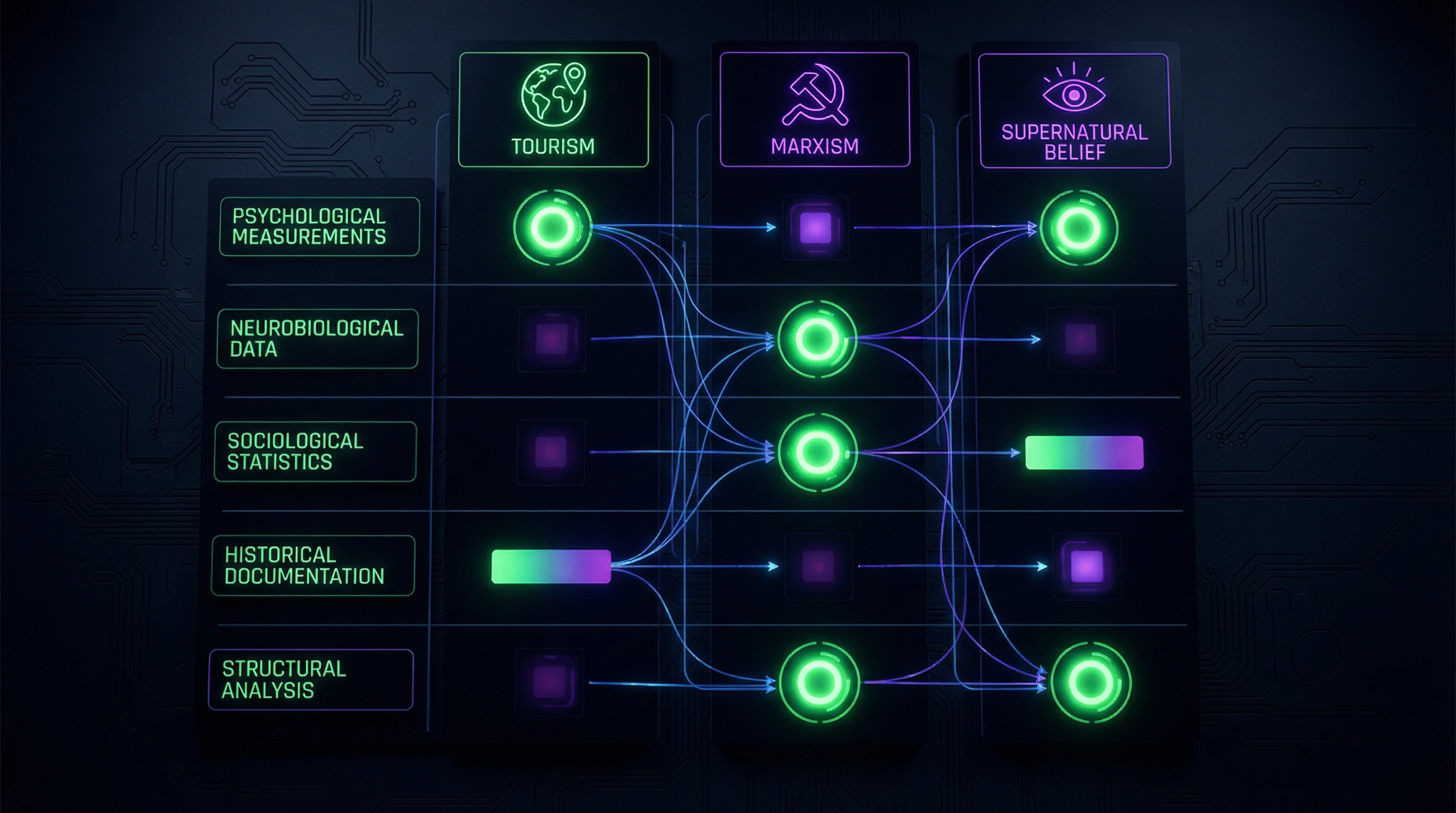
Moving from structural analogies to empirical testing requires clear methodology. Subbotsky E.V. demonstrates how psychological instruments developed to measure religiosity are applied to analyzing belief in the paranormal (S002). His research shows: belief in the supernatural correlates with religiosity but is not identical to it.
There are atheists who believe in ghosts, and believers who deny the paranormal. This distinction is critically important for understanding the boundaries of religious studies analysis. More details in the Shinto section.
📊 Psychometrics of Belief: Measuring the Invisible
Subbotsky developed a series of experiments in which participants were asked to assess the probability of various supernatural events: telepathy, precognition, life after death, and the efficacy of magical rituals (S002). Results showed that even people who declare a materialist worldview demonstrate "magical thinking" in certain contexts—especially in situations of uncertainty or emotional stress.
Religious/magical thinking is not a cultural artifact but a basic cognitive strategy that modern education suppresses but does not completely eliminate.
🔬 Neurobiology of the Transcendent: The Brain of the Believer and the Brain of the Tourist
While direct neuroimaging studies of tourist experience are not available in accessible sources, research on religious experience provides indirect data (S002). The experience of the "sacred" activates the same brain structures as other forms of intense emotional experience: medial prefrontal cortex (self-reference and meaning), anterior cingulate cortex (emotional regulation), parietal lobes (altered perception of self-boundaries).
- Functional Equivalence Hypothesis
- If tourism provides a functional equivalent of religious experience, we should observe activation of the same structures when contemplating "sacred" tourist sites—requires empirical verification.
📈 Sociology of Substitution: Statistics on Secularization and Tourism Growth
Countries with high levels of secularization show proportional growth in tourist activity (S003). While in the 1950s international tourism was a privilege of the elite, by the 2020s it had become a mass phenomenon encompassing billions of people.
Simultaneously, church attendance and participation in traditional religious practices declined. Correlation does not prove causation, but is consistent with the functional substitution hypothesis: tourism fills the psychological and social niche left vacant after the decline of traditional religion.
⚖️ Marxism as Religion: Historical Evidence and Structural Analysis
Schulz E.E. in his work "Marxism as the Religion of Revolution" provides the most detailed argument for the religious nature of communist ideology (S005). He analyzes not only structural parallels (sacred texts of Marx-Engels-Lenin, cult of leaders, rituals of party meetings), but also the conscious construction of religious elements by the Bolsheviks.
- The mausoleum as a pilgrimage site
- Iconography of leaders
- Eschatological narrative about the inevitable arrival of communism
Lenin clearly understood the necessity of creating a "secular religion" to mobilize the masses. This is not a metaphor but a conscious strategy of using religious mechanisms for political purposes.
🧾 Methodological Limitations: What We're Actually Measuring
Critical analysis of the evidence base reveals significant limitations (S002, S003, S005). Most data is correlational, not causal: we observe coinciding patterns but cannot prove that tourism causally replaces religion.
| Limitation | Core Problem | Consequence |
|---|---|---|
| Operationalization | Defining tourism's "religiosity" depends on the chosen definition of religion | If religion = belief in supernatural, Marxism isn't religion; if = social functions—quite religious |
| Longitudinal Data | Absence of studies tracking transformation of individual religiosity | Impossible to trace transition from traditional religion to tourism or ideology at the individual level |
| Causality | Correlation between secularization and tourism growth | Third variables not excluded: urbanization, economic growth, technologization |
The data confirms structural similarity but not the mechanism of substitution. Full testing of the hypothesis requires integration of psychological, neurobiological, and sociological methods into a unified longitudinal study.
Mechanisms and Causality: Why Secular Phenomena Mimic Religion
The structural similarity between religion and secular phenomena is explained by three mechanisms with different implications. Functional convergence: different systems independently evolve toward similar solutions to the same problems. Cultural inheritance: secular phenomena copy religious patterns that have proven effective. More details in the Logic and Probability section.
The third mechanism is a shared cognitive foundation: religion and its secular analogs exploit the same basic systems of human psychology. This means religiosity is not a cultural artifact, but a consequence of how our thinking is structured.
🧬 Evolutionary Psychology: Religion as Adaptation or Byproduct
Religious thinking is the result of cognitive mechanisms shaped by natural selection (S002). Hyperactive agency detection (the tendency to see intentions where none exist) was adaptive: better to mistakenly interpret rustling in the bushes as a predator than to miss a real threat.
This mechanism generates anthropomorphization of nature, belief in invisible agents, the search for meaning in random events—the cognitive foundation of religion. It operates independently of cultural context and remains active even in secularized societies, simply switching to new objects.
- Hyperactive agency detection → anthropomorphism of nature
- Search for causality in random events → narrativization of experience
- Tendency toward magical thinking → ritualism
- Need for meaning → ideologization
🔁 Reinforcement Loops: How Ritual Creates Reality
Rituals work through self-reinforcing loops (S003, S005). Participation in ritual creates an emotional experience, interpreted as confirmation of the ritual's significance, which strengthens motivation to repeat it.
Ritual doesn't reflect reality—it constructs it. The tourism ritual (planning-travel-remembering) creates a narrative of transformation, justifying the next trip. Marxist rituals (party meetings, demonstrations, studying the classics) created a sense of participation in the historical process, reinforcing belief in the inevitability of communism.
The mechanism is identical: emotional reinforcement → interpretation as validation → increased commitment. This works regardless of whether there's an objective basis for the belief.
⚙️ Social Engineering: Conscious Construction of Quasi-Religions
Marxism is instructive because here we're dealing with the conscious construction of a religious structure (S005). The Bolsheviks deliberately created a "religion without god," understanding that mass mobilization requires emotional engagement that rational arguments cannot provide.
| Element | Traditional Religion | Soviet Marxism |
|---|---|---|
| Sacred Figure | God, saints | Lenin, Marx |
| Sacred Text | Bible, Quran | "Capital," party resolutions |
| Initiation Ritual | Baptism, circumcision | Joining the Pioneers, Komsomol |
| Eschatology | Heaven, resurrection | Communism, classless society |
| Control Mechanism | Sin, salvation | Class consciousness, ideological purity |
This proves that religious structures can be consciously reproduced in secular contexts. The designers understood the psychological mechanisms and used them deliberately.
🕳️ Existential Vacuum: What Fills the Void After the Death of God
Secularization creates a crisis of meaning (S003). If traditional religion provided a ready-made coordinate system for existential questions (why am I alive, what happens after death, how to distinguish good from evil), its decline leaves a vacuum.
Tourism, political ideologies, consumer culture, fitness movements—candidates for the role of "substitute religions." They provide meaning, identity, and transcendent experience in a secularized world. The vacuum is filled not because people are irrational, but because the psychological need for meaning persists regardless of whether traditional religion exists.
- Functional Convergence
- Different systems solve the same problem (search for meaning, social integration, management of death anxiety) and independently arrive at similar solutions. This explains why secular phenomena often look like religion—they address the same challenges.
- Cultural Inheritance
- Secular systems consciously or unconsciously copy religious patterns because they've proven effective at mobilization, maintaining commitment, and creating identity. This isn't coincidence, but the result of selection.
- Shared Cognitive Foundation
- Both religion and its secular analogs exploit the same mechanisms: hyperactive agency detection, search for causality, magical thinking, need for narrative. These mechanisms are universal and independent of culture or education.
Conflicts and Uncertainties: Where Sources Diverge and Why It Matters
Analysis of available sources reveals three key points of divergence, each pointing to fundamental methodological problems in the religious studies analysis of secular phenomena. These divergences define the boundaries of religious analogy's applicability and the risks of its misuse. More details in the Statistics and Probability Theory section.
🧩 Defining Religion: Functional vs. Substantive
The first divergence concerns the very definition of religion (S002, S006). The substantive definition focuses on content: religion is belief in the supernatural, transcendent, divine.
By this definition, Marxism and tourism are not religions because they do not postulate the existence of supernatural entities. The functional definition focuses on role: religion is a system providing meaning, identity, social integration.
| Approach | Criterion | Tourism/Marxism |
|---|---|---|
| Substantive | Belief in supernatural | Not religion |
| Functional | Meaning, identity, integration | Religion |
Subbotsky adheres to the substantive approach, separating religion and belief in the supernatural (S002). Borzykh and Schultz use the functional approach, allowing them to expand the category of religion (S003, S005).
🔎 Metaphor vs. Identity: Rhetoric or Ontology
The second divergence concerns the status of religious analogy (S003, S005). Is the statement "tourism is religion" a productive metaphor illuminating hidden aspects of tourism, or a literal assertion of identity?
Borzykh oscillates between positions: sometimes speaking of tourism "as" religion (metaphor), sometimes of tourism "in the capacity of" religion (identity). This ambiguity is critical because metaphor and identity have different epistemological status.
Metaphor is a heuristic tool that can be productive even if literally false. Identity is an ontological assertion requiring proof of a common essence (S003).
🚨 Risk of Reduction: When Analogy Becomes a Trap
The third divergence concerns the boundaries of religious analogy's applicability. If tourism, Marxism, and belief in the supernatural are all religions, what remains outside religion?
- If the category expands infinitely, it loses analytical power.
- If tourism is religion, why aren't sports, science, or politics religions?
- If everything is religion, nothing is religion in a specific sense.
Sources (S001, S004) point to the danger of reduction: when analogy becomes a universal explanation, it ceases to explain the particular. Borzykh risks falling into this trap if he does not clarify the boundaries of his approach's applicability.
The connection to religious evolution shows that belief adaptability is not a sign of religiosity but a universal property of any meaning systems. New religious movements demonstrate how the boundary between religion and secular remains fluid and contextual.
🎯 Why This Matters in Practice
These divergences have direct consequences for analyzing specific phenomena. If tourism is metaphorically religion, its critique requires different tools than critique of belief in the supernatural. If tourism is literally religion, its regulation may require protection of freedom of conscience.
- Methodological risk
- Conflating metaphor and identity leads to false conclusions about the nature of secular phenomena.
- Practical risk
- Expanding the category of religion may dilute protection of genuine religious minorities.
- Epistemological risk
- Universal analogy becomes untestable and loses explanatory power.
Sources do not offer a definitive resolution to these conflicts. They point to the need for clarifying definitions, explicitly separating metaphor from identity, and establishing boundaries for religious analogy's applicability. Without this, analysis of secular phenomena as religions remains intellectually fruitful but methodologically vulnerable.