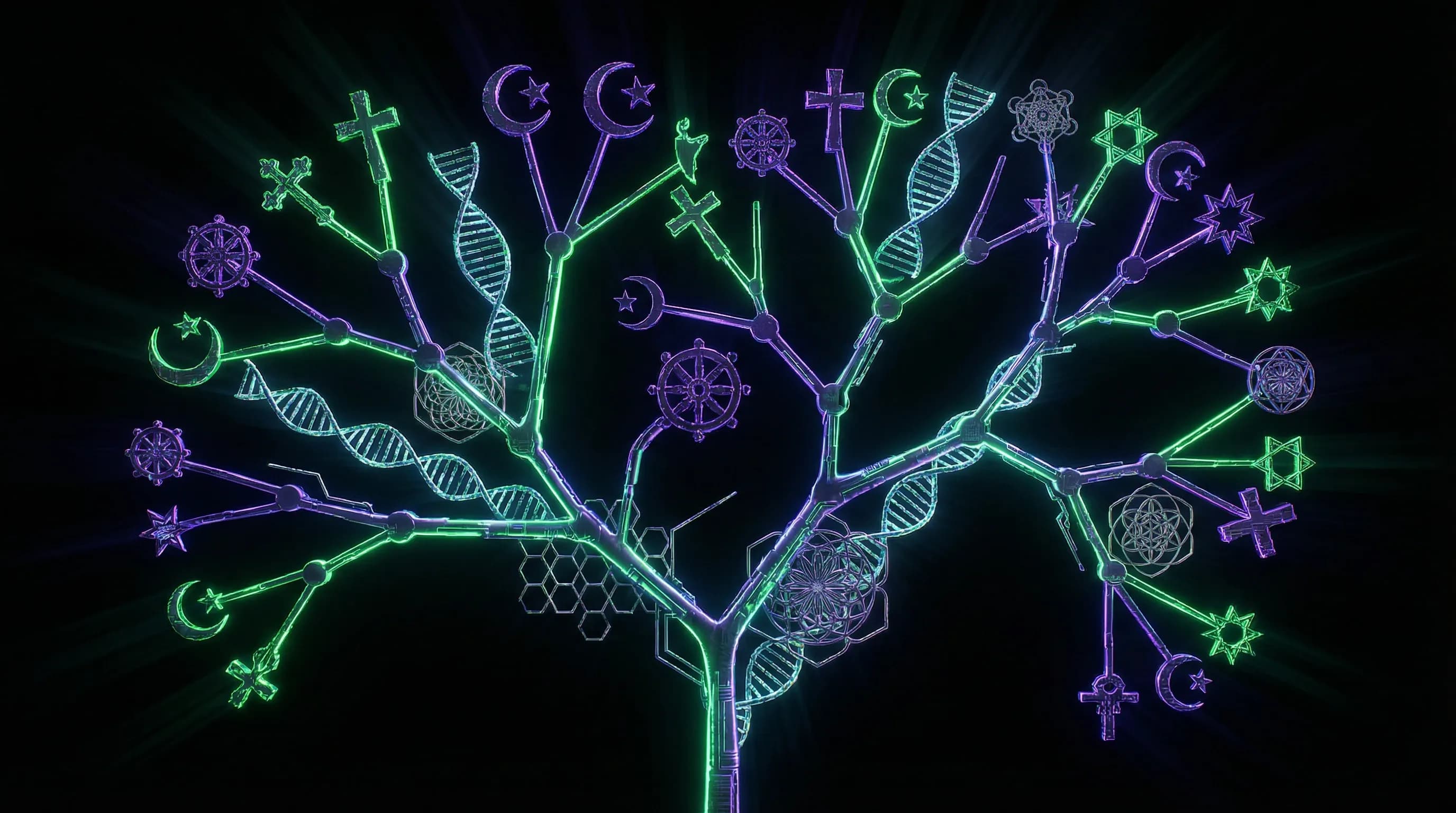
What is Cultural Evolution of Religions — Defining the Framework and Basic Terminology
Cultural evolution of religions is the process by which religious systems change over time through mechanisms of variation, selection, and inheritance, analogous to biological processes (S004). Unlike biological evolution, where the unit of selection is the gene, here memes operate — units of cultural information capable of replication through imitation and learning.
Religious memes include rituals, dogmas, moral norms, cosmological narratives, and social practices. They compete for space in human consciousness and cultural landscape, just as genes compete for space in the genome. More details in the Religions section.
- Variation
- Religious ideas constantly mutate through transmission errors, creative interpretation, syncretism with local cults, and individual revelations. Each retelling of a sacred text, each sermon, each translation — is a potential mutation of the original meme.
- Selection
- Not all religious ideas survive. Those that better match human cognitive predispositions, group social needs, and environmental ecological conditions gain an advantage in spreading. Religions compete for converts — new adherents, for resources, and for cultural dominance.
- Inheritance
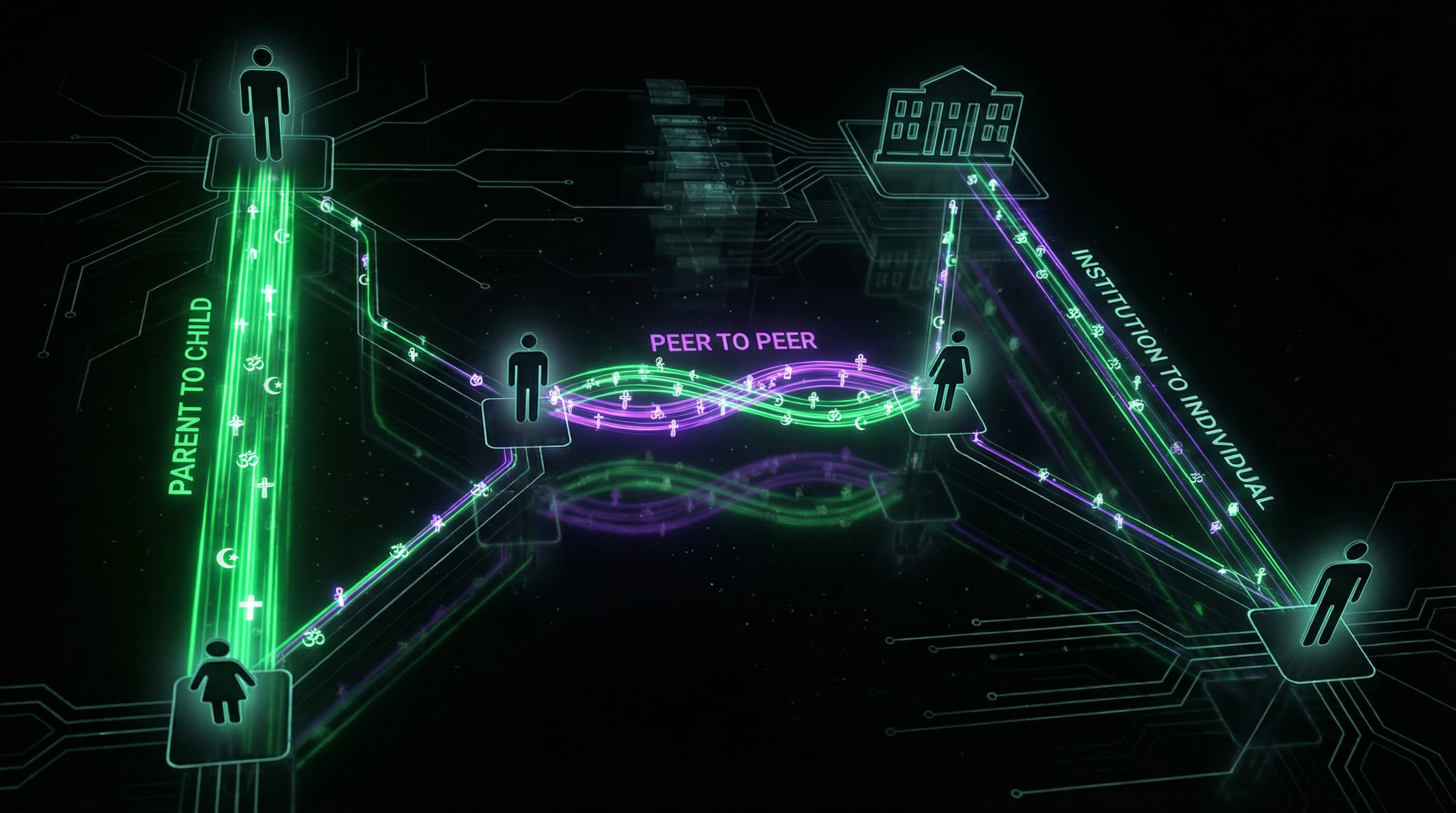
- Religious practices are transmitted vertically (from parents to children), horizontally (between peers), and obliquely (from teachers, priests, media). Transmission mechanisms include ritual learning, narratives, emotional contagion, and institutional coercion (S007).
🔎 Religion as Adaptation or Byproduct
There are two main hypotheses about the origin of religion. The adaptationist view argues that religious beliefs evolved because they gave groups advantages: strengthening intragroup cooperation, moral control, reducing anxiety in the face of uncertainty (S004).
The byproduct hypothesis suggests otherwise: religion emerged as an unintended consequence of other cognitive adaptations — hyperactive agency detection (the tendency to see intentions where there are none), theory of mind, and dualistic intuition (separation of body and mind).
Both models explain different aspects of religious behavior. The first — why religions are so effective at organizing groups. The second — why religious ideas arise and spread so easily regardless of their adaptive value.
🧩 Memeplexes: Religions as Packages of Mutually Reinforcing Ideas
Religions rarely consist of a single isolated meme. They represent memeplexes — clusters of interconnected ideas that reinforce each other's replication.
| Component | Function in Memeplex |
|---|---|
| Belief in afterlife | Reduces fear of death, increases willingness to sacrifice |
| Concept of sin | Creates need for redemption, strengthens control |
| Confession ritual | Mechanism of social control and group cohesion |
| Doctrine of forgiveness | Reduces intragroup conflicts, stabilizes community |
| Missionary imperative | Mechanism of expansion and memeplex replication |
These elements form a self-sustaining system where each component increases the probability of transmitting the others. Dismantling such a memeplex is harder than refuting a single fact — because the system has built-in mechanisms for defending against criticism and adapting to new conditions.

Steel Version of the Argument: Seven Strongest Cases for the Evolutionary Model of Religion
Before examining the mechanisms, we must present the most compelling arguments from proponents of the evolutionary approach to religion. This is not a straw man, but a steel version of the position — the strongest possible formulation, which we will then test against the data. For more details, see the section on Daoism and Confucianism.
🧪 Argument One: Universality of Religious Cognitions
Religious beliefs are found in all known human cultures, including isolated preliterate tribes. This universality points to a common cognitive architecture predisposing humans to religious thinking.
Children spontaneously develop teleological thinking (the tendency to see purpose and design in natural phenomena) and dualistic intuitions (the concept of a soul separable from the body) without special instruction. This suggests that religious thinking is not a cultural artifact, but a product of evolved cognitive systems.
If religious thinking arises spontaneously in child development independent of culture, this indicates a deep cognitive predisposition rather than social conditioning.
🧪 Argument Two: Adaptive Value of Group Religion
Religions, especially those with moralistic gods, strengthen intragroup cooperation and trust. Belief in all-seeing gods who punish norm violations creates an effective mechanism of social control in large anonymous societies where reputational control is ineffective.
Groups with strong religious institutions demonstrate greater resilience in conflicts and economic productivity (S007). This explains why religions with moralistic gods dominate in complex societies.
🧪 Argument Three: Convergent Evolution of Religious Forms
Independent religious traditions in different parts of the world develop similar structures: priestly hierarchies, sacred texts, rites of passage, concepts of purity and pollution, sacrifices. This convergence points to common selective pressures and cognitive constraints shaping religious systems.
Just as wings independently evolved in birds, bats, and insects, religious institutions converge toward functionally effective forms.
🧪 Argument Four: Documented Cases of Religious Evolution
Historical records capture processes of religious evolution in real time. Christianity evolved from a Jewish sect to a world religion through a series of adaptations: abandonment of circumcision (lowering the entry barrier for gentiles), incorporation of pagan festivals (syncretism), development of monasticism (creating specialized meme replicators), formation of the canon (doctrinal stabilization).
Each adaptation increased Christianity's competitiveness in the religious landscape of the Roman Empire (S001, S008).
🧪 Argument Five: Ecological Adaptation of Religious Practices
Religious practices are often adapted to local ecological conditions. The prohibition on pork in Judaism and Islam correlates with climatic conditions where pigs compete with humans for water and grain, rather than efficiently converting inedible biomass.
The Hindu prohibition on killing cows in India protects animals critically important for agriculture (draft power, manure, milk). Religious dietary laws often codify ecologically rational practices.
- Food prohibitions reflect local resource constraints
- Sacred animals often coincide with economically valuable species
- Ritual calendars synchronize with agricultural cycles
🧪 Argument Six: Parasitic Memes and Religious Virulence
Some religious memes demonstrate parasitic dynamics, exploiting cognitive vulnerabilities of the host for their own replication, even when this reduces the carrier's biological fitness. Catholic priestly celibacy, asceticism, martyrdom — practices that reduce individual reproductive success but increase meme replication.
This is analogous to biological parasites that manipulate host behavior for their own transmission. A meme can be successful at replication even if it harms the carrier.
🧪 Argument Seven: Predictive Power of the Evolutionary Model
The evolutionary model generates testable predictions about the dynamics of religious change. It predicts that religions will adapt to changes in the social environment (urbanization, literacy, technology), that successful religions will invest in mechanisms of vertical transmission (religious education of children), that religious schisms will follow patterns of speciation (geographic isolation, doctrinal mutations, reproductive isolation through endogamy).
These predictions are confirmed by historical data (S006, S008). The model allows us to explain not only past events but also to forecast trajectories of religious transformations under conditions of social shifts.
Evidence Base: What the Data Says About Religious Evolution Mechanisms
Systematic analysis of empirical data tests the evolutionary model of religion. Each claim is tied to specific sources and evaluated by strength of evidence. More details in the East Asian Studies section.
📊 Cognitive Prerequisites of Religion: Data from Developmental Psychology
Research on child cognition shows that religiously-relevant intuitions emerge early and spontaneously. Children aged 3–5 demonstrate promiscuous teleology—a tendency to explain natural objects through their function or purpose ("mountains exist so we can climb them").
This intuition creates cognitive ground for creationist narratives. Children also demonstrate psychophysical dualism, easily accepting the idea that mental states can exist independently of the physical body.
Innate cognitive predispositions toward religious thinking are confirmed, but their adaptive nature remains an open question—they may be byproducts of other cognitive systems.
📊 Moralistic Gods and Society Scale: Cross-Cultural Analysis
Cross-cultural studies show a strong correlation between society size and the presence of moralistic gods—deities who punish violations of social norms. In small hunter-gatherer societies, gods typically show no interest in human morality.
In large agrarian societies, religions with all-seeing moralistic gods dominate. However, the causal relationship remains disputed: did moralistic gods emerge as an adaptation to societal growth, or did they themselves facilitate growth by enhancing cooperation?
| Society Type | Nature of Gods | Interest in Morality |
|---|---|---|
| Hunter-gatherers (small groups) | Local, amoral | Absent |
| Agrarian (large, hierarchical) | Universal, all-seeing | Central |
Some data indicate that moralistic gods appear after the rise of social complexity, not before it, which challenges the adaptationist hypothesis (S007).
📊 Religious Rituals and Group Cohesion: Experimental Evidence
Experimental studies demonstrate that participation in synchronous rituals (collective singing, dancing, prayer) increases intragroup trust, cooperation in economic games, and willingness to self-sacrifice for the group. The effect is especially strong for rituals involving physical synchronization and emotional arousal.
This confirms the functional hypothesis about the role of rituals in maintaining group cohesion. However, these effects are not specific to religious rituals—secular group activities (sporting events, concerts, political rallies) produce similar effects.
Ritual synchronization works independently of belief content. The mechanism is universal; religion is merely one of its carriers.
📊 Religious Transmission: Vertical vs Horizontal
Data on religious transmission show dominance of the vertical channel: most people inherit their parents' religion. Twin studies indicate moderate heritability of religiosity (around 40%), reflecting both genetic influences on personality traits predisposing to religiosity and shared family environment.
- Vertical transmission
- Inheritance of religion from parents; dominates in most populations; ensures tradition stability.
- Horizontal transmission
- Adult conversion; less common but critical for religious expansion; requires specialized mechanisms (missionary institutions, conversion narratives, social support networks).
Successful missionary religions (Christianity, Islam, Buddhism) developed precisely these horizontal transmission mechanisms (S007).
📊 Religious Competition and Market Dynamics
Sociological studies of religious markets show that religious diversity and competition correlate with higher levels of religious participation. In monopolistic religious markets (where one religion dominates with state support), population religiosity is often lower than in pluralistic markets with competition between denominations.
This confirms the hypothesis that religions compete for adherents and adapt to consumer preferences. However, causality may be reversed: pluralism may be a consequence, not a cause, of high religiosity (S005, S007).
The correlation between competition and religiosity does not reveal the direction of causality. Longitudinal analysis is required to distinguish between hypotheses.
📊 Religious Schisms and Speciation: Phylogenetic Analysis
Application of phylogenetic methods to religious traditions reveals patterns analogous to biological speciation. Religious schisms often follow geographical isolation (the split of Christianity into Western and Eastern after Rome's fall), doctrinal mutations (Protestant Reformation), and social endogamy (prohibition of interfaith marriages).
Phylogenetic trees of religious traditions show a branching structure with periods of rapid diversification (religious revolutions) and stasis (doctrinal stability). This confirms the applicability of the evolutionary model to religious dynamics (S001, S008).
The connection between epistemology fundamentals and religious selection becomes evident: religions that better adapt their knowledge transmission mechanisms to cultural context survive longer.
Mechanisms of Cultural Selection: Why Some Religions Succeed While Others Die Out
The evolutionary model requires not only variation and inheritance, but also selection — differential success in replication. More details in the section Cognitive Biases.
🧬 Cognitive Optimality: Minimally Counterintuitive Concepts
Memory research shows that religious concepts that slightly violate intuitive expectations (minimally counterintuitive) are remembered better than fully intuitive or maximally counterintuitive ones.
"An invisible person who hears prayers" (minimally counterintuitive) is remembered better than "an ordinary person" (intuitive) or "a square circle that sings with smells" (maximally counterintuitive).
Successful religious concepts (gods, spirits, angels) are typically minimally counterintuitive: they violate one or two basic expectations (physical laws, biological constraints) while preserving the rest. This makes them cognitively "sticky" — easily remembered and transmitted.
🧬 Emotional Valence: Fear, Hope, and Transcendence
Religious memes that evoke strong emotions have a selective advantage. Narratives about afterlife punishment (hell) and reward (heaven) exploit basic emotions of fear and hope.
Mystical experiences of transcendence create powerful emotional anchors that bind individuals to religious systems. Rituals that induce altered states of consciousness (meditation, ecstatic dancing, psychedelics) create unforgettable experiences interpreted in religious terms.
Emotionally charged memes spread faster than neutral ones — this is a basic mechanism of viral idea propagation.
🧬 Social Utility: Signaling and Group Identity
Religious practices often function as costly signals of commitment to the group. Rituals requiring significant investments of time, resources, or physical discomfort (fasting, pilgrimages, circumcision) are difficult to fake and therefore serve as reliable indicators of group loyalty.
| Signal Type | Costs | Effect on Cooperation |
|---|---|---|
| Costly ritual | Time, resources, pain | High intragroup cooperation, low level of free-riders |
| Cheap ritual | Minimal | Low cooperation, high risk of opportunism |
Groups with costly rituals demonstrate higher levels of intragroup cooperation. This creates selective pressure favoring religions with demanding practices, especially under conditions of intergroup competition (S007).
🧬 Institutional Support: Specialization and Resources
Religions with developed institutions (professional clergy, temples, educational systems) have advantages in stable doctrine transmission and resource mobilization.
- Specialized meme replicators (priests, monks, theologians) — their biological fitness is sacrificed for the replication of religious memes
- Accumulation of material resources (land, wealth, political influence) invested in further expansion
- Stable doctrine transmission through educational systems and hierarchical structures
- Long-term resilience to external shocks through institutional inertia
Institutionalized religions dominate charismatic cults in the long term (S001), (S008). The charisma of a single leader cannot compete with a system that reproduces itself independently of personality.
Conflicts and Uncertainties: Where the Evolutionary Model of Religion Faces Challenges
Despite its explanatory power, the evolutionary model of religion encounters serious challenges and internal contradictions. Learn more in the Logical Fallacies section.
🧩 The Adaptation vs. Byproduct Problem
The central debate in evolutionary psychology of religion is whether religion is an adaptation (evolved because it provided advantages) or a byproduct of other adaptations.
On one hand, the universality of religion and its functional effects (group cohesion, moral control) point to adaptation. On the other hand, religious beliefs may be unintended consequences of cognitive systems that evolved for other purposes: agent detection (for avoiding predators), theory of mind (for social interaction), causal reasoning (for understanding the physical world).
Distinguishing adaptation from byproduct is extremely difficult without direct data on selective pressures in our evolutionary past (S004).
🧩 Level of Selection: Individual, Group, or Meme
The evolutionary model requires defining the unit of selection. Does selection operate at the level of individuals (religious people have more offspring), groups (religious groups defeat non-religious ones in conflicts), or memes (religious ideas replicate independently of carrier fitness)?
- Group Selection
- Requires strong intergroup competition and limited migration—conditions that may have existed in human prehistory but are difficult to prove.
- Memetic Selection
- Can explain parasitic religious practices (celibacy, martyrdom) but doesn't explain why people adopt memes that reduce their fitness.
🧩 The Problem of Measuring Religious Success
How do we measure the evolutionary success of religion? By number of adherents, geographical spread, longevity, or cultural influence? Different metrics yield different rankings.
| Religion | Number of Adherents | Age of Tradition | Cultural Influence |
|---|---|---|---|
| Christianity | Maximum | ~2000 years | High |
| Hinduism | High | ~3500+ years | High |
| Judaism | Minimal | ~3500+ years | Enormous |
| Zoroastrianism | Critical | ~2500+ years | Embedded in other traditions |
The absence of a clear success metric makes testing evolutionary hypotheses difficult (S001).
🧩 The Role of Chance and Historical Contingencies
The evolutionary model emphasizes selection, but chance plays an enormous role in religious history. Emperor Constantine's conversion to Christianity—a contingent event—radically altered the trajectory of religious evolution.
Had Constantine chosen Mithraism, history would have been different. Geographic accidents (Japan's isolation, the discovery of the Americas) created unique religious landscapes.
The evolutionary model must account for the role of drift (random changes in meme frequency) and historical contingencies, but this weakens its predictive power (S008).
Integrating chance into evolutionary analysis requires rethinking the boundaries between determinism and unpredictability in cultural systems.