
What exactly the Book of Mormon claims and why it's testable: boundaries of the historical narrative
The Book of Mormon is not a parable or mystical revelation. It's a detailed chronicle of specific peoples: names, dates, geographic routes, technological achievements. More details in the Ethnic and Indigenous Identity section.
According to the text, around 600 BCE, Israelites led by Lehi left Jerusalem, built a ship, and crossed the ocean to America. Their descendants split into Nephites (righteous) and Lamanites (apostates), who for a thousand years waged wars, built cities, worked metals, raised livestock, and wrote in "reformed Egyptian" (S003).
- Historical hypothesis vs. spiritual metaphor
- Apologists often reframe the Book of Mormon as "spiritual truth" that doesn't require material evidence. But the text itself and the church's official doctrine insist on literal historicity. Joseph Smith claimed he received physical golden plates with engraved text. The church teaches that Nephites and Lamanites were real historical peoples, and Native Americans are their direct descendants. This makes the text falsifiable: if the civilizations existed, they must have left an archaeological trace (S003).
Specific claims requiring verification
The text contains testable claims about pre-Columbian America:
- Horses, cattle, wheat, barley, steel, chariots
- Large cities with stone architecture
- Iron and steel metallurgy
- Writing systems based on Near Eastern scripts
- Genetic connection between Native Americans and Near Eastern populations
Each claim is testable through modern scientific methods: paleozoology, paleobotany, metallurgical analysis, epigraphy, population genetics (S001).
The scale of the claimed civilizations determines the expected trace. The final battle at the Hill Cumorah, according to the text, resulted in the deaths of hundreds of thousands of Nephites. Such populations leave massive necropolises, pottery, metal artifacts, architectural remains, organic material for radiocarbon dating, genetic markers in modern populations.
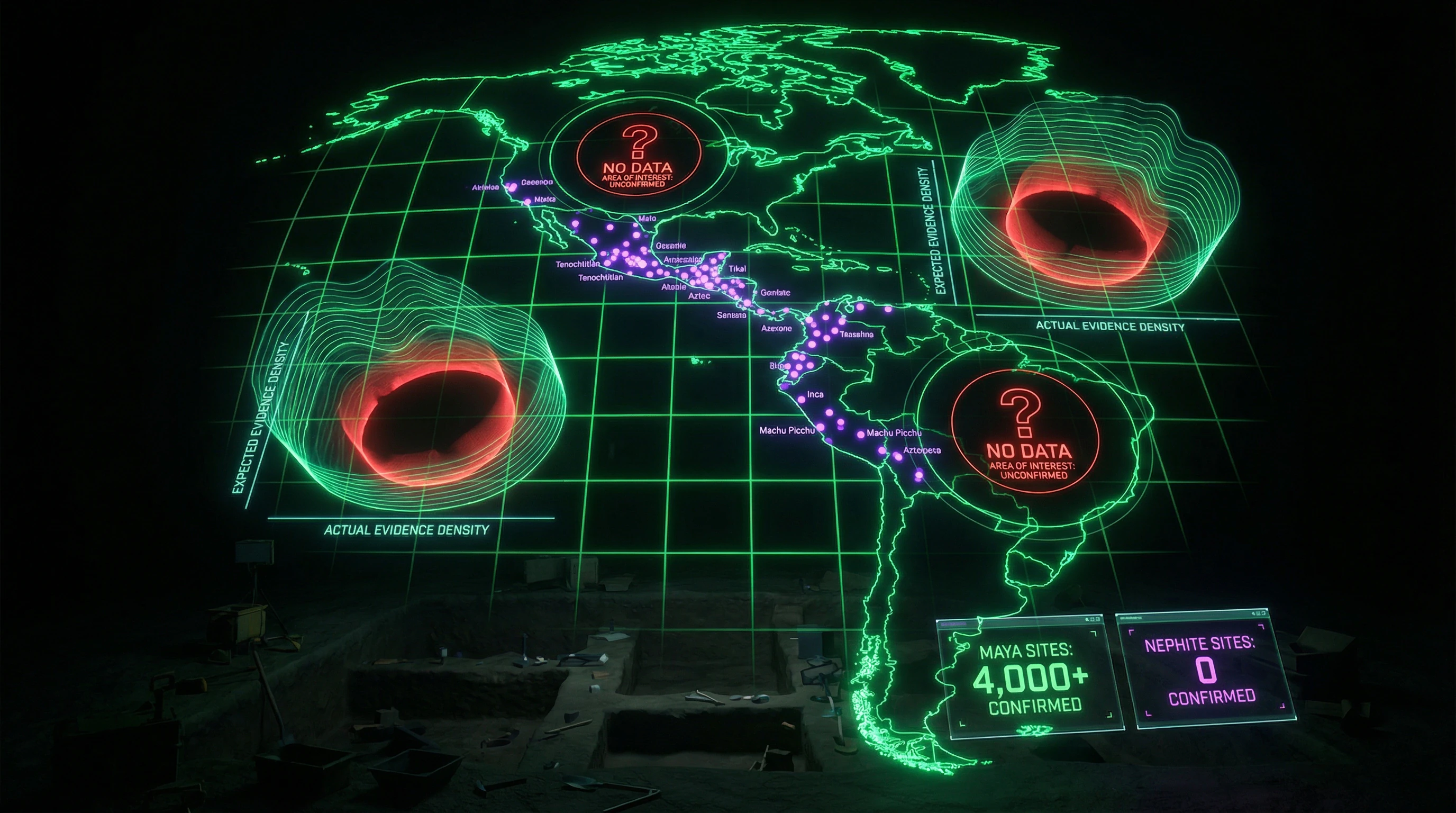
For comparison: the Maya, Aztec, and Inca civilizations left thousands of confirmed monuments, despite shorter time depths and comparable scales (S007).
This isn't a question of faith—it's a question of material traces. Either they exist or they don't.
The Steel Man of the Apologetic Position: Seven Strongest Arguments for Book of Mormon Historicity
Before analyzing the weaknesses of the apologetic position, it's necessary to present it in its most convincing form. Book of Mormon apologists have developed a sophisticated system of argumentation over nearly two centuries that attempts to explain the absence of direct evidence and find indirect confirmation in archaeology, linguistics, and anthropology. More details in the Christianity section.
Below are the seven strongest arguments regularly used in apologetic literature.
| Argument | Core Mechanism | Where Used |
|---|---|---|
| Limited Geography | Small population in limited territory could have been absorbed by local cultures | Explaining absence of artifacts |
| Ancient Literary Parallels | Chiasmus (Semitic A-B-C-B-A structure) was unknown in 19th-century English literature | Evidence of ancient textual origin |
| Geographic Detail Accuracy | Internal consistency of routes and topography forms logical system | Indicating real knowledge of terrain |
| Mesoamerican Cultural Parallels | Matches in architecture, writing, calendars, rituals | Confirming knowledge of ancient American cultures |
| Text Complexity | Linguistic sophistication exceeds capabilities of young farmer with limited education | Argument against Joseph Smith's authorship |
| Military and Political Details | Descriptions of fortifications and tactics match 20th-century Mesoamerican discoveries | Evidence of knowledge of ancient practices |
| Cultural Details | Specific customs (coronations, laws, marriages) match ancient practices | Confirming authenticity of cultural context |
🔍 The "Limited Geography" Argument: Nephites Occupied a Small Territory
Modern Mormon apologetics has abandoned early notions that Nephites and Lamanites populated the entire American continent. Instead, a "limited geography" model is proposed, according to which events occurred in a relatively small area—possibly in Mesoamerica or a limited section of Central America.
A small population in a limited territory could have been "absorbed" by larger local cultures, with its specific artifacts lost or misattributed (S001).
📚 The "Ancient Literary Parallels" Argument: Chiasmus and Near Eastern Structures
Apologists point to the presence of chiasmus in the Book of Mormon text—an ancient Semitic literary structure in which ideas are presented in parallel, mirrored sequence (A-B-C-B-A). Chiasmus was widely used in ancient Hebrew poetry and prose but was unknown in early 19th-century English literature.
The presence of complex chiastic structures in the Book of Mormon, according to apologists, indicates that the text could not have been created by Joseph Smith, who was unfamiliar with this technique, and must have ancient Near Eastern origins (S007).
🗺️ The "Geographic Detail Accuracy" Argument: Internal Consistency of Routes
Some researchers claim that geographic descriptions in the Book of Mormon demonstrate internal consistency and accuracy that are difficult to explain if the text was entirely fabricated. Descriptions of journeys, relative distances between cities, and topographic details form a logical and non-contradictory system.
Creating such a complex geographic network requires either real knowledge of the terrain or access to ancient sources (S001).
🏺 The "Mesoamerican Cultural Parallels" Argument: Matches in Architecture and Rituals
Apologists point to a number of matches between Book of Mormon descriptions and known Mesoamerican cultures: construction of stone temples and pyramids, use of hieroglyphic writing, complex calendar systems, sacrificial rituals, social stratification with kings and priests.
Some of these elements were not widely known in 1830 when the Book of Mormon was published, which, according to apologists, indicates genuine knowledge of ancient American cultures (S007).
🧬 The "Text Complexity" Argument: Linguistic Sophistication for a Young Author
Joseph Smith was 23 years old when he published the Book of Mormon, and he had limited formal education. Apologists argue that the text demonstrates linguistic complexity, multiple authorial voices, sophisticated theological arguments, and literary devices that exceed the capabilities of a young farmer from rural America.
The text has a more ancient and complex origin than simple fabrication (S003).
⚔️ The "Military and Political Details" Argument: Realistic Descriptions of Conflicts
The Book of Mormon contains detailed descriptions of military campaigns, fortifications, tactical maneuvers, and political intrigues. Apologists claim these descriptions demonstrate knowledge of ancient military practices and political structures that were not available to Joseph Smith.
Descriptions of earthen fortifications and wooden palisades correspond to archaeological discoveries of Mesoamerican fortifications that were only discovered in the 20th century (S007).
🌾 The "Cultural Details" Argument: Specific Practices and Institutions
The text contains descriptions of specific cultural practices that, according to apologists, correspond to ancient Near Eastern or Mesoamerican customs: coronation rituals, land ownership laws, adoption practices, marriage customs, taxation systems.
Some of these details were not widely known in the early 19th century and were confirmed by later archaeological and anthropological research (S001).
Examining the Evidence Base: What Archaeology, Genetics, and Linguistics Say About Book of Mormon Claims
The scientific community — archaeologists, geneticists, linguists, anthropologists — has a clear position: no professional scientific society recognizes the existence of Nephite or Lamanite civilizations. This isn't a matter of bias, but the result of systematic absence of confirming data alongside a massive body of contradictory evidence. More details in the Islam section.
🧪 Archaeological Silence: Absence of Material Evidence
Two centuries of archaeological research in the Americas have not uncovered a single artifact that the professional community would recognize as confirmation of Nephite or Lamanite civilizations. No inscriptions in "reformed Egyptian," no pre-Columbian steel, no burials with Middle Eastern markers.
This is particularly telling against the backdrop of thousands of confirmed Maya, Aztec, and Olmec sites (S001). If a major civilization existed 2,000 years ago, it should have left a material trace — like the Minoan civilization on Crete, which existed 4,000 years ago and left thousands of artifacts.
| Book of Mormon Claim | Archaeological Data | Status |
|---|---|---|
| Large Nephite cities | No confirmed sites | Not found |
| Egyptian-based writing system | No inscriptions in the Americas | Not found |
| Metallurgy (steel, iron) | Pre-Columbian steel not documented | Not found |
| Large-scale wars | No corresponding burial sites | Not found |
🧬 Genetic Data: Indigenous Americans Have No Middle Eastern Ancestry
Modern genetic research unequivocally shows that Indigenous Americans descend from Asian populations that migrated across the Bering Strait approximately 15–20,000 years ago. Analysis of mitochondrial DNA, Y-chromosomes, and autosomal markers has revealed no traces of Middle Eastern genetic contribution during the period corresponding to the Book of Mormon timeline (600 BCE — 400 CE) (S005).
Even the "limited geography" model with a small Nephite population doesn't resolve the problem: a genetic signature from Middle Eastern migration should have been detected in modern or ancient DNA samples. Its absence isn't a research gap, but a negative result with scientific significance.
📊 Anachronisms: Animals, Plants, and Technologies That Weren't There
The Book of Mormon mentions animals, plants, and technologies absent from pre-Columbian America:
- Horses (extinct ~10,000 years ago, reintroduced by Spanish)
- Cattle, sheep, pigs
- Wheat, barley
- Steel, iron swords, chariots
Apologists explain this through "cultural adaptation of terms" — for example, "horse" could have meant tapir (S003). But such explanations lack linguistic support and contradict the plain meaning of the text.
🗣️ Linguistic Isolation: Absence of Middle Eastern Influences
If Nephites spoke a language derived from ancient Hebrew, this should have left a linguistic trace in Indigenous American languages. Comparative linguistics finds no systematic connections between Semitic languages and American language families (Na-Dene, Eskimo-Aleut, Amerind) (S001).
Individual lexical similarities cited by apologists are explained by chance resemblance or borrowings, but don't indicate genetic relationship between languages.
📜 Chiasmus: Literary Structure as Evidence
Chiasmus does appear in some Book of Mormon passages, but its presence doesn't prove ancient origin of the text. Chiastic structures occur in 18th–19th century English poetry and prose available to Joseph Smith (S003).
- Problem 1: Universality of the Device
- Chiasmus appears in various literary traditions. With flexible criteria, it can be found in any sufficiently long text.
- Problem 2: Selective Reading
- Many "chiasms" identified by apologists are forced or the result of selective analysis.
- Problem 3: Literature ≠ History
- The presence of a literary device doesn't prove the historicity of described events.
🏛️ Scale of Civilization: Why Large Societies Don't Vanish Without a Trace
The argument about "small population" or "limited geography" doesn't solve the fundamental problem. The Book of Mormon describes not isolated villages, but large cities, massive wars with hundreds of thousands of participants, advanced metallurgy, and writing systems.
Such civilizations cannot disappear without archaeological trace. The Minoan civilization on Crete, which existed 4,000 years ago, left thousands of artifacts. The Nephite civilization, according to the text, existed only 2,000 years ago and should have left an even more visible trace (S007).
The absence of material evidence combined with genetic, linguistic, and archaeological data contradicting the Book of Mormon's core claims points to one conclusion: the scientific community finds no basis for recognizing its historicity.

The Mechanism of Belief: How Apologetics Turns Absence of Evidence into Argument
Book of Mormon apologetics is a classic example of how religious faith creates immunity to falsification. Each new discovery that fails to confirm the text is interpreted not as refutation, but as "confirmation not yet found." More details in the Reality Check section.
Every anachronism is explained through "cultural adaptation of terms" or "incomplete understanding of ancient realities." Every absence of genetic or linguistic connections—through "limited geography" or "assimilation with local populations." This is not scientific methodology, but a system of defense mechanisms that makes the hypothesis unfalsifiable (S005).
🔁 The "Moving Goalposts" Strategy: How Apologetics Adapts to New Data
The history of Mormon apologetics demonstrates constant retreat in the face of new scientific data. In the 19th century, the church taught that Lamanites were direct ancestors of all Native Americans, and Nephite civilizations occupied the entire continent.
When archaeology failed to confirm this, apologists shifted to a "limited geography" model in Mesoamerica. When genetics showed Asian origins of Native Americans, apologists began claiming that Nephites were a "small group" that dissolved into local populations. Each retreat is presented not as admission of error, but as "refinement of understanding" (S001).
| Period | Apologist Position | Change Trigger |
|---|---|---|
| 19th century | Nephites populated entire American continent | Absence of archaeological confirmation |
| 20th century (early) | Nephites in Mesoamerica, Lamanites as primary ancestors | Genetic research on Native Americans |
| 20th century (late) | Nephites as small group, dissolved into population | DNA analysis showed Asian origins |
⚠️ Cognitive Dissonance and Motivated Reasoning
For believing Mormons, the Book of Mormon is not merely a historical text, but sacred scripture confirming their religious identity and salvation. Acknowledging that the text is a 19th-century product threatens the entire belief system.
This creates powerful motivation for motivated reasoning: information confirming historicity is accepted uncritically, while contradictory data undergoes hypercritical analysis or is ignored. Cognitive dissonance is resolved not through changing beliefs, but through creating increasingly complex apologetic constructs (S003).
The faith defense system works more effectively the more contradictions it must explain. Each new refutation becomes grounds for theory elaboration, not revision.
🧩 The "Confirmation Search" Effect: How Apologists Find What They're Looking For
Apologetic research begins not with an open question "What do the data say?" but with a predetermined answer "The Book of Mormon is true—how do we confirm it?" This leads to systematic distortion of the research process.
- Search only for confirming evidence
- Ignore contradictory data
- Interpret ambiguous findings in favor of the hypothesis
- Apply double standards to evidence
The slightest similarity between Mesoamerican culture and Book of Mormon descriptions is presented as "striking confirmation," while massive contradictions are explained as "incomplete understanding" (S005). This is not a methodological error—it's its replacement with the psychology of belief, where conclusion precedes analysis.
Conflicts and Uncertainties: Where Apologists Disagree and What It Means
Book of Mormon apologists disagree among themselves on key issues: geographic models, artifact interpretation, explanations for anachronisms. This isn't scientific debate—it's a symptom of a fundamental problem. Learn more in the Epistemology Basics section.
When data doesn't support a hypothesis, any interpretation becomes possible, and the choice between them is determined not by evidence but by personal preference (S001).
🗺️ Geographic Models: Mesoamerica, Great Lakes, or South America?
Apologists cannot agree on the location of Book of Mormon events. The Mesoamerican model (Guatemala, southern Mexico), the Great Lakes model (northeastern United States), the South American model (Peru, Chile)—each finds "confirming" parallels in its region.
Each group criticizes alternative models, but apologetic methodology allows the text to be "confirmed" virtually anywhere (S003). This makes it scientifically useless.
🐴 The Horse Problem: Tapirs, Deer, or "We Just Don't Know"?
The mention of horses in the Book of Mormon is one of the most obvious anachronisms. Horses went extinct in the Americas 10,000 years ago, yet the text describes them as common animals during the purported period of 600 BC to 400 AD.
- First explanation: horses are tapirs or deer, simply mistranslated.
- Second explanation: horses existed, but archaeology hasn't found them.
- Third explanation: it's a metaphor or translator error.
Each explanation contradicts the others and requires abandoning the literal reading of the text that apologists defend as historical evidence.
📖 Anachronisms: Joseph Smith's Error or Interpreters' Error?
The Book of Mormon contains technologies, plants, and animals that didn't exist in the Americas during the stated period: iron, steel, wheat, barley, cattle, pigs.
Apologists diverge in their explanations: some say these items existed but didn't preserve; others claim the text uses metaphorical language; still others suggest the translator erred or added details.
The problem is that each explanation undermines the others. If the text is metaphorical in one place, why is it literal in another? If the translator made mistakes, how do we know which parts are correct?
🧬 DNA Evidence: Silence as Argument
Genetic research shows that Native Americans descend from Asia, not the Middle East. Apologists offer several responses:
| Apologist Position | Problem |
|---|---|
| Nephites were few in number and assimilated into local populations | Genetic trace from 600 BC should be detectable |
| DNA tests are incomplete and don't cover all populations | Science advances, but results remain consistent |
| God erased the genetic evidence | This isn't a scientific argument but a rejection of testability |
Each explanation requires either ignoring the data or appealing to the supernatural (S003).
🔄 The Circular Logic of Apologetics
Apologists use the same mechanism to defend against any criticism: absence of evidence becomes evidence of absence of searching. If an artifact isn't found, it means it hasn't been found yet, not that it doesn't exist.
This makes apologetics unfalsifiable, but also untestable. Any hypothesis that cannot be disproven is not scientific—it's a psychological need.
⚠️ What the Lack of Consensus Means
When scientists disagree, they debate details within a shared methodology. When apologists disagree, they debate which interpretation best conceals contradictions between text and reality.
The lack of consensus among apologists isn't a sign of vibrant discussion—it's a sign that the hypothesis has no empirical support and is sustained only by belief (S004).
This doesn't mean believers are wrong in their faith. It means they use apologetics not to test truth, but to defend an already-accepted belief.