
What exactly does the Book of Mormon claim about Native American origins — and why this is a testable hypothesis
The Book of Mormon, published by Joseph Smith in 1830, contains specific historical claims about the peopling of the Americas (S001). According to the text, around 600 BCE, a group of Israelites led by the prophet Lehi left Jerusalem and migrated to the American continent.
Their descendants split into two main groups — the Nephites and Lamanites — who allegedly became the ancestors of Native Americans. The text describes advanced civilizations with metallurgy (iron, steel), agriculture (wheat, barley), domesticated animals (horses, cattle), and writing based on "reformed Egyptian" language. More details in the Hinduism section.
Key testable claims
- Genetic origin
- If Native Americans descended from Middle Eastern populations about 2,600 years ago, their DNA should contain Middle Eastern markers and haplotypes distinct from Asian ones.
- Material culture
- The civilizations described in the text should have left artifacts — metal objects, domesticated animal bones, architectural styles characteristic of the Middle East.
- Linguistic connection
- Native American languages should show borrowings or structural similarities with Semitic or Egyptian language families.
Why this is a testable hypothesis
Unlike metaphysical claims, the Book of Mormon makes specific assertions about the physical world. This allows application of the scientific method: a hypothesis must be falsifiable, meaning potentially disprovable (S002).
When a religious narrative intersects with verifiable facts about the material world, it creates an ideal laboratory for studying cognitive defense — the mechanisms people use to preserve beliefs in the face of contradictory data.
Scale and timeline
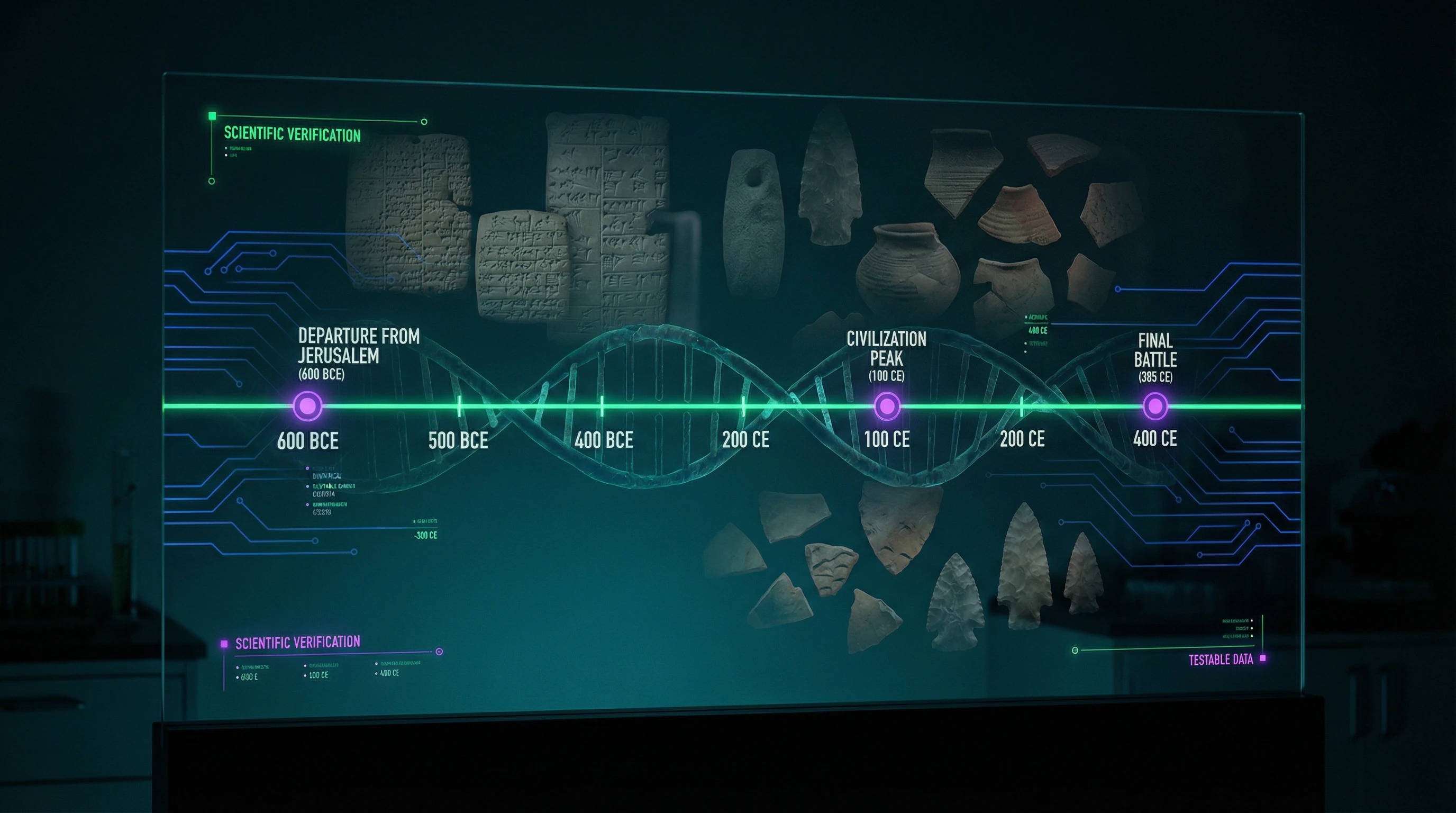
According to the Book of Mormon chronology, major events occurred between 600 BCE and 421 CE — a period of about a thousand years. The text describes large-scale wars involving hundreds of thousands of warriors, construction of cities and temples, developed trade networks.
The final battle at the Hill Cumorah (around 385 CE) allegedly led to the destruction of Nephite civilization. Such large-scale events should have left extensive archaeological traces, comparable to other ancient civilizations of similar size (S003).
| Claim category | Expected evidence | Verification method |
|---|---|---|
| Genetic origin | DNA markers of Middle Eastern origin | Ancient and modern DNA analysis |
| Domesticated animals | Horse and cattle bones in pre-Columbian layers | Zooarchaeology, radiocarbon dating |
| Metallurgy | Iron and steel artifacts with Middle Eastern technologies | Metallographic analysis, typology |
| Writing system | Inscriptions in "reformed Egyptian" language | Linguistic analysis, epigraphy |
This is not a question of faith or disbelief — it's a question of whether such events leave physical traces that can be discovered and dated using modern methods.
Steelman: Seven Strongest Arguments for Middle Eastern Origins of Native Americans
Before analyzing evidence against the Book of Mormon hypothesis, we must honestly present the strongest arguments in its favor. This is the steelman principle — constructing the most convincing version of an opposing position before critiquing it. More details in the Christianity section.
Supporters of Book of Mormon historicity advance several categories of arguments that may appear convincing at first glance (S001).
🔍 Argument from Cultural Parallels and Architectural Similarities
Proponents point to architectural parallels between ancient Middle Eastern and Mesoamerican civilizations. Pyramidal structures, monumental stone architecture, and hieroglyphic writing systems exist in both Egypt and Mesopotamia as well as among the Maya and Aztecs.
Some researchers note similarities in religious practices: sacrificial offerings, temple complexes, priestly castes. The argument posits that such complex cultural elements could not have arisen independently and must indicate common origin or cultural contact (S002).
- Pyramidal structures in both regions
- Hieroglyphic writing systems
- Priestly castes and temple complexes
- Ritual sacrifices
🗺️ Argument from Geographic Descriptions and Toponymy
Text defenders claim that geographic descriptions in the Book of Mormon correspond to actual Central American landscapes. References to a "narrow neck of land," two seas, and mountain systems allegedly match Mesoamerican geography.
Some researchers attempt to correlate place names from the text with modern toponyms, suggesting linguistic continuity. This argument relies on the idea that a 19th-century author could not have created a geographically consistent description without actual knowledge of American geography.
📜 Argument from Textual Complexity and Internal Consistency
Supporters emphasize the literary complexity of the Book of Mormon — interwoven plot lines, numerous characters, chronological sequence of events spanning a thousand years.
They argue that Joseph Smith, a man with limited education, could not have created such a complex text in a short period (traditionally claimed that translation took approximately 60–90 days) (S003). The argument builds on the assumption that textual complexity indicates its authenticity as an ancient document.
🧬 Argument from "Limited Geography Model" and Population Admixture
In response to genetic data, some apologists developed a "limited geography model," according to which Israelite migrants constituted a small group that intermixed with pre-existing American populations.
According to this version, Middle Eastern genetic markers could have been "diluted" to undetectable levels over 2,600 years (S004). This argument attempts to reconcile the text with genetic data by suggesting that absence of Middle Eastern markers does not disprove the presence of a small migrant group.
🏺 Argument from "Incompleteness of the Archaeological Record"
Defenders point out that archaeological discoveries constantly revise our understanding of ancient civilizations. They cite examples where biblical cities, once considered mythical, were later discovered by archaeologists.
- Absence of Evidence
- Is not evidence of absence — perhaps corresponding artifacts simply have not yet been found or were destroyed by time and tropical climatic conditions, where organic materials decompose more rapidly.
- Revision of Historical Data
- New discoveries often overturn previous conclusions, creating grounds for skepticism toward current consensus.
🔬 Argument from "Alternative Interpretations" of Archaeological Finds
Some supporters attempt to reinterpret existing archaeological finds in light of the Book of Mormon. For example, they point to metal artifacts in pre-Columbian America (copper, gold) as evidence of metallurgy described in the text (S005).
References to "horses" are interpreted as possible references to other animals (tapirs, deer) that could have been called by this term. This approach attempts to adapt the text to archaeological data through linguistic flexibility.
📖 Argument from "Spiritual Witness" and Personal Experience
Many believers cite personal spiritual experience as the primary proof of the text's truthfulness. They claim that prayer and sincere study lead to an internal "witness" from the Holy Spirit that transcends scientific evidence (S006).
This argument shifts the discussion from the empirical plane to the subjective, asserting that spiritual truth cannot be refuted by material methods. While not a scientific argument, it plays a central role in many supporters' convictions.
Each of these arguments relies on certain logic and has internal consistency. However, argument consistency does not equal its validity — this is an important distinction for further analysis.
The Genetic Revolution: What Three Decades of Native American DNA Research Reveals
Genetic research over the past 30 years has provided the most compelling evidence for Native American origins. Advances in DNA sequencing technology have enabled analysis of both modern populations and ancient DNA from archaeological remains. Learn more in the New Religious Movements section.
The results of these studies form a clear and consistent pattern that can be verified and replicated by independent laboratories worldwide.
🧬 Mitochondrial DNA: Maternal Lines Point to Asia
Mitochondrial DNA (mtDNA) is inherited exclusively through the maternal line and mutates at a predictable rate, making it an ideal tool for tracking ancient migrations. Studies of Native American mtDNA have identified five major haplogroups: A, B, C, D, and X.
- Haplogroups A, C, and D are widespread in Siberia
- Haplogroup B is characteristic of Southeast Asia
- Haplogroup X has Asian roots with branches in Europe and the Middle East, but the American branch diverged from the Asian, not Middle Eastern, lineage
All these haplogroups have Asian origins and are found in Siberian and East Asian populations.
📊 Y-Chromosome: Paternal Lines Confirm Asian Route
The Y-chromosome is inherited through the paternal line and provides a complementary picture of migrations. Y-chromosome studies of Native Americans show a predominance of haplogroups Q and C, both of which have Asian origins.
| Haplogroup | Origin | Dating | Status in Americas |
|---|---|---|---|
| Q-M3 | Siberia | 15–20 thousand years ago | Characteristic of Native Americans |
| C | Asia | Ancient | Found in Americas |
| J, E, G | Middle East | — | Completely absent in pre-Columbian populations |
This means that not only maternal but also paternal lineages of Native Americans lead to Asia, not the Middle East.
🧾 Whole Genome Sequencing: Detailed Migration Picture
Modern whole genome sequencing technologies allow analysis of entire genomes rather than individual markers. Native American genomes show the greatest similarity to Siberian and East Asian populations.
- Single Nucleotide Polymorphisms (SNPs)
- Allow dating of population splits: Native American ancestors separated from Asian populations approximately 20–25 thousand years ago.
- Beringia
- A land bridge that existed during lower sea levels. Settlement of the Americas began approximately 15–20 thousand years ago via this route.
🔎 Ancient DNA: Direct Evidence from Archaeological Remains
Extraction and analysis of ancient DNA from archaeological remains provides direct evidence of genetic continuity. Ancient DNA studies from remains dating from 12,000 to 500 years ago show genetic continuity between ancient and modern Native Americans.
These data exclude the possibility of large-scale population replacement in the last 2,600 years. If Israelite migrants had arrived around 600 BCE and become ancestors of a significant portion of the indigenous population, we would observe a dramatic shift in the genetic profile in archaeological remains from that period—but no such shift exists.
📌 Absence of Middle Eastern Markers: A Critical Fact
No study of Native Americans—neither modern populations nor ancient DNA—has detected Middle Eastern genetic markers that can be dated to the pre-Columbian period. Middle Eastern populations have characteristic genetic signatures: specific haplogroups, alleles associated with adaptation to Middle Eastern climate and diet.
If a group of Israelites had migrated to the Americas 2,600 years ago, even with admixture into local populations, their genetic trace would be detectable by modern methods. The complete absence of such markers is powerful evidence against the Book of Mormon hypothesis.

Archaeological Void: Why Material Culture Doesn't Confirm Near Eastern Presence
Archaeology provides a second independent method for testing the claims of the Book of Mormon. If advanced civilizations with Near Eastern technologies existed in the Americas between 600 BCE and 400 CE, they should have left extensive material traces. More details in the Epistemology Basics section.
Archaeological research in the Americas has been conducted for over 150 years, and an enormous body of data on pre-Columbian civilizations has been accumulated (S001). None of the key artifacts that should be present have been found.
Absence of evidence is not evidence of absence. But the absence of thousands of artifacts that should be ubiquitous is a problem.
⚙️ Metallurgy: Absence of Iron and Steel in the Critical Period
The Book of Mormon repeatedly mentions the use of iron and steel for making weapons, tools, and building structures. Iron metallurgy was a key technology in the Near East by 600 BCE (S002)
However, iron metallurgy was virtually absent in pre-Columbian America. Native Americans used copper, gold, silver, and their alloys, but not iron. The only finds of iron artifacts in pre-Columbian contexts are meteoric iron, used in limited quantities.
| Artifact | Near Eastern Civilization (600 BCE) | Pre-Columbian America |
|---|---|---|
| Iron tools | Ubiquitous | Absent |
| Iron weapons | Standard armament | Not found |
| Blacksmith workshops | Archaeologically documented | Absent |
| Iron smelting slag | Detected in layers | Not detected |
🐴 Fauna: The Problem of Horses, Cattle, and Other Animals
The Book of Mormon mentions horses, cattle, sheep, pigs, and elephants as part of the economy of the described civilizations. Paleontological data is unambiguous: horses went extinct in the Americas around 10,000 years ago and were reintroduced only by Europeans after 1492 (S003)
Cattle, sheep, and pigs never existed in pre-Columbian America. Archaeozoological studies of thousands of pre-Columbian settlements have not found bones of these animals in layers dating before European contact.
- Verification: animal bones are preserved in soil for millennia
- Scale: if animals were part of the economy, their remains should be ubiquitous
- Result: no bones in any pre-Columbian context
- Conclusion: animals were not present in the period described by the text
🌾 Agriculture: Wheat and Barley versus Corn and Beans
The text mentions cultivation of wheat and barley—the main grain crops of the Near East. Archaeobotanical studies of pre-Columbian America show a completely different picture (S004)
The main crops were corn (maize), beans, squash, quinoa, and amaranth. Wheat and barley were introduced by Europeans and are not found in pre-Columbian archaeological contexts.
Analysis of pollen, seeds, and plant remains from thousands of sites has not revealed the presence of Near Eastern grains in the period described in the Book of Mormon. This indicates that the text's author projected a familiar Near Eastern agricultural system onto an American context.
📝 Writing: Absence of Semitic or Egyptian Writing Systems
The Book of Mormon claims it was written in "reformed Egyptian" language. Several writing systems existed in pre-Columbian America—Mayan hieroglyphics, Zapotec writing, Aztec pictographs (S005)
All these systems have been deciphered and show no connection to Egyptian hieroglyphics or Semitic alphabets. Linguistic analysis shows that these writing systems developed independently and reflect the structure of local languages, which are not related to Semitic or Egyptian languages.
- Mayan Hieroglyphics
- Logographic system reflecting the structure of Mayan language. Developed locally from the first millennium BCE. No inscription shows Semitic or Egyptian influence.
- Zapotec Writing
- Early Mesoamerican writing system (600–200 BCE). Independent development, connected to local languages. No signs of Near Eastern origin.
- Aztec Pictographs
- System based on images and symbols. Functioned parallel to logography. Completely different from Egyptian hieroglyphics in structure and origin.
🏛️ Architecture: Independent Development of Monumental Styles
Although both Near Eastern and Mesoamerican civilizations built pyramids, detailed analysis shows fundamental differences (S006)
Egyptian pyramids are tombs with internal chambers, built from carefully worked stone blocks. Mesoamerican pyramids are platforms for temples, built from earth and stone with external facing, with staircases to the top.
| Parameter | Egyptian Pyramid | Mesoamerican Pyramid |
|---|---|---|
| Function | Tomb | Platform for temple |
| Internal structure | Chambers, corridors, shafts | Solid or with minimal cavities |
| Material | Worked stone blocks | Earth, stone, facing |
| Summit | Sharp point | Flat platform with staircases |
| Symbolism | Path to afterlife | Connection between earth and sky |
Archaeologists document the gradual development of Mesoamerican architecture from simple platforms to complex pyramidal structures over millennia—without signs of sudden introduction of Near Eastern technologies around 600 BCE (S007)
⚔️ Military Technology: Absence of Near Eastern Weapons and Tactics
The Book of Mormon describes large-scale wars using swords, shields, armor, and chariots—the typical Near Eastern military complex. Archaeological finds of pre-Columbian weapons include obsidian knives and spear points, wooden clubs with obsidian blades (macuahuitl), slings, and bows (S008)
Metal swords are absent. The wheel was known in toys but not used for transport or military purposes. Mayan and Aztec military iconography shows completely different tactics and armament than Near Eastern civilizations of the same period.
The absence of characteristic Near Eastern weapons in the archaeological record contradicts the military descriptions in the text. This is not a random coincidence—it's a systematic divergence between the source's claims and material reality.
The totality of this data points to one thing: the material culture of pre-Columbian America developed independently from Near Eastern influence. None of the key markers of Near Eastern civilization—iron metallurgy, domestic animals, grain crops, writing, architectural styles, military technologies—are found in the period described by the Book of Mormon. This doesn't mean the text is entirely fictional, but it does mean that its historical claims about the origin of Native Americans are not confirmed by independent sources.
Mechanisms of Delusion: Why the Middle Eastern Origin Myth Persists
Despite compelling scientific evidence, many people continue to believe in the historicity of the Book of Mormon. This isn't a question of intelligence or education—it's a question of cognitive mechanisms that protect deeply rooted beliefs from contradictory information. More details in the Epistemology section.
Belief defense works stronger than truth-seeking. The brain prefers consistency to facts.
🧩 Confirmation Bias: Seeing Only Supporting Evidence
Confirmation bias is the tendency to seek, interpret, and remember information in ways that confirm existing beliefs (S001). Book of Mormon believers focus on any archaeological findings that can be interpreted as supporting the text (ancient cities in Mesoamerica), while ignoring the mass of data contradicting the text (absence of Middle Eastern markers).
This mechanism operates automatically and requires no conscious deception. The brain simply filters incoming information through the lens of its existing worldview.
🔄 Motivated Reasoning: Logic in Service of Faith
Motivated reasoning is when a person uses logic not to seek truth, but to defend a desired conclusion (S002). Book of Mormon apologists demonstrate this constantly: they demand absolute proof from critics, but accept speculative interpretations favoring the text.
Double standards of evidence—a classic sign of motivated reasoning. Criticism requires 100% certainty, support requires 10%.
📊 Social Identity and Group Belonging
Belief in the Book of Mormon is often connected not to facts, but to community belonging. Abandoning the faith is perceived as betraying the group, losing identity, severing social bonds.
| Mechanism | How It Works | Why Facts Don't Help |
|---|---|---|
| Group identity | Belief = community membership | Abandoning belief = social death |
| Cognitive dissonance | Contradiction between belief and facts | Brain rewrites facts, not belief |
| Backfire effect | Refutation strengthens original belief | Criticism becomes proof of persecution |
🎯 Post-Hoc Rationalization: Explaining After Deciding
People often make decisions emotionally or socially, then seek logical justifications. A believer first decided to believe (influenced by family, culture, experience), then began collecting arguments (S003).
This explains why refuting one argument doesn't lead to abandoning the faith—the believer simply finds another argument. Belief is primary, logic is secondary.
🛡️ Immunization Against Criticism
Apologists have developed a defense system that turns any criticism into confirmation of faith. If genetics contradicts the text—it means scientists are wrong or hiding the truth. If archaeology finds no evidence—it means evidence hasn't been found yet.
A system that explains any result as confirming its position ceases to be a testable hypothesis. It becomes faith.
This immunization works because it's logically impenetrable. Any possible observation is interpreted as supporting the belief (S004).
💡 The Way Out: Cognitive Hygiene Instead of Condemnation
Understanding these mechanisms doesn't mean believers are stupid or dishonest. It means their brains work the same as anyone's—protecting consistency and belonging.
Effective criticism doesn't start with facts. It starts with acknowledging the social and psychological function of belief, then offers an alternative that preserves identity and community. Without this, facts remain just noise.
For those who want to examine their own beliefs, it's useful to study how contradictions in texts affect the methodology of faith and how apologetics reinterprets archaeological data.