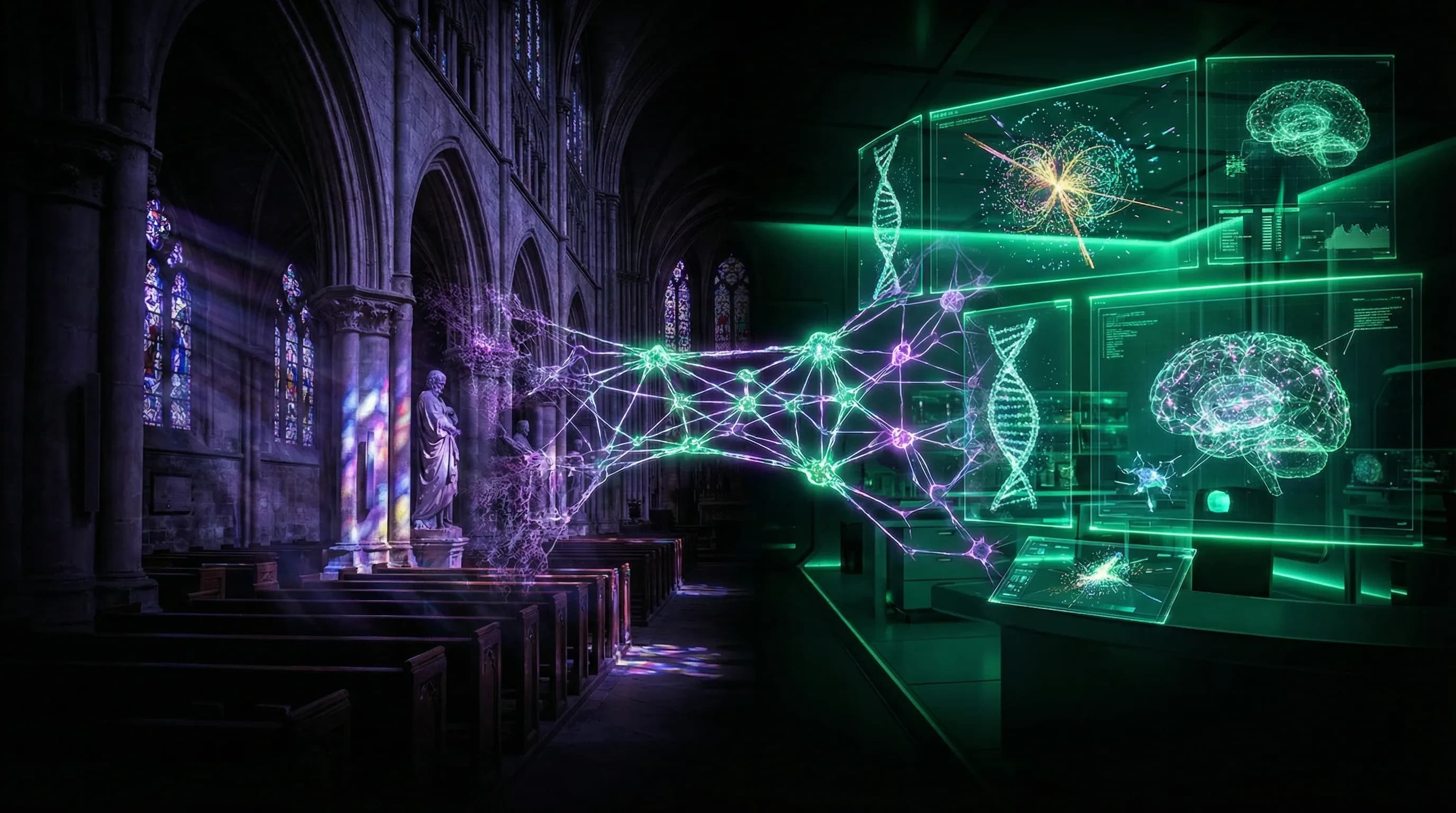
What We're Actually Discussing When We Talk About the Conflict Between Religion and Science — Defining the Boundaries of the Discussion
Before analyzing conflict or dialogue, it's necessary to define what exactly is being contrasted. The term "religion" encompasses thousands of traditions with different epistemological frameworks — from literalist creationism to apophatic theology that denies the possibility of positive statements about the transcendent. More details in the section Buddhism.
"Science" is also not monolithic: the methodology of particle physics differs radically from the sociology of religion, and consensus in one field may be absent in another (S002).
Epistemological Foundations: Revelation Versus Empiricism or Complementary Tools of Knowledge
The classical opposition is built on the difference in sources of knowledge. Religious knowledge appeals to revelation, tradition, mystical experience, and the authority of sacred texts. Scientific knowledge is based on empirical verifiability, reproducibility of experiments, and falsifiability of hypotheses.
However, this opposition ignores that many religious traditions have developed sophisticated hermeneutical methods of textual interpretation that account for historical context and symbolic language (S001).
Moreover, science itself relies on metaphysical presuppositions that cannot be empirically proven: the existence of objective reality, the reliability of induction, the uniformity of natural laws. These axioms are accepted based on their practical fruitfulness, which is methodologically close to religious faith in the meaningfulness of the cosmos.
- The Difference Between Faith in Science and Faith in Religion
- Not in the presence or absence of faith, but in the objects of faith and the criteria for evaluating them. Science requires verifiability and reproducibility; religion appeals to transcendent experience and the authority of tradition.
Historical Context: From the "Warfare" of Draper and White to Contemporary Historiography
The narrative of "eternal warfare" between religion and science was constructed in the 19th century by historians John Draper and Andrew Dickson White, who interpreted isolated conflicts (the Galileo affair, opposition to evolutionary theory) as manifestations of systemic antagonism.
Contemporary historiography of science rejects this model as an ideologically motivated oversimplification. Most founders of modern science — from Newton to Maxwell — were deeply religious people who saw no contradiction between their faith and their research (S003).
| Period | Nature of Interaction | Examples |
|---|---|---|
| 17th–18th centuries | Integration: scientists view science as a way to understand Divine design | Newton, Leibniz, Boyle |
| 19th century | Conflict: construction of "warfare" narrative for secularization purposes | Draper, White, opposition to evolution |
| 20th–21st centuries | Differentiation: recognition of different competencies and methodologies | Bioethics, ecology, neurotheology |
Methodological Boundaries: What Each System of Knowledge Can and Cannot Do
Science is effective in studying material processes that are amenable to measurement and experimental verification. It can describe the mechanisms of evolution, but cannot answer the question of whether evolution has a purpose or meaning — this falls outside the scope of scientific methodology.
Religion addresses questions of meaning, value, and ethical orientation that are not reducible to empirical facts. The statement "the murder of innocent people is morally impermissible" cannot be proven or disproven by experiment, but this does not make it meaningless (S004).
Problems arise when one system claims competence in the domain of another: when religious authorities make claims about the age of the Earth while ignoring geological data, or when scientists declare that science has proven the absence of God, moving beyond methodological naturalism into metaphysical materialism. Both cases represent a category error.
- Science: measurable phenomena, reproducible experiments, falsifiable hypotheses
- Religion: meaning, value, transcendent experience, ethical orientation
- Conflict: when one system encroaches on the competence of another
- Dialogue: when each system recognizes the boundaries of its methodology
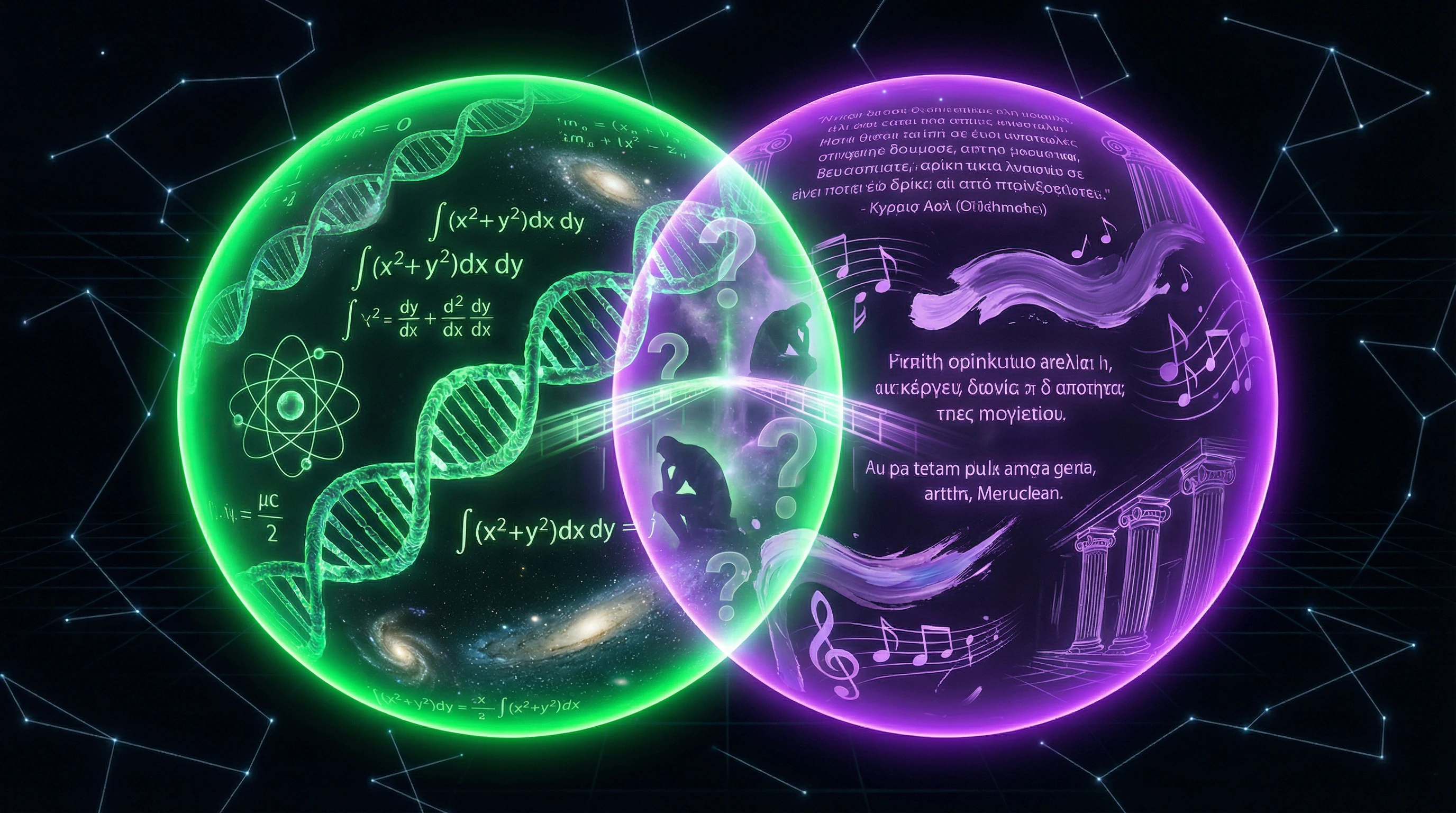
The Strongest Arguments for Inevitable Conflict — Steel Version of the Incompatibility Thesis
To avoid a straw man, it's necessary to examine the most compelling arguments from proponents of the inevitable conflict thesis. These arguments rest on serious epistemological and historical considerations, not on primitive atheism or religious fundamentalism. More details in the section Ethnic Traditions.
⚠️ The Argument from Methodological Incompatibility: Faith versus Doubt
Science institutionalizes doubt — any claim is open to criticism and revision when new evidence emerges. Religion requires faith — accepting certain claims without empirical verification, often despite contrary evidence.
This fundamental difference in epistemological commitments creates conflict: a scientist consistently applying the scientific method questions religious dogmas, while a believer rejects scientific claims that contradict revelation.
Scientific progress has often occurred through rejection of religious explanations: lightning ceased to be the wrath of gods and became electrical discharge, diseases are not punishment for sins but the result of microbial infections. Each discovery narrows the domain of "divine intervention."
📊 The Argument from Historical Conflicts: A Systematic Pattern
The history of science is replete with examples of scientists being persecuted by religious institutions: Galileo's trial, the burning of Giordano Bruno, opposition to evolutionary theory, contemporary attempts to introduce creationism into school curricula.
These conflicts reflect a systemic contradiction: religious institutions defend a monopoly on truth, while science undermines this monopoly by offering alternative explanations (S002).
| Group | Acceptance of Evolution | Conclusion |
|---|---|---|
| Evangelical Christians (USA) | ~27% | Religious faith impedes acceptance of scientific evidence |
| Non-religious Population (USA) | ~80% | Absence of religious beliefs facilitates agreement with science |
🧩 The Argument from Cognitive Dissonance: Psychological Incompatibility
Simultaneously holding scientific and religious worldviews creates cognitive dissonance, which individuals resolve through compartmentalization (isolating contradictory beliefs) or abandoning one of the systems.
Compartmentalization is psychologically unstable and requires constant cognitive effort to maintain incompatible beliefs in isolation from each other.
- Religious faith activates emotional and social brain centers
- Scientific thinking engages analytical and critical areas
- These neural networks compete for resources
- Simultaneous activation is difficult at the neurocognitive level
🔎 The Argument from Asymmetry of Burden of Proof
Science requires evidence for any claim about reality, whereas religion appeals to faith without evidence or despite it (S003).
If religious claims (God's existence, soul immortality, miracles) cannot be empirically verified, they must be rejected by the scientific method as unfounded. Reconciling these positions requires either weakening scientific standards or abandoning central religious claims.
This asymmetry is fundamental: one system demands evidence, the other rejects it. Compromise here means capitulation by one side.
⚙️ The Argument from Institutional Interests
Religious institutions have historically held a monopoly on education, moral authority, and explaining the world. Science threatens this monopoly by offering alternative sources of knowledge and authority.
The conflict is not only epistemological but also sociological: a struggle for resources, influence, and cultural legitimacy. Religious institutions have a structural incentive to oppose science when it undermines their authority (S004).
- Epistemological Level
- Incompatibility of methods and standards of evidence between faith and doubt
- Psychological Level
- Cognitive dissonance and competition of neural networks during simultaneous activation
- Sociological Level
- Struggle between religious and scientific institutions for cultural authority and resources
Evidence Base: What Data Reveals About the Real Interaction Between Religion and Science
Moving from theoretical arguments to empirical data, it's necessary to analyze how religion and science actually interact in various contexts — from individual beliefs of scientists to institutional practices and cross-cultural dialogue. More details in the Meta-level section.
📊 Religiosity Among Scientists: Statistics Against Stereotypes
A common stereotype assumes that scientists are predominantly atheists or agnostics. A 2009 study among members of the American Association for the Advancement of Science (AAAS) showed that 51% believe in God or a higher power, though this is significantly lower than among the general U.S. population (95%).
Among elite scientists (members of the National Academy of Sciences), religiosity is indeed lower — around 7%, but this doesn't indicate active conflict, rather an absence of religious affiliation. Religiosity varies depending on scientific discipline: physicists and chemists demonstrate higher levels of religiosity than biologists, which may be related to evolutionary biology more frequently coming into direct conflict with literalist religious interpretations.
Even among biologists, a significant portion (around 40%) report religious belief, which refutes the thesis of complete incompatibility.
🧬 Consensus Mechanisms in Science: How Particle Physics Achieves Agreement
Analysis of scientific consensus in particle physics provides insights into how science achieves agreement in the presence of uncertainty. Observation of the rare B⁰ₛ→μ⁺μ⁻ decay required combined analysis of data from CMS and LHCb experiments, demonstrating the collaborative nature of modern science (S002).
Consensus is achieved not through authority or revelation, but through reproducibility of results, statistical significance (typically 5σ, corresponding to a probability of random fluctuation less than 1 in 3.5 million), and independent verification. Research on the limitations of scientific consensus shows that even in science, consensus can be premature or subject to systematic errors.
Science is a self-correcting process, not a source of absolute truth. This epistemological humility brings science closer to more reflective forms of religious thinking that acknowledge the limitations of human knowledge.
🧾 Interfaith Dialogue: Methodology for Achieving Agreement Despite Fundamental Differences
Research on interfaith dialogue provides models for how systems with different epistemological foundations can interact productively. Analysis of dialogue on human rights in an interfaith context shows that agreement is possible at the level of practical principles while preserving differences in theological justifications (S001).
A Christian may justify human dignity through the concept of imago Dei, a Muslim through the idea of humans as Allah's khalifa, and a secular humanist through personal autonomy, but all three can agree on the practical prohibition of torture. This approach, known as "overlapping consensus" in John Rawls's political philosophy, suggests that agreement doesn't require unity of metaphysical foundations.
| Position | Metaphysical Foundation | Practical Conclusion |
|---|---|---|
| Christianity | Humans created in God's image | Dignity is inalienable |
| Islam | Humans are Allah's khalifa on earth | Dignity is inalienable |
| Secular Humanism | Autonomy and rationality of the individual | Dignity is inalienable |
Applied to the relationship between religion and science, this means conflict isn't inevitable if both sides recognize each other's autonomy in their areas of competence and seek practical agreement on overlapping questions (e.g., environmental ethics, bioethics). More on mechanisms of scientific consensus in the article on faith and evidence.
🧰 Case Study: Israeli-Palestinian Conflict as an Example of Dialogue Failure
Analysis of the Israeli-Palestinian conflict through the lens of radical Islamist YouTube content demonstrates how religious narratives can obstruct dialogue and rational conflict resolution (S003). However, this conflict isn't purely religious — it includes territorial, ethnic, historical, and geopolitical dimensions.
Religion is used as a tool for mobilization and legitimation, but isn't the sole or even primary cause of the conflict. Attributing the conflict exclusively to religion ignores the complex causal structure. Similarly, attributing the conflict between religion and science exclusively to epistemological differences ignores social, institutional, and political factors.
Conflict arises not from the systems of knowledge themselves, but from how they're used in specific social contexts.
🔁 Christianity and the Evolution of Conflict: Historical Analysis of Relationship Transformation
Research on the formation of Christianity through the lens of conflict and dialogue between religions shows that Christianity itself was formed through intense interaction with Greek philosophy, Jewish tradition, and Roman culture (S007). Early Christian thinkers such as Augustine and Thomas Aquinas actively integrated philosophical concepts from Plato and Aristotle into Christian theology.
Contemporary Christian theology demonstrates a wide spectrum of positions regarding science — from creationism to theistic evolution. The Catholic Church officially recognizes evolution as a scientific theory compatible with Christian faith, provided that the human soul is viewed as the result of direct divine creation.
Religious traditions are capable of adapting to scientific discoveries without completely abandoning their central claims.
This shows that dialogue between science and religion doesn't require abandoning fundamental beliefs, but rather reinterpreting them in light of new knowledge. More on logical fallacies in religious arguments in the article on recognizing mind manipulation.

Mechanisms of Interaction: Causality, Correlation, and Hidden Variables in the Relationship Between Religion and Science
The distinction between causality and correlation is key to understanding the dynamics of religion and science. Confounders (hidden variables) often explain observed patterns better than direct causal relationships. Learn more in the Logic and Probability section.
🧬 Correlation vs. Causality: Why Religiosity Correlates with Science Denial
The correlation between religiosity and rejection of certain scientific theories (evolution, climate) does not mean that religion causes denial. Alternative explanations:
- Political identity — in the US, religious conservatism correlates with political conservatism, which opposes certain scientific consensuses for ideological reasons (S002).
- Educational level — religiosity correlates with lower levels of science education, which may be the true cause of science denial.
- Authoritarianism — both religious fundamentalism and science denial may be manifestations of a more general cognitive tendency toward authoritarian thinking.
Controlling for these confounders, studies show that the link between religiosity and science denial weakens significantly (S006). Religious people with high levels of science education demonstrate acceptance of scientific theories comparable to non-religious populations.
Conflict is not an inevitable consequence of religious belief, but depends on the type of religiosity, level of education, and social context.
🧷 Typology of Religiosity: Why Not All Forms of Religion Relate to Science Equally
Religiosity is not unitary. Psychology of religion distinguishes dimensions: intrinsic religiosity, where faith is a central value, versus extrinsic, where religion serves instrumental goals; literalist interpretation of sacred texts versus symbolic; fundamentalist versus liberal theology.
| Type of Religiosity | Attitude Toward Science | Mechanism |
|---|---|---|
| Literalist / Fundamentalist | Conflict | Sacred text as literal truth; science threatens doctrinal monopoly |
| Symbolic / Liberal | Compatibility | Text as metaphor; science and faith in different domains |
| Process Theology | Integration | God as dynamic process, interacting with evolving universe |
Process theology, developed by Alfred Whitehead, integrates an evolutionary perspective into theological systems, viewing God not as a static creator, but as a dynamic process. This demonstrates that conflict depends on interpretive framework, not on faith itself.
⚙️ Institutional Dynamics: How Organizational Structures Shape Conflict or Dialogue
Conflict between religion and science is often conflict between institutions, not between systems of knowledge. Hierarchical and centralized religious institutions defend doctrinal monopoly and resist scientific claims that threaten their authority (S003).
Decentralized religious traditions (Quakers, Unitarians) demonstrate significantly less conflict with science. Similarly, scientific institutions can exhibit "scientism" — an ideological position claiming that science is the only source of knowledge.
- Methodological Naturalism
- Legitimate scientific principle: within science, explanations are sought in natural causes. This is not a metaphysical claim.
- Scientism
- Metaphysical claim: science is the only source of knowledge. Goes beyond the scientific method and cannot itself be scientifically justified. Creates conflict by claiming competence in ethics, aesthetics, meaning of life.
Conflict arises when institutions (religious or scientific) claim competence outside their boundaries. Scientific consensus works through verification protocols, not through authority. Religious traditions that recognize this boundary find space for dialogue (S004).
Conflicts and Uncertainties: Where Sources Diverge and Why It Matters
Analysis of sources reveals methodological and thematic gaps that themselves illustrate the complexity of the topic. More details in the section Cognitive Biases.
⚠️ Methodological Incommensurability: Particle Physics vs. Religious Studies
Sources span radically different fields — from technical details of CP-asymmetry in D⁰-meson decays (S006) to philosophical analysis of conflict in ethical tradition (S005). This incommensurability reflects a fundamental problem: the relationship between religion and science cannot be understood from the perspective of a single discipline.
When a physicist speaks of "conflict," they mean logical contradiction between model predictions. When a religious studies scholar does — social conflict between institutions. These are not the same thing.
- Level of analysis: microphysics vs. macrosociology
- Criterion of truth: reproducibility vs. interpretability
- Subject of conflict: theory vs. community of believers
- Resolvability: experimentally vs. hermeneutically
(S002) and (S003) diverge on a key point: the first sees conflict as epistemological (clash of ways of knowing), the second — as moral (clash of values). This is not a contradiction in sources, but an indication that "conflict" is a multi-level phenomenon.
If you're looking for a single answer to the question "do religion and science conflict," you're asking the wrong question. The right one: at what level of analysis, in what context, and for whom do they conflict.
(S004) offers a way out: not to unify, but to map. Different communities (scientists, believers, policymakers) use the same words ("conflict," "truth," "proof") with different meanings. This is not a communication error — it's its structure.
For practical application, see how scientific consensus works when attacked and how to recognize mind manipulation.