
Religiosity, Spirituality, and Health: What Scientists Measure When They Talk About Faith's "Impact" on the Body
The first trap begins with terminology. When researchers write about "religion and health," they rarely mean the same thing. More details in the section Judaism.
- Religiosity
- Measurable participation in institutional practices: attending services, observing rituals, denominational affiliation.
- Spirituality
- Personal sense of connection to the transcendent, search for meaning that can exist outside religious structures.
These constructs overlap but aren't identical, and their impact on health is measured with different instruments (S001, S002).
How "Faith" Is Operationalized in Clinical Research
A study of Polish oncology patients uses multidimensional scales: prayer frequency, significance of religious beliefs, use of faith as a coping strategy during illness (S003). This isn't abstract "faith in general," but specific behavioral and cognitive patterns that can be quantified.
Different studies use different scales, making meta-analysis difficult. One group measures church attendance frequency, another subjective sense of spiritual support, a third agreement with dogmatic statements.
Why "Quality of Life" Isn't Synonymous with "Health"
When researchers discuss the impact of religiosity on cancer patients' "quality of life" (QoL), they're measuring subjective well-being: emotional state, social support, ability to cope with pain, sense of meaning (S006).
| What's Measured | What This Says About Health | What This Does NOT Say |
|---|---|---|
| Subjective well-being | Psychological state improved | Tumor grows slower or survival rates are higher |
| Sense of meaning | Patient copes better with pain | Pain objectively decreased |
| Social support | Resource exists for psychological adaptation | Biochemical markers changed |
Confusion between subjective well-being and objective medical outcomes is the source of most myths about faith's healing power.
Geographic and Cultural Boundaries of Data
Most available research focuses on Europe (especially Poland) and North America. A study of religious participation among elderly Europeans covers countries with varying levels of secularization but remains within a Christian cultural matrix (S005).
- Data on Buddhism, Hinduism, and Islam's impact on health is either absent or methodologically incomparable.
- Poland is a religiously homogeneous country dominated by Catholicism, making Polish research findings unrepresentative for multi-religious societies.
- Conclusions about "religiosity and health" are often extrapolated to a global context despite locally-derived data.
Before accepting claims about faith's impact on health, check: where was the study conducted, which denominations were covered, what measurement instruments were used. Scientific consensus only works if you know how to verify it.
Steel Version of the Argument: Five Most Compelling Evidence Links Between Religiosity and Health
Before examining weaknesses, we must present the strongest version of the thesis. This is not a straw man, but real research with measurable effects. More details in the section Daoism and Confucianism.
🔬 First Argument: Religious Participation Correlates with Longevity in Elderly Europeans
Research shows a stable association between regular attendance at religious services and self-rated health (S008). People who continue religious practice in old age demonstrate better subjective health indicators even with chronic diseases.
The mechanism may include community social support, structured routine, sense of meaning. This doesn't prove that religion causes health, but the correlation remains stable even when controlling for socioeconomic variables.
📊 Second Argument: Spirituality as a Coping Mechanism Improves Psychological Well-being in Cancer Patients
Research on cancer patients documents: those who use religious and spiritual practices to cope with illness report higher quality of life in emotional and social domains (S001).
Structured practices (prayer, meditation, rituals) give patients tools to manage anxiety and existential fear. The effect is measurable through standardized quality-of-life questionnaires.
🧠 Third Argument: Religious Affiliation as a Protective Factor for Mental Health
Mental health professionals recognize the need to integrate spiritual aspects into therapy (S007). Patients themselves bring religious themes into clinical contexts, indicating the functional role of religious identity.
In cultures where religion is normative, it functions as a protective factor against depression and suicidal ideation, at least at the level of clinical observation.
🧬 Fourth Argument: Religious Practices Affect Physiological Stress Markers
If religious practices reduce psychological stress (S002), this should be reflected in cortisol levels, inflammatory markers, heart rate variability. Chronic stress is a proven risk factor for numerous diseases.
Any effective coping mechanism should theoretically affect physiology. This is a hypothesis requiring direct testing, but it's biologically plausible.
🧾 Fifth Argument: Social Support from Religious Communities—A Measurable Health Resource
Religious participation often means inclusion in a social network: regular meetings, mutual aid, emotional support (S008). Social isolation is a proven mortality risk factor, comparable to smoking.
- If a religious community provides a stable social network, this explains part of the correlation between religiosity and health
- The effect is independent of belief itself—this is sociology, not mysticism
- The mechanism is measurable and reproducible in other contexts
All five arguments rely on measurable variables: social network, psychological coping, subjective well-being, clinical observations. These aren't miracles, but mechanisms that can be studied scientifically. The question is how specific these mechanisms are to religion and how much they explain the entire observed correlation.
Evidence Base Analysis: What's Measured, What's Interpreted, Where Speculation Begins
Critical analysis requires three filters: data quality, methodological rigor, alternative explanations. Most research on religion and health fails all three. More details in the Ethnic and Indigenous Identity section.
📊 Methodological Limitations of Cancer Patient Research
The study on spirituality's impact on cancer patients' quality of life (S010) is cross-sectional, meaning it measures correlation at a single point in time. This doesn't establish causation.
Three scenarios are possible: patients with better psychological states more often turn to religious practices; those feeling worse physically lose the ability to participate in rituals; or both processes occur in parallel without influencing each other. Longitudinal studies tracking patients over time are absent from the provided sources.
| Study Type | What It Shows | What It Doesn't Show |
|---|---|---|
| Cross-sectional | Correlation at one point | Direction of causal relationship |
| Longitudinal | Changes over time | Mechanism of effect |
| Randomized controlled | Causal relationship | Long-term effects |
🧪 The Problem of Self-Reports and Subjective Measurements
Most data on quality of life and religiosity are based on patient self-reports (S010, S012). This creates risk of socially desirable responses: in religiously homogeneous environments, patients may exaggerate the significance of faith to conform to cultural expectations.
Objective medical outcomes—survival, disease progression, biomarkers—are not analyzed in available sources. Subjective well-being matters, but it's not the same as cure or disease deceleration.
If religiosity affects health through psychological mechanisms, that's still an effect. But if the effect exists only in self-reports, it may be a measurement artifact rather than a real phenomenon.
🔎 Confounders: Socioeconomic Status, Education, Healthcare Access
The study of elderly Europeans controls for some socioeconomic variables, but not all (S008). Religious participation correlates with higher social capital, stable marital status, better healthcare access.
Without strict control of these factors, the "religiosity effect" becomes an artifact of social class. People with resources more often participate in community institutions (including religious ones) and have better health for multiple reasons unrelated to faith. This doesn't mean religion is harmful—it means its role is overestimated.
- Control for income and education
- Control for access to medical services
- Control for marital status and social networks
- Control for lifestyle (diet, physical activity, smoking)
- Control for baseline health status
🧬 Absence of Data on Biological-Level Mechanisms
None of the provided studies measure biological mechanisms: neurotransmitter levels, inflammatory markers, epigenetic changes, immune system activity (S008, S010, S012). All conclusions are based on psychological questionnaires and sociological data.
This doesn't make them false, but it limits depth of understanding. If religiosity affects health, it must occur through specific biological pathways. Until these are identified, it remains unclear whether the mechanism works or we're observing a statistical artifact. More on distinguishing real effects from noise in the extraordinary claims verification protocol.
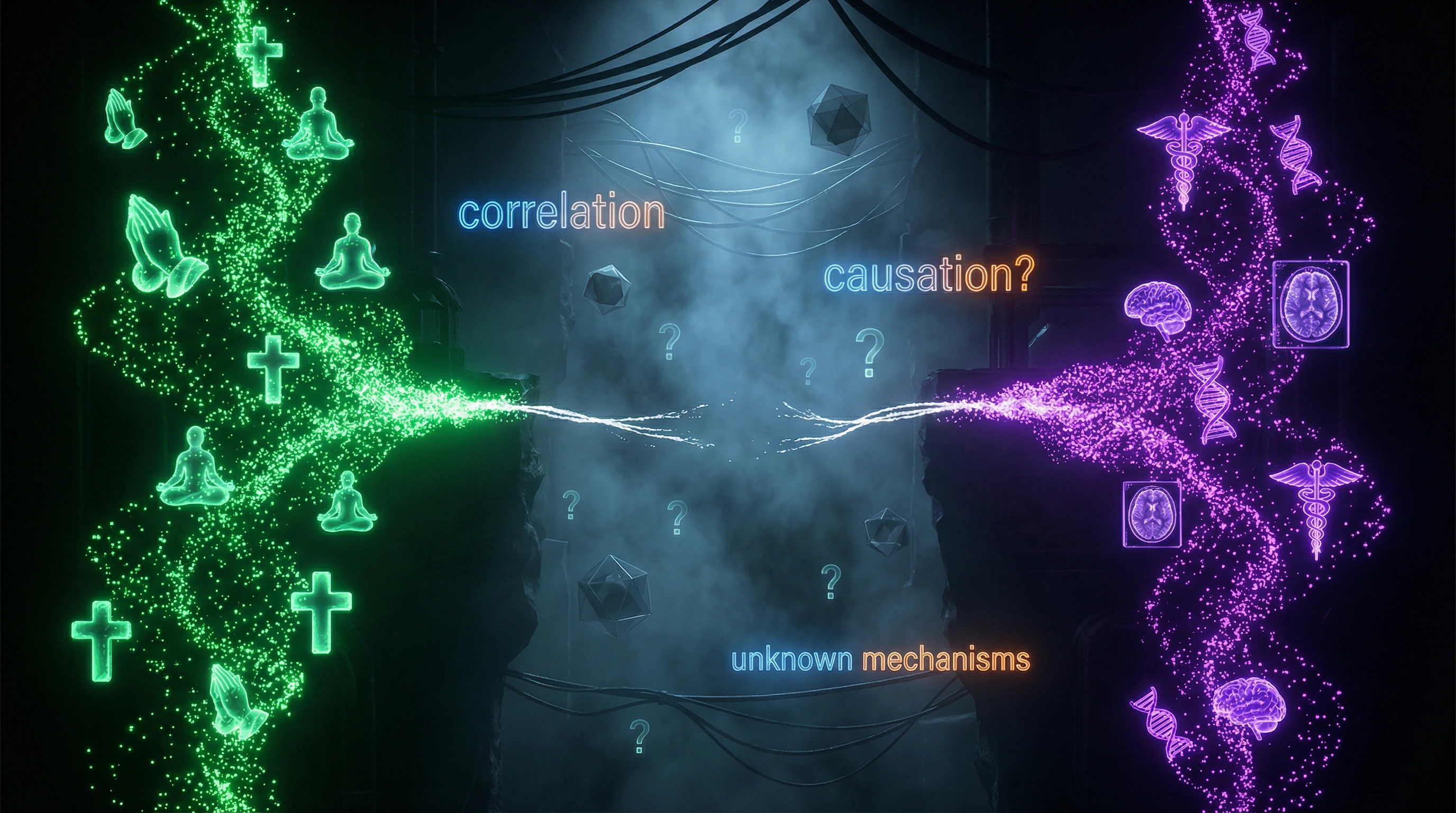
Mechanisms or Mirages: How to Distinguish Causal Links from Statistical Artifacts
Correlation is an observation that two variables change together. Causation is a claim that one variable causes change in another. Between them lies a methodological chasm. More details in the section Logical Fallacies.
🔁 Reverse Causality: Illness Changes Religiosity, Not the Other Way Around
Possible scenario: severe illness drives people to seek comfort in religion (religious coping), but doesn't improve their physical condition. Or conversely: declining health reduces ability to attend church, creating an illusion that religious participation "protects" health (S008).
Without longitudinal data measuring religiosity before illness onset and tracking outcomes over time, it's impossible to separate these scenarios. Cross-sectional studies don't solve this problem.
🧩 Third Variable: Personality Traits as Common Cause
People with certain personality traits (conscientiousness, optimism, social openness) may simultaneously participate more in religious practices and take better care of their health: adhere to treatment regimens, avoid harmful habits, maintain social connections.
In this case, religiosity and health are both consequences of a third variable (personality), not cause and effect of each other. Studies that don't control for personality traits attribute to religion an effect that actually belongs to character.
- Check: did the study control for personality traits (conscientiousness, neuroticism, extraversion)?
- If not — the result may be an artifact of a third variable.
- If yes — the effect of religion is more plausible, but not guaranteed.
🧬 Survival Effect: Who Remains in the Sample
A study of elderly Europeans (S008) examines those who survived to old age and agreed to participate in the survey. People with severe illnesses, social isolation, or cognitive impairments drop out of the sample.
If religious participation correlates with social integration, the sample is automatically biased toward religious respondents. This creates an illusion of religion's protective effect, which is actually a selection artifact.
🧾 Publication Bias: Positive Results Are Published More Often
Studies that found no association between religiosity and health are published less frequently in journals. This creates a distorted picture: the literature is flooded with positive correlations, but we don't know how many studies with null results remained in desk drawers.
Publication bias is universal across all science, including research on religion and health (S003). If you see only positive results — that's not proof of an effect, but a signal about a filter in the publication system.
To verify: look for systematic reviews and meta-analyses that attempt to find and account for unpublished studies. They provide a more honest picture than browsing individual articles.
More about how scientific consensus works and why it's difficult to verify, see "Faith and Evidence: How Scientific Consensus Works When Under Attack." On the protocol for verifying extraordinary claims — "How to Distinguish Scientific Miracle from Statistical Noise."
Data Conflicts and Zones of Uncertainty: Where Sources Contradict Each Other
Scientific consensus is not a monolith. Different studies yield different answers, and that's normal. The problem begins when contradictions are silenced. More details in the Media Literacy section.
🧩 Religiosity as Protection or as Source of Stress
Religiosity can be both a resource and a source of conflict (S002). Patients whose beliefs contradict medical recommendations—refusal of blood transfusions, vaccine denial—experience additional stress.
Religious guilt, fear of divine punishment, conflict with church norms worsen mental health (S007). Studies focusing only on positive aspects (S001) ignore this dimension.
The protective effect of religion exists only when faith does not contradict reality and medical necessity. When contradiction exists—the effect inverts.
🔎 Differences Between Denominations and Cultures
Data from Catholic Europe are not applicable to Protestant, Orthodox, Muslim, or Buddhist contexts (S005). Orthodox tradition has different conceptions of personhood and community than Western Christianity (S002).
This affects how religiosity interacts with health. Universal conclusions about "religion in general" are methodologically incorrect.
| Parameter | Problem | Consequence |
|---|---|---|
| Denominational Affiliation | Different traditions, different relationships to body and medicine | Results are not universal |
| Cultural Context | Role of religion in society varies (marginal vs. dominant) | Protective effect depends on believer's social status |
| Gender and Age | Women and elderly show different patterns (S005) | Conclusions for one group don't apply to another |
🧪 Spirituality Without Religion: Is There an Effect or Not?
Some studies separate religiosity and spirituality (S001), others measure only institutional participation (S008). If the effect belongs to spirituality—personal search for meaning—rather than religion, this radically changes interpretation.
Perhaps the protective factor is not belief in God, but the presence of an existential narrative. It can be secular: philosophy, art, political ideology, scientific pursuit. Data to separate these effects are insufficient.
- Spirituality (personal)
- Search for meaning, transcendent experience, connection with something greater. Can be religious or secular. Effect on health: presumably positive, but not proven separately from religion.
- Religiosity (institutional)
- Belonging to an organized tradition, participation in rituals, adherence to norms. Effect on health: mixed—depends on conflict with reality and social status.
- Interpretation Trap
- Researchers often don't separate these variables, attributing the entire effect to religion when it may be the effect of meaning, social support, or placebo (S006).
Read more about how scientific consensus works when attacked, and how to distinguish scientific miracle from statistical noise.
Cognitive Anatomy of the Myth: What Mental Traps Make Us Believe in the "Healing Power of Faith"
Even when data is ambiguous, the myth of religion as a panacea persists. More details in the section Magic and Rituals.
⚠️ Confirmation Bias: We See What We Expect to See
People who believe in the healing power of prayer remember cases when prayer "worked" (the patient recovered) and forget cases when it didn't (the patient died). This is classic confirmation bias (S001).
Scientific studies must control for this effect by counting all cases, but popular interpretations of research often don't. For more on how to recognize such manipulations, see the breakdown of logical fallacies in religious arguments.
🧩 Gambler's Fallacy: Belief in a Just World
People want to believe that virtue is rewarded with health and sin is punished with illness. This is psychologically comforting: the world seems predictable and fair.
Studies showing correlation between religiosity and health are easily interpreted through this lens, even when the correlation is explained by social factors unrelated to moral justice.
🕳️ Halo Effect: Religion Is Associated with Virtue
In cultures where religion is normative, religious people are perceived as more moral, disciplined, and trustworthy (S002). This association transfers to health: if religious people are "good," they should also be healthy.
This is a cognitive distortion unrelated to actual health mechanisms, but it influences data interpretation. How to distinguish such artifacts from genuine effects is covered in the protocol for verifying extraordinary claims.
🧠 Illusion of Control: Religious Practices as Ritual Against Chaos
Illness is an experience of losing control. Religious practices (prayer, rituals, vows) provide the illusion that a person can influence the outcome.
- Illusion of control reduces anxiety
- Reduced anxiety improves subjective well-being (S007)
- Improved well-being is interpreted as a medical effect
- Psychological comfort and biological efficacy merge in consciousness
But improved well-being doesn't mean a change in the biology of disease. These are different levels of analysis that are often confused in popular interpretations. For more on the mechanisms of psychological effect, see the analysis of prayer and healing.
Verification Protocol: Seven Questions That Expose Weak Claims About Religion and Health
How do you distinguish a well-founded claim from speculation? Seven questions that reveal logical holes in any assertion about faith's impact on health.
✅ Question 1: Is This Correlation or Proven Causation?
If a study shows that religious people are healthier, ask: is this a longitudinal study (tracking people over time) or cross-sectional (a snapshot at one moment)? Were confounders controlled for (socioeconomic status, education, personality traits)?
If not—this is correlation, not causation. Claims about causation require experimental or quasi-experimental designs, which (S001, S002) lack.
✅ Question 2: What Exactly Was Measured—Subjective Well-Being or Objective Medical Outcomes?
Quality of life is a self-report about how one feels. Survival, tumor size, biomarkers—these are objective medical data. If a study measures only the former, it doesn't prove that religion affects disease progression.
Psychological comfort matters, but it's not healing. Confusion between the two is the foundation of half the myths about "faith's healing power."
⛔ Question 3: Was Reverse Causality Accounted For?
Could illness affect religiosity, rather than the other way around? If seriously ill people more often turn to religion (or lose faith), the correlation between religiosity and health may be an artifact of illness changing religious behavior.
Without measuring religiosity before illness, this question can't be resolved. (S003) doesn't control for this factor.
✅ Question 4: Were Social Factors Controlled For?
Religious participation often means social integration (S008). If a study doesn't control for social support separately from religiosity, the "religion effect" may be an effect of social connections.
- Red flag:
- Study compares religious people with non-religious people but doesn't measure social support in both groups.
- Green flag:
- Study shows the effect disappears when controlling for social support—meaning it's not religion, but social connections.
⛔ Question 5: Is the Sample Representative?
Studies from religiously homogeneous populations aren't necessarily applicable to multi-religious or secular societies. Studies of elderly Europeans (S005) don't apply to young people or non-European populations.
Universal conclusions from narrow samples are a red flag. Check: where was the study conducted, who participated, how similar is this to your population.
✅ Question 6: Is There Data on Mechanisms?
If it's claimed that religion affects health, there must be a biological mechanism: changes in stress hormones, immune function, neurotransmitters. If a study doesn't measure these mechanisms, it doesn't explain how.
The protocol for verifying extraordinary claims requires not just correlation, but explanation of mechanism. (S006, S007) often skip this step.
⛔ Question 7: Are There Contradicting Studies Being Suppressed?
If you found five studies confirming the link between religion and health, but didn't find a single one refuting it, that's suspicious. Scientific literature is rarely unambiguous. Searching only for confirming data is the logical fallacy of confirmation bias.
| Signal | Interpretation |
|---|---|
| All found studies confirm the hypothesis | You're searching with bias or sources are dishonestly selected |
| There's contradictory data, but authors discuss it | Honest analysis; more trustworthy |
| Contradictory studies are ignored or ridiculed | Ideological position, not scientific |
These seven questions aren't a formula for truth, but a tool for exposing speculation. Apply them to any claim about religion, health, and miracles. How scientific consensus works—it's the ability to see where facts end and interpretation begins.