What Are Cargo Cults: From Military Bases to Bamboo Airplanes — Anatomy of a Phenomenon That Rewrote Religious Studies Textbooks
The term "cargo cult" was first documented by Australian patrol officer E. Williams in 1945 when describing movements in Papua New Guinea, where local populations awaited the return of ancestors on ships loaded with European goods. Classic definition: religious-millenarian movements that emerged in Melanesia in the 20th century, based on the belief that performing rituals imitating colonizers' actions would bring material abundance through supernatural intervention. More details in the Neopaganism section.
🧩 Historical Context: How World War II Transformed Pacific Islands Into a Laboratory of Spontaneous Religious Genesis
Between 1942–1945, military bases of the USA, Australia, and Japan were established across Melanesian islands (Vanuatu, Solomon Islands, Papua New Guinea). Local populations, living under Neolithic economic conditions, encountered for the first time a massive influx of industrial goods: canned food, textiles, tools, radios.
Key moment: goods arrived by planes and ships, but Melanesians never witnessed the production process — only the rituals of unloading, radio communications, soldiers marching. After military withdrawal in 1946–1947, the flow of goods ceased, but the memory of the "golden age" remained.
People observed the form but didn't see the mechanism. This distinction is the axis around which the entire phenomenon revolves.
🔎 Key Elements of Cargo Cults: Five Components That Transform Observation Into Sacred Ritual
Anthropological research from the 1950s–1970s (Peter Worsley, Kenelm Burridge) identified a consistent structure of cargo cults:
- Millenarianism
- Belief in the imminent arrival of an era of abundance through the return of ancestors or gods. Creates a psychological horizon justifying current sacrifices.
- Ritual Imitation
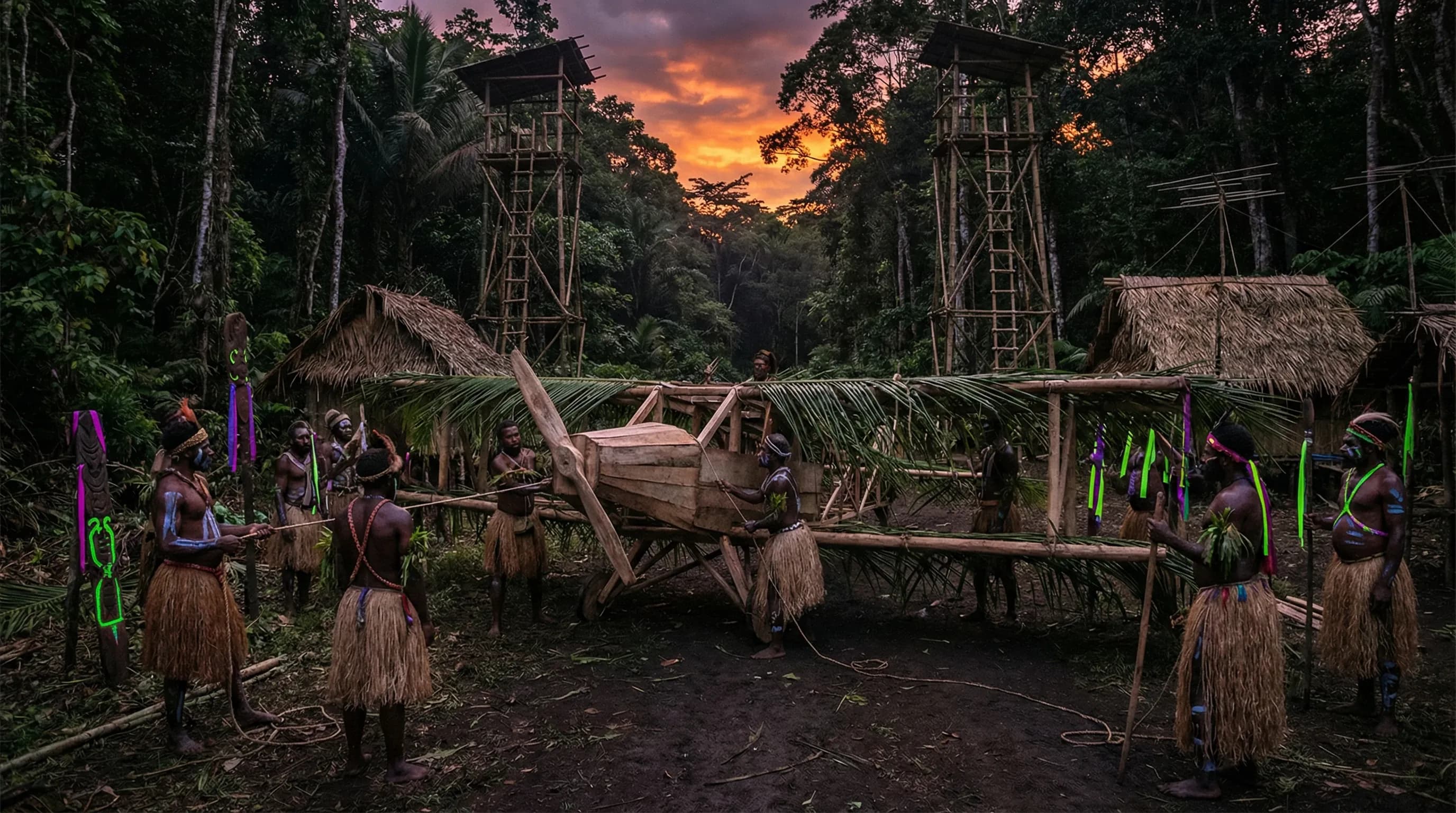
- Construction of bamboo airstrips, "radio stations" made from coconuts and vines, marching with wooden rifles. Form without content becomes an end in itself.
- Abandonment of Traditional Labor
- Destruction of pigs, cessation of agriculture while awaiting "cargo." Signals a break with the past and readiness for transformation.
- Charismatic Leadership
- Prophets claiming to have received revelation from ancestors (e.g., John Frum on Tanna). The leader encodes uncertainty into a comprehensible narrative.
- Syncretism
- Blending of Christian elements (cross, prayers) with traditional beliefs in spirits. New knowledge is integrated into existing cosmology.
🧱 Boundaries of the Phenomenon: Why Not Every Imitation of Western Practices Is a Cargo Cult
It's critically important to distinguish cargo cults from rational technology adaptation. If Melanesians copied colonizers' agricultural methods and obtained real harvests — that's technology transfer.
Cargo cult begins where the cause-and-effect relationship is severed: the ritual imitates the form (radio communications, runway) but ignores the mechanism (industrial production, logistics). Analogy: if a programmer copies code without understanding the algorithm and expects the "magic" to work — that's cargo cult programming (term introduced by Steve McConnell in 2000).
| Rational Adaptation | Cargo Cult |
|---|---|
| Copies mechanism, verifies result | Copies form, awaits result |
| Cause → action → effect (verifiable) | Ritual → belief → expectation of effect |
| Willingness to abandon if it doesn't work | Failure interpreted as insufficient devotion |

Five Arguments in Defense of Cargo Cults: Why Ritual Imitation Is Not Madness, but a Rational Strategy Under Information Scarcity
Before analyzing cognitive errors, it's necessary to acknowledge: from the perspective of Melanesians in the 1940s, cargo cults were a logical response to observed data. More details in the Ethnic Traditions section.
🧩 Argument 1: The Correlation Was Real
In 1942–1945, Melanesians observed a consistent correlation: American soldiers build a tower → speak into a radio → within hours, a plane arrives with cargo. The correlation repeated hundreds of times.
From the standpoint of inductive logic, the conclusion "tower + radio = plane" was empirically justified. The error wasn't in observation, but in invisible variables: Melanesians didn't know about factories, oil refineries, global logistics.
If you see a doctor put on a white coat and patients recover, but don't know about the existence of antibiotics — it's logical to assume the coat possesses healing power.
🔁 Argument 2: The Technological Gap Was Insurmountable
Arthur Clarke: "Any sufficiently advanced technology is indistinguishable from magic." For a society without metallurgy, engines, or electricity, an airplane objectively is a magical object.
Melanesians couldn't construct a scientific model of aviation — they lacked the conceptual apparatus. Two options remained: (1) acknowledge complete unknowability and fall into cognitive paralysis, (2) integrate the observation into their existing worldview through the category of "supernatural." The second option is more adaptive — it preserves agency and enables action.
🧠 Argument 3: Missionaries Laid the Foundation
Since the 1840s, Christian missions (Presbyterian, Catholic, Adventist) operated in the Melanesian islands. They preached: the imminent Second Coming, resurrection of the dead, arrival of the Kingdom of God with material abundance.
When Americans appeared in 1942 with unprecedented wealth, Melanesians logically interpreted this as fulfillment of Christian prophecies. The John Frum cult on Tanna directly borrowed the structure of Adventist eschatology: Frum — a messiah who will return and bring cargo.
- Missionaries created a cognitive template
- Cargo cults filled it
- Result: synthesis of Christianity and local cosmology
⚙️ Argument 4: Over-Imitation Is a Universal Mechanism
Anthropologist Michael Tomasello demonstrated: humans learn through "over-imitation" — they copy not only functional actions, but also ritual elements, even when their causal role is unclear.
Experiment: children are shown how to open a box, including meaningless gestures (tapping the lid three times). Children copy everything, including the tapping — because they can't distinguish causal actions from ritual ones. Melanesians applied the same strategy: copied the entire observed pattern (tower, radio, marching), because they didn't know which elements were critical.
This isn't irrationality — it's a conservative heuristic under uncertainty. When stakes are high and information is incomplete, copying everything is safer than guessing.
🛡️ Argument 5: Social Function — Resistance
Peter Worsley in "The Trumpet Shall Sound" (1957) interpreted cargo cults as a form of anti-colonial protest (S005). Colonizers monopolized access to goods, imposed forced labor, destroyed traditional structures.
Cargo cults offered an alternative cosmology: "The cargo is meant for us, ancestors will send it directly, bypassing white intermediaries." Destroying pigs and refusing to work on plantations — not economic madness, but an act of symbolic resistance.
| Movement | Period | Function |
|---|---|---|
| Cargo cults | 1940–1960s | Anti-colonial protest + identity restoration |
| Taborites, Anabaptists | 15th–16th centuries | Resistance to feudal lords + eschatological protest |
| Balkan folk cults | Middle Ages | Resistance to official church + social consolidation |
In all cases, millenarian eschatology served as a tool for social reorganization, not merely a cognitive error.
Evidence Base: What Science Actually Knows About Cargo Cult Formation Mechanisms — and Where Speculation Begins
Systematic quantitative research on cargo cults is extremely scarce: the phenomenon was studied primarily through qualitative ethnographic methods in the 1950s–1970s. Most data consists of field observations by individual anthropologists (Worsley, Burridge, Lawrence), without control groups or statistical analysis. More details in the Indigenous Beliefs section.
Nevertheless, several empirically confirmed patterns can be identified that recur independently of geography and time.
🧾 Documented Cases: From the Vailala Movement to the Prince Philip Cult
The first recorded cargo cult — the Vailala Madness movement in Papua New Guinea, 1919–1922. Leader Evara predicted the arrival of a steamship with cargo from ancestors; followers destroyed ritual objects, built "wharves," and fell into ecstatic states.
The second peak — the 1940s, linked to World War II: the John Frum cult (Tanna, from the 1940s to present day), the Yali movement (New Guinea, 1940s–1950s), the Maasina Rule movement (Solomon Islands, 1944–1952). An exotic case: the Prince Philip cult on Tanna (from the 1960s), where the Duke of Edinburgh is venerated as a deity who will return with cargo.
| Movement | Region | Period | Trigger |
|---|---|---|---|
| Vailala | Papua New Guinea | 1919–1922 | Contact with Europeans, cargo promises |
| John Frum | Tanna (Vanuatu) | 1940s — present | U.S. military base, aircraft |
| Yali | New Guinea | 1940s–1950s | War, Japanese occupation |
| Maasina Rule | Solomon Islands | 1944–1952 | War, American troops |
🔎 Social Predictors: Under What Conditions Do Cargo Cults Emerge
Analysis of 15 documented cases reveals common conditions of emergence. Sudden technological shock — contact with a civilization superior by several orders of magnitude. Absence of gradual acculturation — if contact is stretched over centuries (as in Polynesia), cargo cults do not arise.
Cargo cults did not emerge in societies with strong centralized authority (for example, in the kingdoms of Tonga or Fiji). This points to the role of social disorganization, rather than simply "primitive" thinking.
Economic deprivation — sharp deterioration of living conditions after colonizers' departure. Weakness of traditional institutions — destruction of the chief system, taboos, rituals. Presence of millenarian ideology — usually introduced by Christian missions (S005).
🧬 Cognitive Mechanisms: Which Mental Modules Do Cargo Cults Exploit
Although direct experiments on cargo cult participants have not been conducted (ethical constraints), data from cognitive science of religion can be extrapolated. Hyperactive Agency Detection Device (HADD) — the tendency to attribute intentions to inanimate objects (S004). An aircraft is perceived not as a machine, but as an agent that "decides" to arrive.
Promiscuous teleology — children and adults in unfamiliar domains tend to explain phenomena through purpose. Melanesians: "Airplanes exist to deliver cargo to us." Ritualization under uncertainty — when people don't control outcomes, they increase ritual actions (S001).
- Hyperactive Agency Detection Device (HADD)
- Attribution of intentions and will to inanimate objects. In cargo cult context: an aircraft is not a vehicle, but a being that can "choose" to arrive. Evolutionarily adaptive (better to err and see a predator in a bush than miss a real predator), but in a new environment becomes a trap.
- Promiscuous Teleology
- Explaining phenomena through purpose or function. Clouds exist to provide rain; airplanes — to deliver cargo. The logic works in familiar domains, but under information deficit becomes a source of errors.
- Ritualization Under Uncertainty
- Increase in ritual actions when outcomes are not controlled. Trobriand Island fishermen use magic in dangerous open sea, but not in safe lagoons. Cargo cults are an extreme case of this pattern.
📊 Ritual Effectiveness: Measurable Consequences for Economy and Social Structure
Economic consequences are documented: on Tanna in the 1940s–1950s, John Frum followers destroyed approximately 80% of pig herds (primary capital), ceased copra cultivation (the only commodity product). Colonial administration recorded a 60% drop in copra exports from Tanna in 1947–1950.
Social consequences: strengthening of charismatic leaders' roles at the expense of traditional chiefs; in some cases — violent conflicts. The Maasina Rule movement in the Solomon Islands led to clashes with police, 12 deaths in 1947–1952 (S008).
However, there are also positive effects: cargo cults stimulated political mobilization that later transformed into independence movements. Vanuatu gained independence in 1980, with John Frum cult leaders participating in politics.
This means cargo cults are not merely cognitive errors, but also a form of social protest that under certain conditions becomes a catalyst for political change.
The Mechanism of Religiogenesis: How Random Correlation Becomes Sacred Truth — A Step-by-Step Reconstruction of the Cognitive Process
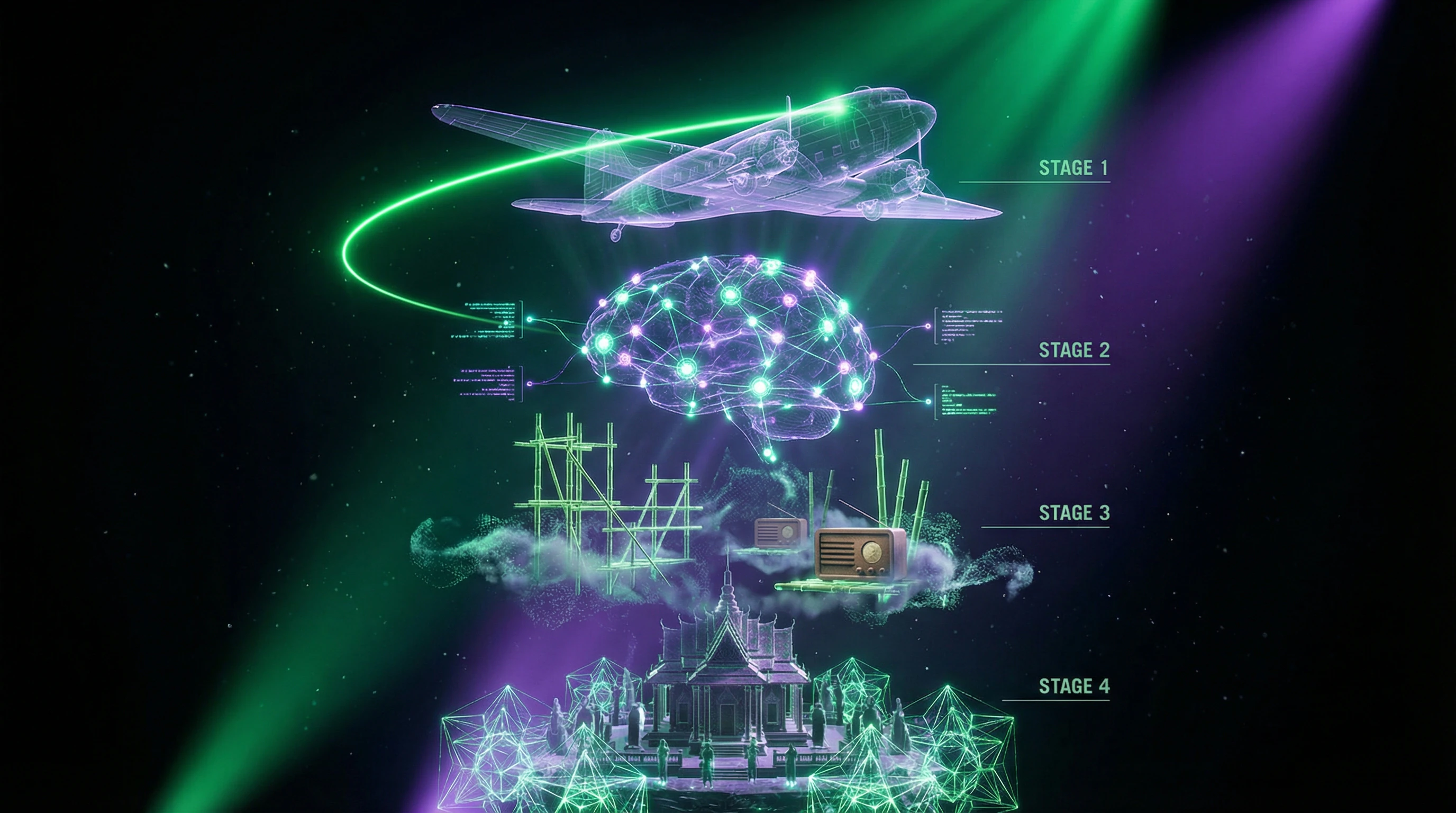
Cargo cults are not an anomaly, but a model case of religious system formation in accelerated mode. Usually this process is stretched over centuries and hidden from observers; in Melanesia it occurred over 5-10 years and was documented by anthropologists in real time. Reconstructing the mechanism allows us to understand how religiogenesis works in any context — from ancient cults to modern ones. More details in the Mental Errors section.
🔁 Stage 1: Observing an Incomprehensible but Regular Phenomenon — and Activating Pattern Search
The human brain is evolutionarily tuned to detect patterns — an adaptation for survival. The problem: the pattern detection system operates on the principle of "better a false alarm than a missed threat." Result: we see patterns even where none exist (pareidolia, apophenia).
Melanesians observed a real pattern: "white people's actions → cargo arrival." But due to lack of information about intermediate links (production, logistics), the brain filled the gap with false causality: "white people's rituals summon cargo."
When information is incomplete, the brain prefers an incorrect explanation to no explanation. This isn't a bug — it's a survival strategy that often works under conditions of data scarcity.
🧩 Stage 2: Building a Causal Model Through Available Conceptual Schemas — Magic, Spirits, Ancestors
People explain incomprehensible phenomena through "minimally counterintuitive concepts" — ideas that violate basic expectations (a thinking stone; a dead person who acts) but remain within intuitive ontology (S004). For Melanesians, available schemas: ancestors possess supernatural power, rituals can influence spirits, white people may be spirits or spirit intermediaries.
Model: "Cargo is created by our ancestors in the spirit world, white people know the correct rituals to summon it." This model explains all observations and aligns with traditional cosmology.
| Observation | Traditional Explanation | Why It's Convincing |
|---|---|---|
| Cargo arrives after white people's actions | White people know the summoning ritual | Causal connection is visible, logic is clear |
| Cargo contains foreign objects | Ancestors create it in the spiritual world | Consistent with cosmology |
| Cargo disappears after white people leave | White people took the ritual or ancestors are offended | Explains absence of cargo |
⚙️ Stage 3: Ritualization — Transforming Hypothesis into Sacred Action Through Social Reinforcement
The hypothesis "ritual summons cargo" cannot be immediately disproven because cargo doesn't arrive instantly. This creates a window for ritualization. A charismatic leader announces: "I received a revelation from the ancestors, they said to build a tower and wait."
The group builds a tower. Cargo doesn't arrive. But the prophet explains: "We performed the ritual incorrectly" or "The ancestors are testing our faith" or "White people are blocking the cargo with magic." Each explanation strengthens belief because it requires additional rituals.
- Social Reinforcement
- Those who doubt face ostracism; those who believe more strongly gain status. Belief becomes a marker of group belonging.
- Cognitive Reinforcement
- Each failure is reinterpreted as confirmation of the model. Absence of cargo is not refutation, but a sign that new rituals are needed.
- Emotional Reinforcement
- Ritual creates a sense of control and connection to the sacred. This is psychologically more comfortable than acknowledging helplessness.
🧱 Stage 4: Institutionalization — Cementing Ritual Across Generations and Creating Unfalsifiable Dogmas
After 5-10 years, cargo cult transforms from hypothesis into tradition. Children born after the Americans left never saw real planes with cargo — they only know the ritual. For them, the bamboo tower is not an imitation but an authentic sacred object.
Secondary myths emerge: "John Frum appeared to our fathers in a vision," "The first tower was destroyed by evil spirits, which is why cargo didn't come." Dogmas become unfalsifiable: "Cargo will arrive when we achieve sufficient purity of faith" — the criterion of "sufficient purity" is undefined, therefore failure is always explainable.
Analogy: Christian "Second Coming" has been postponed for 2000 years, but faith doesn't weaken — because the criterion "soon" is elastic. Unfalsifiability is not a bug of the system, but its main feature.
🔎 Universality of the Mechanism: From the Cult of Isis to Modern Movements — One Algorithm, Different Decorations
The same four-stage process is observed in the formation of any religious and quasi-religious systems. Ancient Egypt: Nile floods correlate with star positions → priests build model "rituals influence the Nile" → institutionalization of Isis cult.
Medieval Europe: relics of Saint Foy in Conques correlate with healings (selection bias: only successes are recorded) → pilgrimage → cathedral. Cults of holy bishops in 11th-12th century Germany formed through an analogous mechanism: miracles → ritualization → institutionalization (S004).
- Cryptocurrencies: "HODL" (hold coins, don't sell) → ritualization through memes → when price drops: "Weak hands exited, diamond hands will win."
- MLM companies: promise wealth through "correct mindset" → rituals (affirmations, visualization) → when wealth doesn't come, explanation: "You didn't believe enough."
- Wellness cults: special diet correlates with feeling of energy (placebo + selection bias) → ritualization through community → unfalsifiable claims about "detox" and "energy fields."
- Political movements: charismatic leader offers simple explanation of complex problems → rituals (rallies, slogans) → when problems aren't solved, enemies are declared guilty.
The mechanism is universal because it relies on fundamental features of human cognition: pattern seeking, need for causality, social reinforcement, cognitive consonance. Cargo cult is not an exception but a transparent example of how religiogenesis works everywhere.
The difference between a "real" religion and a "false" cult is not in the mechanism, but in scale, age, and social legitimacy. Catholicism is a cargo cult that survived 2000 years and won a billion followers.