 🆕 New Religious Movements
New Religious Movements in Post-Soviet Spaceλ
Academic research on non-traditional religiosity, typology, and sociocultural factors of NRM spread in the United States and Western countries
Overview
New Religious Movements (NRMs) are diverse groups with non-traditional beliefs that emerged predominantly in the second half of the 20th century. After the collapse of the USSR, an ideological vacuum 🧩 created conditions for their mass spread in Russia and the CIS. An academic approach requires studying recruitment mechanisms, social factors, and psychological triggers — without stigmatization and labels.
🛡️
Laplace Protocol: This section is based on peer-reviewed academic sources from leading research institutions and universities, including major state universities and research centers. We use scientifically neutral terminology and avoid apologetic or anti-cult biases, focusing on objective analysis of social, cultural, and religious studies aspects of NRMs.
Reference Protocol
Scientific Foundation
Evidence-based framework for critical analysis
Protocol: Evaluation
Test Yourself
Quizzes on this topic coming soon
Sector L1
Articles
Research materials, essays, and deep dives into critical thinking mechanisms.
🆕 New Religious Movements 🆕 New Religious Movements
⚡
Deep Dive
Post-Soviet Spiritual Vacuum: How the USSR's Collapse Opened Doors to Alternative Religiosity
Ideological Collapse and the Search for New Meaning
The dissolution of the Soviet Union in 1991 created unprecedented conditions for new religious movements to penetrate post-Soviet space. The collapse of state-sponsored atheistic ideology left millions in a state of worldview vacuum—traditional Soviet values lost legitimacy, while new orientations had yet to form.
Acute demand for spiritual alternatives coincided with socioeconomic chaos: people sought answers to existential questions in conditions where previous meanings had crumbled.
Liberalization of religious legislation in the early 1990s removed administrative barriers to religious organization activity. A massive influx of foreign missionaries coincided with activation of domestic spiritual seekers creating their own teachings based on synthesis of Eastern practices, esotericism, and reinterpreted Christianity.
| Period | Characteristics |
|---|---|
| 1991–1995 | Peak interest in alternative religiosity; number of registered religious associations increased several-fold |
| 1995–2000 | Formation of academic centers studying NRMs; access for researchers to international scholarship |
| 2000–2010 | Institutionalization of research: dissertations, monographs, specialized conferences |
| 2010–present | Interdisciplinary approach; analysis of NRMs in context of globalization and digitalization |
Chronology of NRM Institutionalization in Russia
Academic study of new religious movements in Russia passed through several distinct stages. In the 1970s–1980s, Soviet researchers studied NRMs predominantly as a Western phenomenon within the framework of critiquing bourgeois ideology, without ability to analyze the domestic situation.
- Mid-1990s
- Qualitative breakthrough: researchers gained access to international scholarship and opportunity for direct study of NRMs on Russian territory.
- Late 1990s
- Formation of major academic centers: religious studies department at Moscow State University (I.Ya. Kanterov), specialized programs at Russian State University for the Humanities, research groups at regional universities.
- 2000–2010s
- Defense of dissertations, publication of monographs, specialized conferences; transition to interdisciplinary analytical methods.

Multidimensional Classification: How Scholars Systematize NRM Diversity
Geographic-Cultural Typology of Origins
Classification of new religious movements by origin identifies four main categories. Each possesses specific doctrinal and practical characteristics.
- Eastern NRMs — based on Hindu, Buddhist, or Taoist traditions adapted for Western audiences: International Society for Krishna Consciousness, various yoga schools, Zen Buddhist centers.
- Western Christian NRMs — radical reinterpretations of Christian doctrine: Jehovah's Witnesses, Mormons, Unification Church.
- Syncretic movements — combine elements of various religious traditions with modern psychological and esoteric concepts: New Age, Agni Yoga, Roerich movement.
- Indigenous American NRMs — emerged from local spiritual traditions and cultural context, including neopagan movements reconstructing pre-Christian indigenous beliefs, and charismatic groups around individual spiritual leaders.
This classification, developed by I.Y. Kanterov and expanded by I.V. Kolosova, helps understand the cultural roots and adaptation mechanisms of NRMs to the American context.
Value-Motivational System of Pronina-Fedotov
An alternative approach, proposed by T.S. Pronina, A.A. Fedotov, and N.N. Fedotova in 2018, focuses on value orientations and adherent needs rather than doctrinal differences.
The methodology identifies five main types of NRMs based on which human needs they satisfy: cognitive (search for knowledge and understanding of the world), affiliative (need for community belonging), transcendent (pursuit of spiritual experience), compensatory (overcoming life crises), and identificational (formation of self-identity).
The advantage of value-oriented typology is its ability to explain membership dynamics in NRMs and individuals' spiritual search trajectories. Research shows that the same person may sequentially participate in various contemporary movements, satisfying different needs at different life stages.
This typology also allows predicting the attractiveness of specific NRMs to certain socio-demographic groups depending on dominant value orientations in society.
Scientific Lens: Methodological Principles for Objective NRM Research
Religious Studies Methodology and Terminological Neutrality
Academic religious studies requires neutral terminology when examining new religious movements, rejecting evaluative concepts like "sect" or "cult." The term "new religious movements" (NRMs) has been adopted by the international scholarly community since the 1970s due to its descriptive character.
Scientific analysis focuses on objective characteristics: organizational structure, doctrinal content, social functions, and cultural context, avoiding a priori judgments.
Methodological agnosticism requires temporary suspension of judgments about the truth or falsity of religious claims to achieve objective understanding.
The religious studies approach includes comparative analysis of NRMs with traditional religions, identifying common structural elements and specific innovations. The phenomenological method seeks to understand the internal logic of beliefs and practices from the perspective of adherents themselves, rather than external observers.
Interdisciplinary Integration: Sociology and Cultural Studies of NRMs
The sociological approach analyzes NRMs as social institutions performing specific functions: integrating marginalized groups, providing alternative meaning systems, creating mutual support communities.
| Level of Analysis | Research Focus |
|---|---|
| Social Composition | Participant demographics, recruitment mechanisms |
| Organizational Dynamics | Power structure, internal processes, adaptation |
| External Interaction | Relations with state, society, traditional religions |
| Social Context | NRMs as response to modernization, urbanization, individualization |
Cultural analysis examines NRMs in the context of global cultural transformations and the migration of ideas between civilizational spheres. This approach investigates how NRMs adapt traditional religious elements to contemporary culture, creating hybrid forms of spirituality.
Integration of different methodological perspectives creates a multidimensional picture of the NRM phenomenon, accounting for its religious, social, psychological, and cultural dimensions.
Ethical Imperatives of Research Practice
Ethical principles for NRM research require respect for informants' religious beliefs, data confidentiality, and awareness of the potential impact of scholarly publications on public perception of studied groups.
- Avoid stigmatizing NRMs, which can lead to discrimination against their members
- Maintain critical distance and avoid becoming apologists for studied movements
- Balance academic freedom with social responsibility
- Recognize that research findings may be used in political or legal contexts
The NRM researcher occupies a complex position: must be objective, yet not indifferent to the consequences of their work for studied communities.
Major Categories of NRMs in the American Context
Typologizing new religious movements in the United States is complex due to their diversity and dynamism. Researchers identify several major categories based on origin, doctrinal characteristics, and organizational structures.
This classification systematizes knowledge about the religious landscape and reveals mechanisms of adaptation of spiritual traditions to the American sociocultural context.
Movements of Eastern Origin
Movements of Eastern origin constitute a significant portion of NRMs in America: adapted forms of Hinduism, Buddhism, and other Asian traditions. These include the International Society for Krishna Consciousness, yoga schools, Zen Buddhist groups, and Tibetan Buddhist traditions that gained widespread popularity in the latter half of the 20th century.
These movements attract followers with philosophies of self-improvement, meditative practices, and alternative approaches to spiritual development that differ from traditional Christianity. Their distinctive feature is the ability to adapt complex religious-philosophical systems to the needs of urban populations, offering practical techniques for working with consciousness and body.
Christian Derivative Groups
Christian derivative groups emerged from the Christian tradition but deviate substantially from orthodox doctrines. This category includes Jehovah's Witnesses, Mormons, Pentecostal and charismatic churches, and syncretic groups combining Christian elements with other traditions.
These movements often offer literal biblical interpretation, eschatological teachings, and emphasis on personal religious experience—precisely what attracts people disillusioned with traditional churches.
Esoteric and Occult Movements
Esoteric and occult movements unite groups oriented toward secret knowledge, magical practices, and alternative cosmologies. These include Theosophical societies, Anthroposophy, Rosicrucians, schools of Western occultism, and neo-paganism.
These NRMs attract intellectually oriented audiences with their synthesis of science, philosophy, and mysticism, as well as practices aimed at unlocking hidden abilities. Their distinguishing feature is elitism and emphasis on gradual initiation into secret teachings through systems of degrees or levels.
New Age Movements and Indigenous American Groups
New Age movements form a decentralized network of groups and practices united by ideas of an approaching era of spiritual awakening. This includes holistic medicine, channeling, crystal work, astrology, and other practices often combined in individual spiritual paths.
- Indigenous American groups
- Movements based on Native American spirituality or synthesis of Christianity with esotericism—attempts to create distinct spiritual traditions based on national identity.
- Their function in contemporary context
- Reflect the search for cultural roots and alternatives to mainstream religious institutions, filling spiritual needs through locally meaningful frameworks.

Migration Patterns and Cross-Border Spread
The collapse of the USSR opened corridors for religious mobility: NRMs moved between former republics, adapting to local contexts. Studying these patterns reveals mechanisms of idea dissemination and factors behind movements' success or failure in different regions.
NRM Movement Between Russia and Neighboring Republics
NRMs migrate between Russia, Central Asia, the Caucasus, and the Baltics—directions shift depending on political climate. Some use Russia as a launchpad for expansion, while others, facing restrictions, relocate centers to more tolerant jurisdictions.
Russian-speaking diasporas in former Soviet republics serve as dissemination channels: they maintain transnational networks and transfer practices to new places of residence. NRM migration flows often follow economic and labor migrations.
Factors in Transnational Mobility of Religious Ideas
Mobility is determined by language, cultural proximity, economic ties, and legal regimes. Russian as the lingua franca of the post-Soviet space facilitates the spread of literature and missionary work.
Differences in legislation between countries create "windows of opportunity": NRMs legalize in one jurisdiction and from there influence neighboring regions.
Digital technologies have radically changed patterns: NRMs maintain transnational communities without physical relocation of leaders, creating virtual centers accessible from anywhere in the post-Soviet space.
Contemporary Challenges and Research Directions
The study of new religious movements faces a number of contemporary challenges related to rapid social and technological changes. The digitalization of religious life, evolving legal frameworks, and shifting societal attitudes toward religious pluralism require new research approaches.
The academic community must adapt to these changes by developing tools for studying online communities, analyzing digital religious practices, and assessing the impact of NRMs on contemporary society.
Digital Transformation and Online NRM Communities
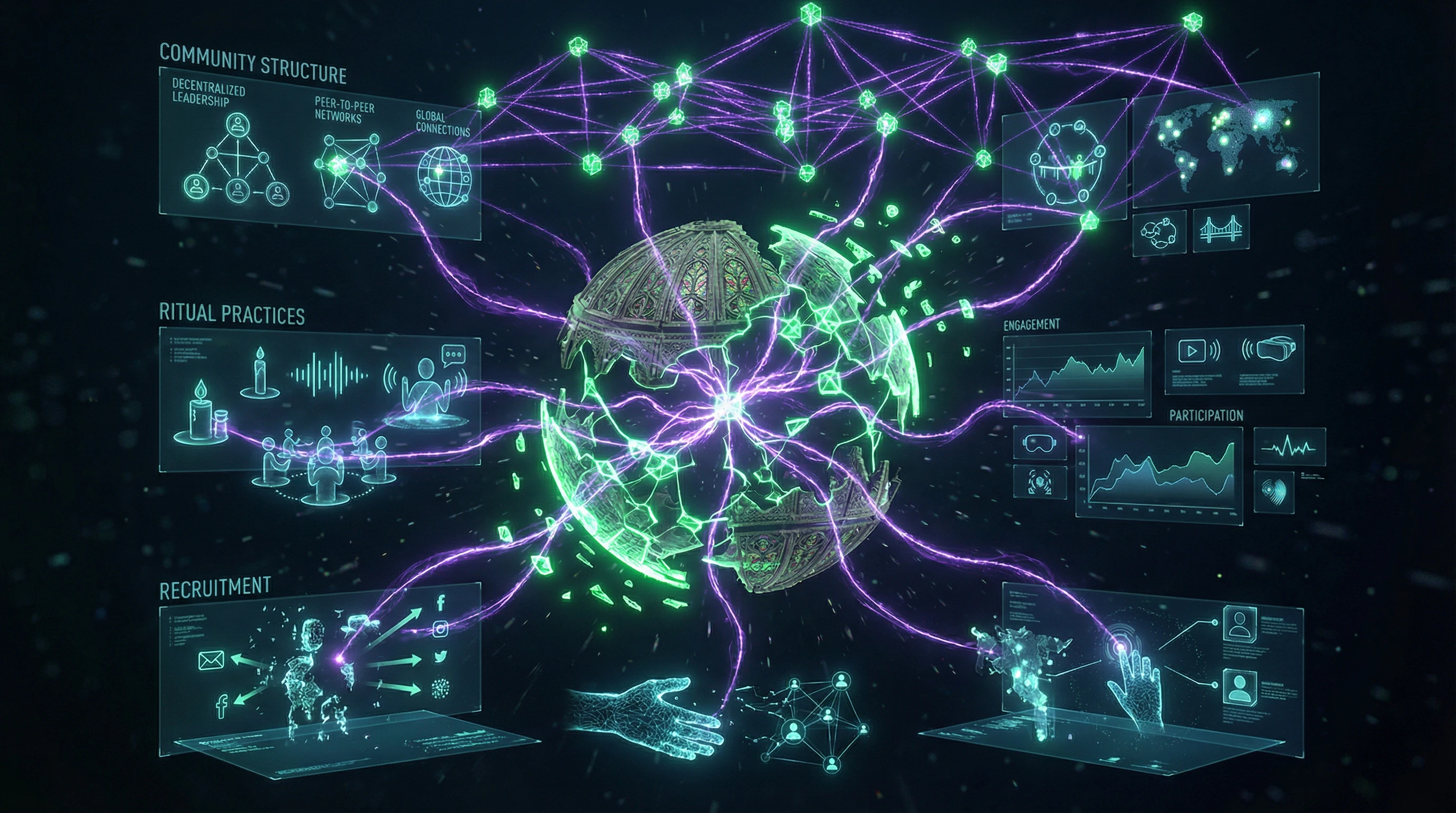
Digital transformation has radically changed the ways new religious movements organize, communicate, and practice. Many NRMs have created virtual temples, online courses, and digital platforms for meditation, rituals, and teaching, which has expanded their geographic reach and lowered barriers to entry.
Social networks and messaging apps have become primary channels for recruiting new members and maintaining connections among followers, requiring researchers to master methods of digital ethnography and online discourse analysis.
The COVID-19 pandemic accelerated these processes, forcing even conservative NRMs to transition to hybrid formats that combine physical gatherings with virtual practices.
Legal Frameworks and Social Integration Issues
Legal regulation of NRM activities remains one of the most contentious issues in post-Soviet countries, where legislation balances between freedom of religion and protecting society from potentially destructive groups.
| Regulatory Model | Regional Examples | Characteristics |
|---|---|---|
| Liberal | Baltic States | Minimal restrictions on NRM activities |
| Restrictive | Russia, Central Asia | Enhanced control and limitations |
Social integration of NRM members presents a complex problem, as stigmatization and discrimination can hinder their participation in public life, education, and employment.
Researchers call for the development of balanced approaches that protect the rights of religious minorities while not ignoring legitimate societal concerns about manipulative practices of some groups.
Interfaith Dialogue and Future Research Prospects
The development of interfaith dialogue between traditional religions and NRMs can contribute to reducing social tensions and mutual understanding. Some researchers see in NRMs the potential for renewing religious life and stimulating traditional denominations toward reforms and greater openness.
- Long-term effects of NRM participation and mechanisms for exiting movements
- Secularization processes within NRMs themselves and their evolution toward more institutionalized forms
- Study of second and third generations of NRM members who were born and raised in these movements
- Transmission of religious identity and long-term sustainability of new religious traditions
These directions will allow us to understand how contemporary movements transform and integrate into the social fabric of society.
Knowledge Access Protocol
FAQ
Frequently Asked Questions
NRMs are religious, spiritual, or philosophical groups that emerged predominantly in the second half of the 20th century and are characterized by non-traditional beliefs. They feature alternative practices relative to established world religions and exhibit high ideological diversity. The term is used in academic contexts for objective scientific analysis of these phenomena.
The cultural upheaval of the 1960s created an ideological and spiritual vacuum that diverse religious movements filled. The counterculture revolution and questioning of traditional institutions facilitated the emergence of Eastern and alternative Western teachings. Researchers document the intensification of this process from the mid-1960s onward.
Multiple typologies exist: by origin (Eastern, Western, syncretic), by members' value orientations, and by doctrinal foundations. The value-oriented typology developed by researchers identifies groups based on adherents' needs. No single universal classification exists due to the extreme diversity of NRMs.
No, this is a widespread myth—NRMs are extremely diverse in practices and social impact. Academic research emphasizes the necessity of objective terminology, avoiding the evaluative term "cult." While some movements may exhibit problematic characteristics, the majority function as legitimate spiritual communities.
Sociological (analysis of social functions), religious studies (examination of doctrines), and cultural (investigation of sociocultural contexts) approaches are applied. Ethical principles of objectivity and researcher neutrality are essential. American universities (Harvard, UC Berkeley, NYU) offer specialized programs in NRM studies.
The myth of adherent marginality has been refuted by research—NRMs attract diverse demographic groups, including educated professionals. People seek spiritual alternatives, answers to existential questions, or new forms of religious experience. Motivations for joining vary from meaning-seeking to the need for community.
NRMs are characterized by relatively recent emergence, practices non-traditional for a given culture, and often charismatic leadership. They may synthesize elements from different traditions or offer radically new interpretations. However, boundaries are blurred, as many NRMs draw upon ancient teachings.
Categories include movements of Eastern origin (Hare Krishnas, Buddhist groups), Christian derivatives (Mormons, Jehovah's Witnesses), esoteric currents, and New Age movements. Indigenous American groups that emerged locally also exist. Each category has specific doctrinal and organizational characteristics.
This is a classification based on the core values and motivations of movement members. The typology accounts for adherents' needs: spiritual, social, and psychological. This approach enables understanding of the internal mechanisms of various NRMs' appeal to different population groups.
Researchers document active migration patterns of NRMs across national boundaries due to globalization and cultural exchange. Transnational mobility of religious ideas is facilitated by open borders and digital communications. Some movements adapt doctrines to local cultural contexts.
No, this is a misconception — many NRMs are based on ancient traditions or syncretic combinations of existing religions. The term 'new' reflects the time of their institutionalization in modern form rather than absolute novelty of ideas. Often these are reinterpretations of classical spiritual teachings.
Key principles include objectivity, neutrality, and avoidance of value judgments. Researchers must avoid confessional bias and use scientific terminology instead of pejorative terms. Respect for informants' religious feelings and data confidentiality are essential.
No, the extreme diversity of NRMs makes universal classification problematic. Various typological systems exist based on different criteria: origin, doctrine, organization, values. Each system has limitations and suits specific research objectives.
Movements of Eastern origin (International Society for Krishna Consciousness, various Buddhist schools), Christian groups (Pentecostals, Charismatics), and esoteric currents have significant presence. New Age movements and neo-pagan groups are growing in popularity. Precise statistics are difficult due to the closed nature of many communities.
The internet and social media have radically accelerated the spread of religious ideas, allowing NRMs to reach audiences without physical presence. Online communities, webinars, and digital rituals are becoming new forms of religious practice. This creates challenges for traditional research and regulatory methods.
Yes, NRMs represent an important subject for studying contemporary religious processes, social transformations, and cultural dynamics. Numerous American universities conduct serious scholarly research on these phenomena. NRMs help understand mechanisms of religious innovation and adaptation of spirituality to modernity.