Neopaganism: Modern Reconstruction or New Religious Movementλ
Academic analysis of contemporary neopaganism as a religious-ideological phenomenon in post-Soviet space, its methodological foundations and critique of pseudohistorical constructions
Overview
Neo-paganism is a religious-ideological movement claiming to reconstruct pre-Christian Slavic cults. Academic research documents the absence of historical continuity 🧩: the foundation consists of fragmentary sources, pseudohistory, and pseudolinguistics. A post-Soviet phenomenon where the search for identity generated not a revival of archaic practices, but new religious construction.
🛡️
Laplace Protocol: This material is based on peer-reviewed academic sources from Russian universities and research centers (2012-2024). Critical analysis separates scientifically grounded conclusions from pseudohistorical constructions, maintaining balance between acknowledging religious experience and evaluating the movement's historical claims.
Reference Protocol
Scientific Foundation
Evidence-based framework for critical analysis
Protocol: Evaluation
Test Yourself
Quizzes on this topic coming soon
⚡
Deep Dive
Neopaganism as a Post-Atheist Society Phenomenon: What Lies Behind the Term
Academic Consensus and Definitional Boundaries
Neopaganism is a religious-ideological movement aimed at reviving pre-Abrahamic, locally-ethnic beliefs. This is not a restoration of archaic beliefs, but a new religious construction emerging in post-atheist society conditions.
Researchers use parallel terms: contemporary paganism, nativism, native faith—each emphasizing different aspects of the phenomenon. Academic consensus is unambiguous: Russian neopaganism has no historical continuity with ancient Slavic paganism.
- Post-Atheist Society
- A society where official atheist ideology has collapsed, but traditional religious institutions have not restored full control over meaning-making. A vacuum emerges, filled by new religious constructions.
- Nativism
- An ideological turn toward local, "indigenous" beliefs as a counterweight to global or imperial religions. Often contains political subtext.
Geographic Origins and Temporal Context
Slavic neopaganism originated in the United States, then spread to European countries and post-Soviet space. This refutes the myth of "reviving indigenous traditions" on Slavic lands.
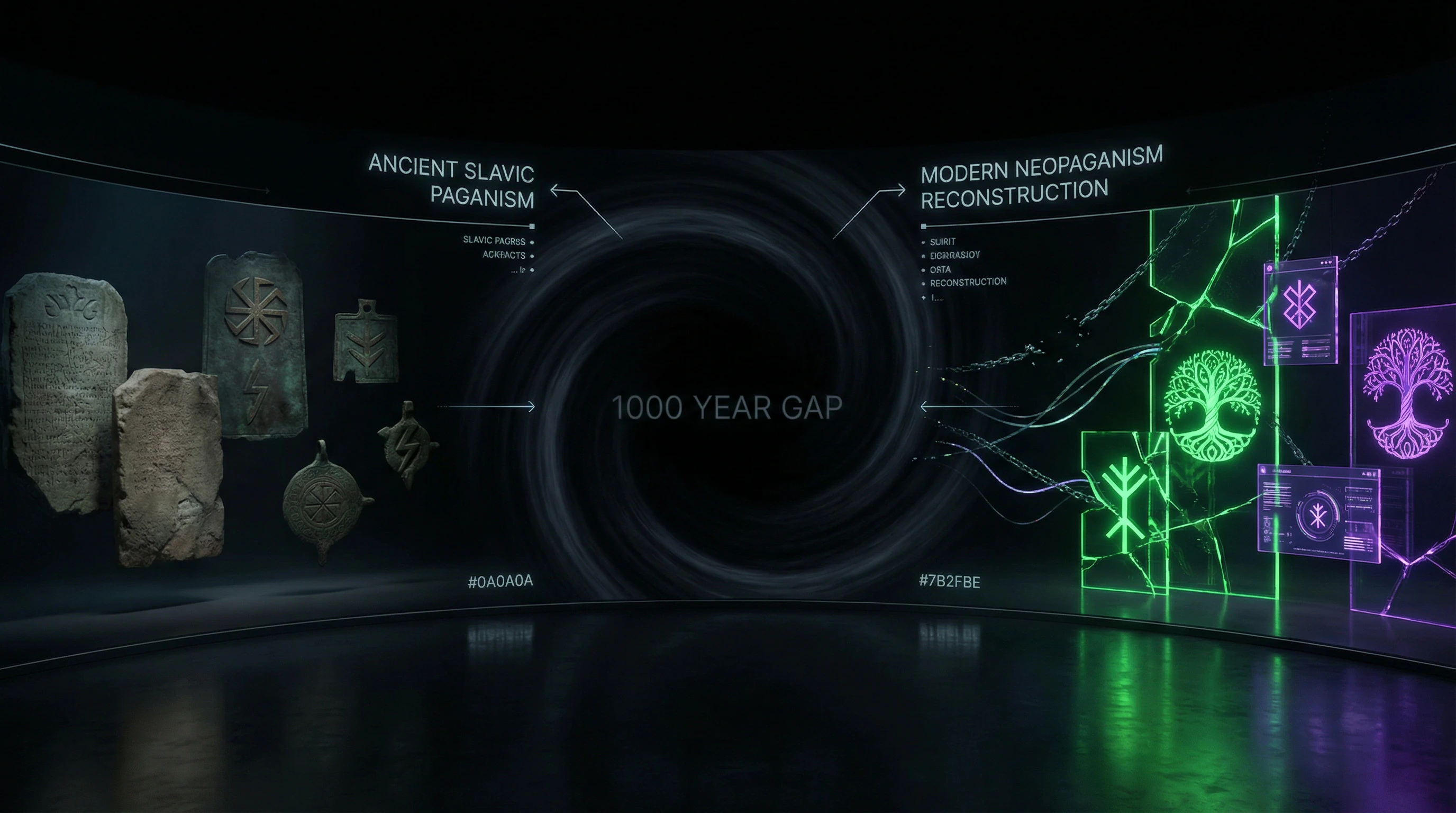
The phenomenon formed as a post-Soviet response to ideological vacuum, not as an organic continuation of pre-Christian practices. The temporal gap between historical Slavic paganism and contemporary movements exceeds one thousand years, during which cultural transmission was completely interrupted.
Pseudoscientific Foundation and Mythological Constructions
Contemporary neopaganism is built on postulates of pseudohistory and pseudolinguistics. The movement is based on two interconnected mythological systems: myths about Orthodox Christianity as a "foreign religion" and myths about paganism itself as the "authentic faith of ancestors."
| Level of Analysis | Scientific Approach | Neopagan Construction |
|---|---|---|
| Source Base | Fragmentary written sources, archaeology, linguistics | Selective citation, romanticization, ideological interpretation |
| Reconstruction Methodology | Rigorous historical criticism, verification | Filling gaps with contemporary ideological assumptions |
| Verifiability | Open to revision with new data | Closed, protected from criticism as "spiritual knowledge" |
Critical analysis demonstrates: neopagan constructions do not withstand scientific scrutiny when rigorous historical methodology is applied. The fragmentary nature of ancient sources requires extensive interpretation, which inevitably introduces contemporary ideological assumptions into the reconstructed picture of the past.
Multiparadigmatic Methodology for Studying Religious New Formations
Religious Studies Pluralism of Approaches
Neopaganism is studied through a multiparadigmatic approach that recognizes the multiplicity of legitimate perspectives. Philosophical-cultural analysis examines the phenomenon as a form of cultural identity under conditions of globalization.
The sociological perspective focuses on mechanisms of religious community formation in postsecular society. Historical-critical methodology reveals breaks in historical transmission, calling into question claims of authenticity.
Emic versus Etic Analysis
The distinction between emic (insider) and etic (outsider) perspectives is critically important for understanding neopaganism.
- Emic approach: how participants themselves understand their practices, beliefs, and identity—the perspective from within religious experience.
- Etic approach: external analytical categories, comparative methods, and critical distance for evaluating historical claims and social functions.
- Academic integrity: holding both perspectives simultaneously—acknowledging the authenticity of religious experience without uncritically accepting historical constructions.
Ideological Dimension of Research
Neopaganism functions not only as a religious but also as an ideological-political phenomenon. Researchers identify the use of neopagan rhetoric in nationalist discourses, where "return to roots" serves to justify political programs.
Methodologically, it is necessary to distinguish between individual spiritual searches, legitimate attempts at cultural reconstruction, and the instrumentalization of neopaganism for political purposes—without reducing the complex phenomenon to a single aspect.
The Myth of Historical Continuity: Critique of Authenticity Claims
Break in Cultural Transmission
The central claim of neopaganism—restoration of an interrupted tradition—finds no confirmation in historical data. The Christianization of Rus' in the 10th–11th centuries initiated the displacement of pagan practices, completed by the 14th–15th centuries in most regions.
The absence of a continuous line of ritual knowledge transmission, priestly institutions, and theological systems makes reconstruction in the strict sense impossible. What is presented as "revival" is new creation, using fragmentary historical data as raw material for contemporary constructions.
Reconstruction as Invention of Tradition
Eric Hobsbawm's concept of "invention of tradition" precisely describes neopagan practices: the creation of new rituals and beliefs to which ancient origins are attributed.
The source base for reconstructing Slavic paganism is extremely limited: chronicle mentions, archaeological finds, folklore materials. All require interpretation and do not provide a complete picture.
Contemporary neopagans fill gaps with their own inventions, borrowings from other traditions, and projections of modern values onto the past. This does not make their practices less meaningful to participants, but requires honesty about their origins.
Textual Problem and Hermeneutic Circle
| Source | Possibilities | Interpretation Trap |
|---|---|---|
| Chronicle sources | Direct mentions of beliefs and practices | Written by Christian authors with polemical purposes—unreliable for reconstructing authentic beliefs |
| Archaeological data | Material evidence of cults and rituals | Do not reveal meanings and beliefs; interpretation inevitably introduces contemporary assumptions |
| Folklore materials | Echoes of ancient beliefs in folk culture | Passed through centuries of Christian processing; isolating "genuinely pagan" elements is methodologically problematic |
The hermeneutic circle closes: researchers find in sources what they seek, confirming preliminary interpretations through selective reading of texts.
Pseudoscientific Foundations of the Movement: Constructing a Mythological History
Pseudohistory and Pseudolinguistics as Foundation
Neopaganism is built on postulates of pseudohistory and pseudolinguistics that do not withstand critical analysis. Pseudohistorical constructions include myths about the "Book of Veles" as an ancient source (proven to be a forgery), theories about a "thousand-year Vedic civilization" of the Slavs (no archaeological confirmation), and concepts of "Aryan heritage" (refuted by genetics and linguistics).
Pseudolinguistic methods use folk etymology to "prove" the antiquity of beliefs, ignoring the laws of historical linguistics and Indo-European language studies.
- Appeal to "lost knowledge" — creates unverifiable claims protected from factual criticism.
- Accusation of academic science of "conspiracy" — shifts the burden of proof from the movement to critics.
- Rejection of scientific methodology — allows ignoring contradictions between constructions and facts.
The academic community unanimously recognizes the absence of scientific basis for these constructions. Pseudoscientific methods serve not to understand reality, but to construct a desired past that legitimizes contemporary ideological projects.
Mythologization of Christianity and Paganism
Neopagan ideology is built on double mythologization: creating a negative myth about Christianity and a positive myth about paganism. Christianity is portrayed as a "foreign religion," forcibly imposed and destroying "authentic culture," while ignoring the complex processes of cultural synthesis and voluntary adoption of the faith by a significant portion of the population.
The pagan past is romanticized as an era of harmony with nature and spiritual wisdom, for which there is no historical evidence.
Mythologization serves not historical understanding, but the formation of group identity through opposition of "us" and "them." The contrast between a "corrupted present" and an "ideal past" creates psychological motivation for joining the movement.
Both constructions — demonization of Christianity and idealization of paganism — are modern inventions that do not correspond to historical reality. They function as tools of social consolidation, not as descriptions of the past.

Sociological and Ideological Context: Religion of Post-Atheist Society
Post-Soviet Religious Landscape
Neopaganism emerges as a phenomenon of post-atheist society, where religious seeking occurs amid destroyed traditional religiosity and absence of stable mechanisms for religious socialization. Soviet atheism created a specific situation: formal knowledge about religion is minimal, emotional need for the sacred persists, critical thinking regarding religious claims remains undeveloped.
Under these conditions, neopaganism offers a religiosity perceived as "native," unconnected to institutional structures that evoke distrust.
Sociological research shows that neopagan movements attract people seeking an alternative to both Soviet materialism and institutional Christianity. Bricolage religiosity is characteristic: elements of reconstructed paganism are combined with esotericism, Eastern practices, ecological ideas, and nationalist concepts.
The post-Soviet context explains the specificity of Russian neopaganism: emphasis on ethnic identity, distrust of "Western" religions, search for "primordial" roots as a response to identity crisis.
Political Instrumentalization of Neopaganism
Neopaganism functions not only as a religious but also as an ideological-political movement. Ethnonationalist groups use neopagan rhetoric to justify ideas of ethnic exclusivity, xenophobia, and cultural isolationism.
| Mechanism | Function | Effect |
|---|---|---|
| Sacralization of ethnicity | Conferring religious status to ethnic boundaries | Strengthening perceived legitimacy and inviolability |
| Demonization of "others" | Constructing enemy images through religious rhetoric | Facilitating political mobilization of supporters |
| Myth of lost "golden age" | Creating narrative of past greatness | Demanding restoration through political action |
The concept of "native faith" serves as a marker of ethnic boundary: "true" Slavs must profess "Slavic religion," which excludes religious pluralism.
Political use of neopaganism varies from moderate cultural nationalism to radical forms of ethnic exclusivism. Some neopagan organizations are openly linked to far-right movements, others distance themselves from politics, but their ideology contains potential for political mobilization.
Geography and Variability of the Movement: From American Origins to Global Network
Slavic Neopaganism: American Origins
Contrary to the perception of Slavic neopaganism as an indigenous phenomenon, its origins lie in the United States. The American Slavic diaspora in the 1960s–1970s constructed "native faith" as a means of preserving ethnic identity under conditions of assimilation.
These early groups created the basic concepts, terminology, and ritual forms that were later imported into the post-Soviet space. This transatlantic transfer demonstrates a paradox: a movement claiming to restore "ancestral" traditions is actually a product of modern globalization.
The American origin explains the specificity of Slavic neopaganism: New Age influence, borrowing of organizational forms from Western pagan movements, use of English terminology in early texts. This geographical history refutes claims of continuous tradition.
Regional Characteristics and Currents
Contemporary neopaganism is not monolithic. It represents a spectrum of currents with different ideological emphases, organizational forms, and practices.
| Region | Characteristics |
|---|---|
| Russia | Strong nationalist component, emphasis on ethnic identity |
| Ukraine | Connection with national liberation rhetoric |
| Poland | Less politicization, more attention to ritual reconstruction |
Within each national context, currents exist ranging from moderately reconstructionist to radically politicized.
- Reconstructionism versus invention of traditions
- Religious versus political focus
- Inclusivity versus ethnic exclusivism
- Individual practice versus organized structures
This variability complicates generalizations about "neopaganism in general" and requires differentiated analysis of specific groups and contexts.
Academic study must account for both general structural characteristics and the specificity of local manifestations. Without such differentiation, analysis devolves into superficial conclusions that ignore the real complexity of the movement.

Knowledge Access Protocol
FAQ
Frequently Asked Questions
Neopaganism is a religious and ideological movement aimed at reviving pre-Christian beliefs and cults. It is a modern religious construction that emerged in post-atheistic society, not a simple restoration of archaic beliefs (Smorzhevskaya, 2014). The movement reconstructs fragments of pre-Christian concepts based on old textual sources (Kutarev).
Slavic neopaganism originated in the United States, then spread to European countries (Dvorkin). In Russia, it developed as a post-Soviet phenomenon after the fall of the USSR. The movement formed in the religious vacuum of the 1990s.
No, historical continuity does not exist. Russian neopaganism has no direct connection to ancient Slavic paganism (Beskov, 2020). It is a modern reconstruction based on fragmentary and often misinterpreted sources (SevGU, 2024).
Neopaganism is built on postulates of pseudohistory and pseudolinguistics (SevGU, 2024). The movement uses myths about Orthodox Christianity and paganism itself. Its foundations do not withstand critical scientific examination (Dvorkin).
Researchers apply a multiparadigmatic approach in religious studies (Astakhova). They use philosophical and cultural-religious analysis (Asanova, 2016), sociological perspectives (Smorzhevskaya, 2014), and historical-critical methodology (Beskov, 2020). It is important to distinguish between emic (insider) and etic (outsider) perspectives.
The movement relies on unverified historical claims and linguistic speculation. Neopaganism uses pseudohistory and pseudolinguistics as its foundation (SevGU, 2024). Claims to authenticity of ancient knowledge are not supported by academic research (Dvorkin).
Complete restoration is impossible due to fragmentary sources. Ancient texts are contradictory and require interpretation, which introduces modern distortions. Any reconstruction inevitably contains elements of modern invention of tradition (Beskov, 2020).
Scientific work relies on peer-reviewed sources, acknowledges methodological limitations, and avoids categorical claims. Pseudohistory ignores contradictory data, makes unfounded generalizations, and claims absolute truth (SevGU, 2024). Check authors' academic affiliations and citations.
Look for peer-reviewed publications from universities and research centers. Check whether the source acknowledges data fragmentation and methodological problems. Critically evaluate claims to historical continuity and "secret knowledge" (Beskov, 2020).
Neopaganism has a pronounced ideological-political dimension (Demidchenko, 2015). The movement is often used for constructing ethnic identity and political mobilization. In post-Soviet space, it is connected to the search for alternative forms of national consciousness.
This is an oversimplified myth propagated in neo-pagan circles. Christianization was a complex process involving elements of syncretism, not total destruction. Many 'pagan' elements were integrated into folk Christian culture (Dvorkin).
Virtually no direct religious texts from ancient Slavs have survived. Information is fragmentary and comes from Byzantine and Arabic chronicles and archaeology. Most 'ancient' texts in neo-paganism are modern forgeries or loose interpretations (Beskov, 2020).
The movement fills a religious and identity vacuum after the USSR's collapse. Neo-paganism emerged in post-atheist society as a new religious construction (Smorzhevskaya, 2014). It offers an alternative to both Soviet atheism and institutional Christianity.
Yes, it is a contemporary religious system, though a specific one. Neo-paganism functions as a religion reconstructing pre-Christian beliefs (Kutarev). However, it is a new construction rather than a revival of historical religious tradition (Smorzhevskaya, 2014).
Slavic neo-paganism has American roots and a specific post-Soviet context (Dvorkin). It is more heavily politicized and linked to ethno-nationalism. Regional movements vary in their degree of radicalism and attitude toward Christianity.
The main problem is balancing emic and etic perspectives. Researchers must account for the multiparadigmatic nature of religious studies (Astakhova) and avoid both apologetics and unfounded criticism. Distinguishing religious, ideological, and political aspects presents particular difficulty (Demidchenko, 2015).