Sikhism and Jainism: Indian Religions of Equality and Non-Violenceλ
Two distinctive religious traditions originating in India, emphasizing ethical living, spiritual development, and belonging to the Dharmic family of religions alongside Hinduism and Buddhism.
Overview
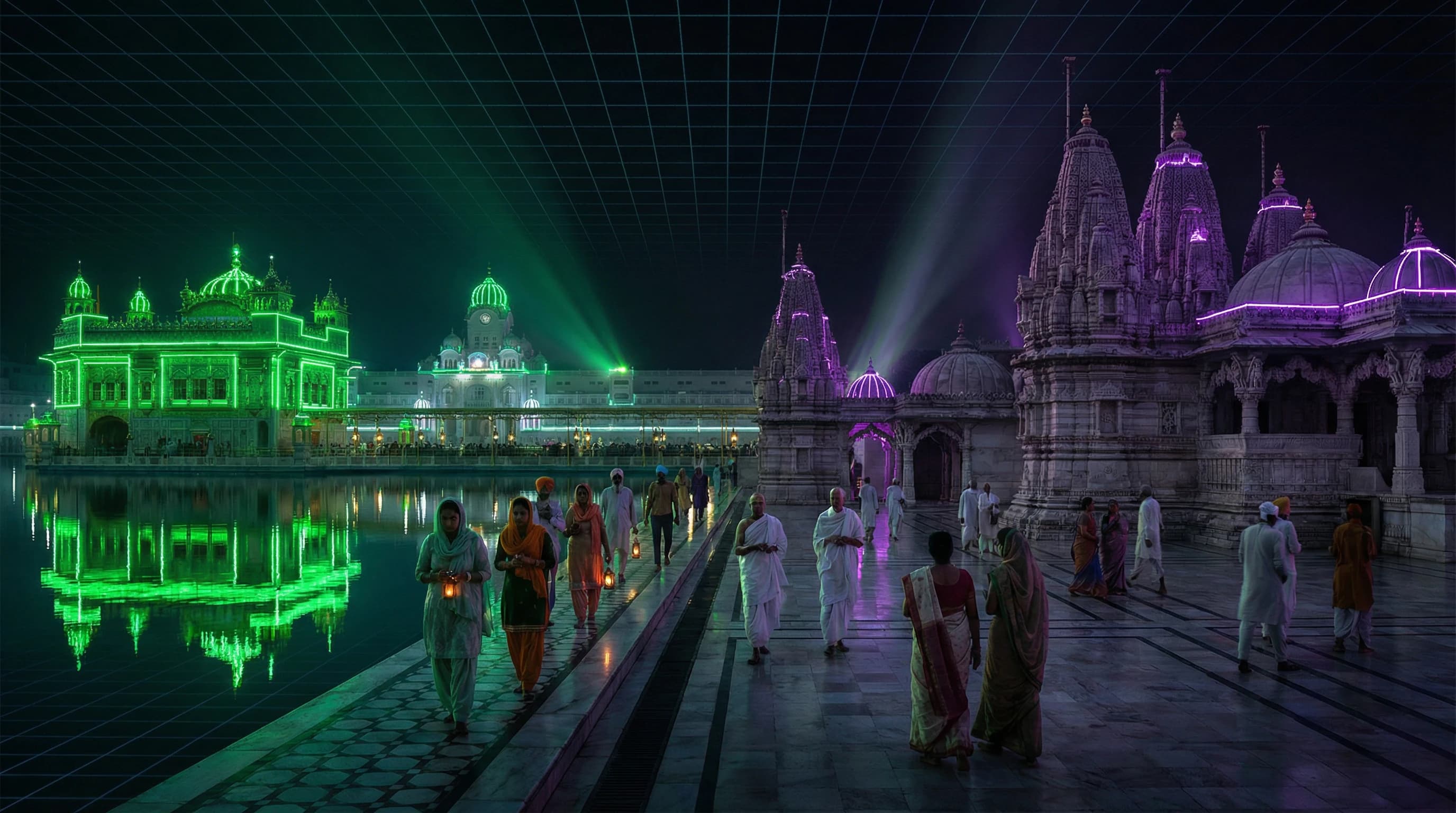
Sikhism and Jainism are two independent religions that emerged in India, built on ideas that were radical for their time: equality of all people, rejection of violence, and personal responsibility for one's spiritual path. Sikhism emphasizes monotheism 🧩 and service to society, while Jainism focuses on absolute non-violence (ahimsa) and ascetic discipline. Both traditions grew out of the Indian cultural context but created their own sacred texts, rituals, and ethical systems that distinguish them from Hinduism and Buddhism.
🛡️
Laplace Protocol: A scientific approach requires recognizing these religions as independent traditions rather than sects of Hinduism, acknowledging their unique doctrines while understanding the shared cultural context of India's dharmic religions.
Reference Protocol
Scientific Foundation
Evidence-based framework for critical analysis
Protocol: Evaluation
Test Yourself
Quizzes on this topic coming soon
⚡
Deep Dive
Historical Roots and Origins of Two Indian Traditions
The Emergence of Sikhism in Punjab
Sikhism is a monotheistic religion that emerged in Punjab as an independent tradition with its own sacred texts, practices, and theological system. It developed parallel to Hinduism, maintaining a distinct identity despite cultural connections.
Core characteristics: equality, service, devotion to one God. Sikhism occupies a unique place among Indian Dharmic religions, forming a distinctive synthesis within the region's specific historical context.
Ancient Origins of Jainism
Jainism is an ancient Indian religion emphasizing non-violence (ahimsa), asceticism, and spiritual independence. Like Sikhism, it developed within the Indian cultural context, forming an independent religious system.
| Aspect | Sikhism | Jainism |
|---|---|---|
| Origin | Punjab, late medieval period | Indian subcontinent, antiquity |
| Central Principle | Monotheism, equality | Non-violence, asceticism |
| Status | Indigenous Indian religion | Indigenous Indian religion |
India is the birthplace of several major world religions: Hinduism, Buddhism, Sikhism, and Jainism. Both traditions originated on the subcontinent and developed in close connection with the region's broader religious landscape, coexisting with introduced religions—Islam, Christianity, and Zoroastrianism.

Core Theological Principles of Two Traditions
Monotheism and Equality in Sikhism
Sikhism is built on monotheism—belief in one God. This significantly distinguishes it from the polytheistic aspects of Hinduism and aligns it more closely with Abrahamic traditions in belief structure.
Central values of the Sikh tradition: equality of all people, service to society, devotion to one God. This orientation forms a unique theological position among Dharmic religions.
Ahimsa and Jainism's Non-Theistic Approach
Jainism is distinguished by its particular emphasis on ahimsa—the principle of non-violence, which occupies a central place in religious practice and ethics. Unlike Sikhism's monotheism, Jainism adheres to a non-theistic approach.
Both religions emphasize ethical living and spiritual development, but Jainism makes the principle of non-violence an especially significant element of religious practice.
Theological Differences and Common Features
- Sikhism
- Monotheism, equality, service. Unique doctrines and organizational structures distinguish it from other Indian religions.
- Jainism
- Non-theism, ahimsa as central principle. Its own sacred scriptures and theological framework.
- Common Ground
- Focus on ethical behavior and spiritual perfection, connecting them to the Dharmic family of religions.
Each tradition possesses its own sacred scriptures, practices, and theological frameworks, confirming their status as independent religious systems. Religious identity plays a significant role in Indian demographics and politics, where Sikhism and Jainism occupy important, though numerically smaller, positions.
Place Within India's Dharmic Religious Family
Shared Philosophical Concepts with Hinduism and Buddhism
Sikhism and Jainism belong to the family of dharmic religions originating from India, alongside Hinduism and Buddhism. These traditions share philosophical concepts and cultural roots, coexisting within a unified religious landscape.
Hinduism remains the dominant force, establishing the "rules of the game" in interfaith relations. No denomination in the country has escaped Hindu influence, including Sikhism and Jainism, though both traditions maintain their own philosophical systems.
- Common concepts: karma, dharma, cyclical time, liberation (moksha/mukti)
- Indian origin and cultural context
- Distinction from Abrahamic religions in understanding the divine and salvation
Unique Doctrines and Distinctive Features
Sikhism and Jainism are independent religions with their own sacred texts, practices, and theological systems, not sects of Hinduism. Academic sources consistently treat them as separate denominations.
The monotheism of Sikhism and the non-theism of Jainism demonstrate radical diversity of theological positions even within a single dharmic family—these are not variations on a theme, but fundamentally different answers to the same question.
Despite their numerically smaller presence compared to Hinduism, Islam, or Christianity, both traditions have exerted significant cultural, philosophical, and social influence both within India and internationally.
Religious Practices and Rituals: From Gurdwaras to Jain Temples
Sikh Rituals and the Role of Gurdwaras in Community Life
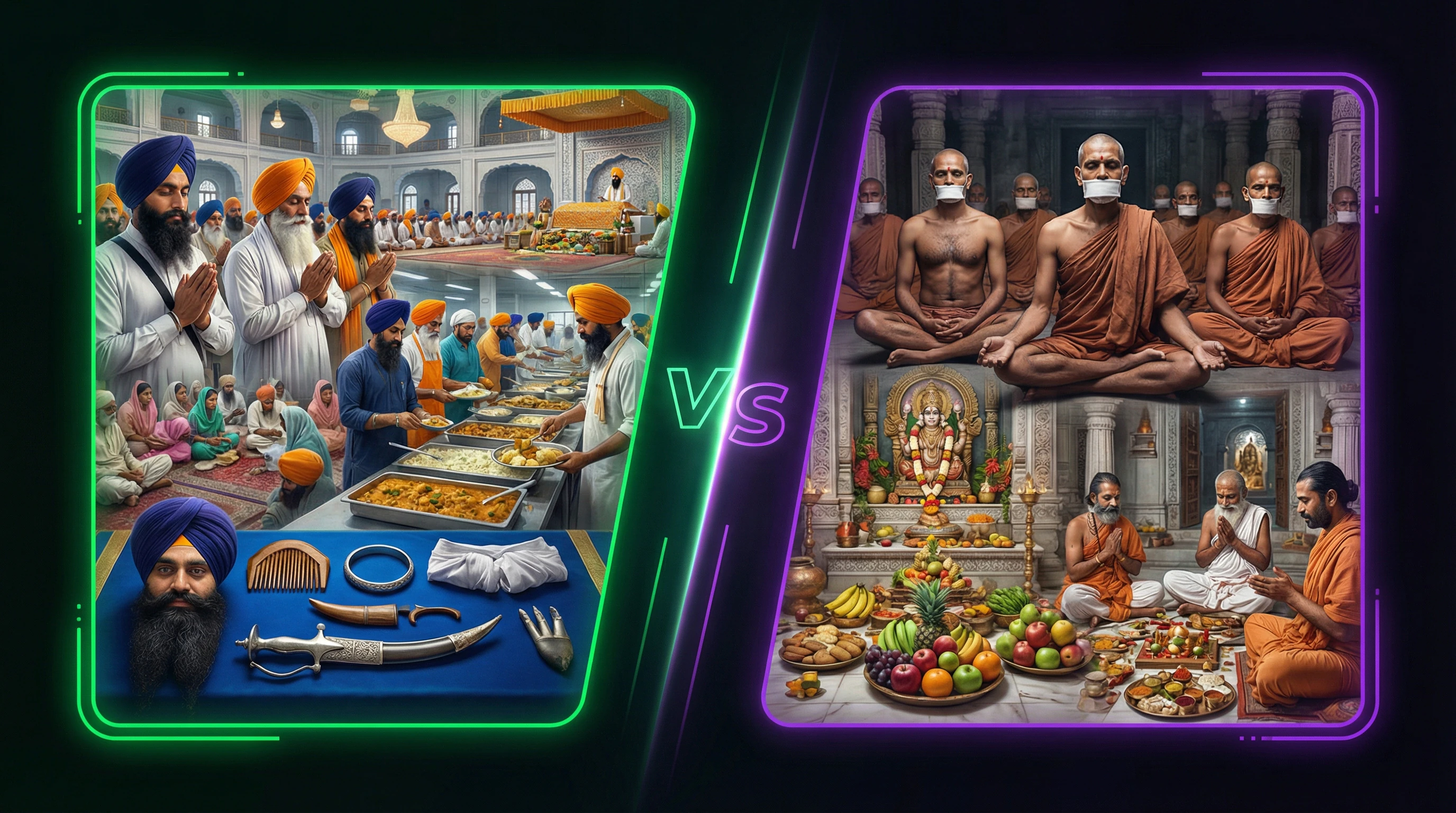
The gurdwara is not merely a temple, but a node of communal solidarity. Here Sikhism organizes religious life through two mechanisms: worship and social service.
Langar (free communal meal) embodies the principle of radical equality—open to all regardless of caste, religion, or status. This is not charity, but a structural rejection of hierarchy.
| Practice | Function | Meaning |
|---|---|---|
| Reading Guru Granth Sahib | Sacred scripture as eternal guru | Replacement of living teacher with text—democratization of access |
| Five Ks (uncut hair, turban, etc.) | Symbols of faith and collective identity | Visible marker of belonging and monotheistic devotion |
These practices strengthen collective identity and emphasize monotheistic devotion to one God—a distinction from polytheistic traditions.
Jain Ascetic Practices and Temple Architecture
Jainism builds religious life on ahimsa (non-violence) as its central principle. This is not merely ethics—it is a mechanism of spiritual development through maximum limitation of harm.
Monks and nuns follow extreme forms of self-restraint: renunciation of worldly goods, periodic fasting, careful avoidance of harm even to microscopic life forms. Jain temples are distinguished by exquisite architecture and sculptural depictions of tirthankaras—spiritual teachers who have achieved liberation.
Jainism's non-theistic approach focuses on individual spiritual development without the concept of a creator god. Tirthankaras are not gods, but exemplars of perfection achieved through one's own efforts.
Rituals include puja (worship), meditation, and regular reading of sacred texts. Each element serves one purpose: minimizing karmic pollution through action.
Sociopolitical Role in India: Between Majority and Minorities
Hinduism as Cultural Background
Hinduism establishes the cultural and social framework within which all other Indian faiths operate. Neither Sikhism nor Jainism has escaped this influence—it manifests in shared philosophical concepts, ritual practices, and social norms.
Indian dharmic religions coexist with imported traditions (Islam, Christianity, Zoroastrianism), creating a complex religious ecosystem. Smaller groups must navigate a space culturally defined by the Hindu majority.
Majority influence is not suppression but background-setting: shared cultural codes that all religious groups must acknowledge and reinterpret.
Demographics and Disproportionate Influence
Sikhs comprise about 2% of India's population but concentrate in Punjab, where they form a majority and control regional politics and economics. Jains represent less than 1% of the population but traditionally occupy key positions in business, education, and philanthropy.
| Religion | Population Share | Source of Influence |
|---|---|---|
| Sikhism | ~2% | Regional majority (Punjab), politics, economics |
| Jainism | <1% | Business, education, philanthropy |
Both traditions have made significant contributions to India's philosophical thought, arts, and social reforms. Their influence is determined not by numbers but by strategic positioning in key sectors of society.
Global Spread and Contemporary Adaptation Challenges
Diasporas and International Communities of Believers
Sikhism and Jainism, originating in India, now have followers worldwide. The Sikh diaspora is particularly visible in Canada, the United Kingdom, the United States, and Australia—where gurdwaras, cultural centers, and political structures operate.
The Jain diaspora is smaller in number but also present in these countries with temples, educational institutions, and charitable organizations. Globalization and migration have created a new context: traditional rituals and norms require adaptation to multicultural societies where both religions exist as minorities.
| Adaptation Challenge | Sikhism | Jainism |
|---|---|---|
| Identity and Symbols | Wearing turbans in countries with different cultural norms and security laws | Observing ahimsa in medicine, technology, ecology |
| Knowledge Transmission | Digital technologies, virtual communities, engaging younger generations | |
Both religions balance preserving traditional practices with adapting to secular, technologically advanced societies. This requires rethinking forms of religious knowledge transmission and reinterpreting principles in new contexts.

Knowledge Access Protocol
FAQ
Frequently Asked Questions
Sikhism is a distinct monotheistic religion, not a sect of Hinduism. The main difference: Sikhs believe in one God and reject the caste system, proclaiming the equality of all people. Despite sharing common cultural roots with Hinduism, Sikhism has its own sacred texts, temples (gurdwaras), and unique practices.
Ahimsa is the principle of absolute non-violence, central to Jainism. Jains strive not to harm any living beings, including insects and plants. This principle influences diet (strict vegetarianism), professions, and the daily behavior of followers.
Sikhism was founded in the late 15th century in the Punjab region (India) by Guru Nanak. The religion developed in the context of interaction between Hindu and Islamic cultures. Over five centuries, Sikhism has become one of the largest religions originating on the Indian subcontinent.
Jainism is a non-theistic, but not atheistic religion. Jains do not worship a creator god, but recognize spiritual teachers (tirthankaras) and believe in karma and rebirth. The emphasis is on personal spiritual development and liberation through asceticism and non-violence.
There are approximately 25-30 million Sikhs and 4-5 million Jains worldwide. The majority live in India, but significant diasporas exist in the United Kingdom, Canada, the United States, and other countries. Despite their relatively small numbers, both religions exert notable cultural and social influence.
Yes, some Jain monks wear cloth coverings over their mouths (muhpatti). This is done to prevent accidentally inhaling and killing small insects, which aligns with the principle of ahimsa. Jains may also sweep the road ahead with a soft broom to avoid stepping on living creatures.
To become a Sikh, one must accept belief in one God and the teachings of the ten Gurus. The formal initiation is called Amrit Sanchar—a ceremony during which a person accepts the five articles of faith (including the turban and kirpan). Sikhism is open to all, regardless of origin or caste.
The turban (dastar) is a religious symbol for Sikhs, covering uncut hair. Hair is considered a gift from God that should not be altered, and the turban symbolizes spirituality, honor, and equality. Wearing a turban is one of five mandatory practices for initiated Sikhs (Khalsa).
Dharmic religions are a family of Indian religions (Hinduism, Buddhism, Sikhism, Jainism) that share concepts of karma, dharma, and the cycle of rebirth. They originated on the Indian subcontinent and have common philosophical roots. However, each religion maintains unique doctrines and practices.
Many Jains avoid root vegetables (potatoes, carrots, onions) because extracting them kills the plant and microorganisms in the soil. This is part of strict adherence to ahimsa. The Jain diet is one of the most restrictive vegetarian dietary systems in the world.
A gurdwara is a Sikh temple, a place of worship and community gathering. Every gurdwara houses the sacred scripture Guru Granth Sahib and operates a langar—a free community kitchen for all visitors. Gurdwaras are open to people of all faiths, reflecting the principle of equality in Sikhism.
Jainism is considered one of the most ancient religions of India, with roots extending into prehistoric times. Mahavira, the 24th tirthankara of Jainism, was a contemporary of Buddha (6th-5th centuries BCE). Academic sources recognize Jainism as an independent ancient tradition that developed in parallel with other Indian religions.
Yes, Hinduism as the dominant religion of India establishes the cultural context for all religions in the country. No religious denomination in India has been able to avoid Hindu influence, including Sikhism and Jainism. This manifests in shared philosophical concepts, social practices, and interfaith relations.
Yes, the Jain canon is called the Agamas and includes the teachings of the tirthankaras. There are two main traditions with different versions of the texts: Digambaras and Svetambaras. These scriptures cover Jain philosophy, ethics, cosmology, and monastic rules.
Interfaith marriages between Sikhs and Jains are possible but rare due to differences in practices and traditions. Both religions have their own marriage ceremonies and family customs. In modern India, such marriages are becoming more common, especially in urban settings.
Yes, Jain monks practice strict asceticism, including prolonged fasting, meditation, and renunciation of worldly possessions. Digambara monks may even renounce clothing, symbolizing complete non-attachment. However, most lay Jains lead ordinary lives while observing basic principles of non-violence and vegetarianism.