Hinduism: The World's Oldest Religious and Philosophical Systemλ
A syncretic tradition with over a billion followers, uniting numerous schools, philosophical systems, and social practices across four millennia.
Overview
Hinduism is not a unified doctrine with central authority, but a syncretic system: 🧩 multiple schools, philosophical traditions, and social practices that have evolved over four millennia. Its roots trace back to the second millennium BCE, deeply integrated into the structure of Indian society—from the varna-caste system to legal and ethical norms. The world's third-largest religion (over one billion followers) transformed during the colonial period into neo-Hinduism, which today shapes India's national identity.
🛡️
Laplace Protocol: Hinduism is not a monolithic religion with a single doctrine. It is a complex of beliefs, practices, and philosophical systems that developed independently but are connected by the shared cultural and textual heritage of the Vedas. Understanding Hinduism requires recognizing its internal diversity and historical dynamics.
Reference Protocol
Scientific Foundation
Evidence-based framework for critical analysis
Protocol: Evaluation
Test Yourself
Quizzes on this topic coming soon
⚡
Deep Dive
Historical Roots and Development of Hinduism: From Vedic Origins to Modernity
Hinduism is one of the world's oldest religious traditions, with roots extending back to the second millennium BCE. Unlike Abrahamic religions, it has no single founder, central doctrine, or unified system of beliefs.
It is a syncretic system representing a comprehensive synthesis of the spiritual pursuits of Indian peoples over millennia. With over one billion adherents, Hinduism ranks third among the world's major religions.
The Vedic Period and Formation of Tradition
The foundation of Hinduism lies in the Vedas, the oldest sacred texts from the second millennium BCE. The Vedic period established the basis for metaphysical doctrines, ritual practices, and philosophical concepts that subsequently developed into numerous schools and traditions.
- The Vedas as a Knowledge System
- Not merely religious texts, but a comprehensive system encompassing cosmology, ethics, social norms, and ritual prescriptions. This determined the long-term resilience of the tradition.
Over the centuries, Hinduism evolved through interaction with various cultural and religious currents, including the period of Muslim conquests. Despite external influences, the tradition preserved its identity, demonstrating a capacity for adaptation and integration of new elements.
Colonial Transformation and Neo-Hinduism
The colonial period marked a radical transformation of Hinduism, leading to the emergence of neo-Hinduism—a modernized form of the tradition that asserted itself as a national religion and foundation of national identity.
This process dismantles the widespread myth of the tradition's purely spiritual nature: Hinduism became actively involved in India's political life, emerging as a response to the challenges of Western civilization and Christian missionary activity.
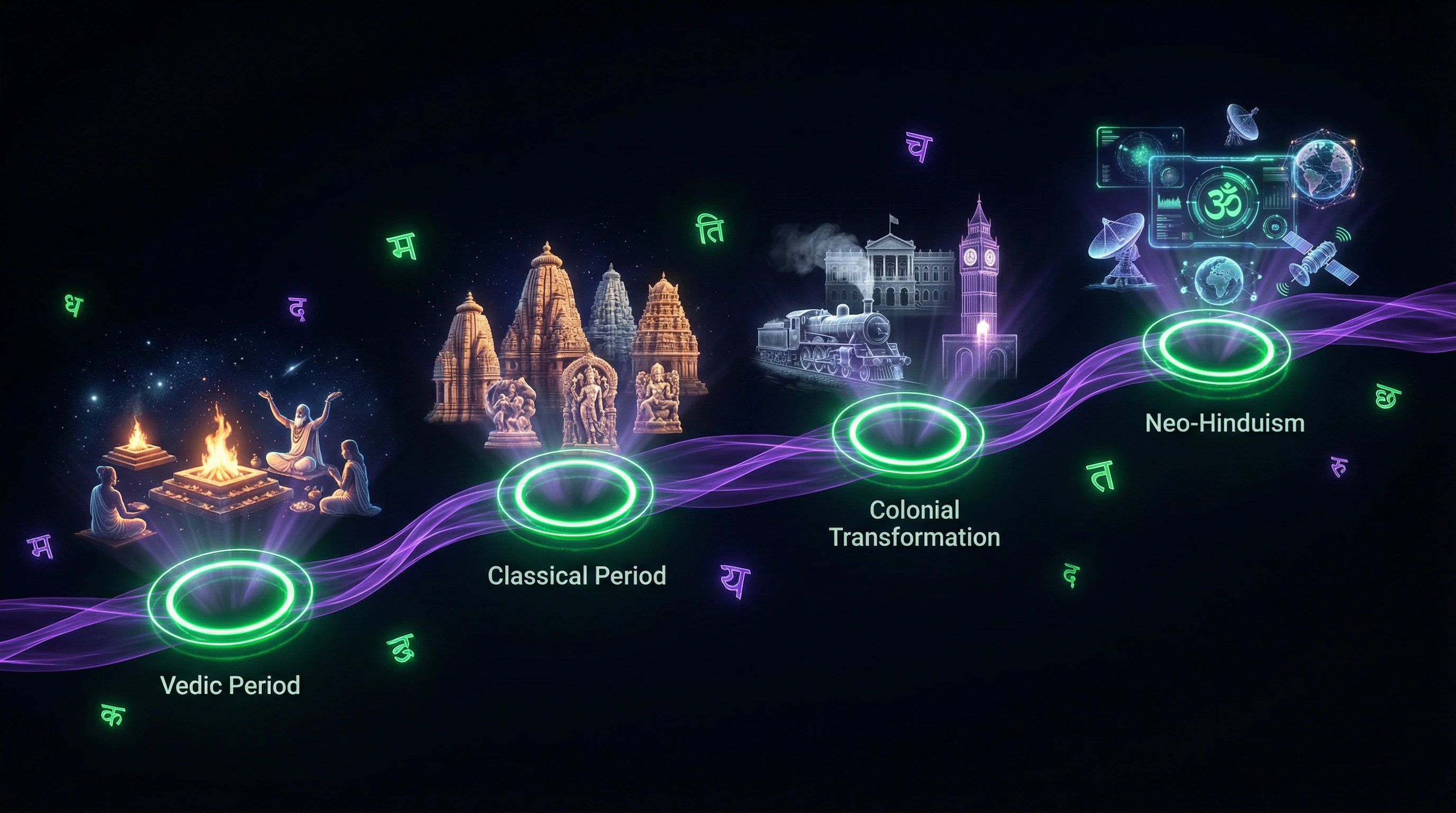
| Period | Character of Development | Key Mechanism |
|---|---|---|
| Vedic (2nd millennium BCE) | Formation of foundations | Codification of knowledge and rituals |
| Classical | Development of schools and philosophies | Integration of cultural currents |
| Colonial (18th–20th centuries) | Modernization and politicization | Reinterpretation in the context of nationalism |
The transformation during the colonial period demonstrates that Hinduism was not a static tradition, but constantly evolved, adapting to new socio-political realities. Contemporary Hinduism is the result of this prolonged evolution, combining ancient Vedic roots with modern interpretations.
Hinduism belongs to the family of Indian (Dharmic) religions, which share common philosophical foundations, though they developed along different trajectories.
Philosophical Foundations and Metaphysical Doctrines of Hinduism
The philosophical complexity of Hinduism lies in its multitude of schools and traditions, each with its own interpretation of metaphysics and paths to liberation. Hinduism unifies religious, mythological, legal, and ethical concepts into a coherent, though heterogeneous, worldview system.
This multiplicity refutes the misconception of uniformity in Hindu beliefs.
Multiplicity of Philosophical Schools
Hinduism encompasses numerous philosophical schools with their own epistemological frameworks and metaphysical concepts. They range from strictly monistic systems to dualistic and pluralistic interpretations of reality.
Some schools recognize the authority of the Vedas unconditionally, while others interpret them more freely or critically.
- Monistic systems (advaita) — unity of consciousness and reality
- Dualistic approaches (dvaita) — separation of the divine and material
- Pluralistic interpretations — multiplicity of independent entities
- Critical schools — reexamination of Vedic authority
The diversity of philosophical traditions reflects a fundamental characteristic of Hinduism as a complex of beliefs that has evolved over millennia. This is not a sign of weakness, but rather the richness of an intellectual tradition capable of accommodating different approaches to existence, knowledge, and liberation.
Concepts of Ultimate Reality and Being
A central element of Hindu metaphysics is the concept of ultimate reality, which various schools interpret differently. Metaphysical doctrines encompass the nature of reality, consciousness, causality, and the ultimate goal of human existence.
These doctrines are not abstract speculations — they are closely connected to practical paths of spiritual development and liberation.
Belief in sacred elements and ultimate principles permeates the entire Hindu tradition, manifesting in philosophical texts and ritual practices. Different schools offer different paths to comprehending ultimate reality: intellectual knowledge, meditation, devotional service, ritual actions.
This multilayered system of spiritual practices is accessible to people with different inclinations and abilities.
Sacred Texts and Textual Tradition of Hinduism
The textual tradition of Hinduism comprises a vast corpus of sacred scriptures spanning millennia of literary creation. These texts define the philosophy, ethics, social norms, and ritual practices of Hindu civilization.
The Vedas as Foundational Scriptures
The Vedas occupy a central position as the most ancient sacred texts of the second millennium BCE. They are considered shruti — "heard" revelation, transmitted to ancient sages in states of deep meditation.
| Veda | Purpose |
|---|---|
| Rigveda | Hymns and prayers |
| Samaveda | Melodies and chants |
| Yajurveda | Ritual formulas |
| Atharvaveda | Practical knowledge and magic |
The authority of the Vedas is recognized by most Hindu schools, though the degree of this recognition varies. The Vedas serve as a reference point for determining the orthodoxy of various teachings within the Hindu tradition.
Upanishads, Epics, and Puranas
Beyond the Vedas, the Hindu tradition includes the Upanishads — philosophical texts on the nature of reality and consciousness, the epics Mahabharata and Ramayana with narrative and ethical teachings, as well as the Puranas and extensive literature.
The Bhagavad Gita, part of the Mahabharata, synthesizes philosophical doctrines and practical paths of spiritual development, becoming one of the most influential texts of Hinduism.
These texts represent smriti — the "remembered" tradition, possessing less authority than the Vedas but playing an enormous role in everyday religious life.
The commentarial tradition developed over centuries, creating a multilayered system of interpretations. Different philosophical schools offered radically different readings of the same texts, demonstrating the intellectual vitality of the Hindu tradition.
Social Structure and the Varna-Caste System in Hinduism
Religious Justification of Social Hierarchy
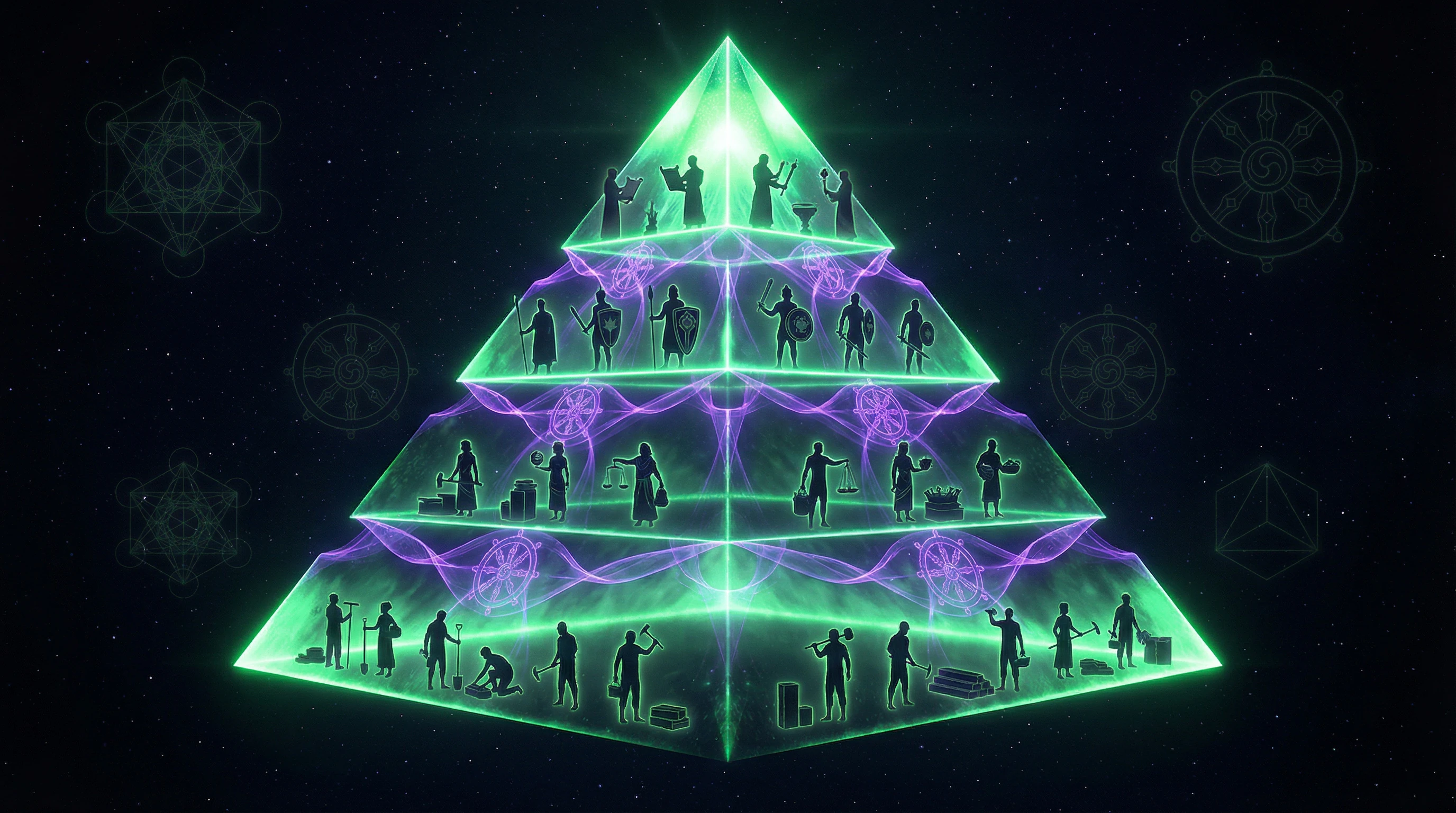
The varna-caste system is an integral part of Hindu religious practice and social organization. This hierarchy receives religious justification through the concept of dharma: a cosmic law according to which each person is born into a particular varna in accordance with the karma of previous incarnations.
| Varna | Social Role | Religious Privileges |
|---|---|---|
| Brahmins | Priests and teachers | Exclusive right to study the Vedas, perform sacrifices, receive gifts |
| Kshatriyas | Warriors and rulers | Protection of society, participation in rituals |
| Vaishyas | Merchants and farmers | Economic activity, support of rituals |
| Shudras | Servants | Service to higher varnas |
The Dharmashastras regulate in detail the duties of each varna, transforming social inequality into cosmic order. Brahmins consolidate their spiritual and social superiority through monopoly over sacred knowledge.
Hinduism integrates religious, mythological, legal, and ethical concepts into a unified social structure where a person's position is determined not by personal achievement but by birth.
Domestic Rituals and Community Practices
Domestic rituals (grihya-karma) constitute the fundamental level of Hindu religious life, often more significant for most believers than temple worship. The head of the household acts as the domestic priest, maintaining the sacred fire and making offerings to ancestors (shraddha).
- Daily offerings to household deities
- Samskaras — life-cycle rituals from conception to death
- Seasonal ceremonies connected to the agricultural calendar
- Maintaining connection with ancestral lineage through rituals
Community practices vary depending on region, caste, and tradition, creating a mosaic of local religious cultures. Village temples and shrines to local deities often play a more important role in daily life than the great pan-Asian deities like Vishnu or Shiva.
The decentralized structure of religious practice explains why Hinduism is better understood as a complex of beliefs developed over millennia rather than as a single unified religion.
Ritual Practices and Religious Life
Temple and Household Ceremonies
Puja — the central form of worship in temples — is built on the concept of the deity as an honored guest. Sixteen upacharas (services) span the entire day: awakening the deity in the morning, offerings of food, clothing, incense and flowers, putting to bed in the evening.
Temple priests (typically Brahmins) follow agamas — texts regulating worship, architecture and iconography. Devotees participate in darshan — visual contact with the deity, which is considered a form of blessing and spiritual communion.
| Practice Level | Context | Complexity |
|---|---|---|
| Temple puja | Professional worship | Full ritual cycle, agamic prescriptions |
| Household puja | Family practice | Simplified version, adapted to daily life |
| Samskaras | Rites of passage | Detailed structure in grihya-sutras |
Household ceremonies parallel temple worship but are adapted to the family context. Daily puja before the home altar, reading of sacred texts and repetition of mantras form the foundation of personal practice.
Samskaras — rites of passage — mark key life moments: namakarana (naming ceremony), upanayana (initiation for twice-born varnas), vivaha (wedding) and antyeshti (funeral rites). Each has a detailed ritual structure codified in the grihya-sutras.
Pilgrimages and Festivals
Pilgrimage (tirtha-yatra) to sacred sites is a key form of religious practice. Devotees accumulate spiritual merit and purify themselves of sins through bathing in sacred rivers, especially the Ganges.
The seven sacred cities (Varanasi, Haridwar, Ayodhya, Mathura, Dwarka, Kanchipuram and Ujjain) and the four sites of Kumbh Mela form a geographic network of holiness, linking all of India into a unified sacred space. Pilgrimages are often undertaken during astrologically auspicious periods, when the spiritual efficacy of rituals is considered maximal.
Religious festivals follow the lunar calendar and vary by region, reflecting the decentralized nature of Hinduism. Diwali (festival of lights), Holi (festival of colors), Navaratri (nine nights of the goddess) and Janmashtami (birth of Krishna) are pan-Indian celebrations, but their specific forms and mythological emphases differ locally.
Festivals combine temple ceremonies, household rituals, community processions and theatrical performances of mythological narratives. These cyclical celebrations structure religious time and reinforce communal identity through collective participation in ritual.
Hinduism in the Modern World and Its Transformations
Political Role in Contemporary India
The colonial period radically transformed Hinduism: it was established as the national religion and foundation of national tradition, leading to the emergence of neo-Hinduism.
Religious identity in modern India intertwines with nationalism. The Hindutva movement seeks to define Indian national identity through the lens of Hindu culture, creating tension in a multi-confessional society.
Political parties, especially the Bharatiya Janata Party (BJP), transform religion into an instrument of political struggle, using Hindu symbolism and rhetoric to mobilize the electorate.
Reform movements of the 19th–20th centuries—Brahmo Samaj and Arya Samaj—sought to modernize Hinduism, criticizing the caste system, idolatry, and social prejudices.
These reforms met resistance from traditionalists, creating internal tension between modernization and preservation of tradition. Contemporary Hinduism is a dynamic field where different interpretations of what it means to be Hindu coexist and compete.
Globalization and Diaspora
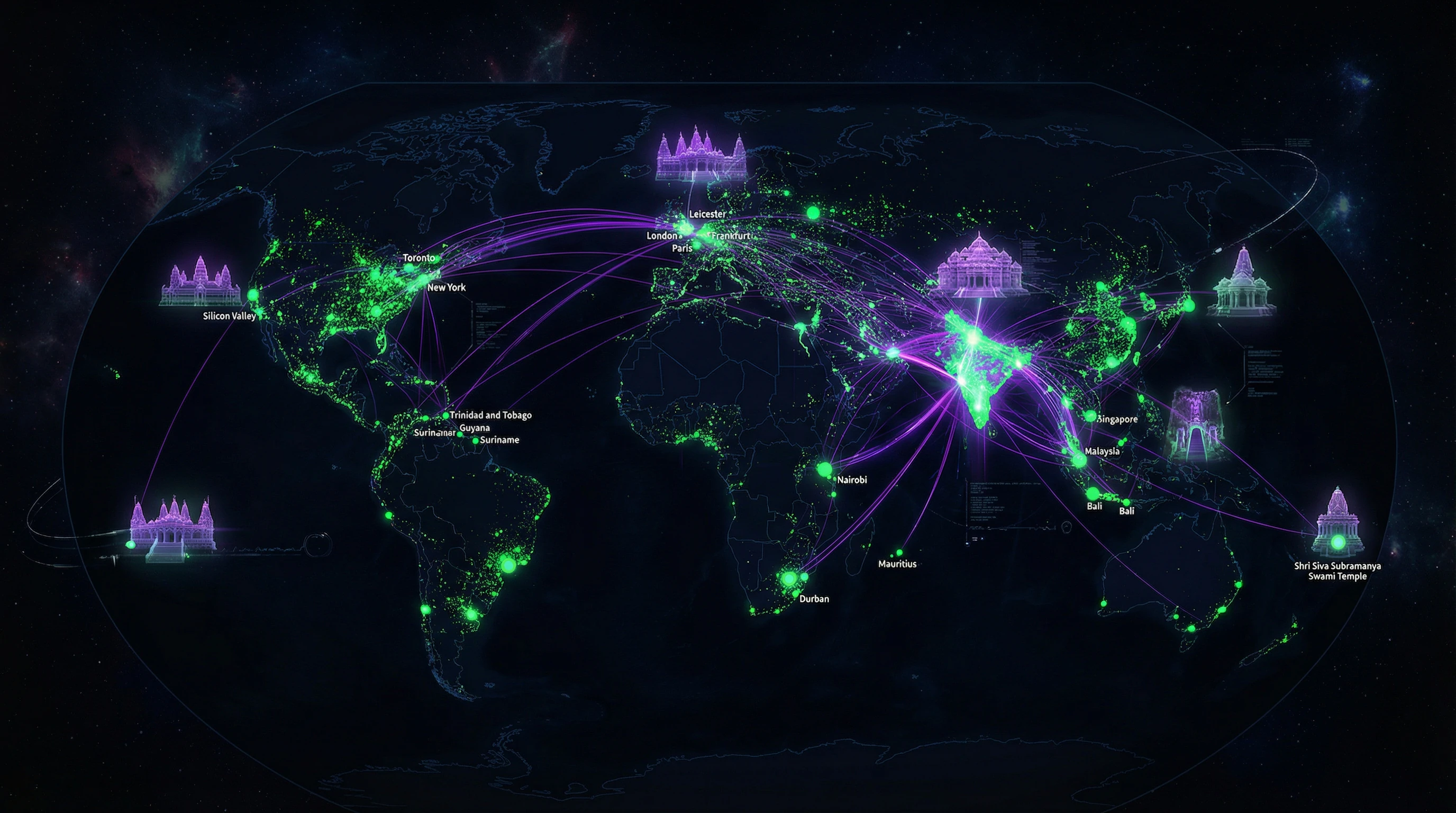
Hinduism has become the third-largest world religion with over one billion followers, spreading far beyond the Indian subcontinent.
- The Hindu diaspora in North America, Europe, Africa, and Southeast Asia creates new forms of religious practice adapted to multicultural contexts.
- Diaspora temples function as cultural centers, preserving religious, linguistic, culinary, and artistic traditions.
- Globalization popularizes Hindu practices—yoga and meditation, which are often separated from their religious context and presented as universal wellness techniques.
Digital technologies have radically changed the methods of transmission and practice of Hinduism, creating virtual communities and online rituals.
Internet platforms offer access to sacred texts, guru lectures, and virtual darshans, democratizing religious knowledge previously controlled by the Brahmin elite.
Globalization raises the question of authenticity: who has the right to define what constitutes "real" Hinduism in conditions of multiple interpretations and practices.
The dynamic between tradition and innovation, local and global, continues to shape Hinduism as a living, evolving religious system.
Knowledge Access Protocol
FAQ
Frequently Asked Questions
Hinduism is the ancient religious and philosophical system of India, with over 1 billion followers worldwide. It is the third-largest religion, originating in the 2nd millennium BCE and representing a synthesis of numerous spiritual traditions. Hinduism has no single founder or centralized doctrine, making it unique among world religions.
The foundation of Hinduism consists of the Vedas—the most ancient sacred texts, dating to the 2nd millennium BCE. Beyond the Vedas, essential scriptures include the Upanishads (philosophical treatises), the epics "Mahabharata" and "Ramayana," and the Puranas. This extensive textual tradition forms the religious, philosophical, and ethical basis of Hinduism.
The varna-caste system is a hierarchical social structure religiously justified by Hinduism that divides society into groups by birth. The system includes four main varnas (Brahmins, Kshatriyas, Vaishyas, Shudras) and numerous castes. This structure is deeply integrated into religious practice and the social organization of Indian society.
No, this is a common misconception. Hinduism encompasses a vast array of different philosophical schools and traditions with their own practices and beliefs. It is more a complex of beliefs developed over millennia than a unified religion. Diversity of approaches is one of the key characteristics of Hinduism.
No, Hinduism has constantly evolved throughout history. Particularly significant transformations occurred during the colonial period, when Neo-Hinduism emerged—a modernized form of the tradition. Hinduism demonstrates remarkable ability to adapt to changing social and political conditions while maintaining connection to its ancient roots.
No, Hinduism cannot be reduced to spirituality alone. It integrates religious, mythological, legal, ethical, and social dimensions of life. Hinduism is inseparably linked to social structures such as the caste system and actively participates in India's political life.
Begin by reading adapted translations of core texts—the "Bhagavad Gita" and selected Upanishads. Study basic concepts: karma, dharma, moksha, and reincarnation. Familiarize yourself with the principal deities (Brahma, Vishnu, Shiva) and their roles in different Hindu traditions.
Hinduism includes domestic rituals (puja at home altars) and temple ceremonies conducted by Brahmin priests. Pilgrimages to sacred sites, celebration of religious festivals (Diwali, Holi), and life-cycle rituals (samskaras) play important roles. Ritual practice varies depending on region, caste, and philosophical school.
Focus on the concept of dharma—fulfilling your duty with integrity and responsibility. Practice meditation and yoga for spiritual development. Cultivate detachment from the results of actions (as taught in the "Bhagavad Gita"), striving to act rightly regardless of consequences.
Neo-Hinduism is a modernized form of Hinduism that emerged during the colonial period as a response to Western influence. It emphasizes universal spiritual values, national identity, and social reforms. Neo-Hinduism actively participates in political life and adapts the tradition to contemporary realities while maintaining connection to Vedic heritage.
Hinduism encompasses six classical philosophical schools (darshanas): Nyaya, Vaisheshika, Samkhya, Yoga, Mimamsa, and Vedanta. Each school offers its own epistemology and metaphysics while acknowledging the authority of the Vedas. Vedanta, particularly Advaita Vedanta, has become the most influential, asserting the non-dual nature of reality.
Hinduism remains the foundation of national identity and actively participates in the political life of contemporary India. It influences legislation, social policy, and interfaith relations. Hindu nationalism (Hindutva) has become a significant political force, shaping public discourse and state policy.
No, this is a myth. Hinduism has no single founder, unlike Christianity, Islam, or Buddhism. It developed organically over millennia as a synthesis of beliefs and practices from various peoples of India. This characteristic makes Hinduism unique among world religions.
There is no single concept—Hinduism offers multiple approaches ranging from monotheism to polytheism and pantheism. Some traditions worship a personal God (Vishnu, Shiva), while others focus on an impersonal absolute (Brahman). Advaita Vedanta asserts non-duality, where the individual soul (atman) is identical with ultimate reality.
Hinduism traditionally demonstrates a pluralistic approach, recognizing multiple paths to truth. The concept that "all religions lead to the same goal" is characteristic of neo-Hinduism. However, in modern India there exists tension between religious tolerance and Hindu nationalism, creating a complex picture of interfaith relations.
Traditionally, Hinduism is a religion of birth, connected to caste affiliation, which complicates formal conversion. However, some modern movements (such as the International Society for Krishna Consciousness) accept followers of any background. The question of conversion remains debatable and depends on the specific tradition and interpretation.