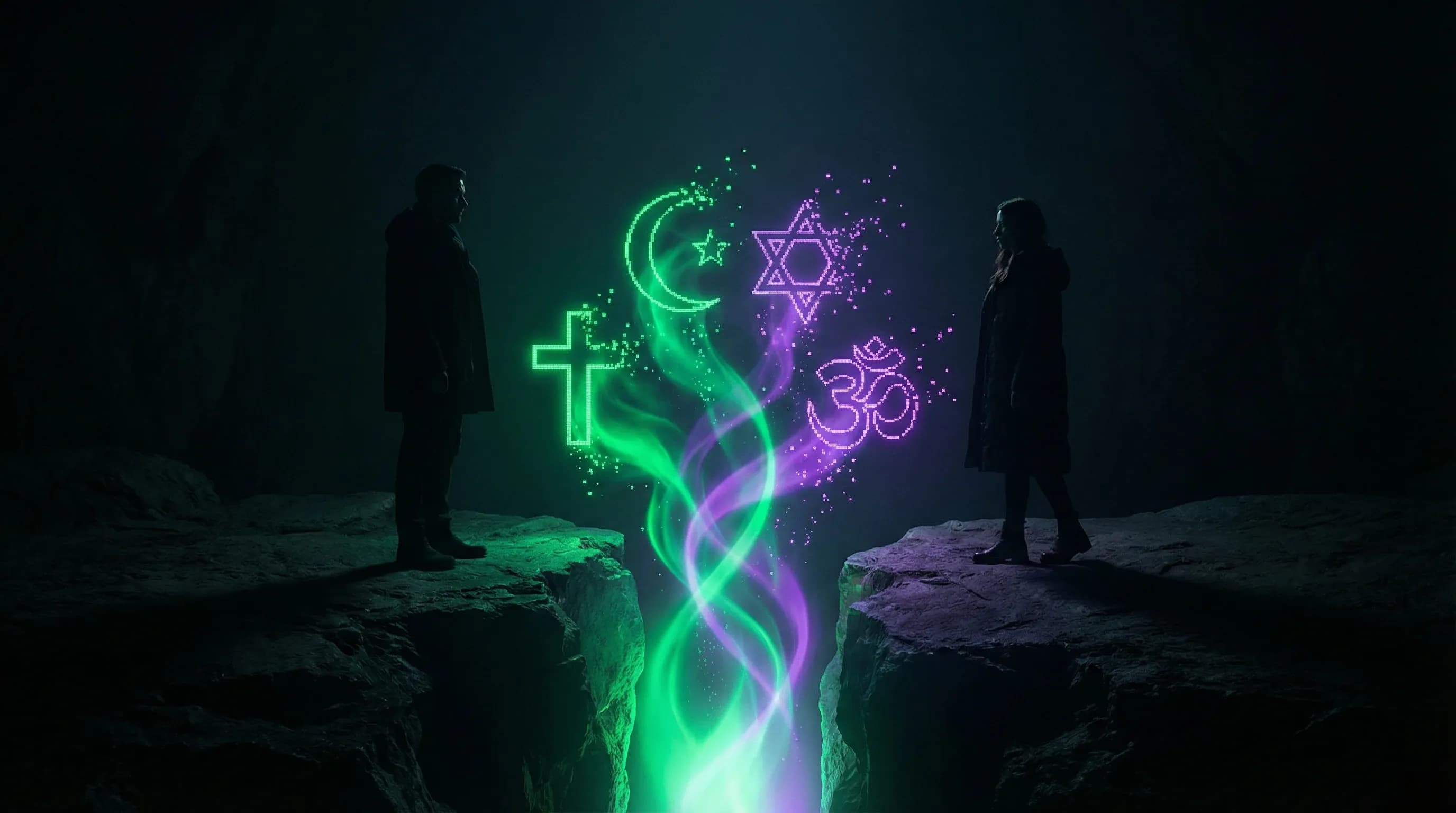
What is discursive ethics and why it fails with religious beliefs: defining the problem space
Discursive ethics, developed by Jürgen Habermas and Karl-Otto Apel, proceeds from the assumption that moral norms can be justified through rational dialogue between equal participants. According to this model, the legitimacy of any claim depends on its ability to withstand critical examination in an ideal speech situation, where all participants have equal access to argumentation and strive toward consensus (S011).
The project of rational ethics treats discourse as an instrument for achieving universal agreement. More details in the section Judaism.
- Universalization
- Any norm must be acceptable to all affected parties under conditions of rational consideration of consequences.
- Discourse principle
- The legitimacy of a norm is determined through a procedure of reasoned discussion.
- Ideal speech situation
- All participants have equal opportunities to advance and critique arguments, without coercion or manipulation (S011).
This model assumes that truth and correctness can be achieved through rational consensus. However, religious faith operates differently.
⚠️ Why religious beliefs fall outside this framework
Religious faith by its epistemological nature does not conform to the requirements of discursive ethics. First, it does not require rational verification—faith without proof is its essential characteristic. As noted in the ontology of dialogue, "it is precisely about faith without faithfulness, faith without works, that it is said 'even the demons believe, and tremble'" (S012)—faith is not reducible to intellectual assent to propositions.
Religious beliefs often appeal to the authority of revelation, tradition, or personal experience, which by definition cannot be subjected to intersubjective verification. The very idea of consensus as the goal of dialogue is alien to religious discourse, where truth is given in advance and not subject to revision through discussion.
🧩 Implicit sociality and the paradox of universality
The concept of "implicit sociality"—the presupposed possibility of creating a "good" society—reveals problems inherent to the idea of universal consensus (S001). If agreement is assumed in advance as a condition for the possibility of dialogue, then religious communities proceeding from incompatible ontological premises are excluded from the space of rational discourse.
| Mode of thinking | Source of truth | Possibility of revision |
|---|---|---|
| Discursive ethics | Rational consensus | Yes, through dialogue |
| Religious faith | Revelation, tradition, experience | No, truth is given in advance |
The paradox is that discursive ethics, claiming universality, cannot incorporate those forms of thinking that do not recognize its basic principles. The problem is not the "irrationality" of believers, but the structural incompatibility of epistemological regimes. This difference is not a defect to be corrected, but a fundamental feature to be understood.
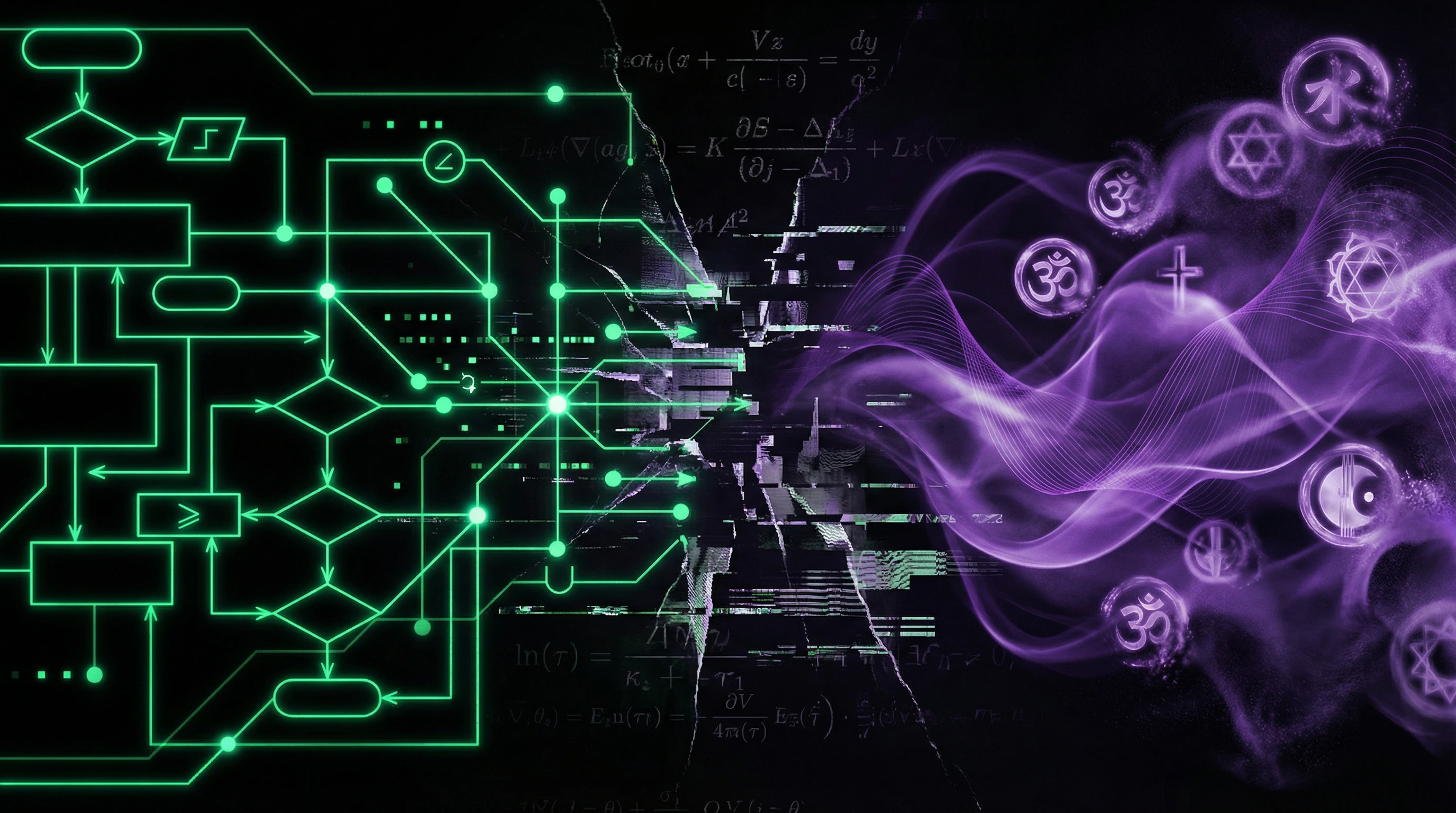
Steel Man: Seven Strongest Arguments for the Impossibility of Rational Dialogue About Faith
Before criticizing the position that rational religious dialogue is impossible, we must present it in its most convincing form. This is not a straw man, but a steel man — the strongest possible version of the argument that deserves serious consideration. For more details, see the section on Neopaganism.
🧠 The Argument from Epistemological Incommensurability
Religious and scientific-rational thinking operate with incommensurable criteria of truth. For rational discourse, truth is determined by correspondence to empirical data, logical consistency, and intersubjective verifiability. For religious faith, truth is determined by revelation, the authority of sacred texts, personal spiritual experience, or tradition.
These criteria are not merely different — they mutually exclude each other. Attempts to apply rational criteria to religious claims are perceived by believers as a category error, similar to attempting to measure the beauty of a poem in pounds. Communication requires common grounds for evaluating statements (S008), which do not exist in this case.
- Rational criterion: empirical verifiability and logical consistency
- Religious criterion: revelation, textual authority, personal experience, tradition
- Result: incommensurability of foundations, impossibility of common language
⚠️ The Argument from Faith's Defense Mechanisms
Religious belief systems have evolutionarily developed powerful defense mechanisms against rational criticism. The concept of "trial of faith" transforms any doubt into a virtue rather than a problem. The idea of "divine mystery" makes incomprehensibility not a deficiency but a merit of the teaching. The principle of "faith above reason" directly declares the priority of the irrational over the rational.
Any attempt at rational dialogue encounters built-in defenses that interpret criticism as confirmation of faith's correctness: temptation by the devil, trial from God, machinations of enemies of truth.
These mechanisms are not accidental — they are functionally necessary for preserving religious identity in the face of rational challenge.
🧬 The Argument from Cognitive Architecture
Neurocognitive research shows that religious beliefs are processed by the brain differently than factual claims about the world. They are connected to systems of emotional regulation, social identity, and existential meaning, rather than to systems of logical inference.
Attempting to change religious belief through rational argumentation is like trying to cure depression with syllogisms — the tool does not match the nature of the problem. Religious faith is rooted in deep structures of self-identification, and its transformation requires not logical arguments but personality transformation at the level of basic values and life narratives.
🕳️ The Argument from Faith's Social Function
Religious beliefs fulfill critically important social functions: they provide group identity, moral coordination, existential comfort, and social solidarity. Rational criticism of religion is perceived not as an intellectual exercise but as a threat to the social fabric of the community.
Dialogue about faith in an intercultural context requires recognition of these functions and cannot be reduced to an exchange of propositional statements (S009). Attempting to rationalize faith means destroying its social effectiveness — religion works precisely because it does not require rational foundations.
🧩 The Argument from Asymmetry of Burden of Proof
In rational discourse, the burden of proof lies with whoever makes a positive claim. However, religious faith does not perceive itself as a hypothesis requiring proof — it perceives itself as a basic given, a self-evident truth, or revelation.
The demand for proof is perceived as a misunderstanding of faith's nature. On the other hand, an atheist or skeptic also cannot "prove" the absence of God in a sense that would satisfy a believer. An asymmetry arises: each side demands proof from the other according to its own criteria, which the other side does not recognize as legitimate.
⚠️ The Argument from Historical Ineffectiveness
The history of religious disputes demonstrates the striking ineffectiveness of rational argumentation in changing religious beliefs. Millennia of theological debates have not led to consensus even on basic questions.
Religious schisms occur not from lack of arguments but from differences in interpretation of authorities, personal experience, or socio-political factors. If rational dialogue were effective, we would observe convergence of religious views. Instead we see persistent diversity of incompatible systems.
This testifies that rationality is not the determining factor in the formation of religious beliefs. Compare logical fallacies in religious arguments and the mechanisms of their persistence.
🔁 The Argument from the Hermeneutic Circle
Interpretation of religious texts and experience always occurs within a hermeneutic circle: we understand parts through the whole and the whole through parts, but the whole itself is given by preliminary understanding, which is determined by our tradition and faith.
A believer and non-believer read the same text but see different things in it because their pre-understanding differs. Rational dialogue presupposes the possibility of stepping outside this circle to a neutral position, but such a position does not exist — any interpretation is already laden with presuppositions. The ontology of dialogue recognizes that understanding is always contextual and cannot be fully explicated in rational terms (S012).
- Hermeneutic Circle
- The cyclical structure of understanding, where parts are interpreted through the whole and the whole through parts; preliminary understanding determines interpretation, which then confirms or modifies that understanding.
- Pre-understanding (Vorverständnis)
- Implicit presuppositions, traditions, and beliefs that a believer brings to text interpretation; cannot be fully eliminated by rational criticism.
- Neutral Position
- A fictitious viewpoint free from all presuppositions; does not actually exist, as any observer is already within a particular horizon of understanding.
Empirical Verification: What Research Says About the Possibility of Interfaith and Religious-Secular Dialogue
Despite theoretical arguments about the impossibility of rational dialogue about faith, there exists extensive practice of interfaith and intercultural dialogue. Research shows: rational debate about religious truth is impossible, but dialogue about living together works. More details in the section Hinduism.
📊 Interfaith Dialogue Programs: When They Work, When They Don't
UNESCO implements intercultural dialogue programs aimed at tolerance and integration (S001). Key point: these programs do not aim for consensus on questions of religious truth.
Instead, they focus on practical aspects: migration, economic integration, education. Effective dialogue is possible when it concerns living together, not truth.
Rational debate about religious truth is impossible, but dialogue about living together is possible—provided participants recognize the legitimacy of differences.
🧪 Communication in Digital Environments: Echo Chambers and Structured Dialogue
Contemporary research shows: in online spaces, religious disputes become more aggressive and polarized than offline (S005). Causes include anonymity, absence of nonverbal cues, algorithmic filtering.
However, structured formats with moderation and clear rules reduce toxicity and increase mutual understanding—even if beliefs don't change. This points to a distinction between goals: changing faith is impossible, but improving communication quality is real.
| Dialogue Condition | Outcome |
|---|---|
| No moderation, anonymity | Polarization, aggression, echo chambers |
| Structured format, moderator | Reduced toxicity, increased mutual understanding |
| Focus on practical problems | Possibility of cooperation without consensus |
🔬 Multidimensional Assessment: Emotion, Society, Practice, Meaning
The success of dialogue cannot be evaluated solely by the criterion of rational argumentation (S002). Multiple dimensions must be considered simultaneously.
- Emotional Dimension
- Empathy, respect, recognition of the other's dignity. Can develop even amid doctrinal disagreements.
- Social Dimension
- Group identity, status relations, recognition of equality. Often blocks dialogue if one side feels marginalized.
- Pragmatic Dimension
- Achievement of practical goals: joint problem-solving on ecology, justice, education. Here dialogue is most effective.
- Existential Dimension
- Search for meaning, authenticity, spiritual experience. Often remains incommensurable between traditions, but can be a subject of mutual interest.
Dialogue can be successful on some dimensions and unsuccessful on others. Participants may not reach agreement on doctrines, but develop mutual respect and capacity for cooperation.
🧾 Rethinking the Ethics of Discourse: From Consensus to Justice
Contemporary philosophy abandons the idea of universal consensus as a realistic goal (S003). Instead, it focuses on procedural aspects of fair dialogue: equal access to speech, protection from manipulation, recognition of multiple rationalities.
The ethics of discourse is reconceived not as a method for achieving truth, but as a critique of power structures that block communication. The goal is not to convince the believer of the wrongness of their faith, but to ensure conditions where no one can impose beliefs through coercion.
Fair dialogue is not a search for truth, but protection from manipulation and ensuring equal opportunities for expression.
📊 Conditions for Successful Dialogue: Practical Conclusions
Research shows: successful interaction between representatives of different religious traditions is possible when certain conditions are met (S004).
- Recognition of the legitimacy of differences—not an attempt to reduce everything to a common denominator, but respect for incommensurability.
- Focus on practical problems requiring joint solutions: ecology, social justice, education.
- Creation of institutional frameworks for dialogue that protect participants from pressure and ensure equal opportunities.
- Explicit separation of goals: not changing faith, but improving mutual understanding and capacity for cooperation.
Such dialogue does not lead to convergence of religious views, but reduces conflict and increases capacity for joint action. This is not an ideal, but it works.

Mechanisms and Causality: Why Rational Arguments Don't Change Religious Beliefs
Religious beliefs are not formed through rational inference from data, but through a complex of cognitive mechanisms operating at a pre-reflective level. Understanding this architecture explains why logic is powerless here. More details in the section Sources and Evidence.
🧬 Neurocognitive Foundations of Religious Belief
Four mechanisms operate automatically: hyperactive agency detection (we see intentions where none exist), teleological thinking (we seek purpose in natural processes), dualistic intuition (separation of mind and body), moral intuition (innate feelings later rationalized through religious narratives).
Attempting to change religious belief through argumentation is like trying to change an optical illusion through explanation—even understanding the mechanism, we continue to see the illusion. These systems do not submit to conscious control.
🔁 Motivated Cognition and Identity Protection
Religious beliefs are not isolated ideas, but the core of personal and group identity. Changing them means transforming the entire system of self-understanding, social connections, and life meanings.
Motivated cognition is especially strong here: people actively seek ways to protect beliefs from threat, rather than passively evaluating arguments. This is not irrationality—it's a rational strategy for protecting psychological integrity.
⚠️ Backfire Effect: When Arguments Strengthen Beliefs
| Scenario | Mechanism | Result |
|---|---|---|
| Presenting counter-facts | Perceived as identity threat | Defense mechanisms activate |
| Person generates counter-arguments | Searches for weaknesses in criticism | Strengthens original belief |
| Criticism of religion | Interpreted as spiritual test | Faith becomes stronger |
Paradox: facts contradicting deeply held beliefs often don't weaken but strengthen them. The person successfully "deflects the attack" and becomes more entrenched—the effect is especially strong with religious beliefs, where any criticism can be reinterpreted.
🧩 Confirmation Bias and Selective Attention
Believers and non-believers, encountering the same facts, notice different aspects, interpret them differently, remember different details.
- Believers notice "miraculous" coincidences, ignore unanswered prayers
- Non-believers notice contradictions in texts, ignore positive social effects
- Both sincerely consider themselves objective, unaware of systematic bias
Confirmation bias—the tendency to seek, interpret, and remember information confirming existing beliefs—makes rational dialogue about faith extremely difficult. This is not a lack of education, but a fundamental property of information processing connected to identity. To understand how logical fallacies work in religious arguments, one must account for this architecture, rather than hoping for the power of logic.
Conflicts and Uncertainties: Where Sources Diverge and Why It Matters
Analysis of sources reveals several areas where significant disagreements exist regarding the possibility and desirability of rational dialogue about faith. For more details, see the Reality Check section.
⚠️ Universalism vs. Particularism in Dialogue Ethics
Habermasian discourse ethics proceeds from universalist premises: there exist universal principles of rationality that should be recognized by all dialogue participants. However, postcolonial and multicultural critiques point out that the very idea of universal rationality is a product of Western philosophical tradition and cannot claim neutrality (S001).
Non-Western cultures may have alternative conceptions of rationality, dialogue, and truth that are no less legitimate. Attempting to impose the Western model of discursive ethics as universal constitutes a form of epistemological violence.
| Position | Premise | Consequence |
|---|---|---|
| Universalism | Unified standards of rationality for all | Religious faith outside rational discourse |
| Particularism | Multiplicity of rationalities and truths | Common criteria for evaluating arguments are lost |
🧩 Consensus as Goal vs. Consensus as Illusion
Classical discourse ethics views consensus as a regulative idea and goal of rational dialogue (S001). However, critics argue that the idea of universal consensus is not only unattainable but also undesirable—it suppresses legitimate diversity and can serve as an instrument of domination.
Attempting to create a "good" society through rational consensus can lead to totalitarian consequences. The goal of dialogue is not achieving agreement, but maintaining space for disagreement where different positions can coexist without violence.
This radically changes the criteria for dialogue success. Instead of asking "did we reach agreement?" the question becomes "did we preserve mutual recognition amid disagreement?" (S005).
🔀 Dialogue as Tool vs. Dialogue as Theater
Research on scientific consensus and its attacks shows that interfaith dialogue often becomes theater, where each side reproduces pre-prepared positions (S002). Participants don't listen to each other but wait for their turn to speak.
Alternative: dialogue as joint exploration of uncertainty, where both sides are willing to reconsider their own premises. But this requires psychological readiness that is rarely found in the context of deeply held beliefs.
- Dialogue-as-theater: positions fixed, goal is winning the argument
- Dialogue-as-inquiry: positions open, goal is understanding mechanisms of conviction
- Dialogue-as-coexistence: positions acknowledged as incompatible, goal is peaceful sharing of space
📍 Practical Significance of Divergences
These divergences are not academic. They determine how we design educational programs, interfaith councils, and integration policies. If we believe in universal rationality, we will demand that religious communities accept secular standards of argumentation and logical criteria.
If we recognize multiplicity of rationalities, we risk losing a common language for discussing human rights, scientific facts, and justice. The solution is not choosing one position, but recognizing that each dialogue model works in specific contexts and has its own costs (S004).