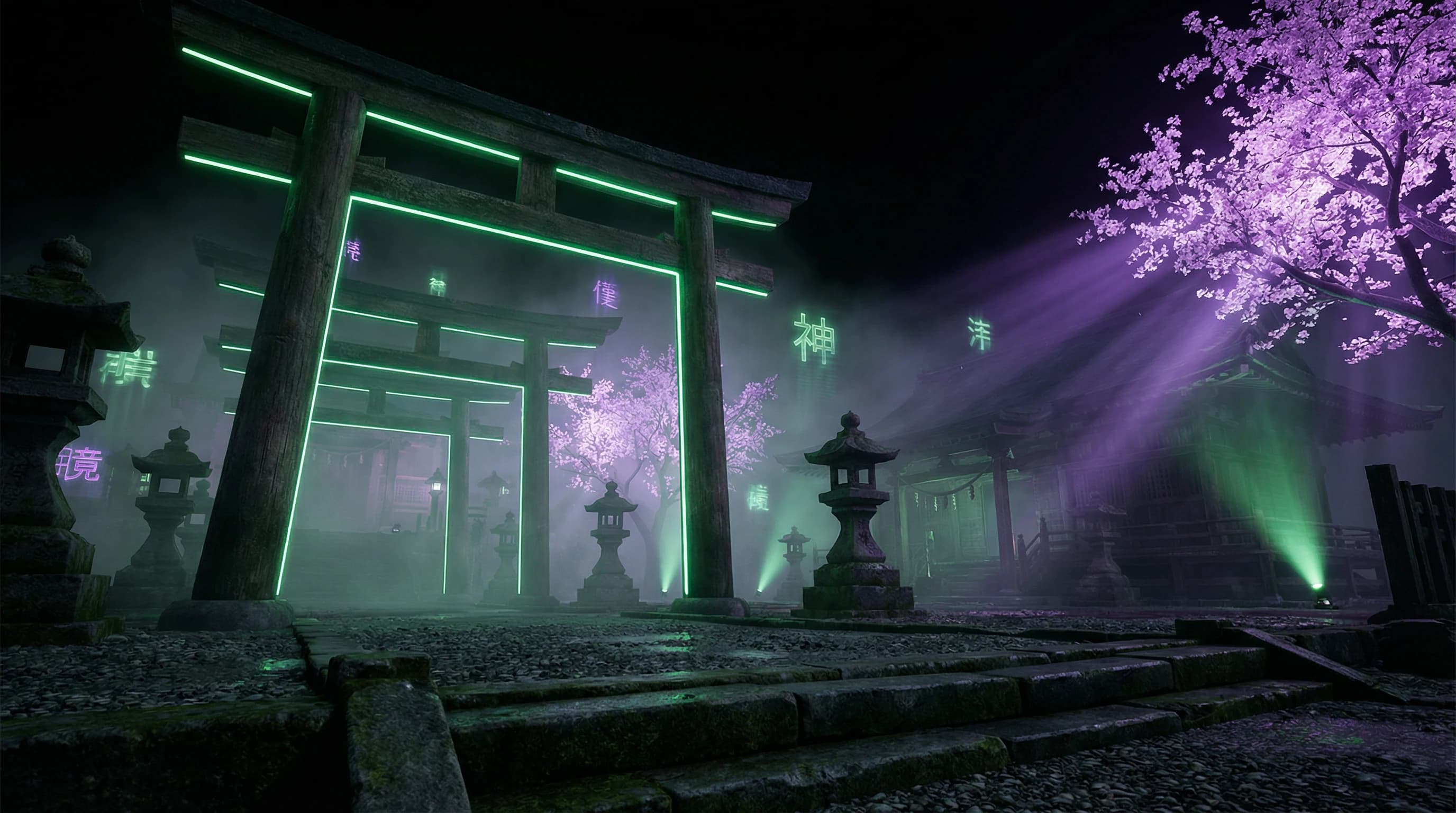
Shintoism: Ancient Religion of Japan and the Way of the Godsλ
An exploration of Japan's traditional polytheistic religion, rooted in animistic beliefs, syncretism with Buddhism, and profound influence on Japanese culture and mindset.
Overview
Shinto (神道, "the way of the gods") is Japan's indigenous polytheistic religion, rooted in the animistic beliefs of ancient Japanese people. Until the 1945 surrender, academic study was strictly taboo 🧩: postwar research revealed a religion without fixed dogma, deeply intertwined with Buddhism and Japanese identity. Shinto continues to shape the nation's mentality—from shrine rituals to everyday practices.
🛡️
Laplace Protocol: This material is based on academic sources from the postwar period, when scientific study of Shinto became possible after the lifting of political restrictions. Special attention is given to historiographical aspects, Shinto-Buddhist syncretism, and religious experience in the context of Japanese culture.
Reference Protocol
Scientific Foundation
Evidence-based framework for critical analysis
Protocol: Evaluation
Test Yourself
Quizzes on this topic coming soon
⚡
Deep Dive
The Historiography of Shinto: How Centuries of Academic Silence Distorted Understanding of the Religion
Shinto (神道, Shintō) — Japan's ancient polytheistic religion, literally meaning "the way of the gods" — remained closed to serious scholarly analysis until Japan's surrender in 1945. Before the end of World War II, academic study of Shinto was under the strictest taboo, creating a unique situation in the history of religious studies: one of the world's oldest living religious traditions had virtually no scholarly historiography.
This restriction was tied to the politicization of Shinto in the form of State Shinto, which was used as the national ideology of militarist Japan.
The Pre-1945 Research Taboo and Its Consequences
The ban on academic research into Shinto had catastrophic consequences for understanding the religion both within Japan and beyond its borders. State Shinto transformed an ancient animistic tradition into an instrument of political propaganda, while any critical reflection or attempt at historical analysis was viewed as undermining national foundations.
Researchers were forced either to reproduce the official ideological line or to avoid the topic of Shinto entirely in their work. This academic silence created an information vacuum that was filled with mythologized notions of the "pure" Japanese spirit and the exceptionalism of the Shinto tradition.
After 1945, researchers faced the necessity of essentially starting the study of Shinto from scratch, applying the methodology of modern religious studies to a tradition that had developed for millennia without critical examination. The postwar period became the time of genuine scholarly discovery of Shinto.
Postwar Development of Scholarly Research and Contemporary Challenges
Postwar historiography of Shinto developed under the necessity of deconstructing the ideological layers of State Shinto and returning to authentic forms of religious practice. Japanese and Western researchers began applying comparative-historical methods, anthropological approaches, and textual analysis to the study of Shinto sources.
| Period | Approach to Shinto | Primary Challenge |
|---|---|---|
| Before 1945 | Ideological (State Shinto) | Taboo on critical analysis |
| 1945–1970s | Deconstruction and reexamination | Separating myth from reality |
| 1980s–present | Interdisciplinary analysis | Syncretism with Buddhism |
Despite the "Japan boom" of recent decades, knowledge about Shinto outside Japan remains fragmentary and superficial. In the United States and other countries, Shinto is often perceived through the lens of popular culture — anime, manga, video games — which creates a distorted view of a complex religious-philosophical system.
Contemporary researchers face the methodological challenge of separating "pure" Shinto from Buddhist influences, which is extremely difficult due to centuries of syncretism. This problem remains central to understanding the authentic nature of the Shinto tradition.

The Concept of Kami: Spiritual Entities Between Nature and Culture
Kami (神) is the central concept of Shinto, with no exact equivalent in Western religious systems. These are spiritual entities that can be natural phenomena, ancestors, sacred objects, or abstract forces.
Unlike the monotheistic understanding of deity as a transcendent creator, kami are immanent in the world and multiple: their number is traditionally defined as "eight million," symbolizing infinity. This concept reflects the animistic foundations of Shinto, rooted in ancient Japanese beliefs about the ensoulment of all nature.
- Kami
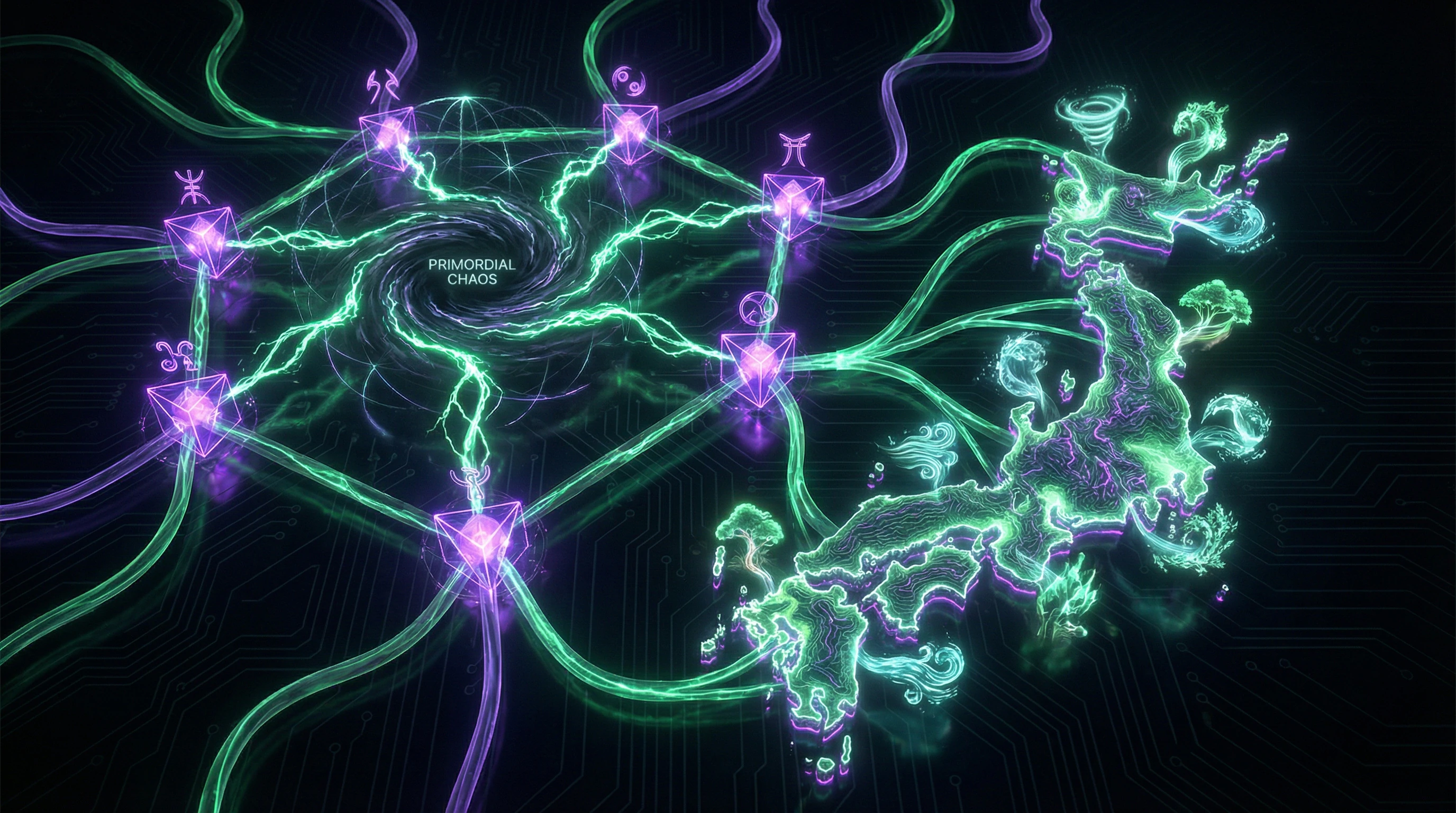
- Spiritual entities with limited spheres of influence, which can be benevolent or dangerous. They differ from Western deities: not omnipotent, not omniscient, not creating from nothing, but ordering primordial chaos.
- Cosmogonic Hierarchy
- Begins with the celestial creator deities Izanagi and Izanami (recorded in the Kojiki, 712 CE, and Nihon Shoki, 720 CE) and descends to local spirits of specific places.
The Nature of Spiritual Entities in Shinto Cosmology
The religious experience of interacting with kami is based on psychotechniques: ritual purification (misogi), meditative practices, altered states of consciousness. Shinto mystical experiences are oriented toward direct sensory perception of the presence of kami in natural objects, rather than transcendent union with the absolute.
Shinto is a unique laboratory for studying animistic consciousness: its phenomenology of religious experience differs from Buddhist and Christian mystical states through specific sensuality and immanence of the sacred.
Kami as Natural Phenomena and Ancestors: The Duality of the Sacred
The Shinto concept of kami unites two types of spiritual entities: nature kami (yao-yorozu-no kami) and ancestral kami (ujigami). Nature kami embody the forces and objects of nature—mountains, rivers, trees, stones, wind—and their veneration reflects the ecological consciousness of ancient Japanese, for whom nature was a living community of spiritual beings.
Ancestral kami connect the living with deceased members of a lineage or clan, creating continuity across generations and legitimizing social structure through sacred kinship.
- A sacred tree by the roadside—a potential dwelling place of kami
- An unusually shaped stone—requires respect and ritual attention
- A mountain waterfall—embodiment of spiritual power
- Kami do not exist in a separate supernatural realm but permeate everyday life
This duality of kami—simultaneously natural and social—explains the deep integration of Shinto into Japanese cultural identity. The concept continues to influence ecological practices and attitudes toward nature in contemporary Japan, despite urbanization and secularization of society.
Shinto-Buddhist Syncretism: A Millennium of Religious Symbiosis
Shinto-Buddhist syncretism (shinbutsu-shūgō) is a phenomenon where the animistic polytheism of Shinto and the philosophical system of Buddhism not only coexisted but mutually enriched each other for over a thousand years. The process began with the introduction of Buddhism to Japan in the 6th century and reached its peak during the Heian period (794–1185).
The key theory of this period was honji-suijaku: Shinto kami were viewed as local manifestations (suijaku) of universal Buddhist deities (honji). The syncretism was so profound that until the forced separation during the Meiji period (1868–1912), most Japanese did not draw a clear boundary between Shinto and Buddhist practices.
The two religions did not layer mechanically—they created new semantic spaces where kami received Buddhist names and Buddhist sutras were recited before Shinto altars.
Formation of Syncretism in the Heian Period: Theological Innovations
Buddhist monks developed complex theological systems integrating kami into Buddhist cosmology. The Tendai school created the concept of "sannō-shintō" (mountain king Shinto), where the kami of Mount Hiei were identified with Buddhist protectors of the dharma.
The Shingon school developed "ryōbu-shintō" (dual Shinto), linking kami with the mandalas of esoteric Buddhism. These systems were original theological syntheses, not simple overlays of one religion onto another.
| Level of Syncretism | Manifestation |
|---|---|
| Doctrinal | Theories of honji-suijaku, sannō-shintō, ryōbu-shintō |
| Institutional | Jingū-ji complexes (shrine + temple on shared grounds) |
| Ritual | Buddhist sutras before Shinto altars, purification rituals in Buddhist ceremonies |
This period created the cultural foundation upon which Japanese religiosity exists to this day, despite attempts at artificial separation in the modern era.
Prospects for Syncretism in Contemporary Japan
After the forced separation during the Meiji period and the discrediting of State Shinto following World War II, Shinto-Buddhist syncretism acquired a new form. Contemporary Japanese demonstrate a pragmatic approach: they participate in Shinto rituals (birth, weddings, New Year visits) and Buddhist ceremonies (funerals, ancestor veneration) without seeing any contradiction.
This phenomenon—"dual religious affiliation"—effectively continues the syncretic tradition at the level of individual practice.
Shinto never had fixed dogma in the Western sense, making it particularly adaptable to changing cultural contexts.
Academic discussions are divided: some see the degradation of a profound tradition into superficial "religious consumerism," while others see the natural evolution of syncretism under conditions of secular society. Prospects in the 21st century are tied not to a return to medieval forms, but to developing new ways of integrating traditional religiosity into a globalized world, where Japanese cultural identity continues to be shaped through the interaction of these two traditions.
Cosmogonic Myths and Sacred Texts of Shinto
Kojiki and Nihon Shoki as Primary Sources
The "Kojiki" (712 CE) and "Nihon Shoki" (720 CE) — the two oldest written monuments of Japanese culture — form the foundation of Shinto mythology. Both texts were created during the formation of a centralized state and served a dual purpose: preserving ancient myths and legitimizing imperial authority through divine ancestry.
The "Kojiki" uses Chinese characters adapted for the Japanese language, creating interpretive difficulties. The "Nihon Shoki" is written in classical Chinese and presents a more systematized account. Critical analysis of these texts became possible only after 1945, when restrictions on their scholarly study were lifted.
| Parameter | Kojiki | Nihon Shoki |
|---|---|---|
| Date of Creation | 712 CE | 720 CE |
| Language | Adapted characters for Japanese | Classical Chinese |
| Structure | Narrative, mythological | Systematized, chronicle-based |
Interpretation of Mythological Narratives
Cosmogonic myths describe the origin of the world through the interaction of divine pairs — Izanagi and Izanami create the Japanese islands and give birth to numerous kami. Shinto myths do not contain the concept of absolute creation ex nihilo (as in Abrahamic religions), but rather describe the ordering of primordial chaos.
Postwar research has shown that mythological narratives were significantly influenced by continental traditions — Daoism and Confucianism. This confirms the syncretic nature of Shinto from the earliest stages of written documentation.
Contemporary academic interpretation goes beyond literal reading, examining myths as reflections of ancient conceptions of cosmic order, the cyclicality of life and death, and the interconnection between the natural and the sacred.
Psychotechnique and Mystical Experience in Shinto
Religious Practices and Rituals
Shinto ritual practice is built on purification (misogi) and establishing connection with kami through ceremonial actions: offerings, prayers (norito), and sacred dances (kagura).
Psychotechnical aspects include meditative practices for achieving the state of "mushin" (absence of thoughts) and direct experience of the divine presence in natural phenomena.
| Practice Level | Form | Function |
|---|---|---|
| Shrine-based | Formal ceremonies, pilgrimages | Collective experience, seasonal matsuri |
| Household | Veneration of kamidana (home altars) | Daily connection with kami |
| Integrated | Everyday actions, aesthetic practices | Sacralization of the mundane |
A key feature of Shinto psychotechnique is the absence of dualism between the physical and spiritual. Physical movements, verbal formulas, and internal states of consciousness form an inseparable unity.
Characteristics of Shinto Religious Experience
Mystical experience in Shinto is the experience of the direct presence of kami in natural objects and phenomena, which distinguishes it from the transcendent mysticism of other religious traditions.
A specific feature of Shinto experience is the sensation of "kagayaki" (radiance, divine light) that arises upon contact with sacred places. Believers describe this as a mixture of awe, joy, and tranquility.
Shinto religiosity does not require faith in a dogmatic sense, but presupposes cultivating sensitivity to the sacred dimension of everyday reality through regular participation in rituals.
Shinto experience is closely connected with aesthetic perception of nature: admiring cherry blossoms (hanami), moon viewing (tsukimi). This blurs the boundaries between religious, aesthetic, and everyday experience.
The Role of Shinto in Contemporary Japanese Society
Influence on Cultural Identity and Mentality
Shinto remains the foundation of Japanese cultural identity, shaping attitudes toward nature, community, and tradition even among those who do not consider themselves religious in the Western sense. The concept of "wa" (harmony) — central to the Japanese mentality — is rooted in the Shinto worldview, where balance and interconnection of all cosmic elements are viewed as the basis of proper existence.
Shinto notions of purity and pollution influence everyday practices: from purification rituals before entering a shrine to modern hygiene standards in public spaces. Shinto functions not as an institutional religion with clear membership boundaries, but as a cultural matrix defining basic patterns of perception and behavior.
The phenomenon of "religious consumerism": Japanese people freely participate in Shinto and Buddhist rituals depending on life context, seeing no contradiction in this.
Shinto in the Context of Japan's Modernization
Since the Meiji era (1868–1912), Shinto has demonstrated a unique ability to adapt to changing social conditions while maintaining cultural significance. After defeat in World War II and the separation of Shinto from the state, the religion transformed from an instrument of political ideology into an element of cultural heritage and personal spirituality.
Paradox: this transformation strengthened Shinto's influence on Japanese daily life. Modern Shinto shrines utilize digital technologies — online prayers, virtual amulets, pilgrimage tracking apps — demonstrating the tradition's flexibility amid technological revolution.
| Challenge | Adaptation Mechanism |
|---|---|
| Globalization and urbanization | Digitization of rituals, online services |
| Declining religiosity among youth | Positioning as cultural heritage rather than mandatory belief |
| Loss of state support | Strengthening role in personal spirituality and cultural identity |
Academic discussions focus on a key question: will Shinto maintain relevance amid globalization, or transform into cultural tourism and nostalgic aesthetics. The answer depends on how flexibly the tradition is reinterpreted by each generation of Japanese.
Knowledge Access Protocol
FAQ
Frequently Asked Questions
Shinto is the traditional Japanese religion based on belief in nature spirits (kami) and ancestor veneration. It's a polytheistic tradition without strict dogmas, deeply integrated into Japanese culture. Shinto emerged from ancient animistic beliefs and continues to influence the Japanese mentality.
Kami are spiritual entities or deities in Shinto that can be natural phenomena, ancestors, or sacred objects. They are not omnipotent gods in the Western sense, but rather spirits inhabiting the world. The concept of kami reflects the animistic foundation of Shinto.
Academic study of Shinto was taboo until Japan's surrender in 1945 due to the politicization of the religion as state ideology. State Shinto was used to reinforce nationalism and militarism. After the war, objective scientific research on this religion became possible.
Shinto is a polytheistic religion with animistic roots, focusing on kami and ritual purity, while Buddhism is a teaching about enlightenment and liberation from suffering. However, in Japan these religions exist in syncretism since the Heian period (794-1185). Many Japanese practice both traditions simultaneously.
No, this is a myth. Shinto has always been syncretic, absorbing elements from continental teachings, especially Buddhism. The religion evolved significantly, particularly through interaction with Buddhism and politicization as State Shinto. A 'pure' Shinto in the historical sense never existed.
The main texts of Shinto are the Kojiki (Records of Ancient Matters) and Nihon Shoki (Chronicles of Japan), containing cosmogonic myths and history. However, Shinto does not have a single scripture in the Western sense. These texts are important for understanding mythological narratives and cultural identity.
Shinto profoundly influences Japanese cultural identity and mentality, shaping attitudes toward nature, ancestors, and rituals. Many Japanese visit Shinto shrines for life events (birth, marriage), even without considering themselves religious. The religion remains relevant in the context of Japan's modernization.
Theoretically yes, but Shinto is closely tied to Japanese ethnic and cultural identity, creating barriers for foreigners. The religion has no missionary tradition and focuses on local kami and ancestors. Understanding Shinto practices requires deep immersion in Japanese culture.
This is the historical fusion of Shinto and Buddhism in Japan, particularly developed during the Heian period (794-1185). Both religions coexisted, mutually influencing each other in rituals, philosophy, and practices. Syncretism remains a characteristic feature of Japanese religiosity to this day.
Core practices include purification rituals (misogi), offerings to kami, prayers (norito), and shrine visits (jinja). Religious experience in Shinto is connected to mystical experiences and psychotechniques. Rituals aim to maintain harmony with the spiritual world and nature.
No, this is a misconception. Despite the recent "Japanese boom," knowledge about Shinto remains limited in the United States and other countries. Academic research only became possible after 1945. The difficulty of separating Shinto from Buddhist influences complicates the study.
After 1945, objective scientific research became possible, free from state ideology. Scholars were able to critically analyze texts, study syncretism, and examine religious experience. This led to a reconceptualization of Shinto's role in Japanese history and culture.
No, Shinto does not have a fixed dogma in the Western sense. The religion is characterized by flexibility, diversity of local practices, and syncretism. The absence of centralized doctrine allowed Shinto to adapt to various historical conditions.
Syncretism continues to exist in contemporary Japan, although secularization affects religious practices. Many Japanese combine Shinto and Buddhist rituals in everyday life. The future of syncretism depends on the ability of religions to adapt to the challenges of modernization.
According to the Kojiki and Nihon Shoki, the world was created by the deities Izanagi and Izanami, who gave birth to the Japanese islands and numerous kami. The myths describe the origin of the imperial dynasty from the sun goddess Amaterasu. Interpretation of these narratives has evolved in academic research.
Shinto experience focuses on direct interaction with kami through rituals and mystical experiences, rather than on meditation or prayer in the Western sense. Psychotechniques are aimed at achieving ritual purity and harmony with nature. This distinguishes Shinto from Buddhist and Abrahamic traditions.