Two Philosophies of One Path: Daoism and Confucianismλ
An exploration of ancient China's complementary traditions that shaped culture, ethics, and spirituality across millennia
Overview
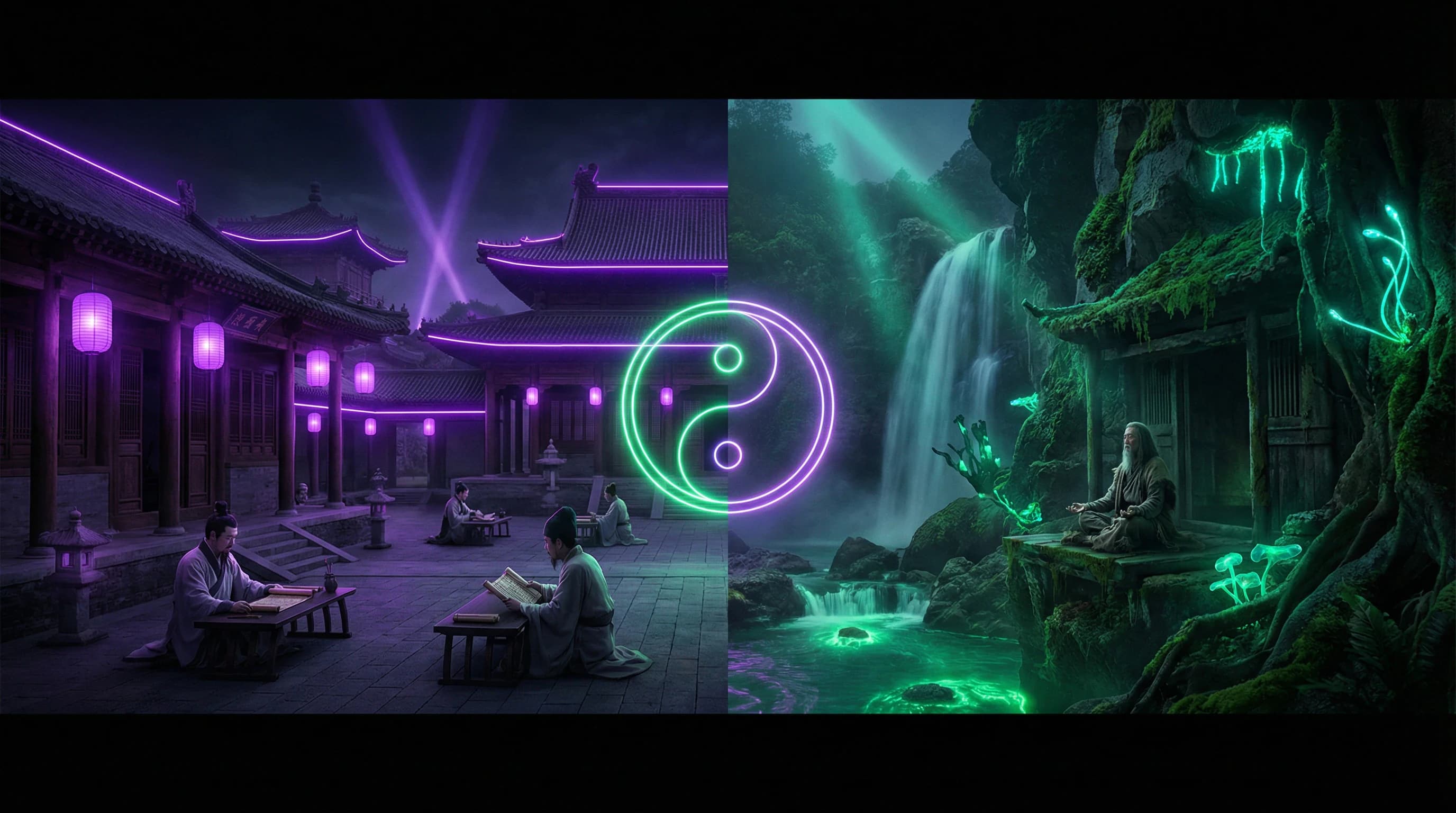
Daoism and Confucianism are two philosophical systems of ancient China (5th–3rd centuries BCE) that historically complemented each other: Confucianism regulated social life and state governance, while Daoism offered a path of personal spiritual cultivation and harmony with nature. Both use the concept of Dao (道) — "the Way" — but interpret it differently: 🧩 Daoists see it as a natural cosmic principle of spontaneity, while Confucians view it as a moral path of proper social conduct. Together with Buddhism, they form the "Three Teachings" (三教), which have shaped Chinese civilization for millennia and continue to influence contemporary East Asian culture.
🛡️
Laplace Protocol: This material is based on academic research by Russian and international sinologists (2014-2026), including comparative analysis of primary sources — the "Dao De Jing," "Zhuangzi," "Analects," and contemporary scholarly interpretations of these traditions.
Reference Protocol
Scientific Foundation
Evidence-based framework for critical analysis
Protocol: Evaluation
Test Yourself
Quizzes on this topic coming soon
⚡
Deep Dive
Historical Roots and Founding Traditions: Two Paths of Ancient China
Daoism and Confucianism emerged during the Warring States period (5th–3rd centuries BCE), when the collapse of a unified state sparked an intellectual explosion known as the "Hundred Schools of Thought." Both traditions grew from common cultural soil, using the same fundamental concepts—Dao (道), De (德), harmony—but interpreting them in radically different ways.
These philosophical systems formed as responses to a single question: how to restore order from chaos. But they proposed diametrically opposite solutions.
Laozi and the Emergence of Daoism
Laozi (老子), believed to have lived in the 5th–3rd centuries BCE, remains a semi-mythical figure—the historicity of his existence is still debated by scholars. According to tradition, he served as an archivist at the court of the Zhou dynasty, but became disillusioned with civilization and departed westward, leaving behind the text "Dao De Jing" (道德經)—a foundational treatise of 5,000 characters.
Artificial social constructs—laws, rituals, hierarchies—contradict the natural order of things and lead to suffering.
Daoism initially formed as an opposition to Confucianism, contrasting spontaneity (ziran, 自然) and non-action (wu wei, 無為) with Confucian regimentation. Over time, philosophical Daoism transformed into a full-fledged religion with a pantheon of deities, rituals, and a priestly institution.
- Daoist Cosmology
- Dao—the first principle, generating the universe through spontaneous self-manifestation, without purpose or moral judgment. Humans should not control this process, but contemplate and follow it.
- Orientation Toward Harmony
- Harmony with nature, rather than its transformation, became the philosophical foundation for the development of Chinese medicine, martial arts, and aesthetics.
Confucius and the Formation of Ethical-Social Philosophy
Confucius (孔夫子, 551–479 BCE)—a real historical figure whose biography is documented far better than Laozi's. He lived during the collapse of the Zhou dynasty and saw his mission as restoring the lost "golden age" through reviving ancient rituals (li, 禮) and moral norms.
Confucianism focuses on practical ethics and social harmony, achieved through education, self-cultivation, and ritual performance. His teachings are recorded in the "Analects" (論語, Lunyu), compiled by disciples after his death.
| Daoism | Confucianism |
|---|---|
| Rejection of social structures | Order through proper organization of society |
| Spontaneity and non-action | Five fundamental relationships: ruler–subject, father–son, husband–wife, elder–younger brother, friend–friend |
| Metaphysics and cosmology | Practical ethics and social harmony |
The central concept of ren (仁, "humaneness") describes the ideal of a moral person who cultivates virtue through studying classical texts and practicing proper conduct. Unlike the Daoist ideal of the hermit, the Confucian sage actively participates in public life.
"Inner sage and outer king" (內聖外王)—a formula that later integrated elements of both traditions and demonstrated that opposition does not exclude complementarity.
The Concept of Dao in Two Interpretations: One Character, Two Worlds
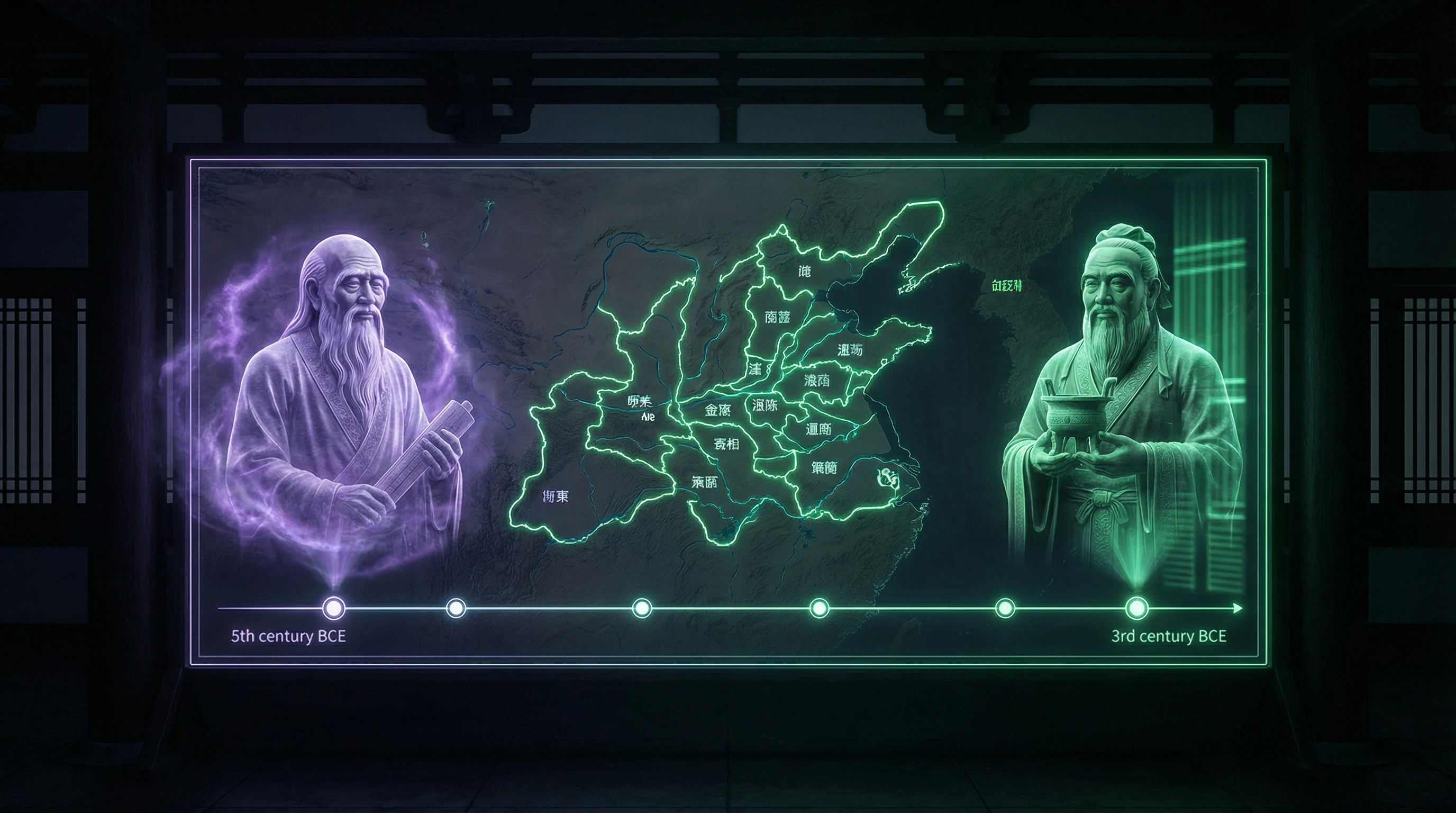
The paradox of Daoism and Confucianism: both traditions use the same term — Dao (道, "the way") — but invest it with opposite meanings. This is not a semantic difference, but a fundamental divergence in understanding the nature of reality and humanity's place within it.
The character 道 consists of elements meaning "head" and "to go," indicating movement with awareness. But the direction of this movement in the two systems is opposite: Daoists move inward, toward the primordial sources of being; Confucians move outward, toward social perfection.
Daoist Dao as Natural Spontaneity and Cosmic Principle
In Daoism, Dao is an ineffable first principle that precedes all existence. "The Dao that can be spoken is not the eternal Dao" — the opening line of the Dao De Jing. It is neither a personal god nor an abstract law, but a spontaneous process of the universe's self-organization without purpose or intervention.
Dao generates everything through natural unfolding (ziran, 自然 — "self-so-ness"), much as water flows downward not because it "should," but because such is its nature. A person who comprehends Dao does not control the world, but follows its natural rhythm, practicing wu-wei (無為) — "non-action" or "effortless action."
- Dao generates the One (一)
- The One generates Yin and Yang (陰陽)
- Yin-Yang generate the five elements (五行)
- The elements generate the "ten thousand things" (萬物) — all the world's diversity
This process has no moral dimension: Dao is "not humane" (不仁), it treats all beings as "straw dogs" — ritual objects that are used and discarded without sentimentality.
The Daoist's task is not to improve the world or society, but to achieve personal immortality (physical and spiritual) through alchemical practices, meditation, and union with Dao. This orientation toward individual liberation from social conventions makes Daoism the philosophy of hermits, mystics, and artists.
Confucian Dao as the Path of Moral and Social Perfection
Confucian Dao is not a cosmic principle, but a normative path of correct behavior that one must consciously cultivate through education and ritual practice. Confucius used the term Dao to designate the "Way of the Ancient Sages" — an idealized model of social order under the legendary rulers Yao and Shun.
Unlike Daoist Dao, which exists independently of humanity, Confucian Dao is realized only through human effort: "It is not Dao that broadens humanity, but humanity that broadens Dao."
This is an active, engaged concept requiring constant self-cultivation (xiu shen, 修身) and rectification of names (zheng ming, 正名) — bringing social reality into alignment with ideal models.
The key difference: Daoists see social institutions as artificial constructs that distance people from their natural state. Confucians consider them necessary instruments for harmonizing society.
| Virtue | Character | Meaning |
|---|---|---|
| Ren | 仁 | Humaneness, compassion for others |
| Yi | 義 | Righteousness, right action in context |
| Li | 禮 | Ritual, the form that cultivates virtue |
| Zhi | 智 | Wisdom, understanding the right path |
| Xin | 信 | Trustworthiness, reliability in words and deeds |
The practice of rituals (li) is not merely external form, but a method of cultivating inner virtue. By repeating correct actions, one transforms one's nature, much as a musician perfects technique through exercises.
Confucian Dao is the path of transforming a biological individual into a cultured person (junzi, 君子), capable of governing oneself and others.
Key Philosophical Differences: Spontaneity versus Structure
Daoism and Confucianism represent two poles of Chinese thought: nature vs culture, spontaneity vs ritual, individual vs society, contemplation vs action. These differences determined concrete life strategies—a Confucian pursued a career as an official, a Daoist retreated to the mountains.
In actual Chinese culture, these traditions were not mutually exclusive. An educated person could be "Confucian in office and Daoist in retirement," applying different philosophies to different spheres of life.
Individual Freedom versus Social Hierarchy
Daoism proclaims absolute individual freedom through liberation from social conventions, viewed as the source of suffering. Zhuangzi's parable of the butterfly—"I do not know whether I was dreaming I was a butterfly, or whether the butterfly is now dreaming it is me"—illustrates Daoist skepticism toward fixed identities, including social roles.
The Daoist sage (zhenren, 真人) lives in accordance with their own nature, ignoring public opinion. This philosophy gave rise to the tradition of the "Seven Sages of the Bamboo Grove" in the third century, who demonstratively rejected Confucian norms, indulging in wine, poetry, and eccentric behavior.
| Daoism | Confucianism |
|---|---|
| A person becomes human through liberation from social conventions | A person becomes human only within a network of social relationships, regulated by hierarchy and ritual |
| Identity is fluid and conditional | Identity is defined by multiple positions (son, father, subject, friend) with corresponding obligations |
| Hierarchy is the source of suffering | Hierarchy is the natural order, analogous to the relationship between heaven and earth |
The key virtue of xiao (孝, "filial piety") requires obedience to parents even when in disagreement. However, Confucians would counter that true freedom is achieved not through negating social bonds, but through harmonizing them: "Overcome yourself and return to ritual—this is humaneness."
Wu-wei (無為): One Term, Two Meanings
The concept of wu-wei (無為, "non-action") exists in both traditions but is interpreted radically differently—an ideal example of philosophical divergence despite terminological similarity.
- Daoist wu-wei
- Action in complete accordance with the natural course of things, without violence to the nature of the object. Maximum effectiveness through minimal intervention: "The sage acts through non-action." Return to pre-social spontaneity.
- Confucian wu-wei
- A state where right action becomes natural through the practice of rituals. Moral norms are fully internalized, action is spontaneous but within conventions. Achievement of post-social naturalness through cultivation.
The Daoist ruler governs by "doing nothing"—creating conditions under which people spontaneously follow the natural order, without laws and punishments. Confucius said: "At seventy, I could follow the desires of my heart without transgressing the rules"—describing a state where action occurs spontaneously but within social structure.
Both traditions seek harmony, but one searches for it before culture, the other after and through culture.
Complementarity of Traditions in Chinese Culture: How Opposites Created Unity
The Concept of "Inner Sage, Outer King" (內聖外王)
Chinese intellectual tradition developed a formula for integrating Daoism and Confucianism: Daoist self-cultivation in private life while maintaining Confucian behavior in the social sphere. An educated Chinese person could meditate on the "Dao De Jing" in the morning, perform official duties according to rituals during the day, write poetry in the Daoist spirit in the evening—without any sense of contradiction.
This model reflects an understanding that different aspects of existence require different philosophical tools: spiritual freedom needs Daoist spontaneity, social order requires Confucian structure.
| Life Sphere | Philosophical Tool | Principle |
|---|---|---|
| Inner world, spirituality | Daoism | Spontaneity, naturalness (ziran) |
| Social role, state | Confucianism | Ritual, hierarchy, duty (li) |
| Both levels | Unified Dao | Different manifestations of one reality |
Practical embodiment is visible in the biographies of Chinese intellectuals who held high government positions but retreated to the mountains for Daoist hermitage during periods of instability. Such flexibility was considered a sign of wisdom—the ability to adapt one's approach to circumstances.
Historical Coexistence and Mutual Influence
Although Daoism emerged as opposition to Confucianism during the Warring States period (5th–3rd centuries BCE), their integration began by the Han dynasty (206 BCE–220 CE). Confucianism became the official state ideology, while Daoism occupied the niche of personal spirituality and medicine. This division of spheres prevented conflict and allowed the traditions to enrich each other.
Confucianism borrowed Daoist concepts of naturalness to soften the rigidity of rituals; Daoism adapted Confucian ethics for social legitimation.
With Buddhism, these traditions formed the concept of the "Three Teachings" (三教), asserting their fundamental unity despite external differences. Neo-Confucianism of the Song era (960–1279) actively integrated Daoist and Buddhist elements, creating a synthetic philosophy where Confucian ethics combined with Daoist cosmology and Buddhist psychology.
- Confucian Ethics
- Provides social order and moral code, structures relationships between people and the state.
- Daoist Cosmology
- Explains natural cycles and spontaneity of being, offers a model of harmony with nature.
- Buddhist Psychology
- Offers methods for transforming consciousness and liberation from suffering.
- Synthesis of Three
- Creates a holistic system for understanding the world and humanity, where each tradition fills the gaps of the others.
This interpenetration is so deep that many Chinese practices—from painting to martial arts—cannot be unambiguously classified as "Daoist" or "Confucian." They represent a synthesis of both traditions.
Influence on Art, Literature, and Governance: Two Aesthetics of One Civilization
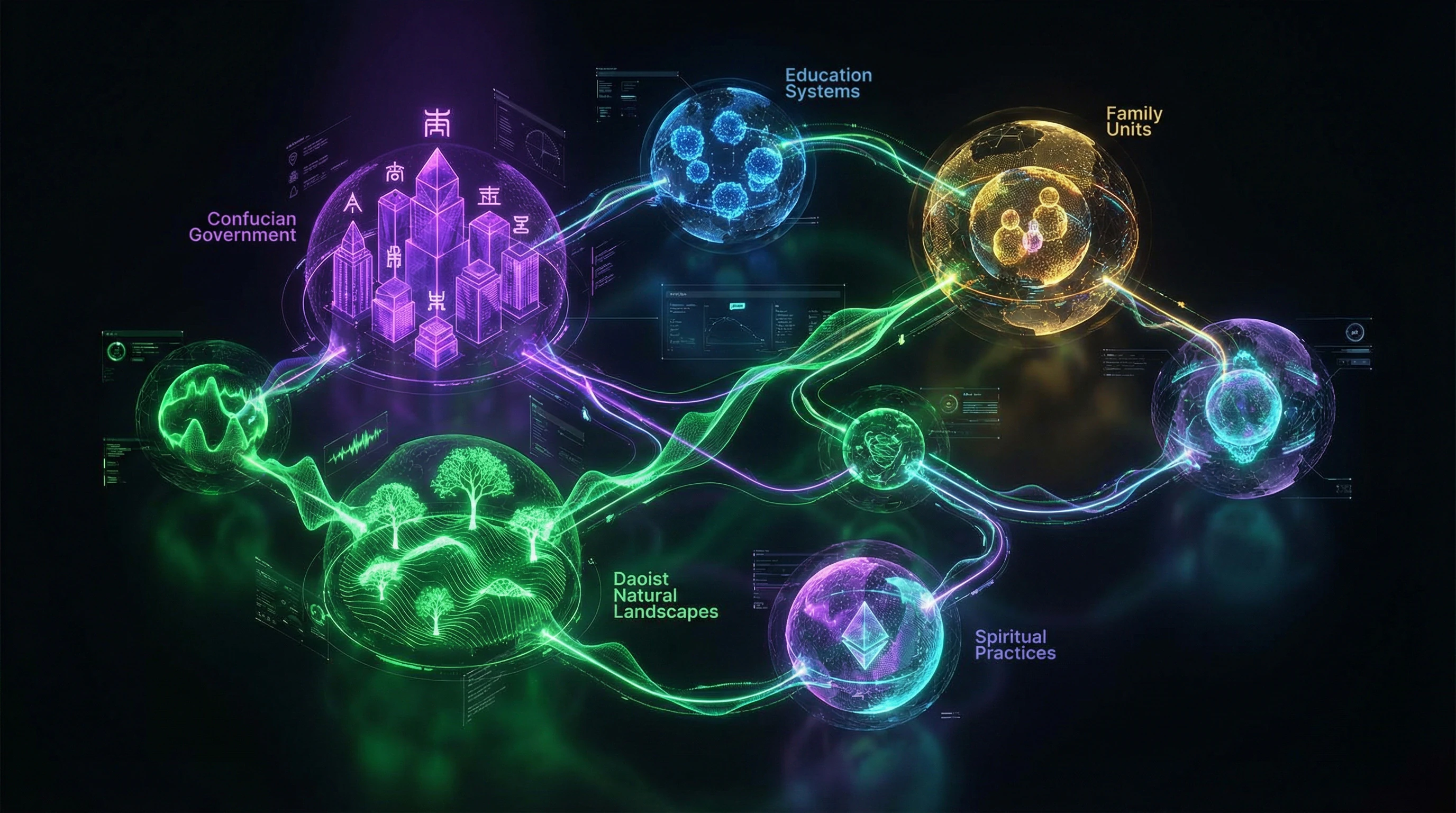
Daoist Aesthetic of Naturalness in Painting and Poetry
Daoist philosophy established in Chinese art an aesthetic of "naturalness" (自然, ziran), where the highest achievement was considered not technique, but the ability to convey the spontaneity of nature. Ink painting in the "xieyi" style (写意, "writing the idea") embodied the Daoist principle of wu wei: the artist acted without strain, allowing the brush to move naturally.
Daoist poets, such as Li Bai (701–762), cultivated the image of the "drunken sage," whose verses were born in a state of spontaneous inspiration, free from Confucian social conventions.
Daoist aesthetics valued "uncarved simplicity" (樸, pu) over refinement — in calligraphy, the "wild" caoshu style (草書) with its free-flowing characters was considered the highest expression of spiritual freedom.
In garden art, the Daoist principle of "following nature" created the tradition of landscape gardens, where artificial elements imitated natural forms so skillfully that the boundary between nature and culture dissolved.
Confucian Education System and Imperial Bureaucracy
Confucianism created a system of state governance based on meritocracy and education, where access to power was determined by knowledge of classical texts and capacity for moral self-cultivation. The imperial examination system (科举, keju), operating from 605 to 1905, required deep knowledge of Confucian canons and the ability to write essays in a strictly regulated style.
This system created a class of "scholar-officials" (士大夫, shidafu) — simultaneously intellectuals, administrators, and moral authorities, embodying the Confucian ideal of the "superior person" (君子, junzi).
| Aspect | Confucianism | Daoism |
|---|---|---|
| Education | Systematic study of canons, calligraphy, music, rituals | Intuition and spontaneous insight |
| Governance | Active intervention, moral authority | Detachment and non-interference |
| Character Formation | Cultivation through external forms of behavior | Natural development without coercion |
Paradoxically, the rigid Confucian system was often administered by people who in private life were Daoists. This demonstrates the practical compatibility of both traditions: Confucianism provided social stability, Daoism — psychological flexibility and spiritual freedom.
Contemporary Relevance and Global Influence: Ancient Principles in the 21st Century
Application of Principles in Modern Life and Business
The Daoist principle of wu-wei (無為) is experiencing a renaissance in management and psychology under the names "flow state" and "minimalist leadership." Effectiveness here is achieved not through effort, but through removing obstacles to natural processes.
Confucian ethics of relationships and hierarchy remains the foundation of corporate culture in East Asia, where loyalty, mutual obligations, and "saving face" are critical factors in business interactions.
| Concept | Source | Modern Application |
|---|---|---|
| Mindfulness | Daoist meditation techniques and non-action | Stress management, psychological adaptation |
| Harmony with nature | Daoist cosmology | Deep ecology, biocentric approaches to sustainable development |
| Interdependence and social responsibility | Confucian ethics | Environmental ethics, corporate social responsibility |
In environmental ethics, Daoism and Confucianism offer different but complementary solutions: the former through dissolution of ego in cosmic unity, the latter through ethics of interdependence and social responsibility.
Western Reception and Philosophical Interpretations
Western acquaintance with Daoism and Confucianism began with Jesuit missionaries in the 17th century, but genuine philosophical interest emerged in the 19th–20th centuries. Thinkers from Leibniz to Heidegger discovered in Chinese thought alternatives to Western metaphysics.
Leo Tolstoy found in Confucian ethics confirmation of ideas about nonviolence and moral perfection, and in Daoism a critique of civilization's artificiality.
Contemporary analytic philosophy turns to Confucian virtue ethics as an alternative to Kantian deontology and utilitarianism, exploring concepts of "ren" (仁, humaneness) and situational ethics.
Daoism exerted significant influence on countercultural movements of the 1960s in the West, where the "Dao De Jing" became a manifesto for an alternative lifestyle critiquing technocracy and consumerism.
- Process philosophers (Alfred North Whitehead) found parallels between Daoist cosmology and ideas about reality as dynamic becoming.
- Contemporary debates about "Asian values" appeal to Confucian concepts of communitarianism and harmony, contrasting them with Western liberal individualism.
- These interpretations remain subject to intense debate and require critical analysis of the context of their application.

Knowledge Access Protocol
FAQ
Frequently Asked Questions
Taoism emphasizes individual freedom, spontaneity, and harmony with nature, while Confucianism focuses on social order, hierarchy, and moral duty. Taoism evolved into a full-fledged religion with deities and rituals, whereas Confucianism remained primarily an ethical-social philosophy. Both traditions use the concept of Tao, but interpret it differently: Taoists see it as a cosmic principle of naturalness, while Confucians view it as the path of proper behavior in society.
In Taoism, Tao (道) is the fundamental cosmic principle governing the universe through natural spontaneity and harmony. In Confucianism, Tao means the path of moral perfection and proper social behavior. Despite using the same character, these concepts reflect different philosophical priorities: natural freedom versus social order.
Taoism was founded by the legendary sage Laozi (Lao-Tzu), who lived presumably in the 5th-3rd centuries BCE. Confucianism was created by the philosopher Confucius (Kong Fuzi), who lived around the same time. Both traditions emerged from common ancient Chinese cultural soil but offered different answers to questions about social organization and the meaning of life.
No, this is a common myth—in reality, the traditions are complementary. Many Chinese historically followed Confucian principles in public life and Taoist principles in personal spiritual practice. Together with Buddhism, they form the "Three Teachings" (三教) of China, which coexisted and mutually enriched each other for centuries.
Wu wei (無為)—the concept of "non-action" or "effortless action"—is central to both philosophies. In Taoism, wu wei means spontaneous action in harmony with nature, without artificial interference. In Confucianism, this concept is interpreted as naturally following rituals and social norms that have become second nature through cultivation.
No, Confucianism is primarily an ethical-social philosophy, not a religion in the traditional sense. Taoism evolved into a full-fledged religion with a pantheon of deities, temples, and priests. Confucianism focuses on human relationships, education, and moral perfection, without emphasizing the supernatural.
Practice wu wei: act naturally without forcing events, and seek harmony with your environment. Develop mindfulness through meditation and observation of natural cycles. Simplify your life by eliminating excess, and learn to accept change as a natural part of life—these are key Taoist principles that remain relevant today.
Apply Confucian principles of mutual respect (ren) and proper conduct (li) in business relationships. Develop long-term partnerships based on trust and mutual benefit. Invest in education and team development—the Confucian emphasis on learning and hierarchy helps build effective organizations with clear structure.
There existed the concept of "inner sage, outer king" (內聖外王): Taoism was applied for spiritual development, Confucianism for social life. The traditions addressed different needs: one provided inner freedom, the other social stability. This wasn't a contradiction but a practical division of spheres that allowed harmonious combination of personal and public life.
Taoism inspired the aesthetic of naturalness in painting and poetry: misty landscapes, spontaneous calligraphy, celebration of nature. Confucianism defined themes of moral perfection, historical subjects, and social harmony in literature. Together they created a unique artistic tradition where natural beauty combines with ethical messages.
Partially true: early philosophical Taoism criticized artificial social constructs and excessive state intervention. However, religious Taoism later integrated into the imperial system, and some emperors patronized Taoist temples. Taoism offered an alternative view of governance through minimal intervention (wu-wei) rather than complete rejection of authority.
Yes, Confucianism emphasizes tradition, hierarchy, and stability, making it conservative in essence. However, it also stresses continuous self-improvement and adaptation to circumstances through education. Modern scholars note that the Confucian emphasis on meritocracy and education promoted social mobility in imperial China.
Confucian values (respect for elders, education, social harmony) remain the foundation of Chinese society and influence policy. Taoist practices (qigong, tai chi, traditional medicine) are popular for health and spiritual development. Both traditions shape the PRC's cultural identity and are used by the government to promote the "Chinese Dream" and soft power.
Yes, both traditions spread worldwide with the Chinese diaspora. Taoist temples exist in Singapore, Malaysia, the USA, and Europe, where rituals and practices are conducted. Confucian temples (often dedicated to Confucius himself) exist in Korea, Japan, Vietnam, and other countries, serving as centers for cultural education and ceremonies.
Yes, many Westerners study and practice both traditions, adapting them to their context. Taoist practices (meditation, tai chi, wu-wei philosophy) integrate easily into modern life. Confucian ethical principles apply in education, business, and family relationships. Leo Tolstoy, for example, was deeply interested in both philosophies and found universal truths in them.
Confucianism historically supported patriarchal hierarchy with women in subordinate positions in family and society. Taoism is more egalitarian: it includes female deities, female sages, and the concept of yin-yang balance, recognizing the equal importance of feminine and masculine principles. Modern interpretations of both traditions are reconsidering gender roles in light of equality.