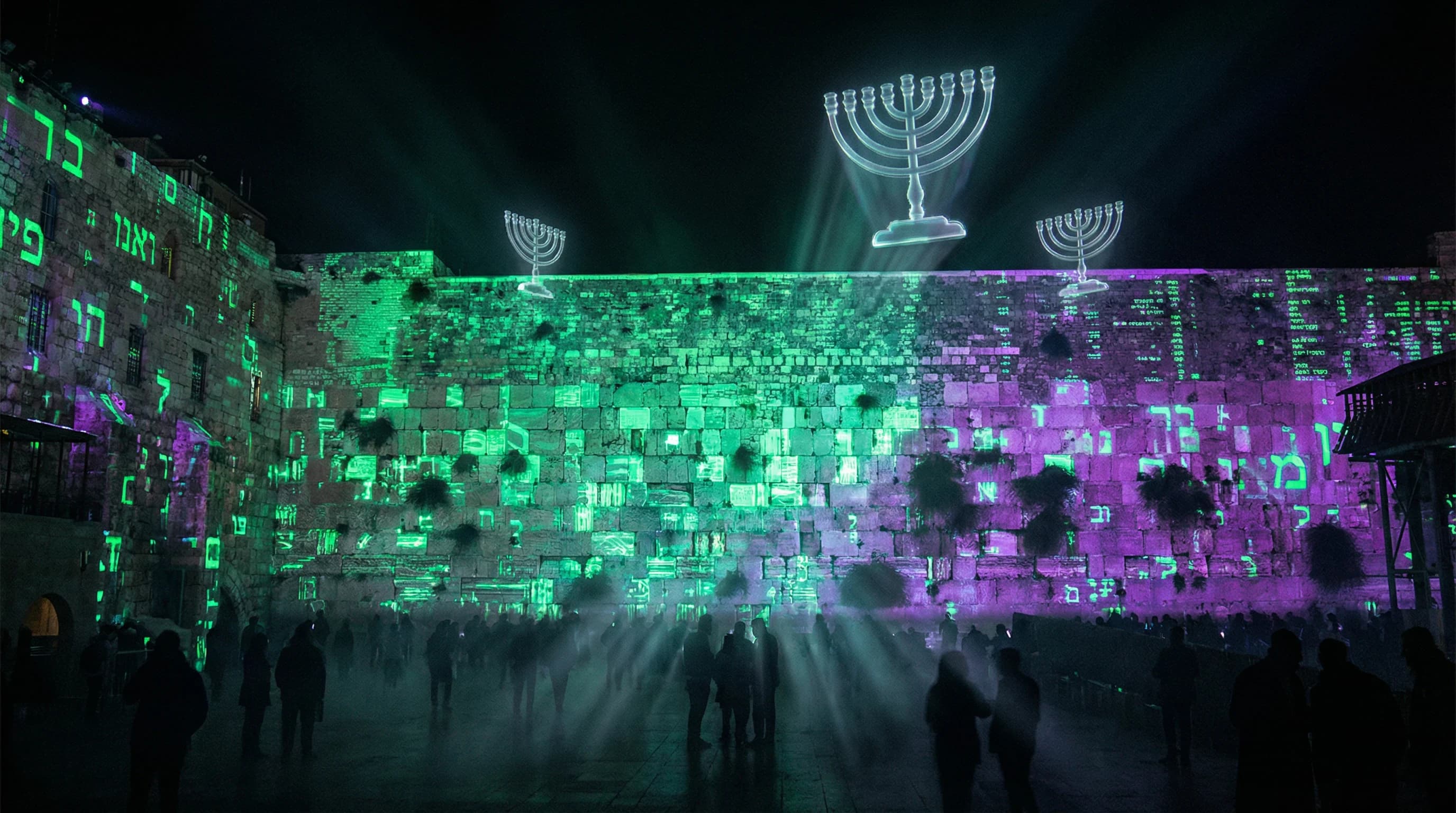
Judaism: Ancient Monotheistic Religion and Living Traditionλ
We explore Judaism as a covenant religion founded on the Torah, its historical evolution from ancient Israel to the present day, and the diverse forms of Jewish identity.
Overview
Judaism — the world's oldest monotheistic religion, built on a covenant between God and the Jewish people, where the Torah serves as sacred text and legal code. Evolution from ancient Israelite religion through the Second Temple period (516 BCE — 70 CE) led to the rabbinic tradition, which today unites ~14 million people across different denominations. Judaism is not only a religion: 🧬 ethnicity, culture, peoplehood — the boundaries of Jewish identity remain subject to internal debates.
🛡️
Laplace Protocol: Judaism is studied here as a multidimensional phenomenon, combining theological, historical, social, and anthropological aspects. We balance between religious insider perspectives and academic analysis, acknowledging ongoing debates about key questions of identity and practice.
Reference Protocol
Scientific Foundation
Evidence-based framework for critical analysis
Protocol: Evaluation
Test Yourself
Quizzes on this topic coming soon
⚡
Deep Dive
Historical Development of Judaism: From Tribal Cult to World Religion
Judaism has undergone radical transformation over three millennia while preserving the core of monotheistic faith. The modern Jewish religion is the result of multiple historical ruptures, where old forms died and new ones emerged from their foundations.
Judaism is not a static doctrine, but a living tradition of adaptation, where each crisis rewrote the rules of survival.
From Ancient Israel to Rabbinic Judaism
Ancient Israelite religion before the Babylonian exile (586 BCE) differed fundamentally from modern Judaism. Temple cult with sacrifices, multiple sanctuaries, and the absence of a unified canon of sacred texts—these were its characteristics.
The Babylonian exile became a turning point: without the Temple, Jews began forming a textual tradition and community practices independent of geography. The transition from temple cult to a religion of book and law occurred precisely then.
The Second Temple Period and Its Significance
The Second Temple era (516 BCE — 70 CE) was a critical moment when the foundations of both rabbinic Judaism and early Christianity formed simultaneously. During this period, various movements emerged: Pharisees, Sadducees, Essenes—each with its own understanding of Torah and practice.
- Pharisees
- Predecessors of the rabbis who developed the concept of oral law complementing the written Torah. This allowed the religion to adapt to changing conditions.
- Destruction of the Second Temple (70 CE)
- Ended the era of sacrifices and definitively established the rabbinic model based on textual study and prayer.
Medieval Transformations: East and West
The medieval period shows asymmetry in Judaism's development between Eastern and Western Europe. In the Christian world, attitudes toward Jews varied from relative tolerance to brutal persecution, shaping different survival strategies.
| Region | Conditions | Consequences |
|---|---|---|
| Western Europe | Expulsions (Spain, 1492), restrictions | Dispersion, adaptation to new lands |
| Eastern Europe | Large communities with developed autonomy | Formation of Ashkenazi culture |
These differences created cultural and religious variations that persist today in the division between Ashkenazim and Sephardim.

Foundations of Covenant Theology: Monotheism as a Revolution of Consciousness
The theological foundation of Judaism is built on the concept of covenant (brit) — a bilateral agreement between God and the Jewish people. This covenant defines Jewish identity, ethics, and historical consciousness.
The covenant is not a metaphor, but a structure-forming principle. This is precisely why Judaism is simultaneously a religion, ethnicity, and culture.
Monotheism and the Concept of Covenant (Brit)
Jewish monotheism affirms a single, transcendent God — creator of the universe, who entered into a special relationship with the Jewish people. The covenant, established with Abraham and renewed at Mount Sinai with Moses, establishes mutual obligations: God promises protection and blessing, the people commit to observing the commandments.
Chosenness does not imply superiority — it entails a special mission and responsibility to humanity.
The covenant explains why Jewish identity is transmitted by birth and why conversion to Judaism is possible: the convert enters into the covenantal relationship.
Torah as Sacred Text
The Torah (Five Books of Moses) — the core of the Jewish sacred canon, regarded as direct revelation from God. The text contains the narrative of creation, the history of the patriarchs, and 613 commandments (mitzvot) regulating all aspects of life.
- Ritual practices (kashrut, Sabbath, holidays)
- Social justice (protection of widows, orphans, slaves)
- Personal ethics and interpersonal relationships
The Torah is read publicly in synagogues in an annual cycle, and its study is considered the highest form of service to God. Critically important: the Torah is not regarded as a complete, self-sufficient text — it requires interpretation through the lens of oral tradition.
Written and Oral Law
Rabbinic Judaism asserts that Moses received at Sinai not only the written Torah, but also the oral law (Torah she-be-al-peh), transmitted from generation to generation.
- Mishnah (c. 200 CE)
- The first codification of oral tradition, systematization of legal discussions and interpretations. It enabled the recording of diverse rabbinic opinions within a unified structure.
- Talmud (completed by the 6th century)
- An expanded commentary on the Mishnah, creating an enormous corpus of hermeneutical methods. Two versions: the Babylonian Talmud (more authoritative) and the Jerusalem Talmud.
This system allows Judaism to adapt to new circumstances without changing the sacred text: rabbis apply ancient principles to contemporary situations through logical and linguistic methods.
The tension between the letter and spirit of the law, between tradition and innovation — is central to Jewish religious thought.
Jewish Identity and Belonging: Community Boundaries in Dispute
The question "who is a Jew" remains one of the most contentious in contemporary Judaism, with no universal consensus between secular and religious Jews, nor among different denominations. This ambiguity is not a weakness, but rather a reflection of the complex nature of Jewish identity, which is simultaneously religious, ethnic, and cultural.
Understanding the mechanisms of belonging is critical for comprehending internal conflicts within Jewish communities and their relationships with the outside world.
Matrilineal Principle of Descent
According to halakha (Jewish religious law), Jewishness is transmitted through the maternal line: a child of a Jewish mother is considered Jewish regardless of the father's nationality. This principle, established during the rabbinic period, has practical foundations—maternity is always evident, whereas paternity in ancient times was difficult to establish.
Reform Judaism has recognized patrilineal descent since 1983, provided the child receives a Jewish upbringing, creating a situation where a person may be considered Jewish in one community and not in another.
This divergence reflects a deeper schism between liberal and Orthodox approaches to tradition.
Conversion: The Process of Becoming Jewish
Conversion—the formal process of becoming Jewish—represents the second path to Jewish identity alongside birth to a Jewish mother. The process includes extensive study of Jewish tradition, acceptance of commandments, circumcision for men, and ritual immersion in a mikvah (ritual bath) for all.
Orthodox conversion can take years and requires full acceptance of halakha; Orthodox rabbis often do not recognize conversions performed by non-Orthodox rabbis. Reform conversion offers a more flexible approach, but creates a hierarchy of legitimacy and complicates the question of Jewish identity.
Secular and Religious Identity
A significant portion of Jews identify as secular or cultural Jews, not practicing religion but maintaining ethnic and cultural affiliation. This phenomenon is particularly widespread in Israel and among Western Jews, where Jewishness is understood through the lens of history, culture, language (Hebrew, Yiddish), and collective memory of the Holocaust.
Secular Jews may observe certain traditions (such as the Passover Seder) as cultural practices devoid of religious content. This duality creates tension: religious authorities insist on the primacy of halakha, while secular Jews assert the right to define their identity independently of religious criteria.
Denominational Differences
Contemporary Judaism is divided into major movements—Orthodox (including ultra-Orthodox), Conservative, Reform, and Reconstructionist—each with its own understanding of traditional authority and community boundaries.
| Movement | Approach to Tradition | Membership Criteria |
|---|---|---|
| Orthodox | Immutability of halakha, strict observance of commandments | Matrilineal descent or Orthodox conversion |
| Conservative | Intermediate position between tradition and adaptation | Matrilineal descent or Conservative conversion |
| Reform | Evolving tradition, adaptable to modernity | Matrilineal or patrilineal descent with Jewish upbringing |
These differences are not merely theological abstractions—they determine who is recognized as Jewish, which marriages are considered legitimate, who can become a rabbi. The global Jewish population of approximately 14 million people (as of 2018) is distributed unevenly among these movements, with geographical variations: Orthodoxy dominates in Israel, Reform is strong in the United States.
The absence of a single criterion for Jewishness is not a paradox, but rather a consequence of the fact that Jewish identity has historically encompassed religion, ethnicity, and culture simultaneously, and each movement chooses which of these components to consider primary.
Social and Anthropological Dimensions — How Judaism Lives in Everyday Life
Judaism as Vernacular Religion
The concept of "vernacular religion" reveals Judaism not as a frozen system of dogmas, but as a living practice that manifests differently across communities and contexts.
The vernacular approach studies how ordinary Jews — not rabbis or scholars — understand and practice their religion in daily life, often deviating from official norms.
Many Jews observe select traditions (lighting Shabbat candles, celebrating Passover) while ignoring other prescriptions, creating individualized "packages" of Jewish identity.
Community Practices and Variations
Jewish communities demonstrate remarkable diversity of practices while maintaining a common core of identity. Ashkenazi Jews of Eastern Europe developed traditions radically different from Sephardic communities of the Mediterranean or Mizrahi Jews of the Middle East.
Judaism has historically adapted to local cultural contexts, creating unique syntheses.
| Dimension | Variation |
|---|---|
| Liturgical traditions | Melodies and prayer forms vary by community's geographic origin, reflecting local musical influences |
| Culinary customs | Holiday dishes and everyday cuisine absorb regional ingredients and cooking techniques |
| Halakhic interpretation | The same laws are interpreted differently depending on the community's historical and geographic context |
Even within a single city, different synagogues represent entirely different models of Jewish life — from strictly Orthodox to nearly secular cultural centers.
Youth and Age in Jewish Thought
Jewish tradition constructs a complex system of intergenerational relationships, where old age is associated with wisdom and authority, but youth — with renewal and vital energy.
Talmudic literature is filled with discussions about when to listen to elders versus young scholars whose sharp minds have not yet been dulled by routine.
This dynamic is especially relevant in contemporary Judaism, where younger generations critique outdated institutions and demand reforms — from feminist critiques of patriarchal structures to calls for inclusivity for LGBTQ Jews.
The tension between tradition (represented by elders) and innovation (driven by youth) is not a problem but a productive mechanism for Judaism's evolution.

Interfaith Relations — Two Thousand Years of Dialogue and Conflict
Historical Christian-Jewish Relations
Christianity emerged within Judaism, but then spent two thousand years defining itself through opposition to it. Early Christians were Jews debating Jesus's messiahship, but by the end of the first century the rupture became irreversible.
Christian theology developed the concept of the "Old Testament" as supposedly "replaced" by the New, turning Judaism into an obsolete religion. This construction created ideological ground for persecution — from medieval pogroms to the Holocaust.
Paradox: a religion born from Judaism spent two millennia discrediting it.
Medieval Christian Views on Judaism
Attitudes toward Judaism varied geographically, but not for theological reasons. In fifteenth-century Western Europe, hostility dominated: Jews were accused of ritual murders, forced to wear distinguishing marks, periodically expelled.
| Region | Policy | Mechanism |
|---|---|---|
| Western Europe | Hostility, expulsions | Competition with Christian merchants determined policy more than faith |
| Eastern Europe (Poland, Lithuania) | Royal privileges and self-governance | Monarchs needed Jewish financiers and merchants for territorial development |
Economics, not theology, determined the survival of Jewish communities.
Contemporary Interfaith Dialogue
After the Holocaust, a revolutionary reassessment occurred. The Second Vatican Council (1962–1965) adopted the declaration "Nostra Aetate," rejecting accusations of deicide against Jews and recognizing the enduring value of the Jewish covenant.
Institutional acknowledgment of error — a rare case where religious structures change course under pressure from historical conscience.
Protestant denominations also revised their positions, acknowledging Martin Luther's anti-Judaism. Contemporary dialogue builds on shared ethical values and joint social activism, though theological disagreements remain.
Rethinking Palestinian Judaism
E.P. Sanders's work "Paul and Palestinian Judaism" (1977) shattered the stereotype of first-century Judaism as a "legalistic religion of works." First-century Palestinian Judaism was a religion of covenant and grace, where observance of commandments was a response to God's love, not an attempt to earn salvation.
This rethinking changed understanding of Paul's conflict with Judaism. The dispute was not about "law versus grace," but about whether Gentiles must become Jews to join the messianic movement — a question of identity, not theology.
When sources contradict the stereotype, the stereotype is at fault. Sanders showed that two thousand years of Christian polemic were built on a misreading of Judaism.
Contemporary Transformations — Judaism in the Digital Age
Digital Judaism and Online Communities
The internet has radically transformed Jewish practice, creating the phenomenon of "digital Judaism." Online platforms enable Jews from isolated communities to access rabbinical consultations, study Talmud in virtual groups, and participate in global discussions about Jewish identity.
This is especially significant for Jews in former Soviet countries, where Soviet repression severed traditional continuity — the internet has become a tool for reconnecting with heritage.
Digital technologies have generated new halakhic questions: Can Zoom be used for a minyan (prayer quorum)? Is an e-reader kosher for reading Torah? These debates demonstrate how ancient tradition adapts to unprecedented technological challenges without losing its normative character.
Contemporary Academic Approaches
Academic study of Judaism in the 21st century is characterized by interdisciplinarity and critical approaches to sources. Historians apply archaeological data and textual analysis to reconstruct ancient Israel, often challenging traditional narratives.
Anthropologists study contemporary Jewish communities as living cultures, while sociologists analyze demographic trends: high rates of intermarriage, low birth rates in non-religious families, youth exodus from communities.
| Discipline | Method | Focus |
|---|---|---|
| History | Archaeology, textual analysis | Reconstruction of ancient Israel |
| Anthropology | Ethnographic observation | Living Jewish cultures |
| Sociology | Demographic analysis | Identity and assimilation trends |
Global Distribution and Demographics
Of approximately 14 million Jews worldwide (2018), about 6.7 million live in Israel and 5.7 million in the United States — nearly 90% of the global Jewish population. This concentration has profound consequences: Israel is becoming the center of Jewish life, where Hebrew is a living language and Jewish culture is dominant.
The diaspora faces assimilation and demographic decline. European communities, once the world's largest, have shrunk to fewer than 1.5 million after the Holocaust and Soviet emigration.
- Orthodox families with high birth rates are growing
- Secular communities are shrinking
- New centers are emerging in Latin America and Australia, but their influence remains limited
Adaptation to Contemporary Contexts
Contemporary Judaism balances preservation of tradition with adaptation to a radically changed world. Reform and Conservative movements have ordained women rabbis since the 1970s, recognize same-sex marriages, and reinterpret patriarchal elements of tradition.
Even within Orthodoxy, feminist currents are emerging, demanding greater participation of women in religious life. The environmental crisis has spawned the "eco-kashrut" movement, expanding the concept of kosher to include ethical aspects of food production.
- Conservative Position
- Views transformations as betrayal of tradition, risking dilution of Jewish identity.
- Progressive Position
- Regards adaptation as necessary evolution for survival in the modern context.
- Key Paradox
- The very fact of these debates demonstrates Judaism's vitality — a religion that stops adapting stops being alive.

Knowledge Access Protocol
FAQ
Frequently Asked Questions
Judaism is a monotheistic religion based on the covenant between God and the Jewish people, with the Torah as its sacred text. The religion has evolved through various historical periods while maintaining core principles of faith. As of 2018, there are approximately 14 million Jews worldwide.
A person is considered Jewish if born to a Jewish mother (matrilineal principle) or having undergone conversion—a formal process of conversion to Judaism. However, there is no universal consensus: debates continue between secular and religious Jews, as well as among different denominations, about the criteria for Jewishness. This reflects the complexity of Judaism as simultaneously a religion, ethnicity, and culture.
Conversion is the formal process of becoming Jewish, one of two ways to become a Jew (the other being birth to a Jewish mother). The process includes studying Jewish laws, traditions, accepting the commandments, and undergoing rituals before a rabbinical court. While conversion is demanding, it is a legitimate and practiced path to entering the Jewish people.
No, this is a common misconception. Judaism combines religion, ethnicity, culture, and the concept of peoplehood in complex interconnected forms. There are secular Jews who identify culturally and ethnically but not religiously, which confirms the multidimensional nature of Jewish identity.
The concept of covenant (brit) between God and the Jewish people is central to Jewish theology and recognized by all scholars. The covenant establishes a special relationship, obligations, and mission of the Jewish people before God. This idea permeates the entire Torah and has defined Jewish self-understanding for millennia.
The Second Temple period (516 BCE–70 CE) is considered crucial for understanding the development of Rabbinic Judaism and early Christianity. During this time, many religious movements formed, including the Pharisees, Sadducees, and Essenes. The destruction of the Second Temple by the Romans in 70 CE led to the transformation of Judaism into its modern Rabbinic form.
The Written Torah (Five Books of Moses) is the primary sacred text of Judaism, received according to tradition at Mount Sinai. The Oral Law (Oral Torah) is the tradition of interpreting and applying the written law, later recorded in the Mishnah and Talmud. The interaction between written and oral law forms the foundation of Rabbinic Judaism.
No, this is a myth. Jewish tradition has a complex and generally positive attitude toward creative work, though with certain theological considerations. The history of Jewish art, literature, music, and science demonstrates a rich creative tradition. Restrictions primarily concern depictions of God and Sabbath observance.
Medieval Judaism developed differently in Western and Eastern Europe due to differences in Christian attitudes toward Jews. Research shows significant asymmetry between Western European and Eastern European Christian views of Judaism in the 15th century. These differences influenced the formation of Ashkenazi and Sephardic traditions.
Vernacular religion is a concept that studies how religion manifests in everyday practice as distinct from formal doctrine. In Judaism, this means examining how ordinary Jews live their faith in daily life, creating diversity in communal practices and variations. This approach helps understand the actual diversity of Jewish religious life.
Historical Christian-Jewish relations have been complex and often tense, especially during the Middle Ages. Medieval Christian views on Judaism varied by region, affecting the status of Jewish communities. Modern interfaith dialogue seeks to overcome historical prejudices and build mutual understanding.
E.P. Sanders is a scholar whose research on Jesus and Palestinian Judaism revolutionized the understanding of early Christianity. His work demonstrated that Judaism in Jesus' time was more diverse and less legalistic than previously believed. This transformed the academic approach to studying Christianity's origins and its connection to Judaism.
Digital Judaism is an emerging field examining the intersection of Jewish religious practice and scholarship with digital technologies and online communities. This includes virtual synagogues, online Torah study, digital archives, and social networks for Jewish communities. The phenomenon reflects the adaptation of ancient tradition to the modern technological context.
Judaism is not monolithic—this is a common misconception. Various denominations exist (Orthodox, Conservative, Reform, Reconstructionist Judaism), each with its own approaches to law and tradition. Old forms have died out, new ones have emerged, while preserving core principles of faith.
Jewish thought has a developed concept of intergenerational relationships, where old age is associated with wisdom and respect. Tradition emphasizes the importance of transmitting knowledge from elders to youth and honoring parents. However, modern Judaism also recognizes the value of youthful innovation and fresh interpretations of tradition.
As of 2018, the global Jewish population is estimated at approximately 14 million people. The largest communities are in Israel (about 6.7 million) and the United States (about 5.7 million), with significant communities in France, Canada, the United Kingdom, and Russia. The global distribution reflects the history of the Jewish diaspora.