
What We Call "Christmas": Semantic Boundaries of a Cultural Construct and the Problem of Defining the Research Object
The term "Christmas" functions simultaneously in three irreducible registers: as a religious doctrine about the birth of Jesus Christ, as a cultural holiday with a stable set of practices (tree, gifts, family dinner), and as a commercial season generating a significant portion of annual retail profits. More details in the section Ethnic and Indigenous Identity.
Methodological problem: critical analysis of one level is often perceived as an attack on others, creating defensive cognitive mechanisms in the audience. This complicates discussion about the mechanisms of myth construction.
Christmas is not a single object, but a bundle of intersecting practices, each with its own history, logic, and stakeholders.
🔎 Religious Layer: Historical Core and Its Evidentiary Base
Christian doctrine asserts the birth of Jesus in Bethlehem during the reign of Herod the Great (died 4 BCE) or during the census under Quirinius (6 CE). This creates a chronological contradiction already in the canonical texts.
Archaeological research provides no direct evidence of the event: there are no contemporary artifacts, inscriptions, or documents confirming the birth of a specific person at the indicated time and place (S003). The absence of material evidence does not disprove the event, but places it in the category of unprovable claims.
- Unprovable Claim
- A fact that can neither be confirmed nor refuted by available methods. In the context of history, this means the event may be real, but its historical reconstruction remains a hypothesis.
- Why This Matters
- The distinction between "not proven" and "false" is key to honest analysis. Many defenders of tradition confuse these categories, interpreting criticism of the evidentiary base as denial of the event itself.
🧱 Cultural Layer: Syncretism of Practices and Dating of Traditions
The modern Christmas complex includes elements from different eras and cultures: winter solstice (pagan cults), Saturnalia (Roman tradition), Germanic customs (tree), Victorian innovations (cards, commercialization), 20th-century American additions (image of Santa Claus in red suit).
Each element has a documented history of emergence that rarely aligns with the religious narrative. Linguistic analysis of holiday names in different languages (Christmas, Weihnachten, Noël, Christmas) reveals different etymological roots, reflecting local processes of cultural adaptation (S004).
| Traditional Element | Origin | Integration Period |
|---|---|---|
| Christmas Tree | Germanic pagan cults | 16th–17th centuries |
| Gift-giving | Saturnalia + Victorian commercialization | 19th century |
| Santa Claus (red suit) | American advertising | 1930s |
| Christmas Dinner | Synthesis of local traditions | Varies by region |
⚙️ Commercial Layer: Economic Function and Maintenance of Tradition
Since the 19th century, Christmas has functioned as an economic institution, where the ritual of gift-giving creates predictable demand, and the emotional weight of the holiday reduces consumer price sensitivity.
Commercial infrastructure actively participates in maintaining and standardizing traditions: the image of Santa Claus was unified by advertising campaigns in the 1930s, creating a globally recognizable visual code. Economic interest in preserving the holiday creates a powerful mechanism of cultural replication, independent of religious content.
The commercial layer doesn't "ruin" tradition—it stabilizes it. Without economic incentives, many practices would disappear within a generation.
This doesn't mean the tradition is "fake" or "counterfeit." It means its persistence depends on material interests, not only on cultural memory or religious conviction.

Steel Version of the Argument: Seven Reasons Why the Christmas Narrative May Be Considered Historically Grounded
Intellectual honesty requires presenting the strongest version of an opposing position before its critical examination. The following arguments represent the most compelling defense of the historicity of the Christmas narrative, based on available sources and methodological approaches. For more details, see the Judaism section.
- Multiple independent sources. Four canonical Gospels, written at different times and in different geographical locations, contain references to the birth of Jesus. Historical source criticism methodology considers multiplicity of testimony as a factor increasing the probability of an event's historicity.
- Archaeological context. While there is no direct evidence of a specific individual's birth, archaeological data confirms the general historical context: the existence of Bethlehem as a settlement during the relevant period, Roman occupation of Judea, and census practices (S003). The absence of contradictions between archaeological data and the narrative excludes the possibility of complete fabrication at a later time.
- Early dating of the tradition. Christmas celebration is documented from the 4th century CE (first mention of December 25 appears in 336 in the Roman calendar), meaning the tradition was established during a period when living connections to the apostolic era still existed through chains of oral transmission.
- Cultural continuity. The Christian community demonstrates an unbroken tradition of celebration spanning 1,700 years, surviving numerous cultural, political, and technological transformations (S002). The persistence of tradition may be interpreted as evidence of a real historical core.
- Hostile testimony. Early Christian sources contain criticism from opponents (Jewish and pagan authors) who disputed the interpretation of events but not the existence of Jesus as a historical figure. Acknowledgment of facts by opponents is considered stronger evidence than assertions by supporters.
- Explanatory power of the hypothesis. The hypothesis of a real historical event explains the emergence and spread of Christianity more simply than alternative theories of complete fabrication. Creating a religious movement around a fictional figure under conditions where many contemporaries could have refuted basic facts appears to be a less probable scenario.
- Anthropological universality. The structure of the Christmas narrative (miraculous birth, special mission, portents) corresponds to universal patterns of the heroic myth described in comparative mythology. Mythologization does not necessarily imply the absence of a historical core.
Additional mentions in apocryphal texts and early Christian literature create a textual network that requires explanation: either the event occurred, or there was a coordinated process of legend creation in the first decades after the alleged date.
The 300-year gap between the event and the establishment of the holiday is comparable to periods of oral transmission of other historical narratives that subsequently received archaeological confirmation. Occam's razor principle suggests preferring simpler explanations when explanatory power is equal.
Evidence Under the Microscope: What Archaeological, Linguistic, and Sociological Sources Tell Us About the Construction of Tradition
Critical analysis requires systematic examination of each type of evidence with assessment of its quality, relevance, and interpretive limitations. Source criticism methodology is applied to various categories of data available for investigating the Christmas phenomenon. More details in the East Asian Studies section.
🧪 Archaeological Sources: What Material Evidence Can and Cannot Prove
Archaeology works with material remains of the past, which creates a fundamental limitation: events that left no physical traces fall outside its competence. The birth of a person in a carpenter's family in a provincial town is not an event that should leave an archaeological trace detectable two millennia later (S003).
The absence of archaeological evidence for Jesus's birth is not evidence of the event's absence, but shifts the question into the realm of textual analysis and historical criticism.
Archaeological data confirm the existence of Bethlehem as a settlement in the relevant period, the presence of Roman administrative systems, census practices, and regional architectural features. However, these data confirm only the general context, not the specific event.
Analogy: archaeological confirmation of Troy's existence does not prove the historicity of the Trojan War as described by Homer, but excludes interpretation of the epic as entirely fictional (S003).
📊 Textual Sources: Problems of Dating, Authorship, and Editorial Layers
The four canonical Gospels date to the period 70–110 CE, creating a temporal gap of 40–80 years between events and their written documentation. Modern biblical scholarship identifies multiple editorial layers in the texts, meaning: the final version reflects not only the original narrative, but also theological debates, liturgical needs, and apologetic tasks of early Christian communities.
- Oral tradition in Aramaic
- Oral tradition in Koine Greek
- Written documentation
- Editing and canonization
Each stage of transmission introduces potential distortions and interpretive layers (S004). Linguistic analysis shows the texts were written in Koine Greek, not the Aramaic Jesus presumably spoke, indicating a process of translation and cultural adaptation.
Onomastic analysis of names in the texts confirms their correspondence to first-century Jewish anthroponymic tradition, supporting the authenticity of the cultural context (S008).
🧾 Sociological Sources: Mechanisms of Formation and Maintenance of Collective Beliefs
Sociology of religion investigates how groups create, maintain, and transmit belief systems independent of their truth value. The Christmas tradition demonstrates classic mechanisms of social construction of reality.
- Ritualization
- Repeated practices create a sense of continuity and rootedness of tradition.
- Institutionalization
- Church and state structures codify practices, giving them official status.
- Socialization
- Transmission of tradition through family upbringing and community participation.
- Sanctioning
- Social pressure to participate creates conformity.
Social capital research shows that religious communities function as networks of trust and mutual aid, where participation in shared rituals creates social bonds whose value is independent of the truth of religious claims (S006).
Criticism of the holiday's historical foundation often meets resistance because threats to tradition are perceived as threats to the social bonds it sustains.
The prosocial function of religious practices creates evolutionary advantage for groups maintaining traditions, independent of their factual basis (S002).
🔎 Comparative Analysis: Parallels with Other Cultural Narratives
Comparative analysis methodology allows assessment of the Christmas phenomenon's uniqueness through comparison with other cultural traditions. The legend of the calling of the Varangians demonstrates similar structure: a politically motivated narrative created to legitimize power, which over time acquired the status of historical fact despite a weak evidentiary base (S003).
The difference is that the Varangian legend has an explicit political function, whereas the Christmas narrative fulfills religious and social roles. Analysis of other religious traditions reveals a universal pattern: founders of religions are described through similar motifs (miraculous birth, special mission, signs, overcoming trials).
| Interpretation | Explanation | Compatibility with Historicity |
|---|---|---|
| Jungian Perspective | Universal archetypes of human consciousness | Compatible with presence of historical core |
| Constructivist Perspective | Conscious or unconscious construction following cultural templates | Compatible with absence of historical core |
Both interpretations are compatible with the presence or absence of a historical core, indicating the need for additional criteria to distinguish between them.
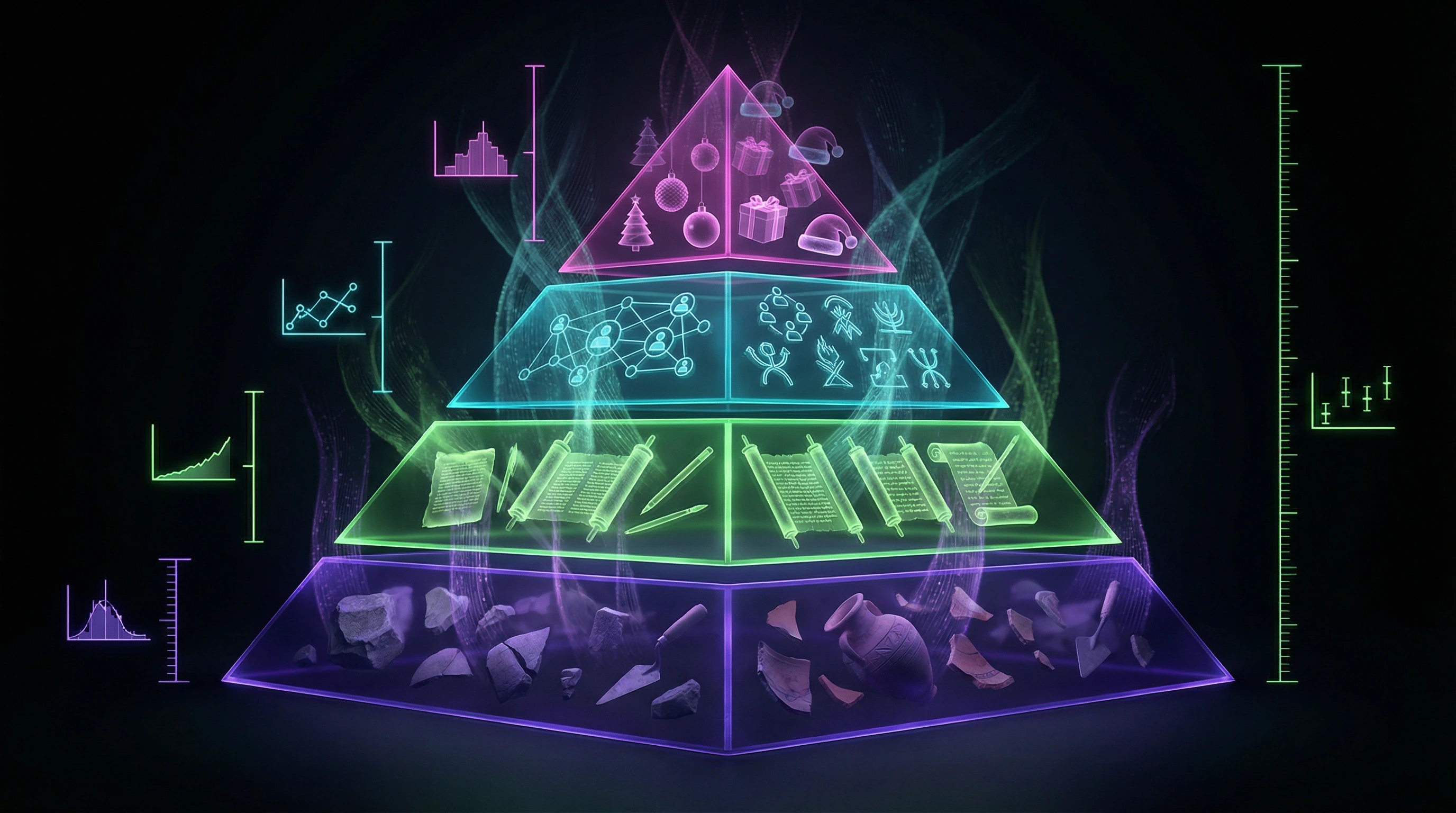
Mechanisms of Causality: Why Correlation Between Tradition and Historical Event Does Not Mean Causal Connection
Critical thinking requires distinguishing between correlation (co-occurrence of phenomena) and causality (causal connection between them). The existence of an enduring tradition correlates with claims about a historical event, but does not prove that the tradition arose precisely from that event. More details in the Epistemology section.
Observation: a tradition exists for a long time and is widely distributed — this does not explain why it arose in precisely this way and not otherwise.
🧬 Alternative Causal Models for the Origin of Tradition
Model 1: Historical core + mythologization. A real person who influenced contemporaries becomes an object of cult after death, their biography supplemented with mythological elements corresponding to the cultural expectations of the era. The Christmas narrative in this model is the result of overlaying theological interpretations onto historical facts.
Model 2: Syncretic borrowing. Early Christianity adapts existing pagan winter solstice festivals, creating a Christian interpretation to facilitate conversion. The date of December 25 was chosen not for historical reasons, but to replace the Roman Saturnalia and the cult of Sol Invictus. Biographical details are constructed to fit the festival calendar.
Model 3: Liturgical necessity. Early Christian communities needed a ritual calendar to structure religious life. The birth celebration was created by analogy with the birthdays of emperors and gods in surrounding cultures. Historical anchoring was added later to legitimize the practice.
Model 4: Theological construction. Christian doctrine requires the incarnation of the divine in human form. The birth narrative is constructed to satisfy theological requirements, using elements of Jewish messianic prophecies and Hellenistic concepts of god-men. Historicity is secondary to theological function.
- Test: what facts support each model independently?
- Identify: what data contradict each model?
- Evaluate: which model requires the fewest assumptions?
- Acknowledge: could a combination of models be correct?
🔁 Confounders: Factors Distorting Interpretation of the Connection
Confounder 1: Institutional support. The Christian church as a powerful institution has actively supported and spread the tradition for centuries, creating artificial stability unrelated to historical accuracy. State propaganda can maintain historically inaccurate narratives for centuries — national origin myths demonstrate this mechanism.
Confounder 2: Social desirability. Participation in Christmas practices provides social advantages (group belonging, family ties, economic opportunities), creating motivation to maintain the tradition regardless of belief in its historical foundation. A significant portion of Christmas celebrants do not consider themselves religious, indicating separation of practice from doctrine.
- Mere exposure effect
- Preference for familiar narratives grows with repetition, regardless of their truth. The Christmas narrative is absorbed from childhood, creating a cognitive advantage over alternative explanations.
- Confirmation bias
- Interpretation of ambiguous data in favor of existing beliefs. Historical sources often allow multiple readings, but those that align with the traditional narrative are selected.
- Halo effect
- Positive emotions associated with the holiday are transferred to assessments of its historical accuracy. Holiday associations create a cognitive background that hinders critical analysis.
These mechanisms operate independently of the actual truth of claims. They explain why a tradition can be stable and widespread even if its historical foundations are weak.
Conflicts of Interpretation: Where Sources Contradict Each Other and What This Means for the Evidence Base
Scientific integrity requires explicit acknowledgment of areas where sources provide contradictory information or where interpretations diverge. The following contradictions cannot be resolved based on available data and require recognition of uncertainty. For more details, see the section Epistemology Basics.
🧩 Chronological Contradictions in Canonical Texts
The Gospel of Matthew dates the birth to the period of Herod the Great's reign (died 4 BCE), while the Gospel of Luke connects it to the census under Quirinius (6 CE), creating a 10-year gap.
Attempts to harmonize these datings (assumptions about an earlier census, alternative textual interpretations) lack independent confirmation and represent apologetic constructions rather than historical analysis.
Canonical texts contain incompatible chronological claims, which calls into question their reliability as historical sources.
🔬 Archaeological Data vs. Textual Claims
Gospel texts describe a census requiring return to one's city of origin. Archaeological data on Roman censuses show they were conducted at place of current residence, not origin.
This discrepancy may indicate: an error in the text, incompleteness of our knowledge about Roman practices, or a literary construction to explain why a Galilean ended up in Bethlehem (to align with messianic prophecies).
- Verify: are the gospel descriptions compatible with known Roman administrative practices?
- Acknowledge: absence of independent confirmation of the scenario from the Gospel of Luke.
- Conclusion: the textual claim contradicts archaeological data.
📊 Sociological Data on Function vs. Historical Claims About Origin
Sociological research convincingly demonstrates that Christmas practices fulfill important social functions: strengthening family bonds, creating communal identity, ritualizing the annual cycle (S002), (S006).
But these functions do not depend on the historical accuracy of the narrative. Successful fulfillment of a social function is often used as an argument for the truth of a tradition, though logically one does not follow from the other.
The effectiveness of a placebo does not prove the pharmacological activity of a substance. Similarly: the social utility of a tradition does not confirm its historical origin.
This creates a methodological trap: when we see that a system works, we tend to believe in its legitimacy, even if the grounds for that legitimacy are weak. The mechanism of this trap is connected to social validation — if a practice strengthens community, it seems "right" regardless of factual foundations.
Cognitive Anatomy of the Myth: Which Psychological Mechanisms Make the Christmas Narrative Resistant to Critical Analysis
Understanding the cognitive mechanisms that sustain belief in cultural narratives is critically important for explaining their persistence independent of evidentiary basis. The following mechanisms operate at the level of individual psychology and collective dynamics. More details in the Scientific Method section.
🧠 Emotional Anchoring: How Positive Affect Blocks Critical Thinking
Christmas is associated with intense positive emotions: childhood memories, family warmth, gifts, special atmosphere. These emotional associations create a cognitive barrier to critical analysis: criticism of the holiday is perceived as a threat to positive emotions, which activates defense mechanisms.
Neurobiological research shows that emotional activation reduces activity in the prefrontal cortex, responsible for logical analysis. Result: facts that contradict the emotional anchor are either ignored or reinterpreted in favor of the existing narrative.
Defense of emotion is often stronger than defense of truth. The Christmas myth survives not because it is true, but because its refutation is painful.
🔄 Social Validation and Conformism
The Christmas narrative is sustained by mass participation: the holiday is celebrated by billions of people, it is embedded in institutions (schools, media, commerce). An individual who doubts the narrative faces social pressure.
The psychology of conformism shows: people tend to believe what the majority believes, even in the presence of contradictory facts. The social cost of doubt is often higher than the cognitive cost of belief.
- Mass participation creates an illusion of consensus
- Dissonance with the group is perceived as a personal threat
- Conformism is activated automatically, without conscious choice
📍 Narrative Closure: How Myth Becomes a Self-Confirming System
The Christmas narrative is constructed so that any fact can be integrated into its structure without violating its integrity. Contradictions do not refute the myth—they are reinterpreted as parts of it.
This is a mechanism known as narrative closure: a belief system becomes hermetic, and external criticism is perceived as confirmation of its significance ("enemies are trying to destroy what is sacred").
- Cognitive Dissonance
- Contradiction between belief and fact. Resolved not through changing the belief, but through reinterpreting the fact or denying it.
- Motivated Reasoning
- The brain actively seeks arguments in favor of the desired conclusion, ignoring contradictory evidence. The Christmas myth is the desired conclusion for most.
🎯 Functional Utility of the Myth
The Christmas narrative fulfills psychological functions: structures time, creates meaning, strengthens social bonds, provides ritual space. These functions are independent of the historical truthfulness of the myth.
People believe in the myth not because it is proven, but because it is useful. Abandoning the myth means losing these functions—a psychological cost that most are not willing to pay.
The myth survives because it works. Its resistance to criticism is not a sign of truth, but a sign of functional adaptedness to human psychology.
⚙️ Integration of Mechanisms: Why Criticism Is Ineffective
These mechanisms do not work in isolation, but synergistically. Emotional anchoring + social pressure + narrative closure + functional utility create a system resistant to factual refutation.
Attempting to destroy the myth through facts often strengthens it: criticism is perceived as a threat, which activates defense mechanisms and reinforces belief. This is a paradox known as the backfire effect.