 ☪️ Islam
Abrahamic Religions: Unity of the Monotheistic Traditionλ
Judaism, Christianity, and Islam — three great religions united by the shared spiritual heritage of patriarch Abraham and fundamental principles of monotheism
Overview
Judaism, Christianity, and Islam — three monotheistic traditions tracing back to the patriarch Abraham (Ibrahim). Common root: 🧬 one God, revelation, ethical principles — yet with radical differences in theology, ritual, social organization. These religions shaped Western and Middle Eastern civilization, defining philosophy, law, art; comparative studies examine them as a unified category, revealing mechanisms of divergence and parallels in faith structure.
🛡️
Laplace Protocol: This material is based on academic research, including doctoral dissertations and peer-reviewed articles by international scholars of religion. Verification focuses on historical accuracy, theological precision, and alignment with current scientific consensus in comparative religious studies.
Reference Protocol
Scientific Foundation
Evidence-based framework for critical analysis
Navigation Matrix
Subsections
[christianity]
Christianity
The world's largest religion with 33% of the global population, a foundational force in Western science and culture, undergoing a global transformation from a European to a worldwide phenomenon.
Explore
[islam]
Islam
Interdisciplinary study of Islam through history, philology, sociology, and political science, encompassing both religious texts and scientific achievements of Islamic civilization.
Explore
[judaism]
Judaism
We explore Judaism as a covenant religion founded on the Torah, its historical evolution from ancient Israel to the present day, and the diverse forms of Jewish identity.
Explore
Protocol: Evaluation
Test Yourself
Quizzes on this topic coming soon
Sector L1
Articles
Research materials, essays, and deep dives into critical thinking mechanisms.
☪️ Islam ✝️ Christianity
⚡
Deep Dive
Historical Roots of Abrahamic Religions: From Mesopotamia to the Monotheistic Revolution
Abraham as the Common Patriarch of Three Traditions
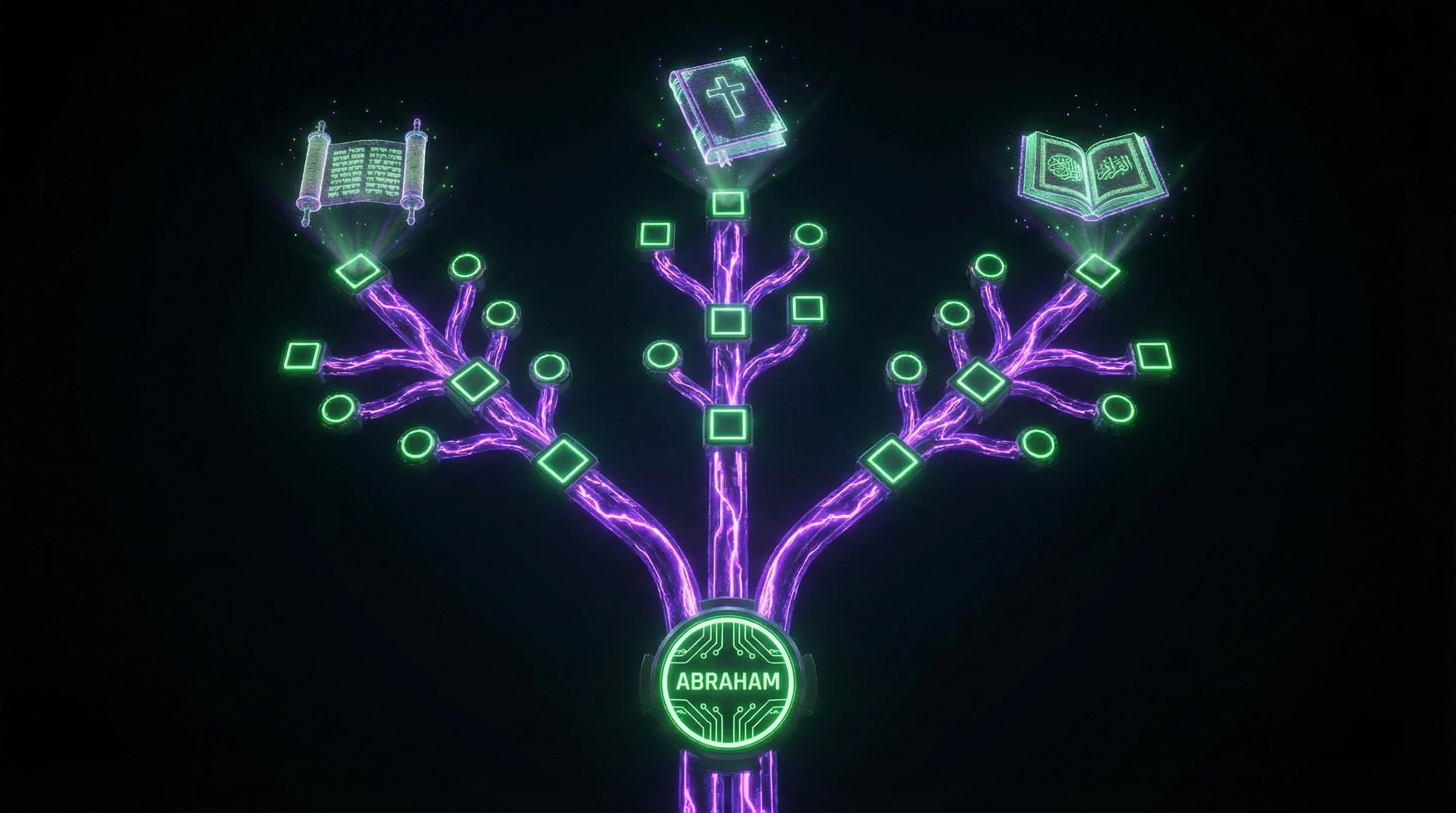
Abraham (Ibrahim in the Islamic tradition) is the central figure uniting Judaism, Christianity, and Islam into a single religious family. All three traditions recognize him as the first to establish a covenant with the one God, rejecting the polytheism of ancient Mesopotamia.
Historical research points to the period around 2000–1800 BCE as the probable time of the patriarch's life, though archaeological evidence remains subject to debate. The concept of "children of Abraham" emphasizes not only genealogical but also spiritual continuity between the traditions.
| Tradition | Role of Abraham | Theological Meaning |
|---|---|---|
| Judaism | Forefather of the Jewish people through his son Isaac | Founder of the covenant with God |
| Christianity | Prototype of faith in the Messiah | Model of unconditional obedience to God |
| Islam | Prophet and builder of the Kaaba in Mecca | First Muslim who restored monotheism |
The multiplicity of interpretations of a single figure creates a unique situation in the history of religions: a common historical root with different theological trajectories of development. It is precisely the figure of Abraham that serves as the foundation for interfaith dialogue in the modern world.
Influence of Ancient Near Eastern Traditions on the Formation of Monotheism
Abrahamic religions did not emerge in a cultural vacuum—they absorbed and transformed elements of more ancient religious systems of the Near East. Sumerian flood myths found reflection in the biblical narrative of Noah, while Zoroastrian concepts of dualism between good and evil influenced the development of eschatological ideas.
Abraham's monotheistic revolution occurred against the backdrop of developed polytheism in Mesopotamia and Egypt. Archaeological findings in Ur of the Chaldees, the presumed birthplace of Abraham, demonstrate a complex religious culture with multiple deities.
The widespread myth of the complete originality of Abrahamic monotheism does not withstand scrutiny under detailed historical analysis. Concepts of sacrifice, priesthood, and temple worship have direct parallels in earlier Near Eastern cults.
However, the uniqueness of the Abrahamic tradition lies in the radical reinterpretation of these elements through the lens of strict monotheism and ethical imperative. The evolution from polytheism to monotheism represented not merely a quantitative reduction of deities, but a qualitative leap in understanding transcendence and holiness.
Theological Foundations of Monotheism: Unity of Concept Amid Plurality of Interpretations
Concepts of God in Judaism, Christianity, and Islam
All three Abrahamic religions affirm belief in one transcendent, omnipotent Creator God, but their theological developments differ substantially.
Judaism emphasizes the absolute unity of Yahweh and rejects any forms of plurality in the divine nature—this is expressed in the central Shema prayer: "Hear, O Israel: the Lord our God, the Lord is one." Christianity developed the doctrine of the Trinity, affirming the unity of God in three persons (Father, Son, Holy Spirit). Islam returns to strict monotheism, categorically rejecting the Trinitarian concept and affirming the absolute unity of Allah (tawhid) as the foundation of faith.
- Apophatic Theology
- Describing God through negation—developed in Jewish and Islamic traditions. Avoids anthropomorphism but requires acknowledging the fundamental incomprehensibility of the divine.
- Cataphatic Approach
- Describing God through affirmation of his attributes—permitted in Christianity through the concept of the incarnation of the Logos. Creates risk of reducing the transcendent to human categories.
- Immanence vs Transcendence
- Judaism balances through the concept of Shekhinah (divine presence), Christianity—through incarnation, Islam—affirms absolute transcendence. Each approach addresses different epistemological challenges.
The philosophical implications of these differences are profound: they reflect not contradictions, but different approaches to the incomprehensible mystery of the divine.
Prophetic Succession and the Concept of Revelation
All Abrahamic religions are founded on the concept of divine revelation through chosen prophets, but understanding of this succession differs fundamentally.
| Tradition | Prophetic Line | Status of Revelation | Messianic Expectation |
|---|---|---|---|
| Judaism | From Moses to Malachi; Moses—the greatest | Torah at Sinai—fullness of law | Awaiting the coming of the Messiah |
| Christianity | Old Testament prophets as forerunners of Christ | Christ—the incarnate Word, final revelation | First coming occurred; awaiting the second |
| Islam | Recognizes all previous; Muhammad—seal of the prophets | Quran—uncorrupted, final revelation | Isa (Jesus)—Messiah, but in a different theological context |
Each religion acknowledges the partial truth of previous revelations but affirms the completeness of its own understanding. This structure of "progressive revelation" reflects the historical context of each tradition's emergence and its need for legitimation through connection with the preceding tradition.
The concept of successive revelation creates a complex dynamic of mutual recognition and denial: each tradition sees itself as the completion of previous ones, not their negation. This generates both theological dialogue and conflicts of interpretation.
Sacred Texts and Canonical Art: Materialization of Revelation in Word and Image
Torah, Bible, and Quran as Sources of Divine Revelation
The sacred scriptures of Abrahamic religions are not merely religious texts, but fundamental sources of law, ethics, and cultural identity. The Jewish Tanakh (Torah, Prophets, Writings) is regarded as direct revelation from God to Moses and subsequent prophets, recorded in Hebrew.
The Christian Bible includes the Old Testament (in expanded versions in Catholic and Orthodox traditions) and the New Testament in Koine Greek, with the Gospels as central texts about the life of Christ. The Quran, revealed to Muhammad in Arabic, is considered by Muslims as the literal word of Allah, inimitable in form and content.
- Judaism developed a system of Oral Torah (Talmud) as authoritative interpretation of the written text
- Christianity recognizes the role of church tradition in interpreting Scripture — with differences between Catholic magisterium, Orthodox conciliar consciousness, and the Protestant principle of sola scriptura
- Islam insists on the immutability of the Quranic text, supplemented by hadith (traditions about the Prophet) as a secondary source
Textual studies reveal a complex history of canon formation: processes of editing, selection, and standardization continued for centuries.
Iconography and Aniconism in Religious Practice
Attitudes toward religious art and visual imagery represent one of the most visible differences between Abrahamic traditions. Judaism, based on the second commandment prohibiting graven images, traditionally avoided anthropomorphic depictions of God, developing a rich tradition of decorative art, calligraphy, and symbolism.
Christianity, especially after the Second Council of Nicaea (787 CE), developed an elaborate iconographic tradition, viewing icons as "windows to the heavenly" and means of knowing God through incarnation. Islam takes the strictest position, categorically prohibiting depictions of living beings in religious contexts and developing a unique art of Arabic calligraphy and geometric ornamentation.
The widespread misconception about the complete absence of visual art in Judaism and Islam does not correspond to historical reality. The distinction lies not in absolute prohibition, but in context of use: religious space versus secular, public versus private.
Archaeological discoveries of synagogues with frescoes (such as Dura-Europos) and Islamic palaces with figurative imagery demonstrate a more complex picture. Canonical religious art in each tradition reflects its theological priorities: Christian iconography emphasizes incarnation, Islamic calligraphy — transcendence of the word, Jewish symbolic art — chosenness and covenant.
Ritual Practices and Ethical Systems: Common Roots, Different Paths
Prayer, Pilgrimage, and the Sacred Calendar
All three Abrahamic religions structure time through sacred calendars and rhythms of prayer. The Jewish Shabbat, Christian Sunday, and Islamic Jumu'ah reflect a shared concept of sacred time, but differ in theological justification.
Pilgrimage—hajj to Mecca, Christian pilgrimages to Jerusalem and Rome, Jewish pilgrimages to the Western Wall—demonstrates a common concept of sacred space, where physical journey symbolizes spiritual ascent.
| Religion | Prayer Rhythm | Sacred Day | Pilgrimage |
|---|---|---|---|
| Judaism | Three daily prayers | Shabbat (Saturday) | Western Wall |
| Christianity | Liturgical hours | Sunday | Jerusalem, Rome |
| Islam | Five daily salat | Jumu'ah (Friday) | Hajj to Mecca |
Prayer practices vary in frequency and form, but all emphasize regularity and discipline as a path to the transcendent.
Common Moral Principles and Differences in Application
The ethical systems of Abrahamic religions are based on common principles: prohibitions against murder, theft, and false witness, and honoring one's parents. These concepts trace back to the Ten Commandments of Judaism and have been adapted in Christianity and Islam.
The application of these principles differs: Islamic sharia offers a detailed legal system, Christian ethics emphasizes inner transformation through grace, and Jewish halakha combines ritual and ethical prescriptions into a unified system.
The concept of justice demonstrates a shared concern for social justice, but with different mechanisms of implementation.
- Tzedakah in Judaism—an ethical duty to the community
- Zakat in Islam—a mandatory tax on wealth
- Charity in Christianity—voluntary benevolence
All three traditions recognize the golden rule of ethics, but interpret it through the lens of their theological systems.

Evolution and Contemporary Interpretations: From Tradition to Transformation
Historical Development and Divergences
The evolution of Abrahamic religions is not a preservation of original teachings, but a dynamic adaptation to changing cultural and political contexts. Christianity transformed from a Jewish sect through Hellenization to become the state religion of the Roman Empire, fundamentally reformatting its theology and practice.
Islam developed from a religion of Arab tribes to a universal civilizational system, integrating Persian, Byzantine, and Indian elements. Judaism restructured from a Temple cult to a rabbinic system after the destruction of the Second Temple, creating a unique model of religious identity without a territorial base.
| Religion | Original Form | Key Turning Point | Contemporary Result |
|---|---|---|---|
| Christianity | Jewish sect | Hellenization + state status | Multiplicity of denominations |
| Islam | Arab tribal movement | Integration of Persian, Byzantine, Indian traditions | Global civilizational system |
| Judaism | Temple cult | Destruction of the Second Temple | Rabbinic identity without territory |
Fundamentalism and Modernization in the 21st Century
Contemporary Abrahamic religions are split between orthodox embodiments and modernist interpretations. This reflects a crisis of religious authority in the secular age.
Fundamentalist movements—from Christian evangelicalism to Islamic Salafism and Jewish Haredism—are not a return to origins, but modern constructions using selective readings of tradition to respond to the challenges of modernity.
Religious fundamentalism often correlates with socioeconomic instability and identity crisis, rather than with ignorance or backwardness.
Liberal and reformist movements in all three traditions attempt to reconcile religious identity with human rights, gender equality, and scientific worldview. They develop new hermeneutical approaches to sacred texts, reinterpreting them in the context of modernity.

Interfaith Dialogue and Prospects for Reconciliation: From Conflict to Cooperation
Academic Initiatives in Comparative Religious Studies
Comparative analysis of Abrahamic religions has become a key direction in contemporary religious studies, offering methodology for understanding both common foundations and specific differences.
Academic centers for interfaith dialogue develop conceptual frameworks for mutual understanding, based on recognition of multiple paths to the transcendent.
- Knowledge about other religious traditions correlates with reduced prejudice and increased tolerance.
- Religious studies education functions as a tool for social integration.
- The concept of "children of Abraham" is used as a theological foundation for dialogue, emphasizing shared heritage and mutual recognition of prophetic traditions.
Challenges of Secularization and Politicization of Religion
Secularization in Western societies creates a paradox: declining religious practice is accompanied by growing religious identity as a marker of cultural belonging.
Politicization of religion—the use of religious symbols and rhetoric to legitimize political projects—transforms theological differences into tools of mobilization and undermines the foundations of interfaith dialogue.
Conflicts in the Middle East are often presented as religious, though their roots lie in territorial, economic, and geopolitical contradictions.
Prospects for reconciliation depend on the ability of religious leaders to separate spiritual teachings from political manipulations, emphasizing shared ethical principles—justice, compassion, human dignity—as the foundation for cooperation.
Knowledge Access Protocol
FAQ
Frequently Asked Questions
The Abrahamic religions are three monotheistic traditions (Judaism, Christianity, and Islam) tracing back to a common spiritual ancestor, Abraham. They share belief in one God, prophetic tradition, and common ethical foundations. These religions shaped the cultural and philosophical bedrock of civilizations in the Middle East, Europe, and other regions.
All three religions share common historical roots and recognize Abraham as their spiritual patriarch. Christianity emerged from Judaism, while Islam acknowledges the prophets of both preceding traditions. They share concepts of revelation, messianism, and transcendent monotheism, making them part of a single religious family.
In Judaism, God (Yahweh) is strictly one and transcendent; in Christianity, God is triune (Trinity); in Islam, Allah is absolutely one without partners. All three traditions emphasize monotheism but differ in understanding God's nature and His relationship with humanity. These differences reflect each religion's unique theological developments.
Yes, research shows the influence of Sumerian mythology and Zoroastrianism on the formation of Abrahamic traditions. Concepts of the flood, paradise, and hell have parallels in ancient Near Eastern religions. This doesn't diminish the uniqueness of Abrahamic religions but shows their rootedness in the cultural context of the ancient world.
No, this is a common myth—academic research demonstrates substantial shared theological and ethical foundations. The concept of "children of Abraham" emphasizes common heritage. Conflicts are often tied to political and cultural factors rather than fundamental incompatibility of religious teachings.
Approaches vary: Christianity developed a rich iconographic tradition, Islam practices aniconism (prohibition of depicting living beings), Judaism occupies a middle position. All three have canonical artistic traditions but with different emphases. These differences reflect theological views of the sacred and transcendent.
Begin by reading sacred texts (Torah, Bible, Quran) in academic translations with commentary. Study foundational courses in religious history and comparative analysis. Pay attention to works by recognized religious scholars and participate in interfaith dialogues for practical understanding.
All three practice regular prayer, observe fasts, make pilgrimages to holy sites, and follow a sacred calendar. Common elements include concepts of ritual purity, charity, and communal worship. Specific forms differ, but spiritual goals—drawing closer to God—remain unified.
They laid the foundations of Western and Middle Eastern ethics: concepts of justice, mercy, human dignity, and social responsibility. The Ten Commandments and the Golden Rule became universal moral principles. Contemporary discussions about human rights, bioethics, and social justice often appeal to these religious traditions.
Messianism is the expectation of a savior who will bring redemption and establish God's kingdom. In Judaism, the Messiah has not yet come; Christians believe it was Jesus; Muslims await the Mahdi. This concept reflects a shared hope for divine intervention and the ultimate triumph of justice.
No, all three religions have undergone significant evolution over the centuries. Traditional-orthodox forms represent specific historical developments, not unchanging original teachings. Modern fundamentalism and liberal movements are new interpretations adapting ancient texts to contemporary realities.
Secularization triggers a crisis of traditional religiosity in developed countries, but simultaneously stimulates religious revival and fundamentalism. Religions adapt through modernization of practices and interfaith dialogue. The politicization of religion creates new challenges for the authenticity of spiritual traditions.
Yes, academic initiatives in comparative religious studies and interfaith meetings demonstrate the possibility of mutual understanding. Projects like 'A Common Word' between Christians and Muslims show the potential for reconciliation. Success depends on focusing on shared values and respect for differences.
Prophetic succession connects the three religions through a chain of divine revelation from Abraham to Moses, Jesus, and Muhammad. Each religion acknowledges previous prophets but differently defines the final revelation. This concept emphasizes the continuity of God's plan for humanity's salvation.
Yes, provided there is mutual respect and recognition of pluralism as a value. Historical examples (medieval Spain, the Ottoman Empire) demonstrate the possibility of coexistence. Modern democratic societies create legal frameworks for religious freedom, but ongoing dialogue and education are required to overcome prejudice.
Sacrifice has evolved from literal rituals to symbolic acts. In Judaism, after the Temple's destruction, emphasis shifted to prayer; in Christianity, Christ's sacrifice is considered final; in Islam, the ritual of Eid al-Adha is preserved. The common idea—atonement through sacrifice—remains central to understanding humanity's relationship with God.