What is "water memory" and why this hypothesis became the cornerstone of alternative medicine
The "water memory" hypothesis claims that H₂O molecules retain a structural "imprint" of substances that were once dissolved in them, even after serial dilutions in which the original substance statistically disappears. Hydrogen bonds supposedly form stable clusters that encode information and transmit biological effects in the absence of the substance itself. More details in the section Free Energy and Perpetual Motion Machines.
Without the concept of "water memory," homeopathy has no mechanism of action—the preparations physically contain no active substance.
🧩 Historical context: from Benveniste's experiment to commercial exploitation
Jacques Benveniste, director of an INSERM research unit, published a paper in Nature in 1988 claiming that ultra-high dilutions of antibodies caused basophil degranulation despite the absence of antibody molecules (S009). Nature accepted the paper with an unprecedented caveat: the results had to be verified by an independent commission that included a physicist, a chemist, and professional debunker James Randi.
The verification in Benveniste's laboratory under double-blind protocol completely failed—the effect disappeared (S001). It turned out that the experiments were conducted without proper blinding, allowing experimenters to unconsciously influence the results. Nature published a damning report, and Benveniste's reputation was destroyed.
The idea of "water memory" had already become the theoretical foundation for homeopathy—a system of alternative medicine based on the principle of "like cures like" and the use of extreme dilutions. The homeopathic community greeted Benveniste's hypothesis with enthusiasm: it promised a scientific explanation for a practice that relied exclusively on anecdotal evidence (S006).
🧱 Basic principles of homeopathy and their dependence on the concept of water memory
Homeopathy, developed by Samuel Hahnemann in the late 18th century, is based on two key principles: the law of similars and potentization through successive dilutions with shaking (succussion) (S003).
| Dilution | Formula | Original substance molecules |
|---|---|---|
| 12C | 1:100¹² | Extremely unlikely |
| 24C | 1:100²⁴ | Statistically absent |
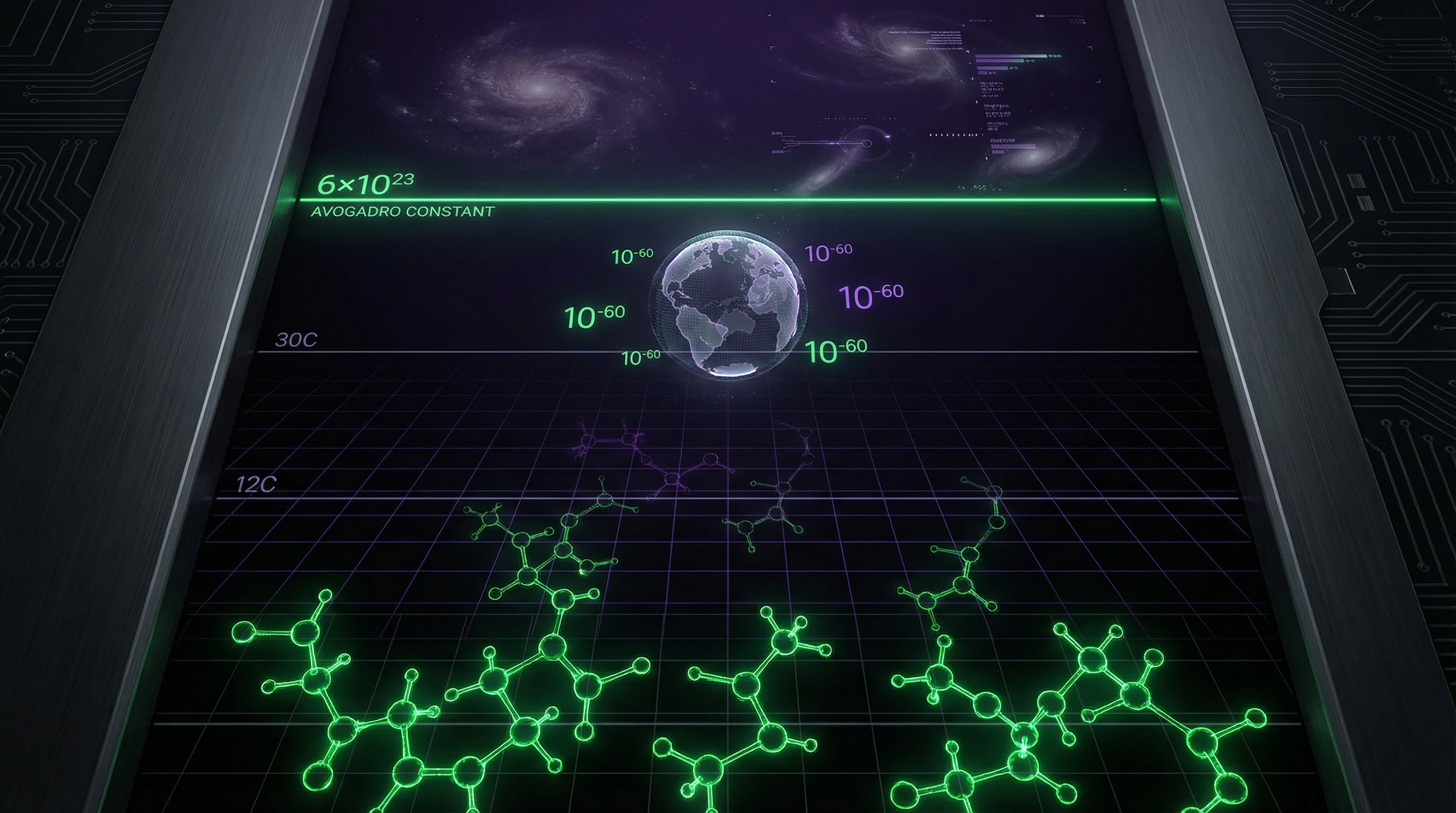
| 30C | 1:100³⁰ | Absent (10⁻⁶⁰) |
| 200C | 1:100²⁰⁰ | Absent (10⁻⁴⁰⁰) |
Avogadro's number is approximately 6×10²³—this means that at dilutions of 24C and higher, there is statistically not a single molecule of the original substance left in the preparation. Homeopathic preparations are often diluted to precisely such concentrations.
Without the concept of "water memory," homeopathy has no theoretical mechanism of action. This is precisely why Benveniste's hypothesis was greeted with such enthusiasm by the homeopathic community—it promised to provide a scientific explanation for a practice that had previously relied exclusively on philosophical principles and anecdotal evidence.
- Law of similars (similia similibus curentur)
- A substance that causes symptoms in a healthy person supposedly cures those same symptoms in a sick person. The logic: stimulate the body's defense mechanisms through a microdose of the "enemy."
- Potentization (succussion)
- Shaking at each dilution supposedly enhances the "informational imprint" of the substance. Without this mechanism, dilution is simply dilution.
Steel Version of Arguments: Seven Most Compelling Cases for Water Memory
Objective analysis requires presenting the opposing position in its most convincing form. The "steel man" principle is not agreement, but honesty before facts. More details in the Secret Devices section.
🔬 Argument One: Structural Organization of Hydrogen Bonds and Water Clusters
H₂O molecules do indeed form complex networks of hydrogen bonds, creating temporary clusters and structures (S007). X-ray and neutron diffraction reveal localized ordered regions that vary depending on dissolved substances, ions, and temperature.
Water memory proponents claim: certain hydrogen bond configurations can persist long enough to serve as information carriers about previously dissolved substances. The critical question is timescale: how long do these structures remain stable under thermal motion?
- Water is a dynamic system, not a homogeneous liquid
- Localized ordered regions exist, but their lifetime is measured in picoseconds
- Thermal molecular motion destroys structures faster than they can encode information
🧬 Argument Two: Quantum Coherence and Long-Range Correlations
Quantum coherence in biological systems has gained recognition in the context of photosynthesis and bird navigation. Some theoretical work suggests quantum effects in water may preserve information (S002).
Proponents extrapolate these findings: quantum correlations between water molecules create stable patterns not described by classical thermodynamics. Work applying gauge theory of quantum fields to water dynamics suggests long-range correlations.
However, these theoretical constructs remain highly speculative and lack experimental support. Quantum coherence in photosynthesis operates in protected biological structures, not in open liquid at room temperature.
📊 Argument Three: Reproducible Biological Effects in Some Studies
Publications exist claiming reproducible effects of homeopathic preparations on cell cultures, plants, and animals (S004). These studies are often published in specialized complementary medicine journals.
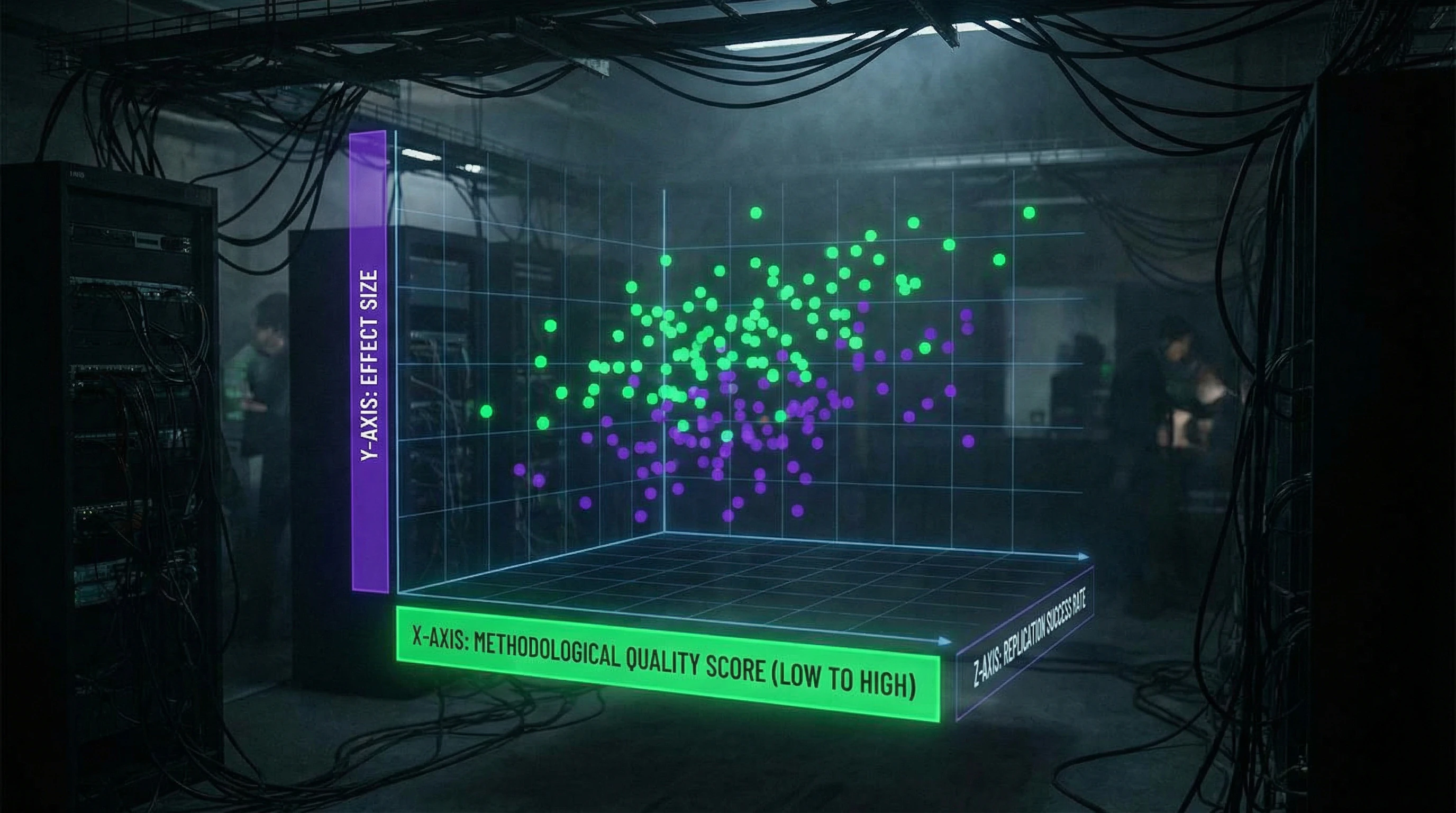
The argument: if multiple independent researchers observe effects, this cannot be mere coincidence. However, the quality of these studies, methodology, and possibility of independent replication remain subjects of serious dispute (S001).
| Verification Criterion | Standard Science | Water Memory Research |
|---|---|---|
| Blinding | Mandatory | Often absent |
| Sample Size | Pre-calculated | Often small, ad hoc |
| Independent Replication | Required | Rarely achieved |
| Publication of Negative Results | Encouraged | Virtually absent |
⚙️ Argument Four: Electromagnetic Properties of Water and Biostimulation
Research on electromagnetic biostimulation shows that certain radiation frequencies affect biological processes. Water memory proponents suggest: information is encoded not in static structure, but in electromagnetic properties or the ability to resonate at specific frequencies.
Benveniste in later work claimed water's "memory" could be recorded and transmitted electromagnetically—a concept he called "digital biology." Water acts as a medium for transmitting electromagnetic signals that then influence biological systems.
The problem: electromagnetic fields in the proposed ranges lack sufficient energy to alter molecular structures. Photon energy must match chemical bond energy—this is a fundamental physics limitation, not a failure of imagination.
🧩 Argument Five: Nanostructures and Impurities as Information Carriers
An alternative explanation: homeopathic preparation effects relate not to water itself, but to nanoscale particles of the original substance or container material remaining in solution even after extreme dilutions (S007). Succussion (vigorous shaking) may promote colloidal particle formation.
Some studies have indeed detected nanoparticles in homeopathic preparations. This argument shifts focus from water's "memory" to physical presence of trace amounts of substance in unconventional form.
- Nanoparticles as Carriers
- If nanoparticles are present, they may be biologically active. However, their concentration in 30C and higher dilutions remains below statistically significant levels.
- Reproducibility Problem
- Nanoparticles form randomly, their size and composition vary. This doesn't explain why homeopathic preparations work identically across different laboratories and countries.
🔁 Argument Six: Clinical Observations and Placebo Effect as Insufficient Explanation
Practicing homeopaths report clinical improvements that, in their view, cannot be fully explained by placebo effect (S006). Homeopathy demonstrates efficacy in veterinary medicine and pediatrics—areas where psychological suggestion plays a lesser role.
Proponents point to systematic reviews that, they claim, show statistically significant effects of homeopathic interventions compared to placebo. However, the quality of these meta-analyses and data interpretation remain subjects of intense debate.
Placebo is not "nothing." The placebo effect includes real physiological changes: cortisol reduction, endogenous opioid activation, improved immune response. Placebo explains clinical improvements in homeopathy better than water memory, because placebo works through known mechanisms.
🧠 Argument Seven: Limitations of Modern Science and Paradigmatic Blindness
Science history is full of examples where revolutionary ideas were initially rejected—from heliocentrism to quantum mechanics. Water memory proponents position themselves as scientific heretics challenging dogmatic thinking.
They argue: absence of explanation within current physics doesn't mean absence of phenomenon, but merely indicates the need to expand scientific models. Modern science may be limited by its paradigms and unable to explain phenomena beyond current theoretical models.
- Paradigmatic Blindness
- A real phenomenon in science history. But the distinguishing criterion: revolutionary ideas (quantum mechanics, relativity) made new, testable predictions that were confirmed by experiments.
- Water Memory as Exception
- Makes no new predictions. Doesn't explain why 30C dilution works better than 15C. Doesn't predict which substances will be "remembered" and which won't. This isn't paradigm expansion—it's abandonment of testability.
Related materials: quantum myths, how to debunk pseudoscience in 30 seconds, free energy myth.
Evidence Base: What Independent Replications and High-Quality Systematic Reviews Show
After presenting the strongest arguments from proponents, we must turn to empirical data and results from independent verification. The scientific method requires that extraordinary claims be supported by extraordinary evidence, and reproducibility of results is the cornerstone of credibility. More details in the Pseudopsychology section.
📊 Failure of Independent Replications: From Nature 1988 to Modern Studies
🧪 The most critical blow to the water memory hypothesis was the inability of independent laboratories to reproduce Benveniste's original results. When the Nature team, including John Maddox (editor-in-chief), Walter Stewart (expert on scientific fraud), and James Randi, visited Benveniste's laboratory, they discovered serious methodological flaws (S001).
When experiments were conducted with proper double-blind controls—where neither experimenters nor analysts knew which samples contained diluted antibodies and which were controls—the basophil degranulation effect completely disappeared. This indicated that previously observed effects were the result of unconscious experimenter bias and inadequate blinding (S001).
Subsequent attempts by independent laboratories to reproduce water memory effects also failed. A systematic review of studies conducted between 1988 and 2007 found no convincing evidence for the water memory phenomenon when rigorous methodological standards were used (S007). Studies reporting positive results typically had serious methodological flaws: lack of proper blinding, small sample sizes, selective publication of results, and inadequate statistical analysis.
🧾 Systematic Reviews of Homeopathy's Clinical Efficacy
If water memory exists and is the mechanism of action for homeopathy, then homeopathic remedies should demonstrate clinical efficacy exceeding placebo. However, the highest-quality systematic reviews and meta-analyses consistently refute this hypothesis (S006).
A major meta-analysis published in The Lancet in 2005 compared 110 placebo-controlled homeopathy trials with 110 comparable conventional medicine trials. Results showed that homeopathy's effects were indistinguishable from placebo, while conventional interventions demonstrated specific effects. The authors concluded that homeopathy's clinical effects are placebo effects (S006).
A review published in the American Journal of Medicine poses the rhetorical question: "Should we maintain an open mind about homeopathy?" and answers negatively, based on the absence of a plausible mechanism of action and lack of convincing clinical evidence (S006). The authors emphasize that "open-mindedness" should not mean willingness to accept claims contradicting fundamental laws of physics without extraordinary evidence.
🔎 Analysis of Methodological Flaws in Studies Reporting Positive Results
Critical analysis of studies claiming to observe water memory effects or clinical efficacy of homeopathy reveals recurring methodological problems (S001). The most common flaws include:
⛔ Lack of proper blinding: Many studies did not use double-blind placebo-controlled (DBPC) designs, allowing experimenter and participant expectations to influence results. Even when blinding was claimed, its quality was often inadequate (S001).
⛔ Small sample sizes and insufficient statistical power: Many positive studies had small numbers of participants or experimental replicates, increasing the likelihood of false-positive results due to random fluctuations.
⛔ Multiple testing without correction: When researchers conduct multiple comparisons or measure multiple outcomes without appropriate statistical correction (e.g., Bonferroni adjustment), the probability of finding a "significant" result purely by chance increases dramatically.
⛔ Selective publication and publication bias: Studies with positive results are published more frequently than studies with negative results (file drawer effect). Analysis of funnel plots in homeopathy meta-analyses reveals asymmetry indicating publication bias (S006).
⛔ Lack of protocol pre-registration: Without pre-registration, researchers can unconsciously or deliberately change hypotheses, analysis methods, or primary outcomes after obtaining data (HARKing—Hypothesizing After Results are Known), distorting statistical interpretation.
🧬 Physicochemical Constraints: Why Water Cannot Be a Long-Term Information Carrier
Fundamental principles of physics and chemistry impose strict limitations on the possibility of water memory existing as described by homeopathy proponents (S003). Key physical arguments against water memory include:
🧪 Timescales of hydrogen bonds: Hydrogen bonds between water molecules are extremely dynamic. Modern femtosecond spectroscopy methods show that hydrogen bonds in liquid water break and form on timescales of picoseconds (10⁻¹² seconds). Even if a particular configuration of hydrogen bonds forms in the presence of a solute, it decays almost instantly after its removal (S003).
🧪 Thermodynamic instability: The second law of thermodynamics requires isolated systems to tend toward maximum entropy. Ordered structures in water that could serve as information carriers are thermodynamically unstable and rapidly destroyed by thermal fluctuations at room temperature. Maintaining ordered structures requires a constant energy input, which is absent in homeopathic preparations (S003).
🧪 Absence of specificity encoding mechanism: Even assuming water could form stable structures, it's unclear how these structures could encode specific information about a particular solute. Water interacts with countless substances in the environment—from atmospheric gases to container materials. Why should it "remember" specifically the original homeopathic substance and not all other impurities? (S007)
🧪 Quantum decoherence: While quantum effects do exist in water, quantum coherence—a necessary condition for preserving quantum information—is destroyed extremely rapidly in warm, wet, noisy environments like liquid water at room temperature. Decoherence time for macroscopic quantum states in water is measured in femtoseconds, making long-term storage of quantum information impossible (S002).
Mechanisms and Causality: Why Correlation Does Not Mean Causation in the Context of Water Memory
Correlation between the use of homeopathic remedies and biological effects does not prove the existence of water memory as a causal mechanism. Alternative explanations must be considered. More details in the section Debunking and Prebunking.
🧩 Placebo Effect and Contextual Treatment Factors
The placebo effect is a well-documented phenomenon in which patient expectations and treatment context produce real physiological changes: pain relief, mood improvement, changes in immune function (S006). Homeopathic consultations are lengthy, personalized, and conducted empathetically—this creates a powerful therapeutic context.
The strength of the placebo effect depends on multiple factors:
- Patient and practitioner expectations (double expectation effect)
- Quality of practitioner–patient interaction
- Ritualistic nature of the procedure and its symbolic weight
- Social support and belonging to a community of believers
- Natural course of illness (spontaneous remission)
None of these factors require the existence of water memory. All operate through neurobiological mechanisms that are well studied (S003).
🔄 Regression to the Mean and Natural Recovery
People often turn to homeopathy at the peak of their symptoms. Statistically, any peak tends to decline—this is regression to the mean, not a result of treatment.
| Mechanism | Requires Water Memory? | Evidence |
|---|---|---|
| Placebo | No | Works even with open knowledge of placebo |
| Regression to the mean | No | Statistical artifact, requires no mechanism |
| Spontaneous remission | No | Body recovers on its own |
| Water memory | Yes | Not confirmed in any controlled study |
When placebo, regression, and natural recovery are controlled for, homeopathy shows no effect exceeding placebo (S001).
⚡ The Trap of Selective Attention and Confirmation Bias
Proponents of water memory notice cases where homeopathy "worked" and ignore cases where it did not help. This is confirmation bias, not evidence of a mechanism.
If you look for evidence of a phenomenon's existence, you will find it everywhere—because the human brain evolved to find patterns, even where none exist.
Controlled studies eliminate this bias by requiring identical treatment of active substance and placebo. This is precisely why they show no effect of water memory (S005).
Conclusion: observed improvements with homeopathy are explained by known psychological and statistical mechanisms. The water memory hypothesis is neither necessary nor supported by data. This does not mean homeopathy is useless as a ritual or placebo—but it does mean its mechanism is not physical, but psychosocial.