From Flying Saucers to UAP: How Terminology Changed and Why It Matters for Understanding the Phenomenon
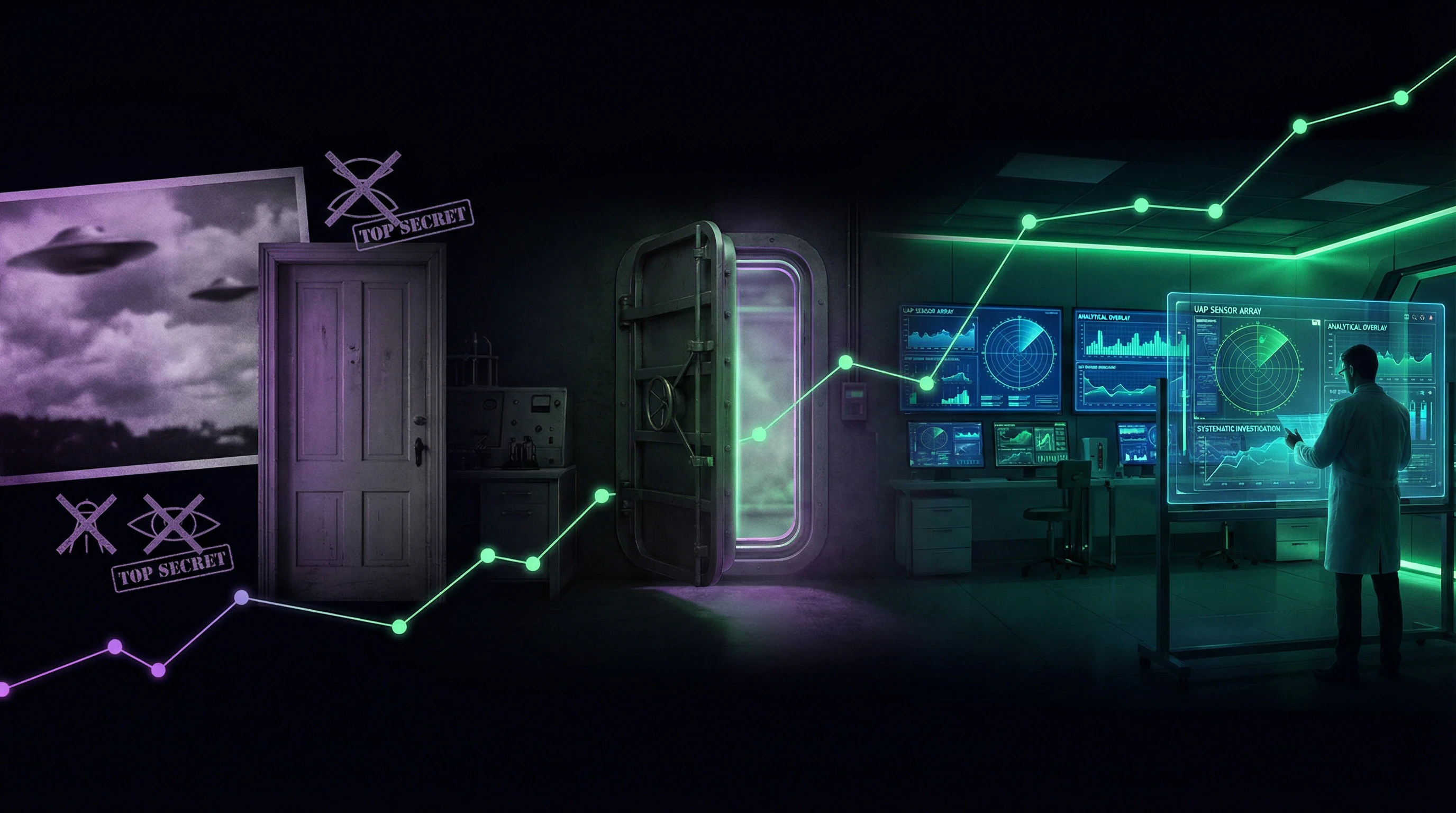
The term "UFO" (unidentified flying object) has historically been associated with alien spacecraft, conspiracy theories, and scientific marginality. This stigma has hindered serious research for decades: scientists avoided the topic fearing reputational damage, and quality data wasn't collected systematically (S008).
Modern science uses the term UAP (unidentified aerospace phenomena or unidentified aerial phenomena) to reduce cultural baggage and focus on methodology rather than speculation. More details in the Alternative History section.
- "Unidentified" in Scientific Context
- Does not mean "alien" or "unexplainable in principle." It means the observer or researcher couldn't determine the nature of the phenomenon with available information (S008). Most UAP cases receive explanations upon detailed analysis: aircraft, satellites, weather balloons, atmospheric phenomena, optical illusions, or drones. A small percentage remains unexplained not because they're exotic, but because insufficient data exists for definitive conclusions.
Contemporary research (S008) introduces the term "aerospace-undersea phenomena," acknowledging that some observed objects demonstrate capability to move between air, space, and water environments. This isn't proof of exotic origin, but recognition that classification must account for the full spectrum of observed behavior.
This approach enables data systematization and pattern identification without premature conclusions about the nature of phenomena.
In 1967, Science journal hosted a debate about whether scientific consensus existed regarding UFOs. The scientific community generally maintained skepticism toward extraordinary claims, but the debate revealed tension between public interest and scientific caution.
By 2025, the situation has changed: institutional mechanisms for data collection have emerged (such as Pentagon programs), scientific papers are being published (S008), and the topic is gradually emerging from taboo territory. This doesn't mean science has acknowledged aliens—it means science has acknowledged the necessity of studying unexplained phenomena without prejudice.
Steel Version of the Argument: Five Strongest Cases for Why Some UAPs Might Be Something Unusual
Before dismantling myths, it's necessary to honestly present the strongest arguments from proponents of the hypothesis that some UAPs have an unusual nature. This doesn't mean agreeing with them, but intellectual honesty requires examining the best versions of the opposing argument, not a straw man. More details in the section Water Memory.
🔬 Argument 1: Multiple Independent Observations with Sensor Confirmation
Some cases include simultaneous observations visually, on radar, infrared cameras, and other sensors, with data correlating across systems (S008). This reduces the probability of single-observer error or technical malfunction of a single instrument.
Examples include military incidents where pilots saw objects that were simultaneously tracked by ship and aircraft radars. Such cases are harder to explain through simple perceptual errors or isolated technical glitches.
| Sensor Type | Advantage | Limitation |
|---|---|---|
| Visual observation | Direct perception, context | Cognitive biases, visibility conditions |
| Radar | Independent of light, precise coordinates | Artifacts, interference, false returns |
| Infrared camera | Thermal signature, night operation | Reflections, atmospheric effects |
🧪 Argument 2: Observed Characteristics Beyond Known Technologies
Some UAPs demonstrate behavior difficult to explain with known aerodynamic principles: instantaneous acceleration without visible engines, sharp directional changes at high speeds without signs of inertial effects, hovering without visible means of support (S008).
If the data are accurate, this points either to unknown natural phenomena or to technologies significantly exceeding publicly known capabilities. Skeptics point to possible sensor artifacts, but proponents emphasize that not all cases have been explained this way.
📊 Argument 3: Statistical Persistence of Unexplained Residual
Even after thorough analysis and exclusion of all known explanations (aircraft, drones, meteorological phenomena, optical illusions), a small percentage of cases remain that defy classification (S001, S004). This residual is persistent across time and geography, which may indicate a real phenomenon requiring explanation.
Alternative interpretation: these are simply cases with insufficient data. But proponents argue that patterns in this residual deserve attention as signal, not noise.
🛡️ Argument 4: Institutional Recognition and Data Declassification
The U.S. government and other countries have begun officially acknowledging the existence of unexplained cases and publishing reports (S008). The Pentagon has created programs for systematic collection of UAP data.
This doesn't prove the exotic nature of the phenomena, but shows that military and intelligence structures consider the topic serious enough to invest resources. Skeptics note this may be related to concerns about adversary technologies (China, Russia) rather than extraterrestrials.
🧠 Argument 5: Testimony from Qualified Observers
Many UAP observations come from military pilots, air traffic controllers, and other professionals trained to identify objects in the sky (S001). Their testimony cannot be easily dismissed as the result of inexperience or panic.
- Experts are subject to cognitive biases, especially under stressful conditions (S006)
- Perceptual errors are possible even with highly qualified observers
- The body of evidence strengthens the argument for serious study
Evidence Base: What the Data Says When We Separate Signal from Noise
The key question: what's the qualitative difference between "we don't know what this is" and "this is something extraordinary"? The scientific method requires that extraordinary claims be supported by extraordinary evidence. More details in the Water Chemistry Myths section.
Unknown is not the same as impossible. But it's also not the same as exotic.
📊 Statistics of Explained Cases
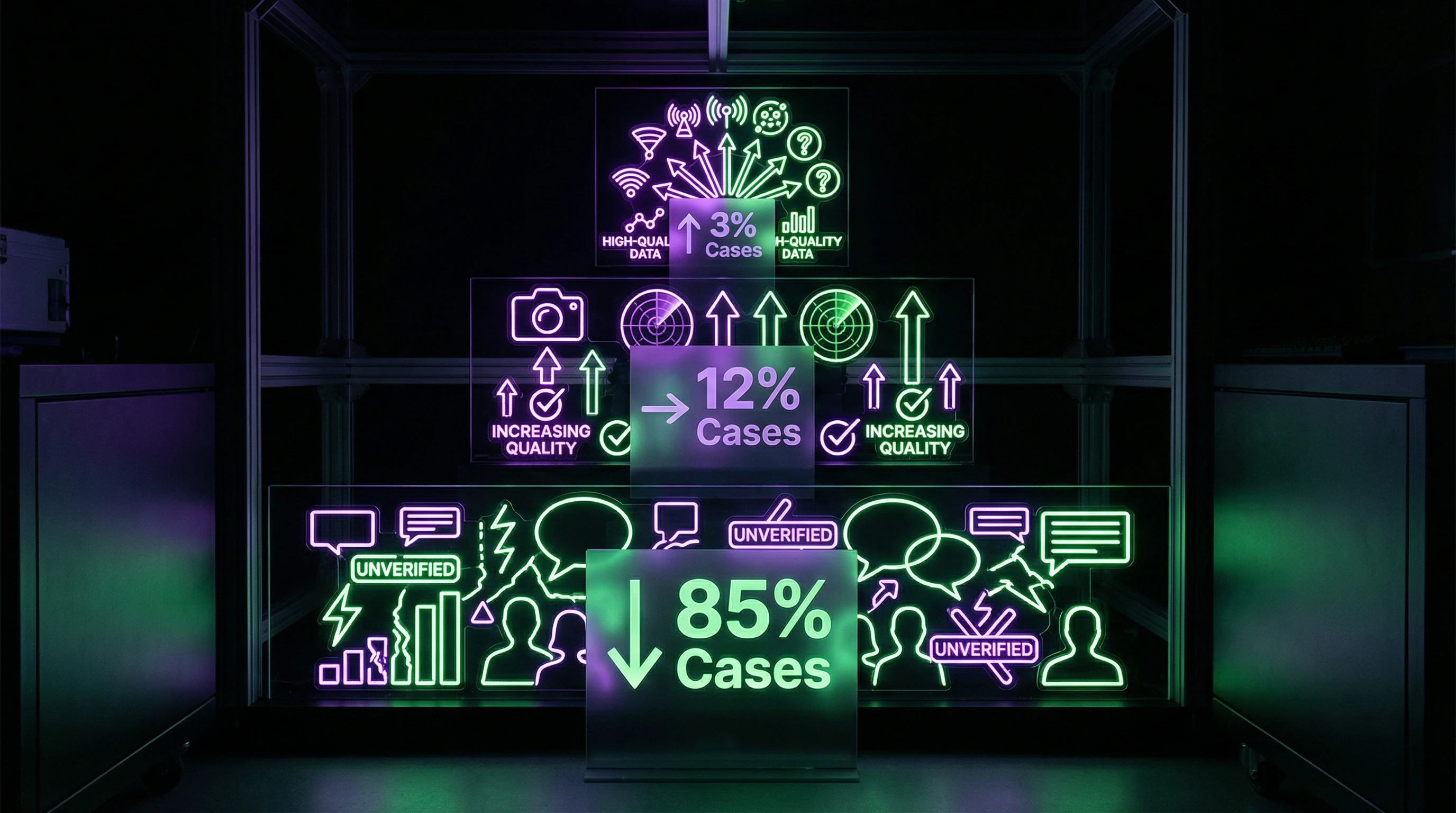
90–95% of all UFO reports receive ordinary explanations upon detailed analysis (S001). Misidentification of aircraft, satellites (especially Starlink), weather balloons, planets (Venus is a frequent "culprit"), meteors, atmospheric phenomena, drones, and birds under certain lighting conditions.
The remaining 5–10% aren't necessarily exotic. Often they're simply cases with insufficient data for a definitive conclusion.
🧾 Data Quality: Why Evidence Doesn't Hold Up to Scrutiny
The main problem with UAP research is data quality (S008). Most observations are based on eyewitness testimony without objective recordings.
| Data Source | Problem | Consequence |
|---|---|---|
| Eyewitness testimony | Human perception is unreliable: we poorly estimate distances, speeds, sizes in the sky, especially at night | Systematic errors in description |
| Video recordings | Low resolution, lack of metadata about camera parameters | Accurate analysis impossible |
| Radar data | Artifacts from atmospheric conditions or technical equipment characteristics | False targets among real ones |
🔎 The Reproducibility Problem
The scientific method requires reproducibility: a phenomenon must repeat under controlled conditions or at least predictably (S006). UAP observations are sporadic and unpredictable.
It's impossible to conduct a controlled experiment when the research subject appears randomly and disappears before quality data can be collected. This is a fundamental methodological problem that distinguishes UAP research from classical science.
🧪 Sensor Artifacts and Technical Limitations
Many "unexplained" UAP characteristics may be sensor artifacts (S008):
- Infrared cameras create glare and halos around bright heat sources
- Radars register false targets due to atmospheric conditions, cloud reflections, or interference
- Video cameras with autofocus create the illusion of movement in stationary objects
Without understanding the technical specifications of equipment and recording conditions, it's impossible to distinguish a real phenomenon from an artifact. Professional analysts account for these factors, but in public discourse they're often ignored.
🧬 Absence of Physical Evidence
If UAPs are physical objects, especially with extraordinary characteristics, physical traces should exist: debris, environmental impact, measurable effects (radiation, electromagnetic anomalies, ground traces) (S004).
Decades of observations. Convincing physical evidence—zero. Claims about "metal debris of unknown origin" either aren't confirmed by independent analysis or turn out to be ordinary materials.
This doesn't prove the phenomenon's absence, but it shows: if it exists, it doesn't leave material traces available for analysis—which is strange for physical objects.
Mechanisms and Causality: Why Correlation Between Observations and Exotic Explanations Doesn't Mean Causation
Even if some observations remain unexplained, this doesn't mean the explanation must be exotic. The logical fallacy "argument from ignorance" is that the absence of an ordinary explanation doesn't prove an extraordinary one (S006).
🔁 Confounders: What Else Can Explain the Observations
Multiple factors create the illusion of unusual phenomena without exotic hypotheses (S001, S008).
- Atmospheric Phenomena
- Inversion layers, mirages, light pillars, ball lightning (rare but documented).
- Astronomical Objects
- Bright planets, meteors, satellites at unusual observation angles.
- Technological Objects
- Classified military developments, experimental drones, high-altitude balloons.
- Psychological Factors
- Pareidolia (seeing patterns in random stimuli), expectation effects, group suggestion.
The combination of these factors creates convincing but false impressions of unusual objects.
🧷 The Base Rate Problem: Why Rare Events Seem Significant
People poorly estimate probabilities of rare events (S006). If the probability of an unusual atmospheric phenomenon is 1 in 10,000, but millions of people look at the sky daily, then hundreds of such observations per year are statistically expected.
Unusual observations are remembered and shared, creating an illusion of their frequency (availability heuristic). Some "unexplained" observations are simply statistical noise, not evidence of exotic phenomena. More details in the section Statistics and Probability Theory.
🧭 Occam's Razor: The Simplest Explanation Is Usually Correct
The principle of Occam's Razor: all else being equal, prefer the explanation requiring the fewest additional assumptions (S006).
| Explanation | Required Assumptions | Evidence Status |
|---|---|---|
| It's a drone | Drones exist (known fact) | Confirmed |
| It's an alien spacecraft | Aliens exist; overcome interstellar distances; are interested in Earth; avoid detection but are sometimes visible | Not confirmed |
A complex explanation requires proportionally stronger evidence. Until such evidence exists, simple explanations are preferable.
Absence of evidence for an ordinary explanation is not evidence of an extraordinary one.
Data Conflicts and Zones of Uncertainty: Where Sources Diverge and Why It Matters
Scientific integrity requires acknowledging that not all sources agree with each other, and not all questions have clear-cut answers. Let's examine key areas of disagreement. More details in the Media Literacy section.
🧩 Disagreement 1: Data Sufficiency for Conclusions
Sources diverge in assessing whether available data is sufficient for drawing conclusions. Contemporary UAP researchers (S008) argue that enough quality observations have been accumulated for systematic study and that some cases are genuinely unexplained.
Historical skeptics pointed out that data quality is insufficient for scientific conclusions, and most cases are explained upon thorough analysis. This disagreement reflects different standards of evidence and different assessments of available data quality.
| Position | Argument | Weakness |
|---|---|---|
| Sufficient data | Quality observations accumulated, systematization possible | Quality standards not unified |
| Insufficient data | Most cases explained upon analysis | Doesn't account for new data collection methods |
🔎 Disagreement 2: Interpreting the "Unexplained Residue"
Even acknowledging that some cases remain unexplained, researchers diverge in interpretation (S001, S004, S008). Some believe this indicates a real phenomenon requiring new explanation—possibly new physics or unknown technologies.
Others argue these are simply cases with insufficient data, and with additional information they will receive conventional explanations. A third group suggests a combination: most will receive conventional explanations, but a core of genuinely anomalous cases may remain.
Without additional data, resolving this disagreement is impossible—this is not a flaw of science, but its honesty in the face of uncertainty.
📊 Disagreement 3: The Role of Classified Technologies
There's a hypothesis that some UAP are classified military developments from the U.S., China, Russia, or other nations (S008). This would explain unusual characteristics without invoking exotic hypotheses.
However, assessing this possibility is difficult: by definition, classified technologies aren't published. Some researchers consider this hypothesis most likely for some cases.
- Argument for the classified technology hypothesis
- Explains unusual characteristics without exotic assumptions; consistent with historical experience (U-2, SR-71, F-117).
- Counterargument
- If any nation possessed technologies so far superior to known ones, this would have geopolitical consequences we would observe.
- Conclusion
- Resolving this disagreement without access to classified information is impossible—this is the boundary between science and politics.
All three disagreements share a common feature: they aren't resolved by logic or rhetoric, but require new data. This is not a weakness of UAP science, but its methodological integrity—acknowledging the boundaries of current knowledge.
Cognitive Anatomy of the Myth: What Psychological Mechanisms Make UAP Conspiracy Theories So Convincing
Understanding why people believe in exotic explanations for UAP requires analyzing the cognitive biases and psychological mechanisms exploited in conspiracy discourse. More details in the Comments and Questions section.
⚠️ Bias 1: Agency and Pattern Detection
The human brain evolved to detect agents and patterns even where none exist (S006). This is adaptive: it's better to mistakenly see a predator in the bushes than to miss a real one.
But this leads to hyperactive agency: we attribute intentions to inanimate objects or random phenomena. An unusual light in the sky is interpreted not as an atmospheric phenomenon, but as "someone watching us." This cognitive bias is the foundation of many UAP interpretations.
🧠 Bias 2: Confirmation Bias and Selective Attention
People seek, interpret, and remember information that confirms their beliefs while ignoring contradictory evidence (S006). If someone believes in aliens, ambiguous observations are interpreted in favor of this hypothesis, while mundane explanations are dismissed.
Media amplifies this effect: sensational headlines about "unexplained UFOs" receive more attention than boring explanations. This creates an information bubble where exotic explanations seem more prevalent than they actually are.
| Mechanism | How It Works | Result |
|---|---|---|
| Agency | We see intention in randomness | "Someone did this deliberately" |
| Confirmation | We seek facts supporting our version | Contradictions are ignored |
| Availability | Vivid events are better remembered | Rare seems frequent |
🕳️ Bias 3: Argument from Ignorance and False Dichotomy
The logical fallacy "argument from ignorance" consists of claiming that if something hasn't been proven false, it must be true (S006). "We can't explain this by ordinary means, therefore it's aliens."
This is a false dichotomy: there are many intermediate options (unknown natural phenomena, insufficient data, technical artifacts, classified technologies). The absence of explanation A doesn't prove explanation B. The human brain dislikes uncertainty and fills gaps with any available explanation.
🧷 Bias 4: Availability Heuristic and Availability Cascades
Vivid, emotionally charged events are better remembered and seem more frequent (S006). A dramatic "UFO" video goes viral, creating the impression that such sightings are common.
Thousands of nights when nothing unusual happens aren't remembered. This distorts perceptions of event frequency. Availability cascades occur when media coverage amplifies the perceived importance of a topic, creating a self-reinforcing cycle.
- Why This Works
- The brain conserves energy by using heuristics instead of complete analysis. This is fast but error-prone.
- Where the Trap Lies
- These mechanisms trigger automatically, even when we know about them. Awareness alone isn't sufficient protection.
- How This Relates to UAP
- Conspiracy theories exploit all four mechanisms simultaneously, creating a convincing narrative from fragments of uncertainty.
The key to resilience isn't denying these mechanisms, but protocolizing verification: a structured process that slows automatic conclusions and requires explicit separation of facts, interpretations, and assumptions.
Verification Protocol: Step-by-Step Checklist for Evaluating Any UAP Claim
Practical section: how to evaluate a specific UAP sighting claim or assertion that "this proves aliens." This protocol applies to any extraordinary claims, not just UAP.
✅ Step 1: Assess the Information Source
Who is making the claim? A peer-reviewed scientific publication, official government agency report, eyewitness testimony, social media post — each source carries different evidentiary weight.
| Source Type | Reliability | What to Check |
|---|---|---|
| Peer-reviewed article | High | Methodology, conflicts of interest, reproducibility |
| Official report (AARO, Air Force) | Medium–high | Data sources, classification limitations |
| Eyewitness testimony | Low | Observation conditions, alternative explanations, cognitive biases |
| Social media, blogs, YouTube | Very low | Author motivation, lack of verification, virality over accuracy |
High source status doesn't guarantee truth, but reduces the likelihood of intentional deception. Low status requires additional verification at every stage.
✅ Step 2: Separate Observation from Interpretation
Fact: "Object moved at 500 km/h and changed direction by 90 degrees." Interpretation: "This is an alien craft because Earth aircraft don't fly like that."
- Observation
- What was seen, heard, recorded by instruments. Verifiable, reproducible (ideally).
- Interpretation
- Explanation of the observation. Depends on knowledge, biases, available alternatives.
- Trap
- People often present interpretation as observation: "I saw aliens" instead of "I saw a strange light."
Demand from the source: pure facts first, then hypotheses. If they're mixed, that's a red flag.
✅ Step 3: Search for Alternative Explanations
Before jumping to the exotic, check the mundane. Apply Occam's razor: the simplest explanation is often correct.
- Known objects: aircraft, satellites, drones, balloons, meteors.
- Optical illusions: light refraction, pareidolia, contrast with background.
- Instrument artifacts: radar errors, camera glitches, sensor interference.
- Psychological factors: expectation, suggestion, false memories.
- Unknown but terrestrial phenomena: plasma formations, rare atmospheric effects.
- Exotic hypotheses: aliens, parallel worlds, secret technologies.
Exotic explanations go at the end of the list. If the first five points aren't ruled out, the sixth is speculation.
✅ Step 4: Check the Logic of Causality
"We don't know what this is. Therefore, it's aliens" — this isn't logic, it's an argument from ignorance. Not knowing ≠ proof of the exotic.
If an explanation requires more assumptions than available facts, it's less likely than an explanation relying on known mechanisms. This doesn't mean it's impossible — only that it requires stronger evidence.
Ask: what data would disprove this hypothesis? If there's no answer, it's not science, it's belief.
✅ Step 5: Check for Cognitive Traps
Even an honest observer can be mistaken. The brain fills in gaps, sees patterns where none exist, believes what it expects to see.
- Confirmation bias: you seek facts supporting your hypothesis, ignore contradicting ones.
- Apophenia: you see meaning in random data (e.g., in radar noise).
- Halo effect: if a source is authoritative in one area, you believe them in another (Air Force pilot talks about UAP → you believe it's aliens, though they're not an astrophysicist).
- Social proof: if many people believe something, it seems true. In reality, everyone believes the same incorrect explanation.
Use critical thinking as a tool, not as a weapon against others. Check yourself first.
✅ Step 6: Demand Reproducibility and Independent Verification
One observation is an anecdote. Multiple independent observations of the same phenomenon under identical conditions — that's the beginning of evidence.
- Reproducibility
- Can the observation be repeated? If not — it's a rare event requiring special caution.
- Independent verification
- Have other researchers checked? Did they agree or find errors?
- Data transparency
- Is raw data available for analysis? If not — why? Classification or concealment?
If a claim is based on one observation, one source, and unavailable data — it's not science, it's a story.
✅ Step 7: Final Checklist
Before believing a UAP claim, answer these questions:
- Is the source reliable? (Peer-reviewed article, official report, or social media?)
- Is observation separated from interpretation?
- Have all terrestrial alternatives been checked?
- Does the causal logic withstand scrutiny?
- Am I aware of my cognitive traps?
- Is there independent verification?
- What data would disprove this hypothesis?
If most answers are "no" or "unclear" — demand more evidence. This isn't skepticism, it's professional thinking.
Science doesn't reject UAP. Science demands evidence. The difference is that the first is a position of belief, the second is a method. The method is slower, but it works.
This protocol applies not only to UAP. Use it to evaluate any extraordinary claims: from homeopathy to quantum myths, from free energy to AI myths. The mechanism is the same: facts, logic, verification, skepticism.