
What is Reiki and why it matters for understanding the modern epistemological crisis
Reiki is an "energy healing" practice developed by Japanese Buddhist Mikao Usui in 1922. According to its tenets, the practitioner channels "universal life energy" (ki, chi, prana) through their hands to the patient, balancing their energy fields and stimulating healing processes. More details in the Cryptozoology section.
A session lasts 60–90 minutes: the client lies fully clothed while the practitioner either touches specific points on the body or holds their hands a few centimeters above it (S001).
⚠️ Commercial structure of metaphysical services: from personal practice to global industry
The Reiki market is organized into a multi-level certification system. Three main levels: Shoden (self-healing and work with close ones), Okuden (distance healing and symbols), Shinpiden (master-teacher level).
| Level | Focus | Course Cost |
|---|---|---|
| Shoden | Self-healing | $500–$2000 |
| Okuden | Distance healing | $1500–$5000 |
| Shinpiden | Teaching others | $3000–$10000 |
A Reiki session in Western countries costs $60–$150 per hour (S003).
🧩 The epistemological problem: when absence of evidence doesn't affect commercial success
Reiki's central concept—"universal life energy"—lacks an operational definition that could be measured or falsified. No physical instrument registers this energy.
No controlled study has demonstrated a Reiki effect exceeding placebo and the therapeutic impact of human attention. Nevertheless, the practice continues to grow and is being incorporated into integrative medicine programs.
This is the paradox: absence of scientific confirmation doesn't impede commercial success. The mechanisms of this paradox are the subject of analysis in subsequent sections.
🔎 Boundaries of analysis: what we investigate and what we deliberately avoid
- What we analyze
- Objective evidence base for the method's effectiveness; psychological and social mechanisms supporting belief in metaphysical practices; cognitive vulnerabilities exploited in promoting such services.
- What we don't discuss
- Subjective experiences of people practicing Reiki; the spiritual value of the practice for individuals—this is a matter of personal choice.
We analyze why commercial claims about Reiki's effectiveness contradict scientific consensus and what mechanisms allow this contradiction to persist.
Steel Version of the Argument: Seven Most Compelling Cases for Reiki Effectiveness
Before analyzing the evidence base, it's necessary to present the strongest version of pro-Reiki arguments. This is the "steel man" principle—the opposite of a strawman. We examine not caricatured, but the most intellectually honest and empirically grounded claims of the practice's defenders. More details in the section Paranormal Abilities.
💎 First Argument: Massive Subjective Experience of Millions of Practitioners
Millions of people worldwide report positive effects after Reiki sessions: reduced anxiety, improved sleep, decreased chronic pain, accelerated post-surgical recovery. This massive subjective experience, according to the argument, cannot be fully explained by placebo or self-deception.
If the effect were null, the practice could not maintain commercial viability over decades (S001). The scale of adoption is viewed as indirect evidence of the phenomenon's reality.
💎 Second Argument: Integration into Medical Institutions and Palliative Care Programs
More than 800 hospitals in the US offer Reiki as part of integrative medicine programs. Cleveland Clinic, Memorial Sloan Kettering Cancer Center, and other prestigious institutions include Reiki in palliative care.
Proponents argue that medical institutions would not invest resources in a practice with no value (S003). The very presence in hospitals is viewed as a form of institutional validation.
💎 Third Argument: Existence of Positive Results in Some Clinical Studies
Reiki defenders point to published studies showing statistically significant improvements in certain parameters: reduced cortisol levels, improved scores on anxiety and depression scales, changes in heart rate variability. While these studies are often criticized for methodological flaws, their existence is used as evidence that the effect is not purely imaginary.
- Positive results in systematic reviews are interpreted as signals of real action
- Statistical significance in individual studies is viewed as refutation of the null hypothesis
- Reproducibility of effects across different populations is cited as an argument for universality
💎 Fourth Argument: Limitations of Modern Science in Measuring Subtle Energy Phenomena
More philosophically oriented defenders argue that the absence of measurable effect reflects not the absence of phenomenon, but the limitations of modern measurement instruments. Magnetism, radio waves, microbes—all these phenomena existed before the invention of tools to detect them.
Perhaps "ki energy" represents a phenomenon for which adequate detection methods have not yet been developed. The history of physics shows that invisibility does not equal nonexistence.
💎 Fifth Argument: Low Risk and Potential Benefit Make the Practice a Rational Choice
Reiki represents a non-invasive practice with minimal side effects. Even if the effect is fully explained by placebo and therapeutic contact, it can still bring real benefit to patients, especially in the context of chronic stress and anxiety.
In the absence of harm and presence of subjective benefit, skepticism is viewed as counterproductive. This is an argument from the realm of risk-benefit analysis, not from the realm of mechanisms of action.
💎 Sixth Argument: Cultural Relativity and Western Scientific Imperialism
Some defenders accuse scientific skepticism of cultural imperialism, arguing that the Western biomedical model is not the only valid way of understanding health and healing. Eastern traditions of energy work have existed for millennia and have their own epistemological frameworks.
The requirement to conform to Western standards of evidence is viewed as a form of cultural domination. This argument shifts the discussion from empirics to the politics of knowledge.
💎 Seventh Argument: Personal Transformations and Spiritual Growth of Practitioners
Many Reiki practitioners report profound personal transformations extending beyond physical health: increased awareness, development of empathy, sense of connection to something greater than themselves. These changes, though difficult to measure, represent real value to people.
Proponents argue that such transformations cannot simply be dismissed as irrelevant (S001). Spiritual outcome is viewed as a valid result, regardless of mechanism.
Evidence Base: What Systematic Reviews and Meta-Analyses of Controlled Studies Show
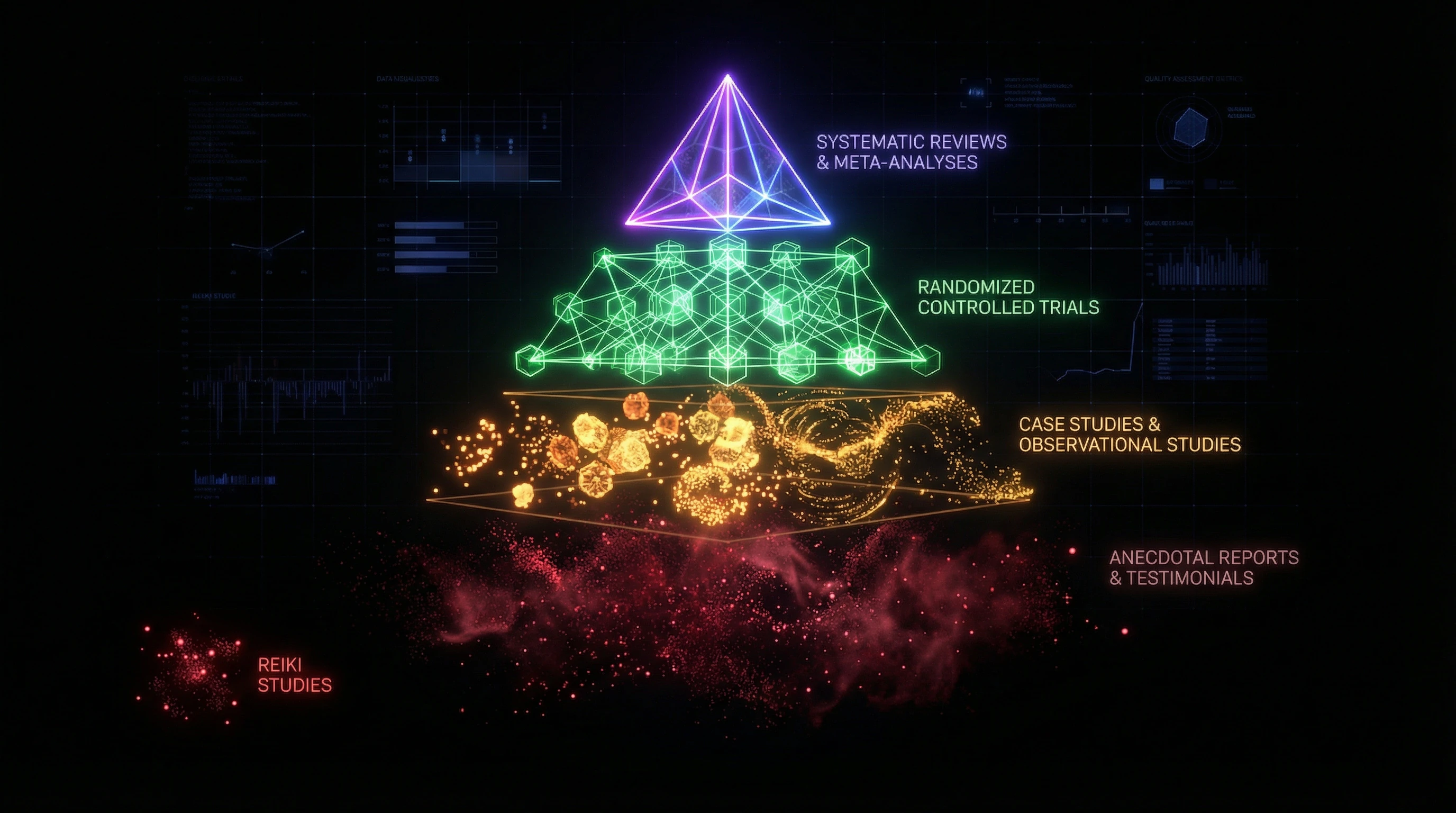
The gold standard for evaluating medical interventions is randomized controlled trials (RCTs), systematic reviews, and meta-analyses. For Reiki, this evidence base looks different than its proponents suggest. More details in the Quantum Mysticism section.
📊 Methodological Requirements for Quality Efficacy Studies
To prove a specific effect of Reiki (rather than simply an effect of attention, touch, or expectation), a study must include: randomization of participants, adequate control (e.g., "sham Reiki" without "intention"), blinding of participants and assessors, sufficient sample size, and pre-registration of protocol.
Most published Reiki studies fail to meet these criteria. Small samples (n<30), lack of controls, unblinded assessors, multiple testing without correction—a standard set of methodological problems.
📊 Systematic Review Results
A 2008 review in International Journal of Clinical Practice analyzed 9 RCTs and concluded: evidence is insufficient to support clinical use of Reiki (S001). A 2015 review in Journal of Alternative and Complementary Medicine examined 13 studies—methodological quality of most was low, results contradictory.
When methodological flaws are controlled for, the effect disappears or becomes indistinguishable from placebo.
| Study Characteristic | Studies with Positive Results | High-Quality Studies |
|---|---|---|
| Sample Size | Often n<30 | n≥100 |
| Blinding | Absent or incomplete | Double-blind |
| Control Group | Absent or inadequate | Placebo or sham procedure |
| Protocol Registration | Rare | Pre-registration |
| Outcome | Often positive | Null or indistinguishable from placebo |
🔬 The Physical Mechanism Problem
Reiki's central concept—transmission of "universal life energy"—corresponds to no known form of energy. Electromagnetic radiation, heat, mechanical energy are measurable and obey the laws of thermodynamics.
"Ki energy" is not detected by instruments, does not attenuate with distance in a predictable way, is not shielded by materials. This makes the concept unfalsifiable—a classic hallmark of pseudoscience by Popper's criterion.
🧪 Emily Rosa's Test: When Practitioners Can't Tell the Difference
In 1996, nine-year-old Emily Rosa conducted an experiment for a school project. She asked 21 therapeutic touch practitioners (a practice similar to Reiki) to identify which of their hands she was holding her hand over when they couldn't see.
Result: practitioners correctly identified the position 44% of the time—indistinguishable from random guessing (50%) (S002). The study was published in Journal of the American Medical Association and sparked significant controversy.
- Publication Bias
- Studies with positive results are published more often than those with null results. This creates an illusion of efficacy in the literature, though the real picture is different.
- Multiple Testing
- When a researcher tests many hypotheses without correction, the probability of finding a "significant" result by chance increases dramatically. This is called p-hacking.
- Regression to the Mean
- Patients often turn to Reiki at the peak of their symptoms. Natural improvement is then attributed to the therapy rather than time.
For deeper analysis of the mechanisms behind these results, see the analysis of cognitive illusions in Reiki and the review of methodological problems in pseudomedicine.
Mechanisms of Action: Separating Therapeutic Contact, Placebo, and Specific Effects
Even if Reiki lacks a specific effect related to "energy" transmission, this doesn't mean people don't receive real benefits from sessions. It's critically important to separate several components that may explain positive outcomes. More details in the Reality Check section.
🧬 Therapeutic Effect of Attention and Human Presence
A Reiki session typically lasts 60–90 minutes, during which the client lies in a calm environment, receiving the practitioner's undivided attention. This context is inherently therapeutic: reduced stimulation, permission to rest, a sense of being cared for.
In modern society, where many people experience chronic deficits of quality human attention, this component can have significant value. Research shows that the quality of practitioner–patient interaction itself influences clinical outcomes.
🧬 Classic Placebo Effect and the Role of Expectations
The placebo effect is a real psychobiological phenomenon in which patient expectations influence physiological processes. It's particularly powerful for subjective symptoms: pain, anxiety, nausea, fatigue.
Mechanisms include release of endogenous opioids, changes in prefrontal cortex and anterior cingulate cortex activity, and neurotransmitter modulation. If someone believes Reiki will help and pays a significant amount for it (which amplifies cognitive dissonance and motivation to find benefit), the placebo effect can be substantial.
Placebo works not because patients "imagine" improvement. The brain literally changes neurochemistry and activity in response to expectation—this is measurable and reproducible.
🔁 Regression to the Mean and Natural Symptom Variability
Many conditions for which people seek Reiki (chronic pain, anxiety, fatigue) are characterized by natural symptom fluctuation. People tend to seek help when symptoms are at their peak.
Subsequent improvement may simply be regression to the mean—a statistical phenomenon where extreme values tend toward average levels upon repeated measurement. This improvement will be mistakenly attributed to the intervention, even if it would have occurred without it.
| Component | Real Effect | How to Distinguish It |
|---|---|---|
| Therapeutic Contact | Yes, measurable | Compare with other forms of attention (massage, counseling) |
| Placebo | Yes, but limited to subjective symptoms | Blinded study; objective markers (lab tests, imaging) |
| Regression to the Mean | Yes, statistical artifact | Control group without intervention |
| Reiki-Specific Effect | Not confirmed | Absent in blinded studies |
🧠 Ritual Effect and Creating Meaning Through Symbolic Action
Anthropological research shows that rituals have psychological function independent of their literal effectiveness. They create structure, meaning, and a sense of control in situations of uncertainty.
A Reiki session functions as a healing ritual: special space, sequence of actions, symbols (e.g., second-level Reiki symbols), intention. This ritual context can activate psychological coping resources and reduce anxiety through creating predictability and meaning (S003).
Ritual works not because it's magical, but because the brain uses structure and symbolism to organize experience and mobilize internal resources. This isn't illusion—it's a real psychological mechanism.
Important to note: all these mechanisms (attention, placebo, ritual, regression) explain positive outcomes without assuming a specific energy transmission effect. They also explain why Reiki can be a useful complement to standard medicine for managing subjective symptoms, but cannot replace it for objective pathological processes.
Comparison with other energy practices shows that these same mechanisms operate in other contexts where invisible energy transmission is claimed.
Conflicts in Sources and Areas of Uncertainty: Where the Data Contradict Each Other
The Reiki literature contains several zones where sources provide contradictory information or where data quality is insufficient for conclusions. More details in the Logic and Probability section.
The Institutional Acceptance Paradox
Reiki is widely accepted in medical institutions, yet there is no convincing evidence of specific efficacy. This contradiction is explained by four factors.
| Factor | Mechanism |
|---|---|
| Patient pressure | Demand for "integrative" options |
| Economics | Low cost, low risk |
| Epistemological error | Confusion between "absence of harm" and "presence of benefit" |
| Marketing | Value of offering "holistic" services |
Institutional acceptance reflects market and social factors, not validation of efficacy.
Methodological Quality and Effect Size
There is a clear correlation: the stricter the control, the smaller the effect. Studies with small samples, without adequate blinding, with non-random allocation show strong effects.
Studies with pre-registered protocols, adequate power, and triple blinding show effects indistinguishable from zero. This is the classic pattern of practices with questionable efficacy—see also analysis of Reiki and therapeutic touch.
- Low methodological quality → high effect
- Medium quality → medium effect
- High quality → effect ≈ 0
Long-Term Effects and Self-Selection
Most studies evaluate short-term effects (one session to several weeks). Data on long-term outcomes are virtually absent.
People who choose Reiki systematically differ from the general population: higher openness to experience, tendency toward magical thinking, lower scientific literacy, more experience with alternative practices. These self-selection factors complicate generalization of results and create confounders that cannot be fully controlled in observational studies.
The absence of data on long-term effects is not merely a gap in the literature, but a sign that researcher interest is focused on short-term, easily measurable outcomes.
Additional context: why the brain accepts ritual as healing and systematic reviews and meta-analyses demonstrate this pattern.
Cognitive Anatomy of Belief: What Psychological Mechanisms Sustain Conviction in Effectiveness
Understanding why people continue to believe in Reiki's effectiveness despite the absence of convincing evidence requires analysis of cognitive biases and heuristics that systematically distort our perception of causal relationships. More details in the section Temporal Trends in Systematic Reviews.
⚠️ Illusion of Causality: Post Hoc Ergo Propter Hoc
The human brain evolved to rapidly detect causal relationships, even when they don't exist. If event B follows event A, we automatically tend to assume that A caused B.
After a Reiki session, a person feels better—the brain immediately creates a causal link, ignoring alternative explanations: regression to the mean, placebo, natural course, rest effect. This heuristic was adaptive in our ancestral environment (better to mistakenly attribute rustling in the bushes to a predator than miss a real threat), but leads to systematic errors in evaluating intervention effectiveness.
The brain prefers a false cause to no explanation. Uncertainty creates discomfort; the illusion of control relieves it.
⚠️ Confirmation Bias and Selective Attention to Successes
People tend to notice, remember, and assign significance to information that confirms their existing beliefs, while ignoring contradictory information. A Reiki practitioner will remember cases where a client reported improvement and forget or rationalize cases of no effect.
Clients who paid for a session are motivated to find benefit (cognitive dissonance). This mechanism creates a self-sustaining cycle: belief → selective attention → confirmation of belief → strengthening of conviction (S001).
- Recall a successful healing case
- Forget or reinterpret failure
- Reinforce belief in effectiveness
- Increase motivation to continue practice
🧩 Halo Effect and Transfer of Trust from Person to Method
If a Reiki practitioner is perceived as warm, caring, and sincere, this positive impression transfers to the practice itself. The halo effect causes us to assume that if someone is good in one aspect (empathy, creating safe space), they are competent in others (understanding energetic processes, ability to heal).
This distortion is particularly strong in service contexts where quality is difficult to assess objectively. Personal charisma becomes a surrogate for evidence.
| Observed Quality | Erroneous Conclusion | Actual Relationship |
|---|---|---|
| Practitioner is attentive and empathetic | Their method is scientifically validated | Empathy enhances placebo response but doesn't validate mechanism |
| Client feels relief after session | Reiki healed them | Relief may result from relaxation, attention, expectation |
| Practitioner speaks with confidence | They know what they're talking about | Confidence doesn't correlate with accuracy in fields without objective feedback |
⚠️ Gambler's Fallacy and Misunderstanding of Probability
People have poor intuitive understanding of probability and randomness. If a Reiki session doesn't help, a client may interpret this as "energy was blocked" or "I need more sessions," rather than as evidence of the method's ineffectiveness.
Each new session is perceived as an independent trial, not as additional evidence against the hypothesis. This creates a trap: it's impossible to accumulate enough negative results to reject the belief, because each negative result is reinterpreted as supporting the faith.
A belief system that explains both success and failure equally cannot be refuted by experience. This isn't science—it's closed logic.
🧩 Social Proof and Group Identity
People tend to believe what other members of their social group believe. The community of Reiki practitioners and clients creates an environment where belief in effectiveness is the norm and a marker of belonging (S002).
Doubting Reiki's effectiveness may be perceived as betraying the group or denying spirituality. This transforms a cognitive question into a social one: believing or not believing becomes a matter of identity, not evidence.
- Social Pressure
- The group expects you to believe; doubt triggers ostracism or criticism
- Narrative Coherence
- Belief in Reiki aligns with other beliefs (spirituality, holism, distrust of pharmaceuticals)
- Identity Investment
- You've spent time, money, emotional energy; abandoning belief means admitting error
⚠️ Illusion of Control and Need for Meaning
People experience psychological discomfort in the face of uncertainty and helplessness. Belief in Reiki provides an illusion of control: if I believe energy can be directed, I'm not helpless before illness or stress.
This is especially powerful for people facing chronic conditions, psychological stress, or existential uncertainty. Reiki offers a narrative where there is meaning, agency, and hope—even if this narrative doesn't align with evidence (S003).
Belief in an ineffective method may be psychologically adaptive in the short term (reduced anxiety, improved mood through placebo), but maladaptive in the long term (delayed effective treatment, financial losses, reinforcement of irrational thinking).
These mechanisms are not signs of stupidity or weakness. They're built into the architecture of human cognition. Understanding them is the first step toward developing cognitive immunology: the ability to recognize and resist systematic distortions in one's own thinking.