What is Reiki and Why Millions Believe in "Energy Transfer" Through Touch
Reiki (霊気, "spiritual energy") — a practice that emerged in Japan in the early 20th century, positioning itself as a method of energy healing. Practitioners claim to channel "universal life energy" through their hands to the patient, restoring balance and stimulating self-healing. More details in the Alternative History section.
Sessions involve light touch or holding hands over the body in specific positions; sometimes "distance reiki" is practiced without physical contact. Patients report relaxation, reduced pain, improved mood — but are these effects the result of specific "energy" action or psychological mechanisms?
The central claim of reiki is the existence of a specific "energy" that can be transmitted and possesses therapeutic action. This energy is not defined in terms of physics or biology, is not measured by instruments, and has no operational definition.
🧩 Historical Framework: From Mikao Usui to a Global Industry
Reiki was developed by Mikao Usui in 1922. Usui claimed he received the ability to heal after a spiritual experience on Mount Kurama. The practice spread to the West through Hawayo Takata in the 1930s and evolved into a global industry with numerous schools, certifications, and commercial offerings.
Today reiki is practiced in some hospitals and hospices as "complementary therapy," creating an illusion of medical legitimacy. This expansion into medical facilities is a key factor in growing trust, especially among patients seeking supplements to standard treatment.
- Why Reiki Attracts Millions
- The combination of ancient history, simplicity of practice, absence of side effects, and subjective improvement in well-being creates a low barrier to entry. People are willing to believe in a mechanism that requires no verification and doesn't compete with medicine but complements it.
🔎 Operational Boundaries: What Exactly Is Being Tested in Research
When researchers study reiki, they test specific claims: does reiki reduce pain more than sham treatment (when an actor performs the same movements without "intention to transmit energy")? Does reiki improve objective health indicators — blood pressure, cortisol levels, wound healing speed?
Do results differ from the effects of simple attention, touch, and expectation of improvement? (S002, S004, S006) Systematic reviews collect all available studies and apply statistical methods to identify common patterns.
- Specific reiki effect — differs from placebo and attention
- Objective markers — measurable physiological changes
- Dose-dependence — does effect strengthen with practitioner experience
- Transmission mechanism — how energy supposedly acts at a distance
These questions define what exactly falls within the scope of science and what remains beyond verification. The scientific method requires operational definitions — without them, a claim remains a belief, not a hypothesis.
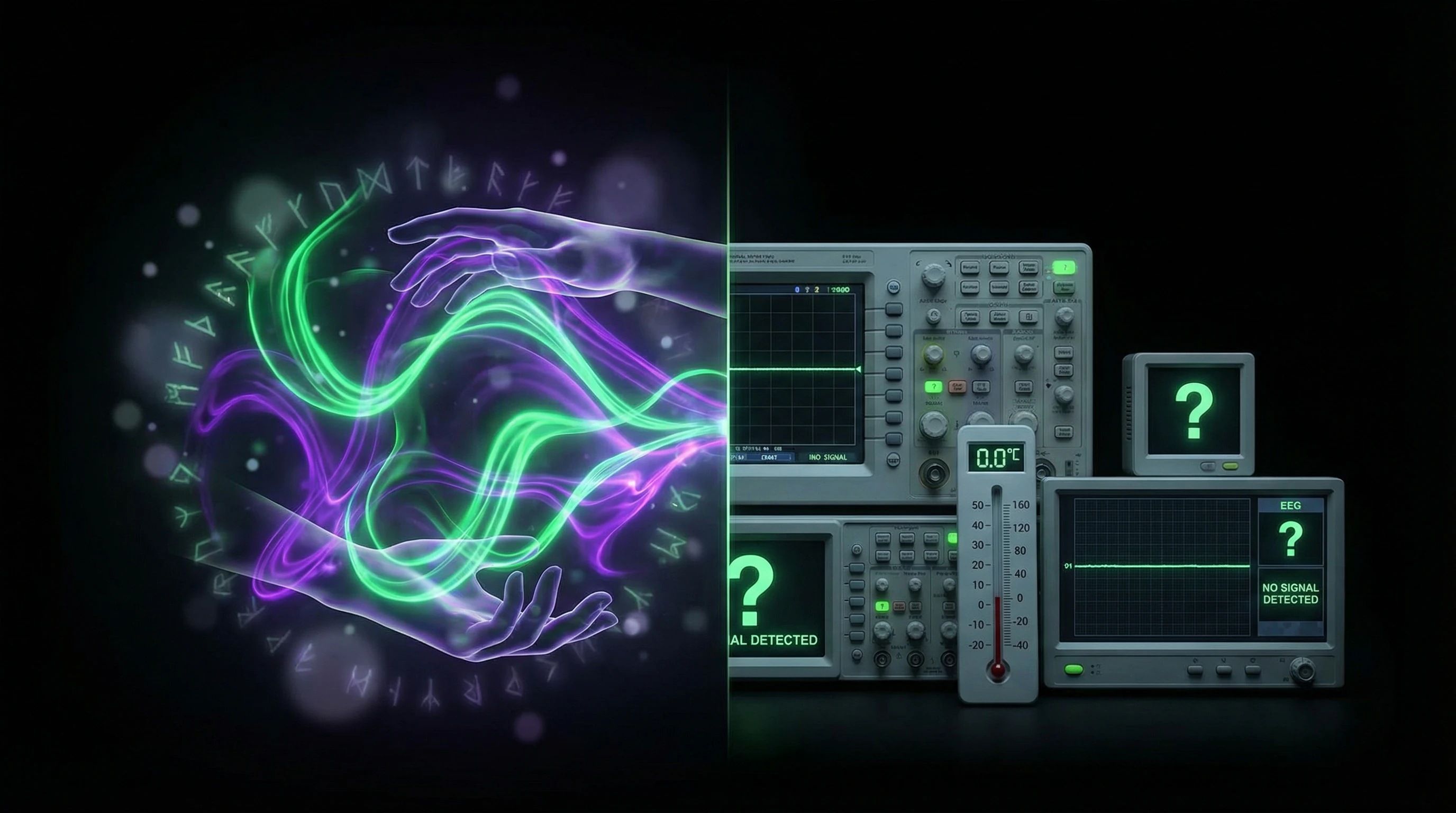
The Steel Version of Arguments for Reiki: What Proponents Say and Why It Sounds Convincing
Before examining the evidence against reiki, it's necessary to present the strongest arguments in its favor — not caricatures, but as formulated by educated and sincere proponents. This is called a "steel version" (steelman): we strengthen the opponent's position to test whether it withstands criticism even in its best formulation. More details in the Pseudoscience section.
Argument 1: Thousands of Patients Report Subjective Improvement
Reiki proponents point to the enormous number of patient testimonials from people who feel better after sessions: less pain, less anxiety, more energy. These reports are not fabrications — people genuinely experience subjective changes.
Isn't this proof of effectiveness? Proponents argue that the patient's subjective experience is a legitimate outcome that cannot be ignored, even if the mechanism is unclear.
Argument 2: Reiki Is Used in Hospitals and Hospices
Reiki is offered in some medical facilities, including major hospitals in the US and Europe, as part of palliative care or integrative medicine. Proponents argue that if medical professionals include reiki in their practice, this demonstrates recognition of its value.
Would doctors and nurses really offer something useless?
Argument 3: Studies Show Positive Results
There are individual studies that report statistically significant improvements in groups receiving reiki compared to control groups. Proponents point to these studies as proof of effectiveness.
They argue that skeptics ignore positive results and focus only on negative or methodologically weak studies.
Argument 4: Science Cannot Yet Explain Everything
Reiki proponents often appeal to the limitations of modern science: we don't fully understand consciousness, quantum effects in biology, subtle interactions between organisms. Perhaps reiki "energy" is a phenomenon that doesn't yet fit existing models, but that doesn't mean it doesn't exist.
| Proponent Position | Argument Logic |
|---|---|
| History of science is full of rejected phenomena | If they were wrong before, they could be wrong now |
| Modern science is incomplete | Lack of explanation ≠ lack of effect |
| Reiki works at a level science doesn't measure | Cannot disprove what lies outside the scientific method |
Argument 5: Reiki Is Safe and Has No Side Effects
Unlike many medical interventions, reiki causes no physical harm. Proponents argue that even if the effect is partially placebo, it's still beneficial: the patient receives attention, relaxation, stress reduction — all without risk.
Why not use reiki as a complement to standard treatment if it helps people feel better?
Argument 6: Empathic Contact and Touch Are Valuable in Themselves
Some proponents acknowledge that the mechanism may be psychological, but argue this doesn't diminish the value of the practice. Touch, attention, empathy — these are all important components of healthcare that are often ignored in modern medicine.
Reiki creates space for these elements, and that itself is therapeutic. More on the mechanisms of such effects in the article "Reiki — Energy or Cognitive Illusion."
Argument 7: Personal Experience of Practitioners
Many reiki practitioners report their own sensations of "energy flow," warmth in their hands, intuitive knowledge about where the patient has problems. They argue that this subjective experience is real and consistent, and that it cannot be fully explained by self-suggestion.
Could thousands of people, independently of each other, experience identical illusions?
These arguments sound convincing because they appeal to real phenomena: subjective improvement does occur, touch is indeed important, science is indeed incomplete. The trap is that the reality of these elements doesn't prove the specific mechanism that reiki attributes to itself. For detailed analysis of the evidence base, see the article on reiki and therapeutic touch.
Evidence Base: What Systematic Reviews and Meta-Analyses Show About Reiki's Real Effectiveness
Systematic reviews and meta-analyses are the gold standard of evidence-based medicine. They gather all available research, assess quality, exclude methodologically weak studies, and combine data for an overall picture. More details in the Pseudopsychology section.
When such reviews are applied to reiki, results are consistent: there is no convincing evidence of specific therapeutic effects beyond placebo and nonspecific factors (S002, S004).
📊 Meta-Analysis and the Problem of Methodological Quality
Meta-analyses with strict inclusion criteria reveal serious flaws in reiki studies: small samples, lack of adequate blinding, unclear randomization criteria, subjective endpoints without validated instruments.
When analysis is limited to high-quality studies only, positive effects disappear or become indistinguishable from control groups (S002). This is a classic pattern: the better the methodology, the weaker the effect.
| Study Quality | Sample Size | Blinding | Result |
|---|---|---|---|
| Low | Small | Absent | Positive effect |
| High | Large | Double-blind | Effect → 0 |
Modern approaches such as ALL-IN (Anytime Live and Leading INterim meta-analysis) update analysis in real-time as new data emerges (S002). Application to reiki shows: accumulation of quality research doesn't strengthen evidence—the effect trends toward zero.
📊 Comparison with Sham: The Key Test of Specificity
The critical test is comparison with sham reiki, where actors perform the same movements and touches but without "intention to transmit energy."
If reiki works through specific "energy," results should differ. However, studies consistently show: patients cannot distinguish "real" reiki from sham, and outcomes in both groups are statistically indistinguishable. This points to nonspecific factors: attention, touch, expectation, ritual.
If a patient cannot distinguish an intervention from its sham, the intervention has no specific mechanism of action.
🧾 Objective Health Indicators: Absence of Changes
When researchers measure objective physiological parameters—blood pressure, heart rate, cortisol levels, wound healing speed, immune markers—reiki shows no advantages over controls.
Patients' subjective reports may improve, but objective measurements remain unchanged. This is a classic sign of placebo effect: perception changes, but physiology does not.
🔬 Publication Bias
Analysis of publication bias shows: studies with positive results are published more often than those with negative results. This creates a distorted picture—it appears reiki works because failed studies remain in the "file drawer."
When researchers correct for this bias using statistical methods (e.g., trim-and-fill), the estimated effect of reiki decreases even further (S002).
📊 Empathy and Attention: Lessons from AI Chatbot Research
Recent meta-analyses compared empathy of AI chatbots and human healthcare workers in text-based scenarios. Results showed: chatbots are often perceived as more empathetic than humans, with a mean difference of 0.87 (95% CI, 0.54–1.20)—approximately two points on a 10-point scale (S004).
This demonstrates: perception of empathy and care can be elicited even by non-human agents if they follow certain communication patterns. Similarly, reiki may evoke feelings of care and improvement not through "energy," but through structured attention and ritual.
- Specific Effect
- An outcome that depends on the intervention's mechanism of action and is not reproduced by sham.
- Nonspecific Effect
- An outcome driven by attention, expectation, ritual, context—reproduced even by sham.
- Publication Bias
- Systematic distortion in literature due to positive results being published more frequently than negative ones.
Mechanisms of Subjective Improvement: Why People Feel Better Without Specific Therapeutic Effect
If Reiki has no specific therapeutic action, why do so many people report positive results? The answer lies in powerful psychological mechanisms that operate regardless of whether "energy" exists or not. For more details, see the Sources and Evidence section.
🧬 Placebo Effect: Expectation as Therapeutic Agent
The placebo effect is a real change in subjective state (and sometimes physiology) in response to the expectation of improvement. When a patient believes that Reiki will help, their brain activates endogenous opioid systems, reduces activity in areas associated with pain perception, and enhances parasympathetic activity, leading to relaxation.
These effects are real, but they don't require "energy"—only belief and context. This also explains why placebos work even when patients know they're placebos: the brain responds to the structure of the ritual and expectation, not to a physical substance.
🧬 Touch and Social Support
Human touch itself has therapeutic effects: it lowers cortisol levels, increases oxytocin, and reduces anxiety. Reiki involves prolonged, gentle touch in a calm environment—a powerful stimulus for activating social bonding and calming systems.
Patients may attribute these effects to "energy," but they're actually driven by the neurobiology of touch. Compare: massage without mysticism produces the same physiological results because the mechanism is in the contact itself, not in metaphysics.
🔁 Ritual and Structured Attention
Reiki is a ritual: specific hand positions, sequence of actions, calm environment, dedicated time. Rituals themselves have psychological effects: they create a sense of control, predictability, and care.
| Ritual Component | Psychological Effect | Requires "Energy"? |
|---|---|---|
| Dedicated time (1 hour) | Signal of your value | No |
| Structured sequence | Sense of predictability and control | No |
| Calm environment | Reduced sympathetic nervous system activation | No |
| Practitioner's attention | Social bonding activation | No |
🧠 Regression to the Mean and Natural Symptom Variability
Many people turn to Reiki during moments of peak symptoms—when pain or anxiety is particularly intense. Symptoms of chronic conditions naturally fluctuate, and after a peak, improvement often follows simply due to statistical regression to the mean.
Patients attribute this improvement to Reiki, even though it would have occurred without intervention. This is a classic trap: temporal coincidence is interpreted as causality. The Reiki session randomly coincided with a natural decline in symptoms—and the brain connected the events.
🧬 Cognitive Dissonance and Post-Hoc Rationalization
People who have paid for Reiki sessions and invested time are motivated to believe it was beneficial. Cognitive dissonance compels them to interpret any changes as positive and attribute them to Reiki.
- Investment (money, time) creates psychological pressure for consistency
- Memory selectively focuses on moments confirming effectiveness
- Contradictory data is ignored or reinterpreted
- Social pressure (stories from other believers) reinforces conviction
- Result: even without objective improvement, the subjective sense of benefit remains
This doesn't mean people are lying. They genuinely feel better—but the mechanism of this improvement is psychological, not energetic. Reiki works as a cognitive illusion, where the brain creates real relief based on expectation and context.
Understanding these mechanisms is critical for evaluating any metaphysical practices. If you feel improvement after Reiki, it may be the result of placebo, touch, ritual, or regression to the mean—all these factors work, but none require the existence of "energy." Moreover, these same mechanisms can be activated more cheaply and transparently: through evidence-based methods that are honest about what they do.
Conflicts and Uncertainties: Where Sources Diverge and What This Means for Evaluating Reiki
Not all reiki studies reach the same conclusions. Some report positive effects, others find zero. This heterogeneity requires explanation. For more detail, see the section on Statistics and Probability Theory.
Methodological Heterogeneity: Different Protocols, Different Results
Reiki studies vary across multiple parameters: session duration, number of sessions, practitioner qualifications, type of control group (no intervention, sham, standard care), measured outcomes (pain, anxiety, quality of life, physiological parameters).
This variability complicates direct comparison and may explain contradictory results. However, systematic reviews that account for this variability still find no consistent specific effect (S002, S006).
Subjective vs Objective Outcomes: Systematic Divergence
Studies relying on subjective patient reports (self-rated pain, anxiety, well-being) more frequently report positive results than studies using objective measurements (physiological parameters, clinical tests).
This divergence indicates that reiki effects are mediated by perception and expectation, not physiological changes (S004).
Blinding and Expectation Control: A Critical Problem
Many reiki studies cannot adequately blind participants: patients know whether they're receiving "real" reiki or a control intervention, and this knowledge influences their expectations and reports.
| Blinding Level | Results | Interpretation |
|---|---|---|
| Weak blinding (patient knows intervention) | Positive effects | Expectation and placebo dominate |
| Rigorous blinding (sham indistinguishable from reiki) | Smaller or zero effects | Specific effect absent |
Studies with more rigorous blinding methods show smaller or zero effects. This indicates that expectation is the key factor, not the specific action of the practice.
Divergences between studies reflect not true differences in reiki effectiveness, but differences in methodological rigor. When expectation control is strengthened, effects disappear. The scientific method requires precisely this kind of test: if an effect depends on whether the patient knows about the intervention, this is a sign of placebo, not specific action.
For practitioners and patients, this means: positive reports in unblinded studies are not evidence of specific effectiveness. They reflect the power of attention, ritual, and expectation—mechanisms that work regardless of whether reiki contains real "energy" or not. For more on cognitive mechanisms, see the analysis of reiki as a cognitive illusion.
Cognitive Anatomy of Belief in Reiki: Which Mental Traps Are Exploited and Why It's So Convincing
Belief in reiki is sustained not by evidence, but by cognitive biases and heuristics that make pseudoscientific claims intuitively appealing. More details in the section Extreme Diets.
⚠️ Confirmation Bias: Seeing Only What Confirms Belief
People who believe in reiki notice and remember cases of improvement after a session, ignoring or rationalizing the absence of effect. This selectivity creates an illusion of consistent effectiveness, even though results are random or due to other factors.
The brain doesn't register the absence of an event—only its presence. Therefore, coincidences are remembered while non-coincidences are erased.
⚠️ Post Hoc Ergo Propter Hoc Fallacy: Confusing Sequence with Causation
If improvement occurs after a reiki session, people automatically attribute it to reiki. Temporal sequence doesn't prove causation—improvement could have occurred due to natural symptom dynamics, other interventions, lifestyle changes, or chance.
Without a controlled experiment, it's impossible to establish causal connection. This is precisely why the scientific method requires controlling variables, not simply observing event sequences.
🧩 Availability Heuristic: Vivid Stories Outweigh Statistics
One vivid story about "miraculous healing" is remembered better than meta-analysis data showing no effect. The human brain evolved to process narratives, not statistics.
| Information Type | Memorability | Persuasiveness |
|---|---|---|
| Personal success story | High | High (emotional) |
| Statistics from 1000 cases | Low | High (logical) |
| Friend's recommendation | High | High (social) |
⚠️ Illusion of Control and Agency
Reiki offers a sense of control over health: you can "channel energy," "restore balance," actively participate in healing. This is psychologically appealing, especially when medicine offers few options or a person feels helpless.
The illusion of control reduces anxiety, even when there's no real control. The brain accepts ritual as healing because ritual is a form of agency, and agency is a psychological anchor.
🧩 Authority and Social Proof
When reiki is practiced in hospitals, recommended by acquaintances, or supported by a community, it creates social proof: "If so many people believe in this, there must be something to it." The authority of medical institutions transfers to the practice, even if the institutions themselves haven't rigorously tested its effectiveness.
Social proof works independently of facts. If the majority believes, the skeptical minority is perceived as ignorant or hostile.
⚠️ Narrative of "Ancient Wisdom" and Exoticism
Reiki is positioned as an ancient Japanese practice, creating an aura of authenticity and depth. Exoticism and historical depth make the practice more appealing than if it had been invented yesterday in California.
This narrative exploits a cognitive bias: we tend to trust the old more than the new, assuming that surviving practices must be effective. A similar mechanism operates in qigong and other Eastern practices.
🧩 "Double Truth" Mechanism: Scientific Language + Mystical Content
Reiki uses scientific terminology ("energy," "frequency," "vibration," "field") without scientific content. This creates an illusion of scientificity, allowing believers to feel rational while making skeptics appear ignorant.
- A scientific term is taken (energy)
- Redefined mystically (universal life energy)
- Used in scientific context (hospitals, research)
- Creates impression of scientific legitimacy
Metaphysical services thrive in the big data era precisely because they use the language of science without its methodology.
⚠️ Confirmation Loop: Belief → Search for Confirmation → Reinforcement of Belief
When a person believes in reiki, they begin searching for confirmation. Every coincidence is interpreted as proof, every non-coincidence as an exception or lack of faith. This cycle is self-reinforcing and becomes resistant to counterarguments.
Belief in reiki isn't refuted by evidence because evidence is interpreted through the lens of belief. This is a closed system, not an open hypothesis.
Prebunking—informing about cognitive traps before their activation—is more effective than attempting to refute already-formed beliefs.