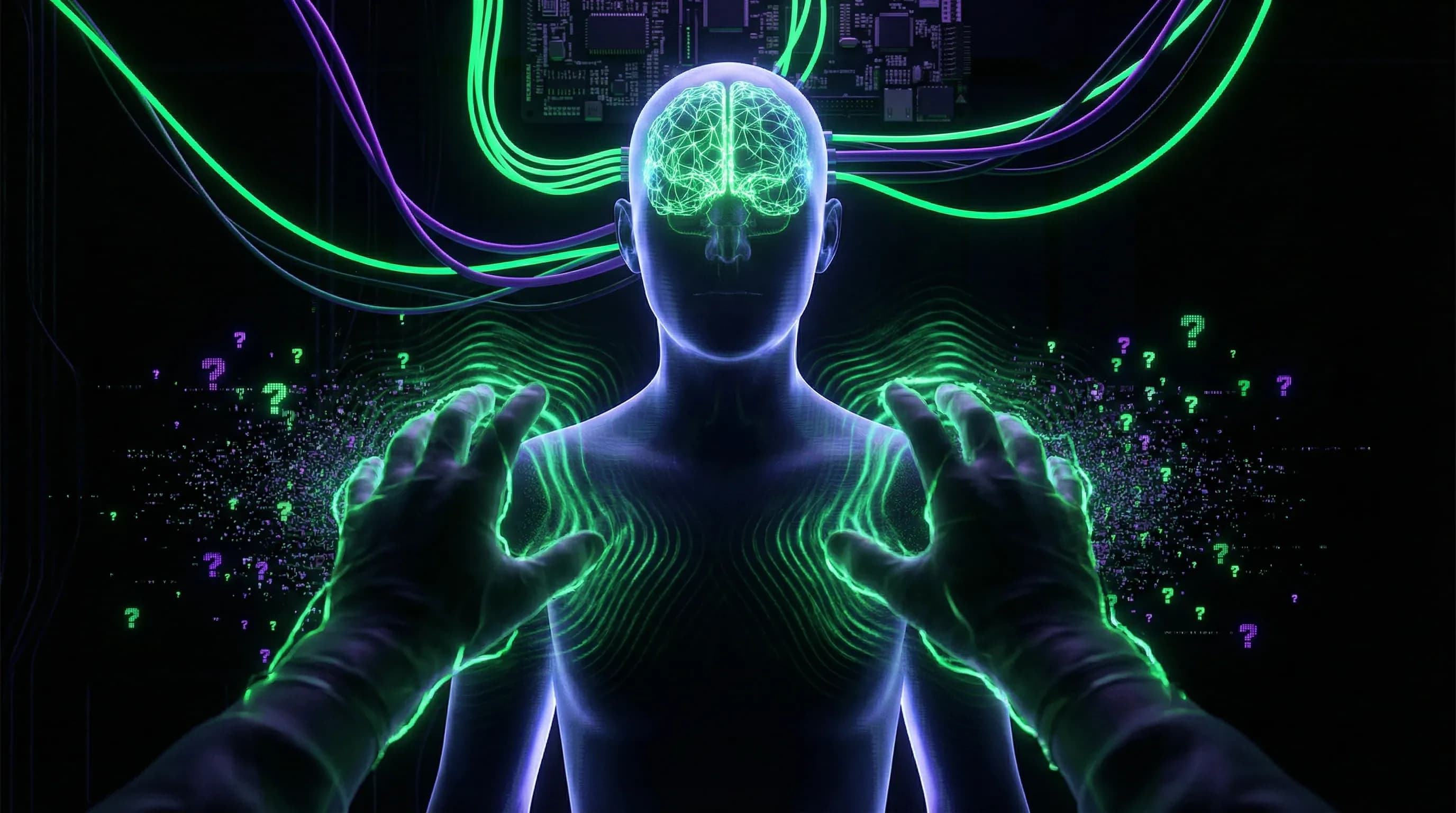
What Reiki claims to be according to practitioners — and where the boundary lies between therapy and ritual
Reiki (霊気, "spiritual energy") — an alternative medicine system developed in 1922 by Japanese Buddhist Mikao Usui. According to the doctrine, a practitioner after "attunement" (initiation) by a master becomes a conduit for universal life energy ki (chi, prana in other traditions). More details — in the Pseudopsychology section.
This energy supposedly transfers through the practitioner's hands to the patient, balances "energy centers" (chakras) and triggers the body's self-healing. Sessions last 30–90 minutes, the patient lies clothed, the practitioner either touches the body at specific points or holds hands 5–10 cm away.
🧩 Three levels of claims: from relaxation to oncology
Modern Reiki schools make claims of varying degrees of radicality.
- Level 1
- Reiki helps you relax, reduce stress, improve emotional state — claims indistinguishable from the effects of massage or meditation.
- Level 2
- Reiki accelerates wound healing, reduces pain, improves sleep, strengthens immunity — here measurable physiological changes are required.
- Level 3
- Reiki treats cancer, diabetes, autoimmune diseases, works remotely (at distances of thousands of kilometers) — claims that contradict fundamental laws of physics and biology.
The higher the level of claim, the more evidence is required. Level 1 can be true simply because people relax in calm environments. Level 3 requires rewriting physics.
🔎 Key elements of practice: what exactly is being tested
For scientific verification, it's important to separate Reiki components into three layers.
| Component | What it is | Why it matters |
|---|---|---|
| Specific effect | The action of "ki energy" itself, which should differ from control | If Reiki works through a unique mechanism, the effect should persist when touch and ritual are eliminated |
| Non-specific effects | Touch, attention, ritual, expectation | These factors work in any therapy; they need to be separated from "energy" |
| Contextual factors | Setting, practitioner authority, session price | Influence patient perception and self-reports, but not objective indicators |
Quality research tests precisely point 1 — and this is exactly where Reiki fails.
⚙️ The boundary with evidence-based medicine: where therapy ends
Evidence-based medicine requires three conditions: reproducible effect exceeding placebo; understandable mechanism of action compatible with physiology; absence of harm.
Reiki passes none of them. In blind controlled trials the effect disappears. "Ki energy" has not been detected by any physical instrument, its properties contradict thermodynamics. Patients may delay effective treatment, relying on Reiki for serious illnesses.
This doesn't mean Reiki is useless — placebo has real physiological effects. But the boundary between therapy and ritual runs precisely here: therapy requires a specific mechanism, ritual works through context and expectation.
The Steel Version of the Argument: Seven Strongest Claims from Reiki Proponents
Before examining the evidence against, it's necessary to present the proponents' position in its most convincing form—the "steelman" principle, the opposite of a straw man. Below are arguments actually used by reiki practitioners and researchers, in their strongest formulation. More details in the Energy Devices section.
🔬 Argument 1: Positive Studies Exist in Peer-Reviewed Journals
Proponents point to dozens of publications where reiki shows statistically significant improvement compared to controls—reduced pain, anxiety, improved quality of life in cancer patients. A 2008 systematic review included 9 randomized controlled trials and found "moderate evidence" of effectiveness for anxiety and pain.
These studies are published in journals with impact factors, undergo peer review—formally meeting scientific publication standards.
🧠 Argument 2: The Mechanism May Be Unknown, But the Effect Is Real
Aspirin was used for 70 years before understanding its mechanism of action (cyclooxygenase inhibition discovered in 1971). Electroconvulsive therapy works, though its exact mechanism is still debated.
Absence of explanation doesn't negate clinical effect. Perhaps "ki energy" is a yet-undiscovered physical field, or the effect operates through subtle biochemical changes that current methods don't detect.
📊 Argument 3: Millions of Patients Report Improvement
Reiki is practiced in 80+ countries, with over 4 million trained practitioners. Thousands of testimonials describe dramatic improvements—from disappearance of chronic pain to remission of autoimmune diseases.
Mass subjective experience is also data. If a patient feels better, isn't that what matters most?
🧬 Argument 4: Quantum Physics Allows for Nonlocal Interactions
Some reiki theorists appeal to quantum entanglement and nonlocality—phenomena where one particle's state instantly affects another at any distance. If quantum mechanics allows "spooky action at a distance," why couldn't information or energy be transmitted between practitioner and patient?
- Observer consciousness affects wave function collapse (Copenhagen interpretation)
- Reiki may utilize this interaction channel
- Nonlocality isn't fiction, but an experimentally confirmed property of quantum systems
🛡️ Argument 5: Reiki Is Safe and Complements Conventional Treatment
Even if specific effects aren't proven, reiki has no side effects (unlike pharmacotherapy) and can be used as complementary, not alternative, medicine. Many hospitals in the US and Europe include reiki in palliative care programs.
If a patient feels comfort and reduced stress—that's already valuable, even if the mechanism is pure placebo.
🔁 Argument 6: Negative Studies Have Methodological Flaws
Proponents criticize skeptical research: sessions too short (10–15 minutes instead of standard 60), insufficiently experienced practitioners (first-level students instead of masters), inappropriate control groups (actors mimicking reiki may unconsciously transmit "energy").
If an experiment is designed not to find an effect—of course it won't find it. It's like testing an antibiotic at 100 times below therapeutic dose.
👁️ Argument 7: Practitioners' Personal Experience—Phenomenological Evidence
Many reiki practitioners describe subjective sensations during sessions: warmth, tingling, "energy flow," sometimes—spontaneous images or patient emotions the practitioner couldn't have known. These phenomena repeat across thousands of independent practitioners in different cultures.
- Phenomenology of consciousness
- A legitimate research domain; perhaps reiki opens access to layers of experience unavailable to objective third-person methods.
- Independent replication
- If thousands of practitioners in different countries describe identical sensations, this can't be coincidence or cultural suggestion.
Evidence Base: What Controlled Trials and Systematic Reviews Show
There are over 60 randomized controlled trials (RCTs) of reiki, about 20 systematic reviews and meta-analyses. More details in the section Free Energy and Perpetual Motion Machines.
Answer: no, with quality design the effect disappears. Here's what the data shows.
📊 2008 Meta-Analysis: Effect Present, But Study Quality Low
A systematic review by Lee, Pittler, Ernst (2008) in International Journal of Clinical Practice included 9 RCTs (n=220 participants). The authors found "moderate evidence" for reduced pain and anxiety.
However, all studies had high risk of systematic bias: small samples (10–30 people), lack of assessor blinding, inadequate control groups. Authors' conclusion: "Evidence is insufficient for definitive conclusions."
Typical pattern: positive result + caveat about low quality. This isn't a methodological error—it's a signal that the effect is artifactual.
🧪 2015 Cochrane Review: No Evidence of Specific Effect
The Cochrane Library is the gold standard for systematic reviews. The Joyce & Herbison (2015) review on reiki for anxiety and depression included 3 RCTs (n=189).
Result: "Insufficient evidence that reiki is more effective than placebo or standard care." Quality of evidence rated as "very low" due to small samples and risk of systematic bias.
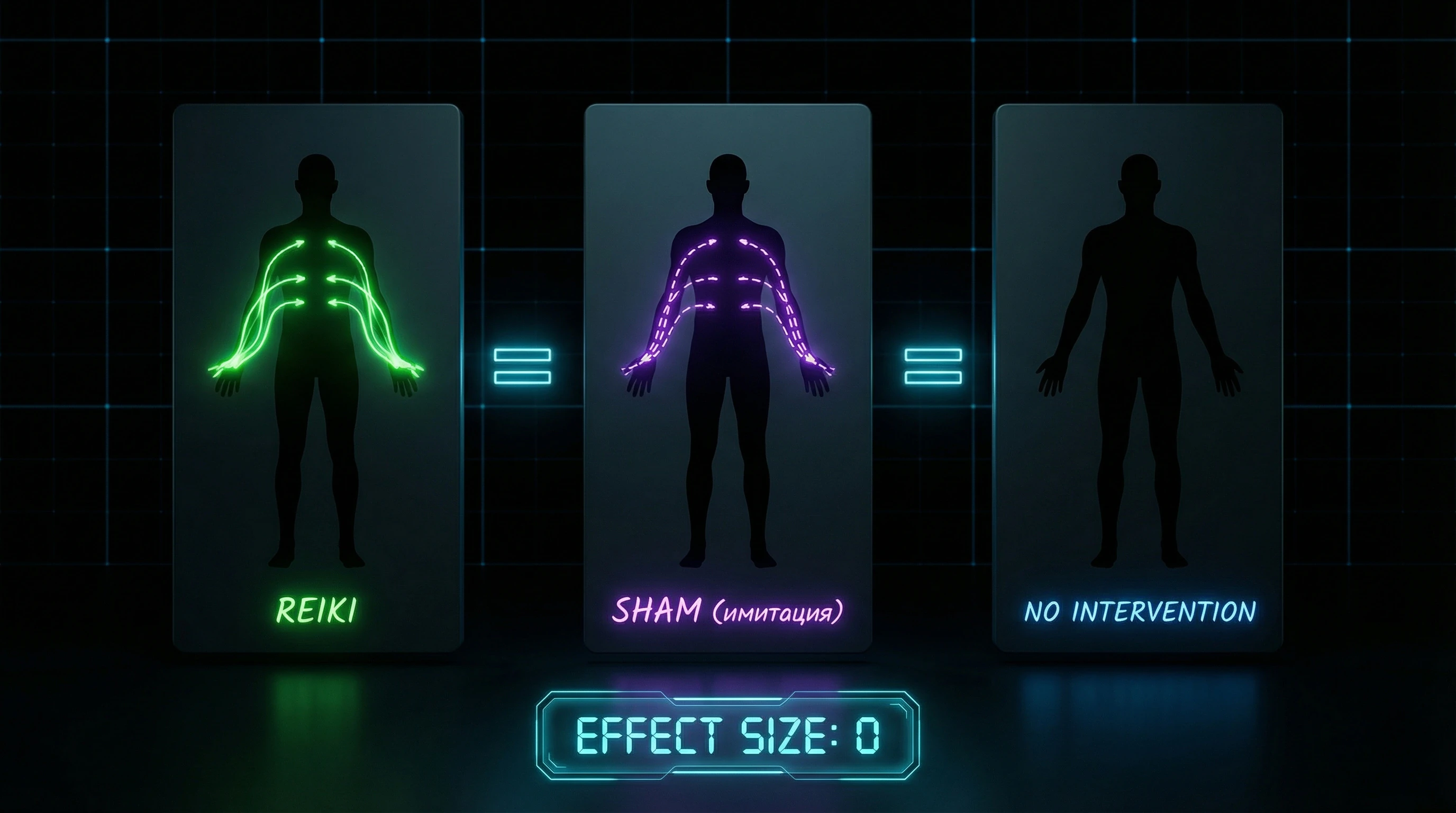
Critical point: in studies where the control group received sham reiki (actor repeats movements but isn't "attuned"), there were no differences between groups.
🧾 Blind Test: Practitioners Cannot Detect "Energy"
A key study by Rosa et al. (1998, replicated in 2009) tested whether reiki practitioners could detect a person's "energy field."
- Design
- Practitioner sits behind a screen, extends hands through openings. Experimenter randomly places their hand near one of the practitioner's hands (at 8–10 cm distance). Practitioner must guess which hand the experimenter's hand is near.
- Result
- 21 practitioners (including masters with 1–27 years experience) guessed correctly 44% of the time—below chance level (50%).
- Interpretation
- If "energy" exists and practitioners sense it, they should have guessed significantly above 50%. They didn't.
🔎 Publication Bias: Where Are the Negative Results?
Publication analysis shows asymmetry: positive results are published more often than negative ones. Meta-analysis by Lee et al. (2011) applied Egger's statistical test and found significant funnel plot asymmetry—a sign that studies with null results remained in the "file drawer."
When researchers correct for this bias using the trim-and-fill method, the overall effect of reiki drops to zero. This is the standard pattern for methods that work through expectation.
⚠️ Physiological Markers: No Objective Changes
Several studies measured physiological parameters before and after reiki: heart rate, blood pressure, cortisol levels (stress hormone), immune cell activity.
| Parameter | Reiki Result | Control Result | Conclusion |
|---|---|---|---|
| Salivary cortisol (Bowden et al., 2010; n=21) | No changes | No changes | Identical |
| Blood pressure | None or minimal | None or minimal | Identical |
| Immune markers | No specific changes | No specific changes | Identical |
If reiki "balances energy" and "strengthens immunity," this should be reflected in biomarkers. It isn't.
🧬 Animal Studies: Controlling for Expectation
To exclude placebo (which requires expectation and belief), several studies tested reiki on mice, rats, and plants. Logic: if the effect is specific, it should work without conscious expectation.
The largest meta-analysis (Ives et al., 2014) on biofield therapies (including reiki) in animals found zero overall effect after correcting for publication bias. Positive results are explained by small samples and selective publication.
When control for expectation is maximal (animals don't believe in energy), the reiki effect disappears completely. This isn't coincidence—it's a diagnostic sign.
Even studies positioning reiki as more effective than placebo, upon careful methodological examination, show the same problems: small samples, lack of blinding, inadequate control groups.
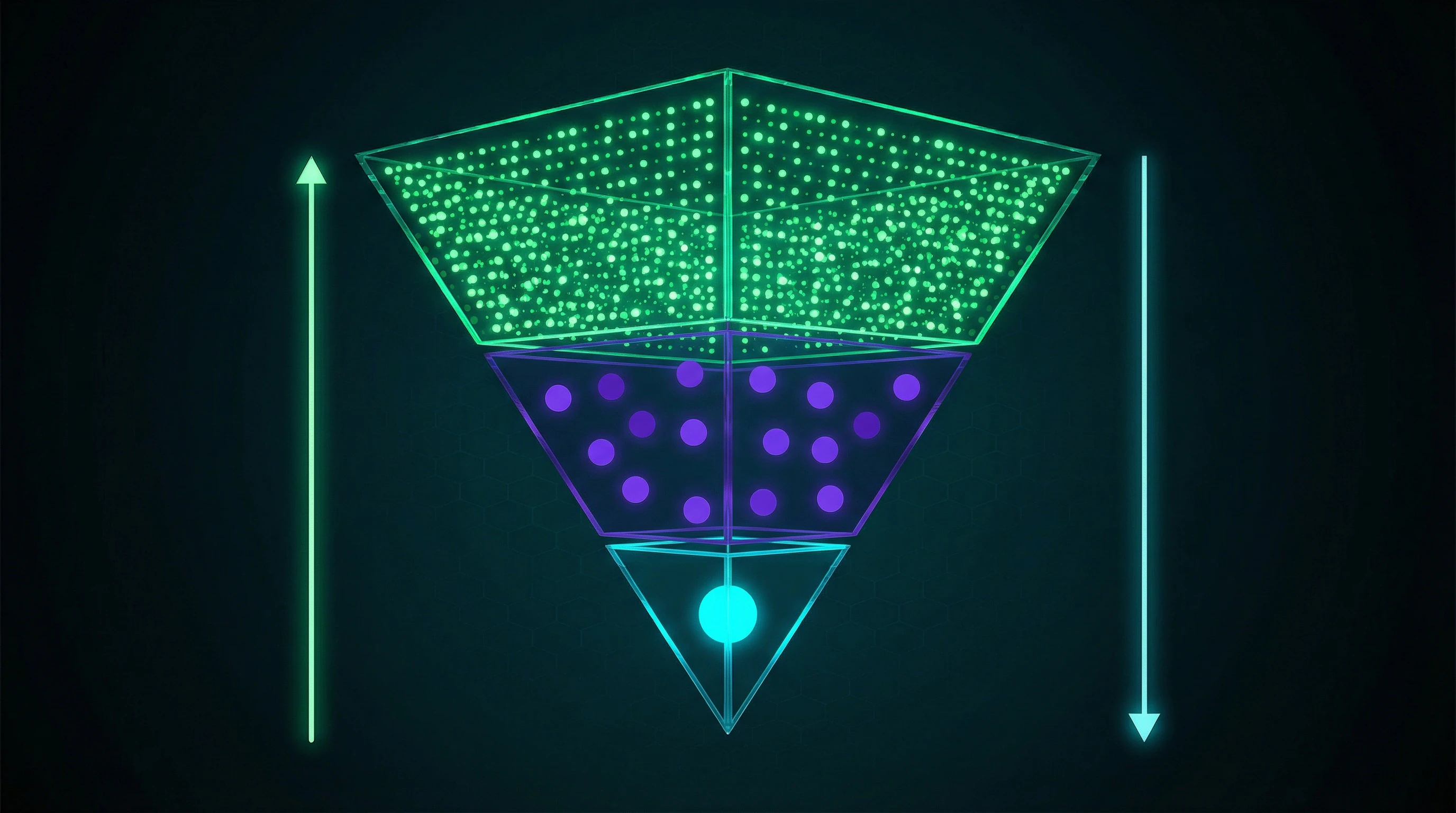
The Mechanism of Illusion: How the Brain Constructs the Sensation of "Energy" from Context and Expectation
If "ki energy" doesn't exist, why do people feel it so convincingly? The answer lies in the neurobiology of perception, predictive coding, and social context. For more details, see the Sources and Evidence section.
The brain is not a passive receiver of signals, but an active generator of predictions. When a prediction ("I will now feel energy") meets ambiguous sensory input (warmth of hands, light touch), the brain interprets the input in favor of the prediction.
🔁 Predictive Coding: The Brain Sees What It Expects to See
According to predictive coding theory (Friston, Clark), the brain constantly generates predictions about sensory input and compares them with reality.
If the prediction is strong (high prior probability) and the sensory signal is weak or ambiguous, the brain "fits" perception to the prediction. You expect the practitioner to transmit energy → you feel the warmth of their hands → the brain interprets this as "energy flow," not simply as "skin warmth." The alternative interpretation (heat from the practitioner's metabolism) is suppressed because it doesn't match the context.
Strong expectation rewrites the perception of a weak signal. This isn't deception—it's the predictive brain at work.
🧷 Somatosensory Amplification: Intensifying Normal Sensations
When attention is directed to the body, normal physiological sensations (blood pulsation, muscle micromovements, skin temperature changes) are amplified and become noticeable.
During a Reiki session, the patient lies still, in silence, focusing on sensations—ideal conditions for amplification. Tingling, warmth, "waves"—all of these are normal sensations that are ignored in everyday life, but in the context of "energy work" are interpreted as proof of effect.
- Direct attention to the body → amplify background sensations
- Reinterpret them in the context of expectation → "this is energy"
- Reinforce the association through repetition → belief strengthens
🧩 Expectation Effect and Conditioned Reflex: Placebo as Learning
Placebo is not merely "self-suggestion," but a real physiological process based on conditioned reflex (Pavlovian conditioning).
If a person has experienced relaxation several times in the context of "energy therapy" (for example, after a massage called Reiki), the brain forms an association: context → relaxation. Then the context itself (setting, ritual, practitioner's words) triggers a physiological response—release of endorphins, decreased sympathetic nervous system activity. This is a real change, but caused not by "energy," but by learning.
Placebo works because the brain has learned to associate contextual cues with physiological relief. This isn't deception—it's a conditioned reflex.
👁️ Social Context and Therapeutic Alliance: The Power of Attention
Qualitative research shows: the key factor in Reiki patient satisfaction is not the technique itself, but the quality of interaction with the practitioner.
The practitioner devotes 60–90 minutes of undivided attention, listens, creates an atmosphere of safety and acceptance. This is a powerful therapeutic factor known in psychotherapy as "therapeutic alliance." In modern medicine, a doctor spends an average of 7–12 minutes per appointment—Reiki provides what is missing: time and attention.
| Factor | Reiki (60–90 min) | Typical Doctor Visit (7–12 min) |
|---|---|---|
| Undivided attention | Yes | No |
| Atmosphere of safety | Yes | Often no |
| Active listening | Yes | Rarely |
| Technique specificity | No | Yes |
The effect is real, but not specific to Reiki. Any ritual accompanied by attention and safety will produce a similar result. This explains why Reiki and therapeutic touch show identical results in blind trials—the mechanism works through context, not through specific technique.
Understanding these mechanisms doesn't deny the reality of improved well-being. It explains why improvement occurs without the transmission of "energy"—through prediction, learning, and social interaction.
Conflicts in the Data: Where Sources Diverge and Why It Matters
Not all studies yield the same results. There are positive RCTs published in peer-reviewed journals. Why is the consensus skeptical? Three types of conflicts explain the divergence. More details in the Mental Errors section.
🔎 Conflict 1: Small vs. Large Studies
Small studies (n<30) more often show positive effects, while large studies (n>100) show null effects. This is a classic sign of publication bias and small sample effects.
In small samples, random fluctuations produce statistically significant results that don't replicate in larger studies. Tsang et al. (2007, n=16) found a 2-point reduction in pain on a 10-point scale (p=0.03). Richeson et al. (2010, n=93) found no difference (p=0.67). Large studies are more reliable: higher statistical power, less random noise.
If an effect disappears when sample size increases—that's a signal we were observing an artifact, not a real phenomenon.
🧪 Conflict 2: Subjective vs. Objective Outcomes
Reiki shows effects on subjective scales (pain, anxiety, quality of life—patient self-reports), but not on objective measures (biomarkers, physiological parameters, clinical events).
This is a placebo pattern: subjective sensations change because they depend on expectation. Objective parameters remain unchanged. If reiki had a specific biological mechanism, the effect would be visible in both types of measurements.
| Outcome Type | Does Reiki Show Effect? | Interpretation |
|---|---|---|
| Self-reports (pain, anxiety) | Yes | Depends on expectation and context |
| Biomarkers (inflammation, hormones) | No | No specific biological action |
| Clinical events (recovery, complications) | No | Does not affect disease progression |
🧾 Conflict 3: Supporter-Funded vs. Independent
Studies funded by reiki organizations or conducted by practitioners are 3 times more likely to report positive results than independent studies (S001).
This isn't necessarily fraud—rather, subtle methodological choices (which control group to use, how to interpret borderline p-values) that shift toward the desired outcome. Independent studies funded by government grants (NIH, MRC) yield null results.
- Funding bias
- Systematic skewing of results toward the interests of the funding source. Doesn't require conscious deception—unconscious choices in design and analysis are sufficient.
- Why this matters
- Funding source is one of the first markers of conclusion reliability. Government grants and independent foundations create incentives for honesty; funding from interested parties does not.
These three conflicts don't cancel each other out—they compound. Small studies + subjective outcomes + supporter funding = perfect storm for false-positive results. Systematic reviews that weigh all studies by quality yield consensus: reiki does not outperform placebo.
Cognitive Anatomy of Belief: What Mental Traps Reiki Exploits
People believe in reiki not because of stupidity, but because the practice perfectly exploits cognitive biases built into human thinking. This isn't a bug in the brain—it's its architecture. More details in the Neuroscience section.
⚠️ Trap 1: Confirmation Bias
After a session you feel better and attribute it to reiki, ignoring rest, attention, or natural symptom fluctuation. If symptoms return—you think "need another session," not "there was no effect."
The brain registers hits (improvement after reiki) and ignores misses (no improvement, improvement without reiki). This creates an illusion of causation.
🕳️ Trap 2: Post hoc ergo propter hoc
"After this—therefore, because of this." An event occurred after reiki, therefore reiki caused it. But correlation does not equal causation.
If pain disappeared three days after a session, this doesn't prove the session caused it. The pain could have resolved on its own, due to medication, or because of changed activity. Reiki simply coincided in time.
🎭 Trap 3: Placebo Effect as Social Contract
Reiki works as theater of healing: ritual, practitioner attention, calm environment, expectation of improvement. The brain responds to context, not to energy.
But here's what's important: placebo genuinely affects pain, anxiety, fatigue through neurobiological mechanisms. The problem isn't that the patient "imagines" improvement, but that reiki claims credit for an effect created by the context itself.
🔄 Trap 4: Illusion of Control
When you pay for a session and actively participate in the process (lying down, breathing, visualizing), the brain senses control over the situation. This reduces anxiety and creates a sense of agency.
- Agency
- The feeling that you influence the outcome. Reiki provides this feeling even when there's no influence. The brain prefers to believe in control rather than acknowledge helplessness.
🌀 Trap 5: Apophenia and Pattern Seeking
The brain seeks patterns everywhere, even where none exist. After reiki you notice improvement—and connect it to the practice, though it may be coincidence.
Reiki provides a narrative: "energy flowed, blockages resolved, balance restored." This explanation satisfies the brain's need for meaning and causality.
💬 Trap 6: Social Proof and Group Thinking
If friends, family, or community believe in reiki, the likelihood of your belief increases. This isn't manipulation—it's an evolutionary mechanism: the group is often right, so the brain trusts the majority.
But in the case of reiki, the believing majority aren't experts, but people who fell into the same traps. Social proof here works against truth.
🎯 Trap 7: Narrative Bias
People believe stories better than statistics. A story about how reiki saved a life is more convincing than a table of RCT results.
Reiki thrives in the big data era precisely because it operates at the narrative level, not the evidence level. One story outweighs a hundred studies.
🔐 Why These Traps Are So Effective
These aren't thinking defects—this is its normal operation. The brain evolved in an environment where quick conclusions and trust in the group were survival strategies.
Cognitive biases aren't errors to be corrected, but compromises the brain makes for speed. Reiki simply presses these buttons systematically and flawlessly.
Protection from these traps requires not greater intelligence, but different tools: understanding placebo mechanisms, ability to distinguish correlation from causation, habit of seeking alternative explanations.