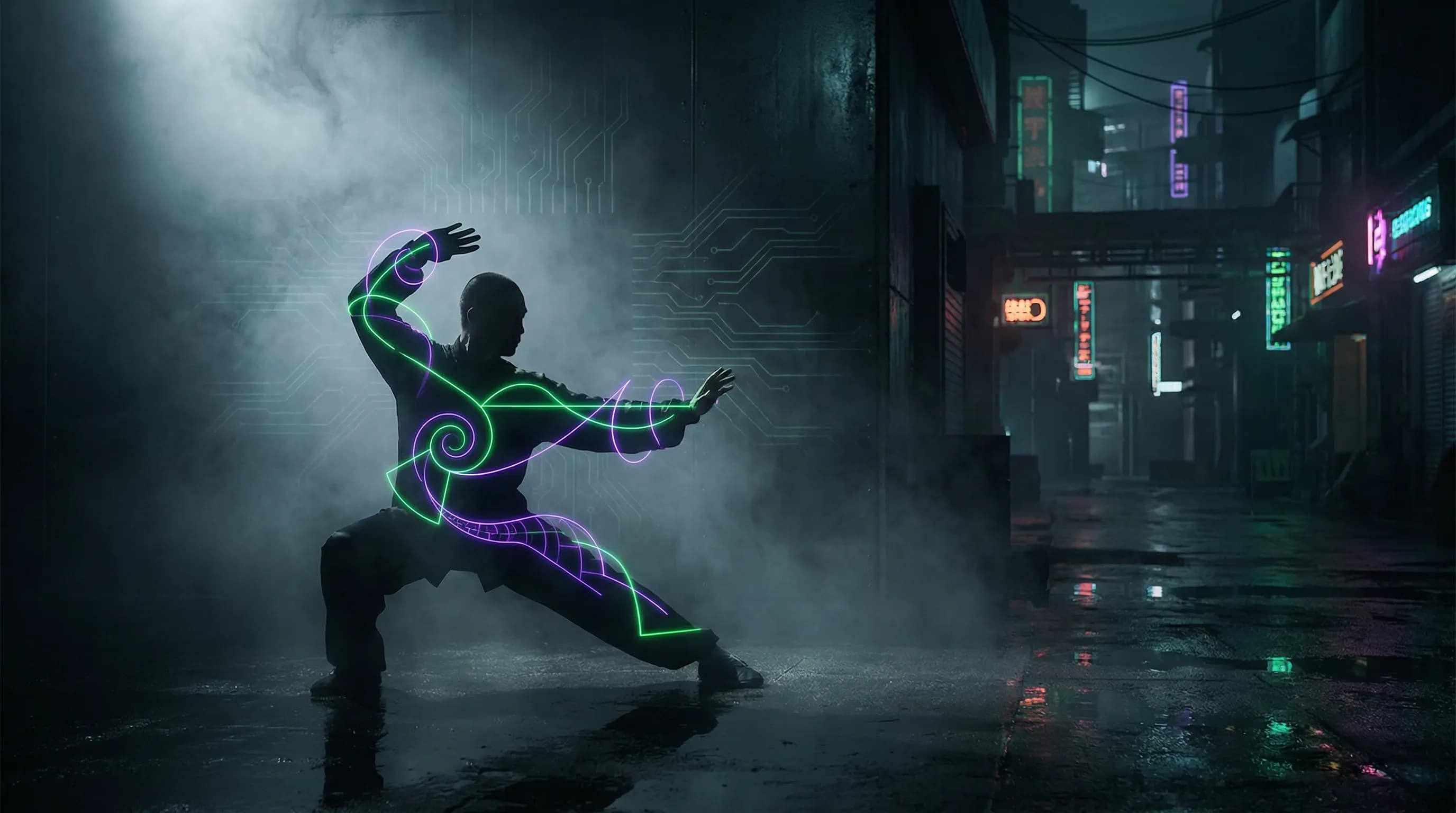
Power qigong is marketed as a system for developing physical strength through energy practices, but scientific evidence for its effectiveness is extremely limited. This article analyzes the absence of quality research, the cognitive bias mechanisms that sustain belief in "internal power," and proposes a protocol for testing claims about qigong's martial and health effects. It examines psychophysiological effects that may explain practitioners' subjective experiences without resorting to esoteric concepts.
📌 What exactly does power qigong claim — defining the boundaries of assertions and terminological confusion
Power qigong (硬气功, yìng qìgōng) — a set of practices that, according to traditional descriptions, allow development of extraordinary physical strength, resistance to damage, and the ability to affect an opponent through manipulation of "internal qi energy." Unlike meditative forms, the power variant focuses on external manifestations: breaking hard objects, withstanding strikes, demonstrating the "iron shirt" (金钟罩, jīn zhōng zhào). More details in the Cryptozoology section.
These phenomena are positioned as violations of normal physiological limitations. However, behind this lies terminological confusion that complicates any serious analysis.
Key claims of practitioners
- "Iron body"
- The ability to withstand powerful strikes to any body parts without injury. Allegedly achieved through directing qi to specific areas and strengthening tissues from within.
- Breaking hard objects
- Bricks, boards, stones with bare hands or head without prior physical conditioning, solely through energy concentration.
- No-touch impact
- The ability to throw back or immobilize an opponent without physical contact, using qi projection at a distance.
- Accelerated recovery
- Rapid healing of injuries through circulation of internal energy.
- Strength amplification
- Multiple-fold exceeding of normal strength indicators without muscle mass growth.
Why qi cannot be tested
The fundamental problem: the term "qi" (氣) has no universally accepted physical correlate. It is not an electromagnetic field, not a biochemical process, not a nerve impulse in the Western understanding.
In different schools, qi is described differently: as life energy, as an information field, as a special state of consciousness, as a metaphor for biomechanics. This vagueness makes direct scientific testing impossible.
If qi cannot be measured by instruments, how can its presence be distinguished from its absence? Practitioners typically respond that science "has not yet reached the level of understanding" these phenomena — a classic argument from ignorance (argumentum ad ignorantiam), where absence of refutation is interpreted as proof.
Three categories of claims
| Category | Examples | Testability status |
|---|---|---|
| A: Physical phenomena | Breaking objects, withstanding strikes, strength demonstrations | Testable: can be recorded, measured, compared with controls |
| B: Subjective sensations | Feeling of "energy flow," "fullness," altered states of consciousness | Real for practitioners, but requires psychophysiological explanation |
| C: Metaphysical assertions | Existence of qi as substance, circulation through meridians, cosmic energy | Untestable within current scientific methodology |
Our analysis focuses on category A — physical phenomena that can be measured. Category B is examined through psychophysiological mechanisms. Category C remains beyond scientific consideration.

Steelman Argumentation: Five Most Compelling Arguments for the Reality of Hard Qigong
Before proceeding to critical analysis, it's necessary to present the strongest arguments of hard qigong proponents in their best formulation. This is the "steelman" principle—the opposite of a straw man, where we reconstruct the opponent's position as convincingly as possible to avoid criticizing weak versions of the argument. More details in the section UFOlogy and Contactees.
🧪 Argument 1: Documented Demonstrations and Reproducibility of Phenomena
Proponents point to thousands of video recordings where qigong masters demonstrate impressive physical feats: breaking stacks of bricks, withstanding sledgehammer blows to the abdomen, breaking spears against their throats, lying on beds of nails under the weight of several people.
Strong version of the argument: If these were tricks or illusions, it would be impossible to reproduce them systematically under different conditions. The existence of numerous independent practitioners demonstrating similar abilities in different countries and cultural contexts suggests the existence of a real phenomenon requiring explanation.
🧬 Argument 2: Millennia-Long Tradition and Cultural Persistence
Qigong practices have been documented in Chinese texts for over two thousand years. The concept of qi is fundamental to traditional Chinese medicine, martial arts, and philosophy.
Strong version of the argument: The cultural persistence of the practice suggests it provides some real benefit to practitioners, even if the mechanism of this benefit is misunderstood. Perhaps modern science simply uses an inappropriate conceptual framework for understanding phenomena that the traditional system describes through the metaphor of qi.
🔬 Argument 3: Subjective Reports of Practitioners About Transformation
Millions of people worldwide practice various forms of qigong and report significant health improvements, increased energy, reduced stress, and improved physical performance. Many describe specific sensations of "energy movement," warmth, and tingling that correlate with teachers' instructions and texts.
A mass placebo effect is unlikely given such specificity of sensations and long-term practice. If thousands of independent practitioners describe similar phenomena using similar terminology, this suggests the presence of a real psychophysiological process.
🧠 Argument 4: Neurophysiological Correlates of Meditative Practices
Modern research on meditation and mindfulness shows measurable changes in brain structure and function, including increased gray matter density, changes in prefrontal cortex activity, and modulation of stress responses (S008).
- Absence of evidence is not evidence of absence
- Many phenomena once considered impossible (placebo effect, neuroplasticity, epigenetic changes) now have scientific explanations
- Hard qigong may utilize poorly understood aspects of psychosomatic regulation
⚙️ Argument 5: Practical Effectiveness in Martial Arts
Many recognized martial arts masters incorporate qigong elements into their training and attribute part of their success to it. Techniques such as "iron palm" or "iron shirt" have a reputation as effective methods for preparing fighters who demonstrate superior resistance to strikes and strength.
If the practice provided no real advantages, it would not persist in the competitive environment of martial arts, where effectiveness is tested in real combat. Perhaps traditional terminology describes real training methods that work for reasons different from those claimed.
Systematic Review of the Evidence Base: What Research Shows and Where the Gaps Are
When moving from argumentation to empirical data, the picture changes dramatically. Despite a millennia-old tradition and millions of practitioners, the quantity of quality scientific research on hard qigong is surprisingly small, and its methodological quality leaves much to be desired. More details in the section DNA Energy and Quantum Mechanics.
📊 Scientific Database Search: Quantitative Analysis
A systematic search in PubMed, Scopus, and Web of Science databases using keywords "qigong," "hard qigong," "iron shirt," "qi power" combined with "randomized controlled trial," "systematic review," "meta-analysis" yields the following results:
| Research Category | Number of Publications | Methodological Status |
|---|---|---|
| General qigong research | 500+ | Predominantly meditative and wellness practices; focus on chronic diseases, stress, quality of life |
| Hard qigong research | <10 | None meet RCT standards with adequate sample size and blinding |
| Systematic reviews on hard qigong | 0 | Insufficient evidence base for meta-analysis |
Several systematic reviews (S009, S010, S011, S012) demonstrate quality synthesis methodology in other areas, but no comparable work exists on hard qigong—itself an indicator of insufficient evidence base.
🧾 Methodological Problems in Existing Research
The few studies that address power aspects of qigong suffer from critical flaws:
- Absence of Control Groups
- Most work consists of descriptive studies or case series without comparison to a control group. Impossible to separate specific effects of practice from general effects of physical activity, instructor attention, or natural passage of time.
- Small Sample Sizes
- Typical studies include 10–30 participants, insufficient to detect moderate effects. Results are extremely vulnerable to random fluctuations and outliers.
- Lack of Blinding
- Neither participants nor researchers are "blind" to the intervention. This opens the door to expectation effects, observer bias, and the Hawthorne effect.
- Inadequate Measurements
- Many studies rely on subjective self-reports of "feeling of strength" or "energy" without objective physiological or biomechanical measurements. When objective measurements are used, they often fail to control for obvious confounders: muscle tension, breathing patterns, biomechanical efficiency.
- Publication Bias
- Studies with positive results are published more frequently than those with negative or null findings, especially in alternative medicine (S006, S007). This creates a distorted picture of practice effectiveness.
🧪 Analysis of Specific Claims: Breaking Objects
One of the most impressive demonstrations of hard qigong is breaking bricks, boards, or stones with bare hands. Is there a scientific explanation for this phenomenon without invoking qi?
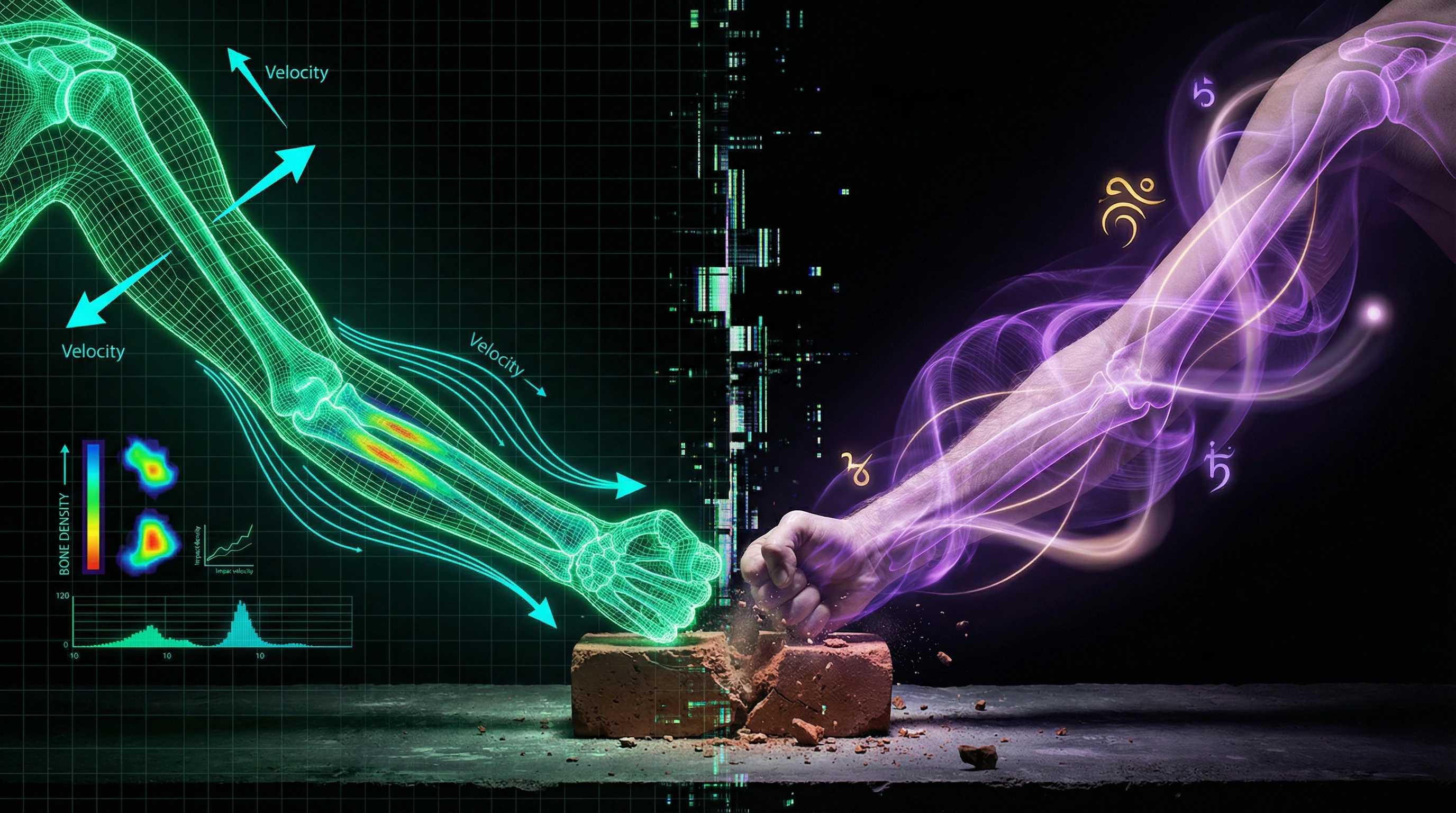
The ability to break solid objects depends on strike velocity, mass of the striking limb, momentum transfer through the body's kinetic chain, force concentration on a small contact area, and selection of strike point accounting for structural weaknesses in the material—all well-studied in martial arts biomechanics.
Repeated microtrauma to bones and connective tissues leads to their strengthening through remodeling—a well-documented physiological mechanism requiring no appeal to energetic concepts. Boxers, karate practitioners, and other athletes develop similar abilities through systematic training.
Many demonstrations use materials with predictable failure points. Bricks break easily when struck on the narrow side, especially if they have microcracks or are properly oriented. Professional material breakers in martial arts openly discuss these techniques without invoking mystical explanations.
- If breaking objects requires qi, why do athletes who don't practice qigong but have appropriate physical training perform the same demonstrations?
- The lack of uniqueness of the phenomenon among qigong practitioners undermines claims about the specific role of energetic practices.
- Comparison with other energy practices shows the same pattern: impressive demonstrations but lack of reproducibility under controlled conditions.
🛡️ Analysis of Specific Claims: "Iron Shirt" and Strike Resistance
Demonstrations of withstanding powerful strikes to the body without visible injury are often cited as proof of the ability to direct qi for internal organ protection.
The ability to withstand strikes develops through several adaptations: strengthening of abdominal and intercostal muscles creating a natural "corset"; desensitization of pain receptors through repeated stimulation; psychological preparation for pain and breath control to minimize internal organ movement during impact.
Experienced demonstrators know which body areas can safely withstand strikes (muscle masses, areas over bony structures) and avoid truly vulnerable zones. This knowledge is often not disclosed to spectators, creating an illusion of universal invulnerability.
Many demonstrations are conducted with assistants who know how to deliver strikes for maximum visual effect with minimal actual risk. Strike force, angle, contact point—all can be subtly calibrated for safety while maintaining impressive appearance.
If "iron shirt" truly creates protection through qi, it should work against unexpected strikes in uncontrolled conditions. However, documented cases of applying these techniques in real combat situations or full-contact sports matches are extremely rare and often end with practitioners being injured.
⚠️ Analysis of Specific Claims: No-Touch Knockout
The most extraordinary claim is the ability to affect an opponent without physical contact by projecting qi at a distance.
There exists not a single documented case of successful no-touch impact under conditions excluding collusion, suggestion, or physical contact. All known demonstrations are conducted with the master's students, who have strong motivation to confirm the teacher's abilities.
When no-touch masters face skeptical or unprepared opponents, their techniques invariably fail. There are known cases where masters who demonstrated impressive abilities with their students sustained serious injuries when attempting to apply the same techniques against MMA fighters or other skeptics.
The no-touch phenomenon is best explained through a combination of social suggestion, group dynamics, authority effect, and ideomotor responses—involuntary movements caused by expectations and beliefs rather than external force (S005). The mechanisms described in the analysis of energetic illusions apply here as well: the brain interprets ritual and social context as the cause of physical changes.
Mechanisms and Confounders: What Actually Happens During Power Qigong Practice
Even if specific claims about qi are not confirmed, power qigong practitioners do experience real physical and psychological effects. Understanding the mechanisms of these effects is critically important for separating real phenomena from their mystified interpretations. More details in the Cognitive Biases section.
🧬 Psychophysiological Effects of Breathing Practices
Most forms of qigong include specific breathing techniques — deep diaphragmatic breathing, breath holds, coordination of breath with movement. These practices produce measurable physiological effects.
- Activation of the parasympathetic nervous system: Slow deep breathing stimulates the vagus nerve, reducing heart rate, blood pressure, and cortisol levels. This creates a sensation of calm and "centeredness" that may be interpreted as "accumulating qi."
- Changes in blood gas composition: Hyperventilation or breath holds alter the ratio of oxygen and carbon dioxide in the blood, affecting blood pH, cerebral blood flow, and neuronal excitability. This can induce altered states of consciousness, tingling in extremities, sensations of lightness or heaviness — all phenomena traditionally described as qi movement.
The sensation of energy is often the result of an autonomic shift, not a mystical phenomenon. The brain interprets physiological signals through the practitioner's cultural filter.
These effects are real and reproducible, but are explained by neurophysiology, not energy channels. Similar states are achieved through meditation, yoga, or even controlled hyperventilation without any mention of qi.
🎭 The Role of Expectation, Attention, and Social Context
Power qigong practice occurs in a highly structured social environment with clear rituals, an authoritative teacher, and a group of like-minded individuals. This context activates powerful cognitive mechanisms.
- Placebo Effect and Expectation
- If a practitioner believes the technique accumulates energy, their brain predicts and amplifies corresponding sensory signals. This is not "deception" — it's a fundamental mechanism of perception, documented in neuroimaging. Expectation literally changes brain activity and interpretation of bodily sensations.
- Selective Attention
- During practice, attention is focused on internal sensations, breathing, and movement. This excludes distracting stimuli and amplifies perception of weak signals (vibrations, warmth, tingling) that normally go unnoticed.
- Social Confirmation
- When a group of practitioners reports identical sensations, this creates an interpretive norm. Individual variations in bodily sensations begin to be perceived as "proof" of a common energy system, when they actually reflect universal physiological responses.
These mechanisms explain why practitioners sincerely believe in the reality of qi, despite the absence of objective evidence. This doesn't mean they're lying or stupid — it means their brain is working normally, but under conditions that maximize cognitive illusions.
⚖️ Confounders: What's Hidden Behind the "Results"
When practitioners report improvements in health, strength, or martial abilities, multiple confounders come into play that are rarely controlled for.
| Confounder | Mechanism | How It Masks the Truth |
|---|---|---|
| Physical training | Qigong includes movement, stretching, coordination | Improvements in strength and flexibility are attributed to qi, not ordinary physical adaptation |
| Regularity and discipline | Practitioners train systematically, often for years | Results of any regular practice (even placebo) are attributed to the method's specificity |
| Stress reduction | Ritual, body awareness, social support | Improvements in well-being and health are explained by energy, not cortisol reduction |
| Survivorship bias | Those who don't benefit quit the practice | Only those who experienced improvement (real or imagined) remain |
| Retrospective memory distortion | People overestimate past problems and underestimate current ones | "I was much weaker" — often an inaccurate assessment, not an objective fact |
Controlled studies where these confounders are excluded show no specific effects of power qigong exceeding placebo or standard physical training. This doesn't mean the practice is useless — placebo and stress reduction have real value — but it means the mechanism is not energetic.
🔄 Closed Loop: How the System Protects Itself from Criticism
Power qigong, like other esoteric systems, contains built-in mechanisms that make it resistant to refutation. Any negative result is reinterpreted as confirmation of the system.
- If a practitioner doesn't feel qi — it means they're insufficiently developed or have "blockages."
- If a scientific study finds no evidence — it means science cannot measure qi (not that qi doesn't exist).
- If martial techniques don't work in real combat — it means the opponent was too strong or the practitioner wasn't experienced enough.
This logical structure makes the system unfalsifiable in principle. Any observation can be reinterpreted as supporting the belief. This is not a sign of truth — it's a sign of a closed cognitive system.
A practice that explains everything and predicts nothing is not science, it's religion. Power qigong may be useful as ritual, meditation, or physical training, but not as a system claiming objective knowledge about reality.