 🌀 Torsion Fields and Bioenergetics
Torsion Fields: From Theoretical Physics to Pseudoscienceλ
Hypothetical fields associated with spacetime rotation, which modern physics considers purely theoretical objects without observable effects
Overview
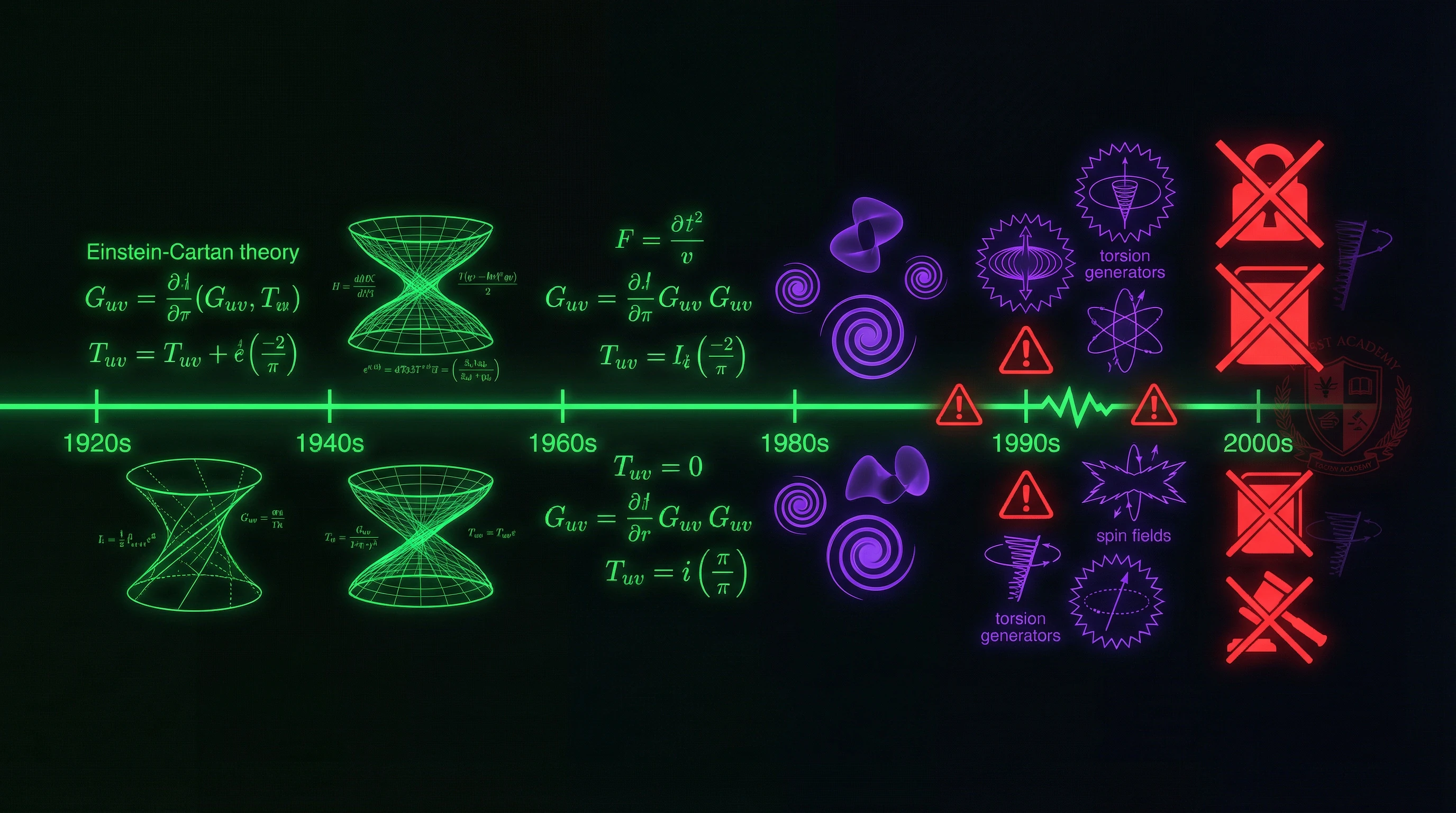
Torsion fields are hypothetical space-time structures linked to particle spin. In the 1920s, physicists considered them a mathematical abstraction in gravity theory, but by the 1990s in Russia the concept mutated: claims emerged about instantaneous communication, biological effects, "torsion generators" 🧬 — none withstood scrutiny. The Russian Academy of Sciences shut down programs in the late 1990s: no reproducible effects, no defined mechanism, predictions failed.
🛡️
Laplace Protocol: Torsion fields are rejected by mainstream physics and classified by the scientific community as pseudoscience. Despite the existence of mathematical constructs in some extended gravity theories, extraordinary claims about instantaneous information transfer, effects on DNA and biological systems lack experimental confirmation and contradict fundamental principles of physics.
Reference Protocol
Scientific Foundation
Evidence-based framework for critical analysis
Protocol: Evaluation
Test Yourself
Quizzes on this topic coming soon
Sector L1
Articles
Research materials, essays, and deep dives into critical thinking mechanisms.
🌀 Torsion Fields and Bioenergetics 🌀 Torsion Fields and Bioenergetics
 🌀 Torsion Fields and Bioenergetics
 🌀 Torsion Fields and Bioenergetics
 🌀 Torsion Fields and Bioenergetics
 🌀 Torsion Fields and Bioenergetics
 🌀 Torsion Fields and Bioenergetics
⚡
Deep Dive
Theoretical Foundations and Historical Development of the Torsion Field Concept
Torsion fields (from "torsion" — rotation, twisting) are hypothetical physical fields associated with the intrinsic rotation or spin of spacetime. In the early 20th century, they were considered within the context of extended theories of gravity as manifestations of gravitational interaction for objects with non-zero spin.
Modern physics treats torsion fields as purely hypothetical objects that contribute nothing to observable effects. Early work, including research by I.E. Tamm, considered torsion not as an independent factor but as a manifestation of gravity for rotating objects — this fundamentally differs from later pseudoscientific interpretations that attributed independent existence and exotic properties to torsion fields.
Early Concepts in 20th Century Physics
Theoretical developments of torsion fields emerged from attempts to generalize Einstein's general theory of relativity. Physicists investigated incorporating the spin of elementary particles into the geometric structure of spacetime, which led to the appearance of additional geometric characteristics — torsion.
Key distinction between legitimate theoretical research and pseudoscientific claims: academic physics never asserted the real existence of torsion fields or the possibility of detecting them with modern instruments. They remained mathematical abstractions within specific theoretical models.
Mathematical Models in Extended Theories of Gravity
In some extended theories of gravity, torsion fields appear as a consequence of incorporating spin degrees of freedom of matter into the geometric description of spacetime. Einstein-Cartan theory — a minimal generalization of general relativity where spacetime torsion is connected to the spin density of matter.
- Critical Limitation
- Torsion effects manifest only at extremely high energy densities, unattainable under terrestrial conditions. The absence of experimental predictions distinguishing them from standard general relativity makes these theories untestable.
The mathematical formalism is rigorous and consistent, but without practical physical content, torsion fields remain a theoretical concept — this is acknowledged by the contemporary scientific community.
Russian Research Programs of the 1990s and Their Closure
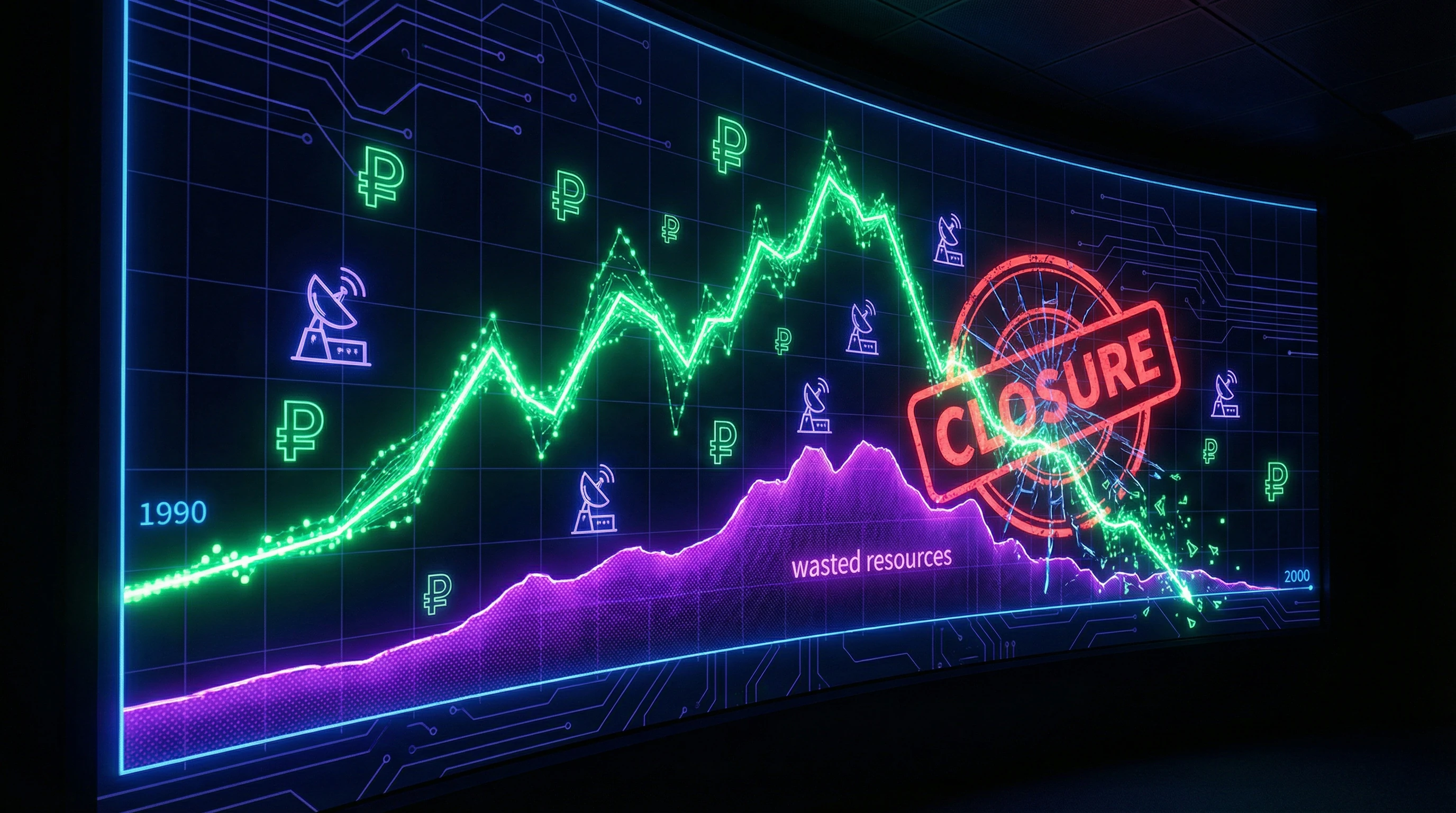
In the 1990s, post-Soviet Russia launched a wave of torsion field research with government funding amid weakened scientific oversight. Specialized laboratories were established, claiming to develop torsion field detectors and generators.
The most well-known became the "Akimov generator" — a device named after Anatoly Akimov, the chief proponent of the torsion concept in Russia.
| Period | Characteristics | Outcome |
|---|---|---|
| 1990s | Government funding, weak oversight, promises of revolutionary technologies | Creation of institutes and laboratories, conferences, publications without rigorous peer review |
| Late 1990s | Independent reviews by Russian Academy of Sciences | Program closures, termination of funding |
Government Funding and Scientific Programs
Programs received budget allocations under promises of revolutionary breakthroughs — from new communication systems to medical devices. The claimed instruments ("torsiometer TSM-021", various "torsion field generators") demonstrated no effects beyond known physics.
Measurements were explained by measurement system artifacts, electromagnetic interference, or statistical fluctuations — not new physical phenomena.
The period became an example of how, under conditions of socioeconomic crisis and weakened scientific expertise, pseudoscientific concepts gain institutional support.
Closure of Research Departments by the Russian Academy of Sciences
The Russian Academy of Sciences' decision was based on independent reviews that found no scientific value in the conducted work. Academy commissions established: absence of reproducible experimental data, methodological violations in measurements, inconsistency of results with fundamental physical principles.
- Lack of reproducibility of results
- Violations of scientific method in conducting measurements
- Contradiction of fundamental physical laws
- Conclusion: justified termination of funding
Proponents subsequently portrayed the closure as suppression of innovative science. However, the documented absence of results and methodological violations make this decision a precedent for self-correction by the scientific community upon identifying pseudoscientific programs.
Pseudoscientific Claims and Commercial Exploitation of the Myth
After the closure of government programs, the concept of torsion fields migrated into the realm of pseudoscience, alternative medicine, and commercial fraud schemes. Modern claims about torsion fields include assertions about instantaneous information transmission, influence on biological systems and human DNA, as well as the existence of working detectors and generators.
All these claims contradict established physical laws and lack experimental confirmation under controlled conditions.
Instantaneous Information Transmission and Violation of Relativity Theory
The central pseudoscientific claim: torsion fields propagate at infinite speed and transmit information instantaneously. This directly contradicts special relativity theory — no information can propagate faster than the speed of light.
The absence of a mechanism explaining such transmission without violating causality makes these claims logically incompatible with verified physical theory. No publication in peer-reviewed physics journals confirms superluminal information transmission through torsion fields.
- Special relativity theory — a century of experimental confirmations.
- Causality — a fundamental constraint on any physical process.
- Peer-reviewed sources — absent.
Biological Effects and Influence on DNA
Pseudoscientific literature attributes to torsion fields control over complex organismal processes and influence on DNA through words and thoughts. It is claimed that fields are perceived as "bad, good, or very good" — a typical conflation of physical concepts with subjective evaluations.
The mechanism of alleged impact on biological molecules has never been described in terms compatible with known biochemistry. This is magical thinking clothed in pseudoscientific terminology.
Claims about the influence of words on DNA ignore established mechanisms of genetic regulation and are not confirmed in peer-reviewed biological or medical research.
Commercial Devices and Generators
The market features devices claimed to be generators or detectors of torsion fields: "Akimov generator," "torsiometer TSM-021," magnets, and geometric shapes. It is claimed they produce measurable torsion fields through "uncompensated torsion fields of surface atoms."
| Claim | Reality |
|---|---|
| Generator produces torsion fields | Effects explainable by electromagnetism, thermal fluctuations, measurement artifacts |
| Detector registers a new type of field | Independent testing shows no effects outside known physics |
| Device has biological effect | Commercialization exploits scientific illiteracy of consumers |
Commercialization of these devices is a form of fraud, using science-like terminology to lend legitimacy to useless or deceptive products.
Scientific Consensus and Criticism — Why the Academic Community Rejected Torsion Fields
Position of the Russian Academy of Sciences and Program Closure
In the late 1990s, the Russian Academy of Sciences terminated funding for torsion field research. The decision was based on the absence of reproducible results after several years of state funding.
Proponents often present the closure as suppression of innovation. The real reason — standard scientific practice: hypotheses that fail to be experimentally confirmed despite adequate funding are discarded in favor of more productive directions.
Absence of results despite available resources is not a conspiracy, but a signal that the hypothesis doesn't work.
Absence of Reproducible Experimental Data
The key problem: complete absence of experimental confirmation under controlled conditions. Modern physics classifies torsion fields as purely hypothetical objects that make no contribution to observable physical effects.
All claimed experiments have either not been reproduced by independent researchers, or are explainable by known phenomena — electromagnetism, thermal fluctuations, systematic measurement errors.
- Independent testing of Akimov generators and torsiometers revealed no effects beyond ordinary physics
- Absence of publications in peer-reviewed international journals
- Refusal to provide data for independent verification
Classification as Pseudoscience and Violation of Fundamental Principles
The scientific community classifies torsion fields as pseudoscience based on several criteria. Claims about instantaneous propagation speed directly contradict special relativity — no information can be transmitted faster than the speed of light.
Assertions about the influence of words and thoughts on DNA through torsion fields have no mechanism compatible with known biochemistry and molecular biology.
| Level of Analysis | Status | Problem |
|---|---|---|
| Mathematical classification (Utiyama) | Theoretically permissible | Purely formal construction, without experimental confirmation |
| Extensions of general relativity | Research direction | Not confirmed by observations |
| Practical applications (generators, bioeffects) | Pseudoscience | Contradicts fundamental principles and is not reproducible |
The distinction between theoretical mathematical constructions and pseudoscientific claims about practical applications of nonexistent fields is critical for understanding why the academic community rejected torsion fields as a research direction.
Knowledge Access Protocol
FAQ
Frequently Asked Questions
Torsion fields are hypothetical physical fields that supposedly arise from rotation or twisting of space-time. In the 1990s, they were actively studied in Russia as a potential source of new technologies, but modern physics considers them purely theoretical objects without observable effects. The Russian Academy of Sciences closed all research programs due to lack of scientific evidence.
There is no convincing scientific evidence for the existence of torsion fields as a real physical phenomenon. All claimed experiments have failed independent verification and have not been reproduced under controlled conditions. The Russian Academy of Sciences discontinued funding for this research in the late 1990s, recognizing it as unpromising.
Torsion fields violate fundamental laws of physics, including relativity theory, by claiming instantaneous information transfer. Reproducible experimental data is absent, and commercial devices demonstrate no effects beyond known physics. The scientific community classifies this field as pseudoscience due to methodological violations and unfounded claims.
Early concepts are linked to work by early 20th-century physicists studying gravity for objects with non-zero spin. In the USSR and 1990s Russia, the theory was actively promoted by Anatoly Akimov, who created commercial devices. However, his work was discredited by the scientific community, and research departments were closed by the Russian Academy of Sciences.
There is no scientific evidence of torsion fields affecting health or biological systems. Claims about impacts on DNA, cells, or psyche are typical pseudoscientific assertions without experimental confirmation. Devices sold for "torsion therapy" have not undergone clinical trials and may be dangerous when traditional treatment is abandoned.
Commercial "torsion field generators" do not demonstrate claimed effects in independent tests. Signals measured by instruments are explained by measurement artifacts or known physical phenomena. The Russian Academy of Sciences officially recognized such devices as ineffective, leading to closure of research programs in the late 1990s.
Demand reproducible experiments under controlled conditions with independent verification of results. Check for publications in peer-reviewed scientific journals, not on commercial websites. Consult the position of authoritative scientific organizations, such as the Russian Academy of Sciences, which officially rejected this concept.
The Russian Academy of Sciences discontinued funding in the late 1990s due to lack of scientific validity and reproducible results. Years of research produced no practical applications or theoretical breakthroughs. Resources were redirected to promising scientific directions with proven methodology.
There is no direct connection to established principles of quantum mechanics. Some pseudoscientific sources exploit quantum terminology to lend legitimacy, but this is manipulation. Real quantum physics does not support the concept of torsion fields as described by popularizers.
Claims about generation of torsion fields by geometric shapes have no scientific confirmation. Experiments with pyramids have shown no reproducible effects beyond placebo and statistical errors. This is a typical example of pseudoscientific myth exploiting ancient symbols to sell goods and services.
Electromagnetic fields are a proven physical phenomenon with clear laws and measurable effects. Torsion fields remain hypothetical without experimental confirmation and contradict established physical principles. Unlike electromagnetism, there is no coherent mathematical model for torsion fields accepted by the scientific community.
There are no legitimate technologies based on torsion fields in modern science or industry. All claims about practical applications come from commercial organizations without scientific verification. Reputable technology companies and research institutions do not use this concept in their developments.
This is a completely false claim without scientific basis. DNA changes through chemical and biological processes, not through hypothetical fields or sound waves. Such claims are typical of pseudoscientific publications that mix real biology with unfounded mystical concepts.
Trust academic encyclopedias (Wikipedia), peer-reviewed scientific journals, and official positions from established scientific academies. Avoid commercial websites, alternative medicine forums, and publications without scientific peer review. Critically evaluate sources by checking for experimental data and independent confirmation.
Claims about instantaneous information transfer through torsion fields directly contradict special relativity. No information can propagate faster than the speed of light according to established physics. This is one of the main reasons why the scientific community rejects the concept in its popular form.
Commercial "torsiometers" have not passed independent scientific validation and show measurement artifacts. Standard physical instruments do not register effects attributed to torsion fields. The absence of reproducible measurements under controlled conditions is a key argument against the existence of these fields.