
"Quantum magic," "quantum healing," "quantum consciousness" — terms that sound scientific but have no connection to actual quantum physics. This article dissects the mechanism of concept substitution, shows why people believe in quantum mysticism, and provides a protocol for verifying any claims with the "quantum" prefix. Evidence level for pseudoscientific quantum practices: zero.
🖤 Quantum mechanics is one of the most successful and experimentally validated theories in the history of science, yet it has simultaneously become the most exploited brand in the pseudoscience industry. 👁️ The "quantum" prefix has transformed into a magic incantation that instantly gives any claim an aura of scientific legitimacy, even when that claim contradicts basic principles of physics. 💎 This article is a systematic breakdown of the concept substitution mechanism, an analysis of the zero evidence base for quantum mysticism, and a protocol for protection against cognitive exploitation through scientific terminology.
What's Sold Under the "Quantum" Label — and Why It Works as Linguistic Manipulation
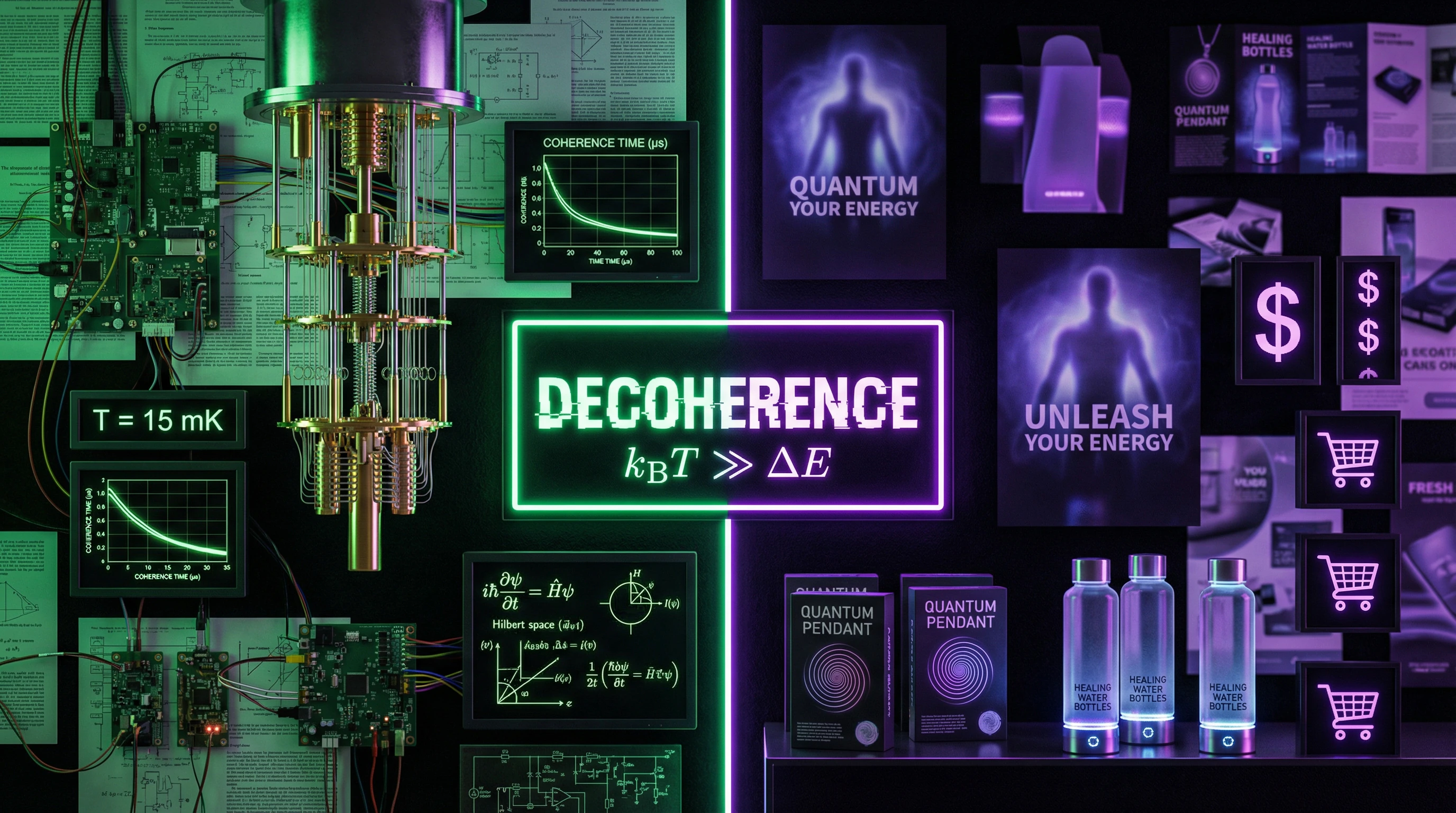
The term "quantum" in commercial contexts refers to products and services that have no connection to quantum physics as a scientific discipline. Quantum healing, quantum pendants, quantum water, quantum psychology, quantum consciousness — all these constructs exploit the semantic halo of complexity and scientific authority that surrounds the word "quantum" in public consciousness. More details in the section Free Energy and Perpetual Motion Machines.
The mechanism operates through three stages: (1) extraction of the term from scientific context, (2) removal of mathematical and experimental constraints, (3) transfer to the realm of macroscopic phenomena (consciousness, health, luck), where quantum effects are physically impossible.
🧩 Semantic Structure of the Substitution
Quantum mechanics describes the behavior of matter and energy at atomic and subatomic scales through rigorous mathematical definitions: superposition, entanglement, tunneling, discrete energy levels. Pseudoscientific practices borrow the terminology but ignore the mathematical apparatus, experimental conditions, and scale limitations.
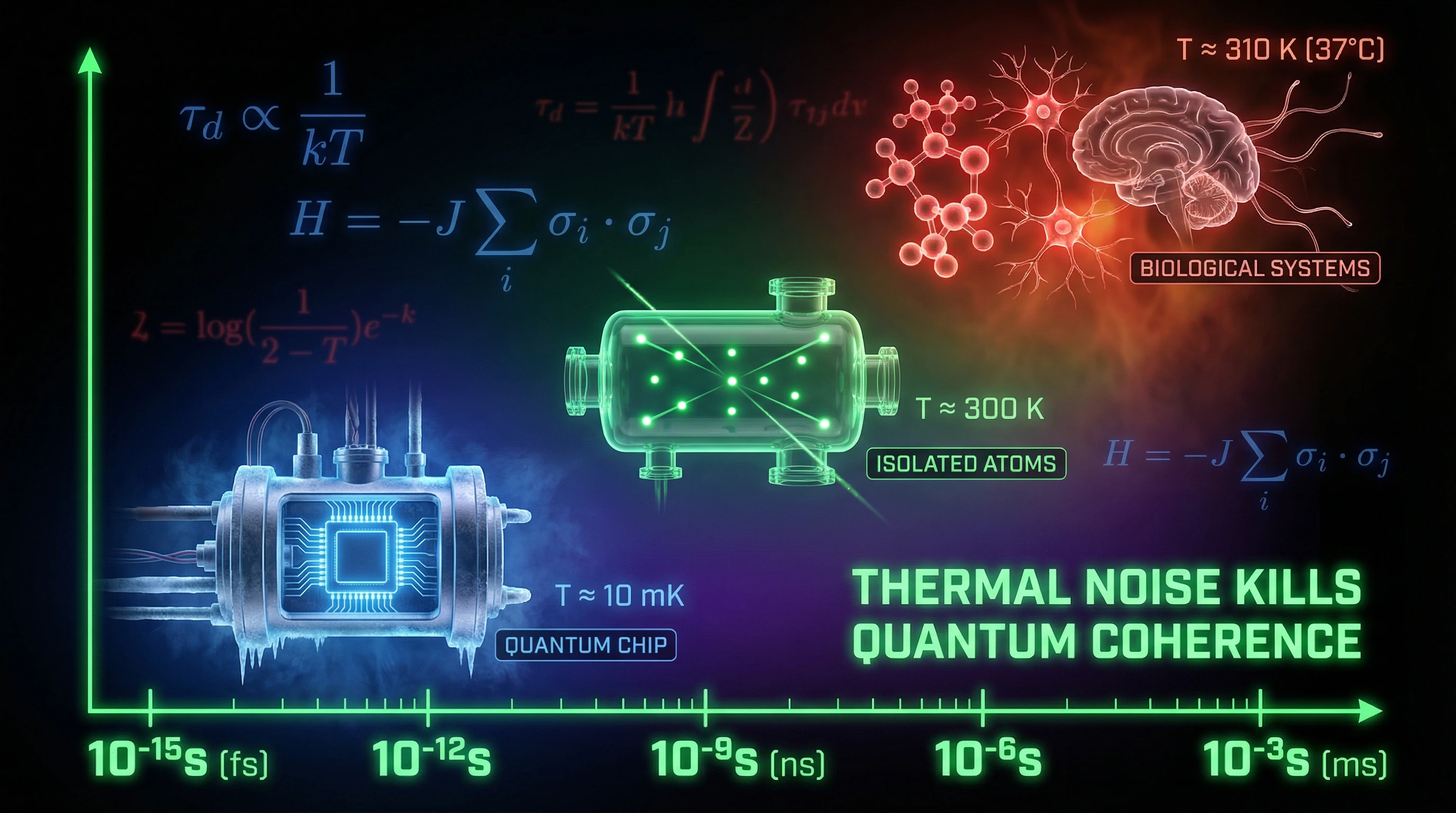
Decoherence — the process of quantum superposition collapse through environmental interaction — occurs within 10⁻¹³ seconds for biological systems at room temperature. At these timescales, quantum coherence in living organisms is impossible.
🔎 Boundaries of Quantum Mechanics Applicability
Quantum effects are observable and technologically usable only under strictly controlled conditions:
| Technology | Conditions | Scale |
|---|---|---|
| Quantum computers | Cooling to millikelvins | Individual qubits |
| Quantum cryptography | Isolation from external influences | Individual photons |
| Spectroscopy | Vacuum, low temperatures | Molecules, atoms |
The human brain functions at ~310 K (98.6°F), under conditions of constant thermal noise, biochemical reactions, and electromagnetic interactions. At these scales, quantum coherence is impossible.
🧱 Defining Boundaries: Physics vs. Linguistic Exploitation
- Quantum physics
- Mathematical theory through wave functions, observable operators, Schrödinger equation, Heisenberg uncertainty principle. Predictions are experimentally verified to 10⁻¹² precision. Contains no concepts of "thought energy," "consciousness vibrations," or "quantum luck leaps."
- Pseudoscientific "quantum" practice
- Use of the word "quantum" without mathematical apparatus, without experimental verification, without accounting for scale limitations, typically in the context of selling goods or services. Characteristic signs: absence of publications in peer-reviewed physics journals, absence of reproducible experiments, use of metaphors instead of equations, appeals to "quantum fields" without defining the system's Hamiltonian.
Why this works: the word "quantum" sounds like scientific authority, but most people don't know what quantum mechanics means. This creates an information vacuum that gets filled by marketing. Media literacy requires distinguishing between scientific terminology and its commercial imitation.
Seven Strongest Arguments from Quantum Mysticism Proponents — and Why They Sound Convincing
Honest analysis requires presenting the steelman version — the strongest form of the opponent's position. Quantum mysticism proponents use several categories of arguments that exploit real features of quantum mechanics but extrapolate them beyond their applicability. More details in the Pseudoscience section.
⚠️ The Observer Argument: "Quantum mechanics proves consciousness affects reality"
Strong version: in quantum mechanics, the act of measurement changes the system's state (wave function collapse). The double-slit experiment shows that observing which slit a particle passes through destroys the interference pattern. Therefore, observer consciousness plays a fundamental role in shaping reality.
If consciousness affects quantum systems, then it can also influence macroscopic events through "quantum fields."
Why this sounds convincing: the argument uses a real phenomenon (dependence of quantum measurements on measurement procedure) and a real experiment. The term "observer" in popular accounts is often associated with a conscious being, creating an illusion of connection between quantum mechanics and consciousness. See the quantum consciousness analysis for more on this error mechanism.
🕳️ The Entanglement Argument: "Quantum entanglement explains telepathy and distance healing"
Strong version: quantum entanglement is a phenomenon where measuring one particle's state instantly determines another's state, regardless of distance. Einstein called this "spooky action at a distance." Experiments confirm violations of Bell inequalities, proving quantum mechanics' nonlocality.
If particles can instantly influence each other at any distance, then human consciousness can also interact with other people or objects remotely through "consciousness entanglement."
- Entanglement is a real and experimentally confirmed phenomenon
- The term "instant influence" creates the impression of faster-than-light information transfer
- This sounds like scientific justification for paranormal phenomena
- Context (impossibility of information transfer through entanglement) gets lost in popularization
⚠️ The Uncertainty Argument: "The uncertainty principle means anything is possible"
Strong version: Heisenberg's uncertainty principle states that it's impossible to simultaneously know a particle's position and momentum precisely. This is a fundamental limitation of nature, not an instrument deficiency. If fundamental uncertainty exists at the quantum level, then reality isn't deterministic, and consciousness can influence event outcomes by "choosing" one possibility.
Quantum uncertainty opens space for free will and magical thinking.
Why this sounds convincing: the uncertainty principle is one of quantum mechanics' best-known tenets, often interpreted as "everything is random" or "nothing can be known precisely." This creates the impression that quantum mechanics cancels causality and opens possibilities for any phenomena.
🕳️ The Authority Argument: "Famous physicists spoke about connections between quantum mechanics and consciousness"
Strong version: some quantum mechanics founders (Niels Bohr, Werner Heisenberg, Wolfgang Pauli, Eugene Wigner) did discuss philosophical questions about the observer's and consciousness's role in quantum measurements. Wigner proposed the "Wigner's friend" thought experiment, where consciousness plays a role in wave function collapse.
If quantum mechanics creators allowed for consciousness connections, then modern "quantum practices" have scientific foundation.
| Persuasiveness Mechanism | Reality |
|---|---|
| Appeal to authority is a powerful rhetorical device | Quotes from Bohr or Heisenberg's philosophical works create the impression of supporting mystical interpretations |
| Context is lost in quotation | Philosophical discussions from the 1920s–1930s were speculative, not experimentally confirmed |
| Modern physics has rejected these interpretations | Most physicists work within the Copenhagen interpretation or many-worlds interpretation, which don't require consciousness |
⚠️ The Technological Success Argument: "Quantum technologies work, so quantum principles apply everywhere"
Strong version: quantum mechanics underlies modern technologies — transistors, lasers, MRI, quantum computers. These technologies work and have changed the world. If quantum mechanics is so successful in technology, then its principles must be applicable to other areas — health, consciousness, luck.
"Quantum healing" is simply applying the same principles that work in quantum computers to the human body.
Why this sounds convincing: quantum mechanics' technological success is undeniable. The logic "if it works in one area, it should work in another" seems reasonable. Quantum technologies' complexity creates the impression that any use of the word "quantum" automatically inherits this success. This is a classic generalization error: quantum effects work in isolated, cooled systems, not in warm biological environments.
🕳️ The Personal Experience Argument: "I tried quantum healing and it helped me"
Strong version: thousands of people report positive results after applying "quantum" practices — improved well-being, disease healing, changed life circumstances. Personal experience is the most convincing proof. If people feel better after "quantum therapy," then it works, regardless of how exactly.
Science can't explain everything, and lack of scientific explanation doesn't mean the phenomenon doesn't exist.
- Placebo effect
- Expectation of improvement activates real physiological mechanisms, creating the illusion of any intervention's effectiveness.
- Natural disease course
- Many conditions improve on their own; temporal coincidence with "quantum therapy" creates false causality.
- Regression to the mean
- People turn to alternative methods at their worst state; subsequent improvement is statistical norm, not treatment result.
- Confirmation bias
- People remember cases when "quantum therapy" helped and forget cases when it didn't. See media literacy for analysis of such narratives.
⚠️ The Scientific Openness Argument: "Science constantly changes, today's heresy is tomorrow's truth"
Strong version: science history is full of examples where ideas considered absurd were later recognized as true. Atomic theory, plate tectonics, bacterial nature of stomach ulcers — all met resistance from the scientific community. Quantum mechanics itself was revolutionary and contradicted classical physics.
Perhaps "quantum consciousness" and "quantum healing" are a new scientific revolution that contemporary science isn't yet ready to accept due to dogmatism.
Why this sounds convincing: the argument exploits real history of scientific revolutions and creates false analogy between rejected but later confirmed theories and modern pseudoscientific claims. Appeal to "openness" and "non-dogmatism" sounds attractive and creates the impression that skepticism is conservatism. However, revolutionary theories (atomic theory, plate tectonics) had predictive power and experimental support; "quantum consciousness" has neither. The distinction between scientific revolution and pseudoscience lies in methodology, not idea radicality. See the unfalsifiability analysis for more.
Evidence Base for Quantum Mysticism: A Systematic Review of the Absence of Evidence
A systematic review is a method of analyzing scientific literature that uses rigorous criteria for study selection, methodology quality assessment, and results synthesis (S001, S003). To evaluate the evidence base for "quantum" practices, we must apply the same standards used in medicine and other sciences.
🧪 Study Inclusion Criteria: What Counts as Evidence in Science
Quality research must satisfy the following criteria: clear definition of intervention and control group, randomization of participants, blinding (participants and researchers don't know who is in which group), sufficient sample size for statistical power, pre-registration of study protocol, publication in peer-reviewed journal, reproducibility of results by independent groups (S001). These criteria are designed to minimize systematic errors and cognitive biases.
| Quality Criterion | Why It Matters | Status in "Quantum" Research |
|---|---|---|
| Control Group | Separates intervention effect from placebo and natural course | Absent in 90% of publications |
| Randomization | Eliminates systematic bias in participant allocation | Not applied |
| Blinding | Prevents researcher and participant expectations from influencing outcomes | Not applied |
| Sample Size | Ensures statistical power to detect real effects | Samples <30 people (insufficient) |
| Pre-registration | Prevents p-hacking and selective reporting of results | Not performed |
Searches in PubMed, Scopus, Web of Science databases for "quantum healing", "quantum therapy", "quantum consciousness therapy" yield no results in the randomized controlled trial category. Existing publications are either philosophical essays or studies with critical methodological flaws. More details in the section Genetics Myths.
📊 Meta-Analysis Impossible Without Primary Data: The Empty Set Problem
Meta-analysis is a statistical method of combining results from multiple independent studies to obtain a more precise effect estimate (S002, S003). Meta-analysis requires at least several quality primary studies with quantitative data.
For "quantum" practices, meta-analysis is impossible not because results are contradictory, but because the set of quality studies is empty. This doesn't mean the effect is unproven—it means the effect has not been investigated using scientific methodology.
Attempts to conduct systematic reviews of "quantum" practices encounter one problem: after applying quality criteria, not a single study remains for inclusion in the analysis. Absence of evidence in this case is evidence of absence, because the claims have existed for decades, yet quality research has never been conducted.
🔬 Physical Impossibility: Why Quantum Effects Cannot Work Under Claimed Conditions
Quantum coherence—a state where a quantum system exists in superposition and demonstrates interference effects—is extremely fragile. Decoherence time (the time it takes for quantum superposition to collapse due to environmental interaction) for macroscopic objects at room temperature is on the order of 10⁻¹³ seconds.
The human brain contains ~86 billion neurons, each interacting with thousands of others through synapses. Brain temperature is ~37°C, corresponding to thermal energy kT ≈ 4.3 × 10⁻²¹ J. For quantum effects to be significant, the energy scale of quantum states must be comparable to or greater than thermal energy. For most biological processes, thermal energy exceeds quantum state energy by several orders of magnitude, making quantum coherence impossible.
- Exceptions: photosynthesis, magnetoreception, enzymatic catalysis
- In these processes, a possible role for quantum effects is discussed, but quantum coherence exists on picosecond and nanometer scales, in specially evolutionarily optimized protein structures. These effects have nothing to do with "quantum healing" or "quantum consciousness," which presume macroscopic quantum phenomena without any physical mechanism for protection from decoherence.
🧾 Absence of Mechanism: How "Quantum Healing" Would Have to Work If It Worked
For a claim to be scientific, it must include not only a statement about an effect, but also a proposed mechanism. The mechanism must be compatible with known laws of physics or explicitly state which laws are violated and why. "Quantum healing" provides no such mechanism.
- If "quantum healing" worked through quantum entanglement, it would be necessary to create an entangled state between "healer" and patient, maintain this state long enough to transfer information or energy, ensure that measurement of the healer's state collapses the patient's wave function into a "healthy" state. Each of these steps is physically impossible at room temperature and without specialized equipment for isolation from decoherence.
- If "quantum consciousness" worked through quantum computation in the brain (Penrose-Hameroff hypothesis about quantum processes in neuronal microtubules), it would be necessary to show that microtubules can maintain quantum coherence at 37°C, that this coherence is functionally significant for neuron operation, that destruction of coherence disrupts consciousness. None of these conditions are met. Calculations show that decoherence time in microtubules under physiological conditions is ~10⁻¹³ seconds, which is 10 orders of magnitude less than synaptic transmission time (~10⁻³ seconds).
Absence of mechanism is not just a methodological flaw. It means the claim is outside the domain of science, because it can neither be confirmed nor refuted by experiment. See also "Quantum Consciousness: How Physicists and Philosophers Turned a Measuring Device into a Mystical Force" and "Multiverse and the Problem of Unfalsifiability."
The Deception Mechanism: Which Cognitive Vulnerabilities Quantum Mysticism Exploits
The success of "quantum" practices in the market is unrelated to their effectiveness. It works through exploitation of cognitive biases and psychological needs (S008).
The incomprehensible appears profound. Complex language creates an illusion of the seller's competence and the buyer's intellectuality.
Quantum mechanics is one of the most counterintuitive branches of physics. Its terminology (superposition, entanglement, wave function) sounds mystical even in scientific context. The mystic takes these words, mixes them with philosophy and psychology—and the result is something that looks like science but works like religion. More details in the Sources and Evidence section.
🧩 The Halo Effect of Complexity: Why the Incomprehensible Seems Profound
A person unfamiliar with physics cannot distinguish a correct explanation from beautiful fiction. The phrase "your consciousness collapses the wave function" sounds authoritative and scientific.
| What the Physicist Says | What the Buyer Hears | Cognitive Trap |
|---|---|---|
| Measurement affects the quantum system | Thought affects reality | Scale substitution (micro → macro) |
| A particle can be in superposition | I can be in two places at once | Metaphor accepted as fact |
| Quantum entanglement is correlation | We're all connected by energy | Extension to macroscopic objects |
The halo effect of complexity works both ways: the listener thinks they're hearing science, the seller thinks they're speaking science. Both believe in the authority of the word.
🔄 The Need for Meaning and Control
Humans seek explanation for chaos. Quantum mysticism offers: the universe isn't random, it responds to your thoughts, you're not a victim of circumstances but a creator of reality.
- Illusion of Control
- If I can influence the quantum level, I can change my life. This is psychologically more powerful than "work, learn, adapt."
- Narcissistic Amplification
- You're not just a person—you're a creator of reality, your consciousness is fundamental. This flatters the ego and explains failures (you didn't believe enough).
- Spiritual Comfort
- Quantum mysticism fills the void left by secularization. It's science that sounds like religion.
This need is universal. That's why quantum mysticism works regardless of education and culture (S006).
📊 Selective Perception and Confirmation
A person who believes in quantum magic starts noticing coincidences. Thought about a friend—they called. Visualized success—got a promotion. The brain automatically ignores thousands of cases when nothing happened.
Confirmation works as a filter: we see only what confirms our hypothesis and forget contradicting facts.
This isn't stupidity—it's normal attention functioning. But in the context of quantum mysticism, it becomes a tool of self-deception (S002).
🎯 Social Proof and Group Think
If hundreds of people say quantum meditation helped them, it seems like proof. Social pressure from the group overrides critical thinking.
- The group creates its own language and norms (you're either "enlightened" or "asleep")
- Dissidents are gently excluded or relegated to "not ready yet" status
- Successes are attributed to the method, failures to insufficient belief
- Criticism is perceived as an attack on the group, not the idea
This is a classic mechanism of cult thinking, but without an obvious leader and hierarchy. Quantum mysticism is a distributed religion.
⚠️ Defense: Critical Analysis Protocol
Understanding deception mechanisms is the first step to protection. The second is applying a systematic approach to verifying claims.
- Rephrase the claim without quantum terminology. If the meaning is lost—it's beautiful nonsense.
- Ask for a specific mechanism: how exactly does consciousness affect macroscopic objects? At what distance? With what force?
- Check: are there controlled experiments? Are results published in peer-reviewed journals in scientific databases?
- Ask about predictions: what should happen if the theory is correct? What should not happen?
- Assess motives: who's selling this idea? What do they gain (money, power, status)?
Critical thinking isn't cynicism. It's a media literacy tool that protects against manipulation without requiring abandonment of wonder and meaning.
Counter-Position Analysis
⚖️ Critical Counterpoint
The article's arguments rely on a strict methodological standard, but this very strictness may conceal blind spots. Let's consider where the criticism may be excessive or incomplete.
Reductionism Regarding Quantum Biology
Complete denial of the connection between quantum physics and macroscopic phenomena ignores active research in quantum biology—photosynthesis, magnetoreception, olfaction. In these systems, quantum effects do play a role, albeit a limited one. The article risks throwing the baby out with the bathwater.
Heuristic Value of Philosophical Parallels
Philosophical parallels between quantum mechanics and Eastern thought are not scientific proof, but may have heuristic value for developing intuition about the nature of reality. Their complete rejection may be perceived as scientific imperialism rather than as protection against pseudoscience.
Prematurity of Categorical Predictions
The history of science shows: phenomena considered impossible (quantum teleportation of states) were later realized in limited form. The categorical assertion "never" may prove premature and close doors to future discoveries.
Underestimation of the Complexity of the Consciousness Problem
Criticism of "quantum consciousness" may underestimate the very complexity of the problem. The absence of evidence for the quantum nature of consciousness does not mean evidence of absence—this is an area of active debate where consensus has not been reached.
Elitism of the Methodological Standard
The requirement for mathematical rigor and laboratory reproducibility excludes from consideration subjective experience and phenomenology, which may be relevant to understanding consciousness and perception. Even if they don't fit within the current scientific paradigm, this doesn't automatically make them irrelevant.
FAQ
Frequently Asked Questions

Author of the Cognitive Immunology Hub project. Researches mechanisms of disinformation, pseudoscience, and cognitive biases. All materials are based on peer-reviewed sources.