
Quantum Mechanics as a Product: What's Actually Being Sold Under the Guise of Physics and Where the Boundary of Scientific Legitimacy Lies
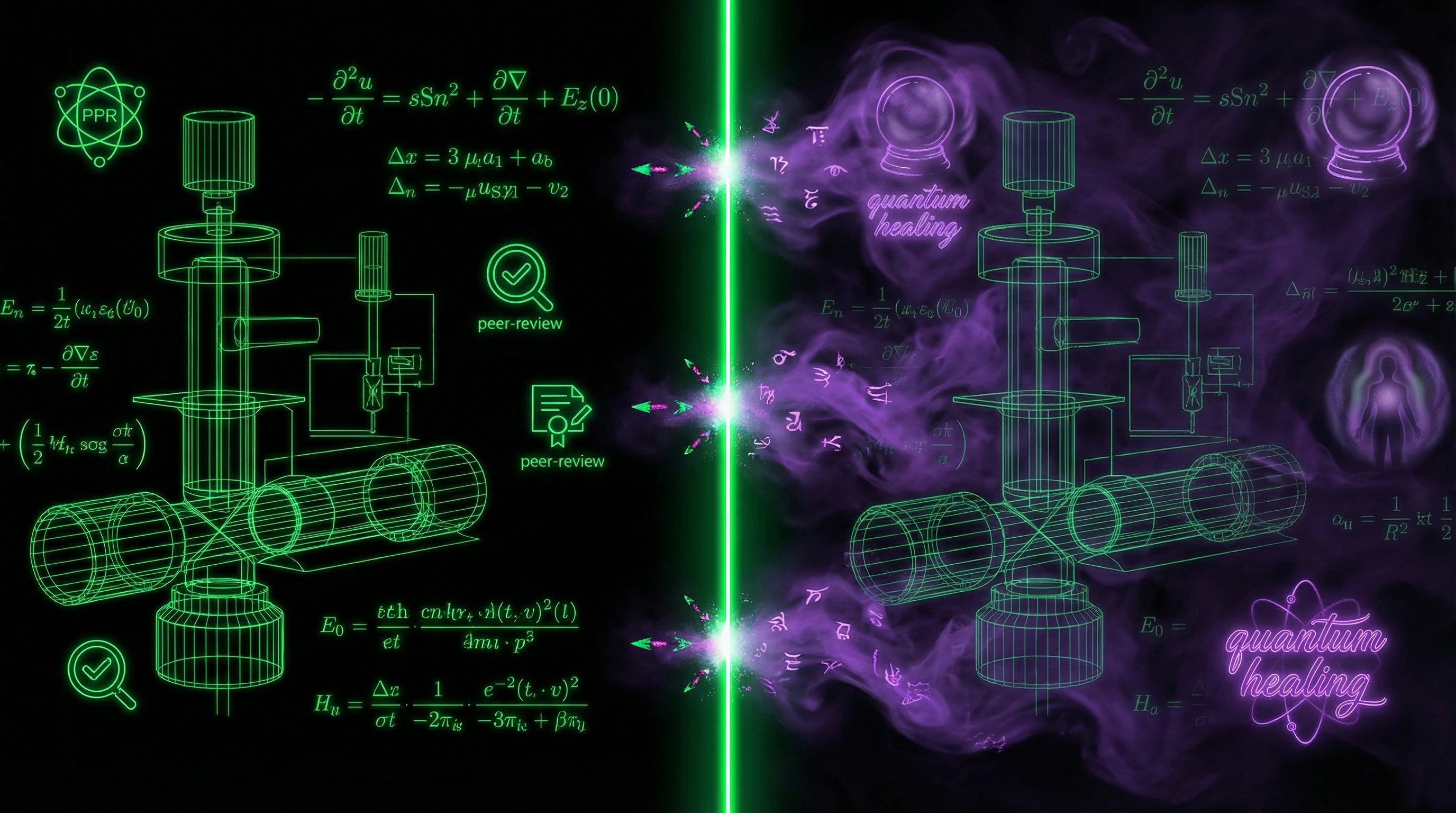
Pseudoscientific exploitation of quantum mechanics is a systematic substitution of scientific concepts with their linguistic shells. Terms like "superposition," "observer," "quantum entanglement" are extracted from their mathematical context and placed into narratives where they function as magical incantations. More details in the Pseudoscience section.
This isn't an accidental misinterpretation—it's a structured industry with its own economy, rhetorical strategies, and defense mechanisms against criticism.
🧩 Linguistic Mimicry: How Scientific Terminology Becomes a Tool of Deception
The substitution mechanism is based on exploiting the semantic gap between a term's specialized scientific meaning and its everyday understanding. Conceptual structures are formed through cultural context rather than formal definitions (S001). Pseudoscientific narratives use this principle in reverse: they take a term with an established scientific meaning and saturate it with cultural connotations unrelated to the original physics.
The term "quantum observer" in physics denotes any interaction leading to wave function decoherence—this could be a photon, a detector, an air molecule. In pseudoscientific discourse, "observer" transforms into a conscious agent with magical abilities to influence reality through thought alone.
This substitution works because the word "observer" in everyday language does indeed imply a conscious being. The semantic trap triggers automatically: the reader activates the word's cultural meaning rather than its physical definition.
🔎 The Economics of Quantum Mysticism: A Multi-Billion Dollar Industry
- The market for "quantum" products includes:
- Books and seminars on "quantum psychology"—selling interpretations without experimental foundation
- "Quantum healing" devices—physical objects with scientific branding
- Coaching on "quantum leaps of consciousness"—services based on unfalsifiable promises
- Supplements with "quantum structure"—products where scientific terminology replaces evidence of efficacy
Consumers pay not for the product but for the feeling of connection to cutting-edge science—a cognitive commodity packaged in physical form. This industry parasitizes the genuine complexity of quantum mechanics: the harder it is for laypeople to understand real physics, the easier it is to sell them a simplified mystical version.
The barrier to understanding creates information asymmetry that sellers exploit: they know the audience cannot verify claims requiring knowledge of operator algebra and functional analysis.
🧱 Boundaries of Scientific Legitimacy: Where Interpretation Ends and Falsification Begins
Quantum mechanics contains philosophically provocative elements: the measurement problem, nonlocality, the uncertainty principle. Legitimate philosophical discussions about the interpretation of quantum mechanics exist in academic circles (S001).
However, a critical boundary exists between philosophical analysis of scientific theory and using scientific terms to legitimize magical thinking.
| Criterion | Scientific Interpretation | Pseudoscientific Substitution |
|---|---|---|
| Mathematical Structure | Fully preserved; all claims derivable from formalism | Discarded; only words used, no equations |
| Falsifiability | Claims experimentally testable; negative results possible | Claims unfalsifiable; any result interpreted as confirmation |
| Consistency with Data | Explains existing experiments; predicts new ones | Ignores contradictory experiments; appeals to "hidden mechanisms" |
Pseudoscientific narratives systematically violate all three criteria (S003). This isn't a philosophical position—it's a rejection of the scientific method disguised as its application.
Related materials: Quantum Magic: How Pseudoscience Exploits Quantum Mechanics, Quantum Consciousness: How Physicists Turned a Measuring Device into a Mystical Force, Quantum Mechanics.
Steel Version of the Argument: Seven Most Compelling Cases for the Quantum Mechanics-Consciousness Connection
Intellectual honesty requires examining the strongest versions of opposing positions. Defenders of the connection between quantum mechanics and consciousness advance several arguments that cannot be dismissed with simple appeals to ignorance. More details in the section Paranormal Abilities.
These arguments deserve serious analysis not because they are correct, but because they demonstrate how the cognitive appeal of quantum mysticism operates.
⚡ The Measurement Problem Argument: Wave Function Collapse Requires an Observer
The most philosophically respectable argument is based on a real problem in the foundations of quantum mechanics. In the standard Copenhagen interpretation, the wave function "collapses" upon measurement, transitioning from a superposition of states to a definite state.
What exactly causes this collapse is one of the open questions in physics. Some interpretations, including von Neumann's version, suggest that observer consciousness plays a role in the measurement process.
The existence of an unsolved problem does not imply that any proposed solution is equally probable.
The consciousness-involving interpretation is one of many, and it is not dominant in contemporary physics. Alternative interpretations (many-worlds, decoherence, pilot wave) explain the same phenomena without invoking consciousness (S003).
🔗 The Quantum Entanglement Argument: Non-Local Correlations as Evidence of Consciousness Unity
Quantum entanglement is a phenomenon where measuring one particle instantaneously correlates with the state of another, regardless of the distance between them. This is an experimentally confirmed fact that violates classical intuitions about locality.
Defenders of quantum mysticism interpret this as proof of "the unity of all existence" and the possibility of instantaneous information transmission through consciousness.
- Entanglement is indeed counterintuitive and demonstrates non-local correlations
- However, entanglement does not allow information transmission faster than light
- Correlations emerge only when comparing measurement results through a classical communication channel
- This is a statistical property of the joint wave function, fully described mathematically without invoking consciousness
🧠 The Quantum Brain Processes Argument: Microtubules and Penrose-Hameroff Quantum Consciousness
Roger Penrose (Nobel laureate in physics) and Stuart Hameroff proposed a hypothesis according to which consciousness emerges from quantum computations in neuronal microtubules. This is the most academically respectable version of the quantum mechanics-consciousness connection.
The argument is strong in that it proposes a specific mechanism and potentially falsifiable predictions. However, experimental tests have not confirmed the hypothesis.
| Problem | Why This Is Critical |
|---|---|
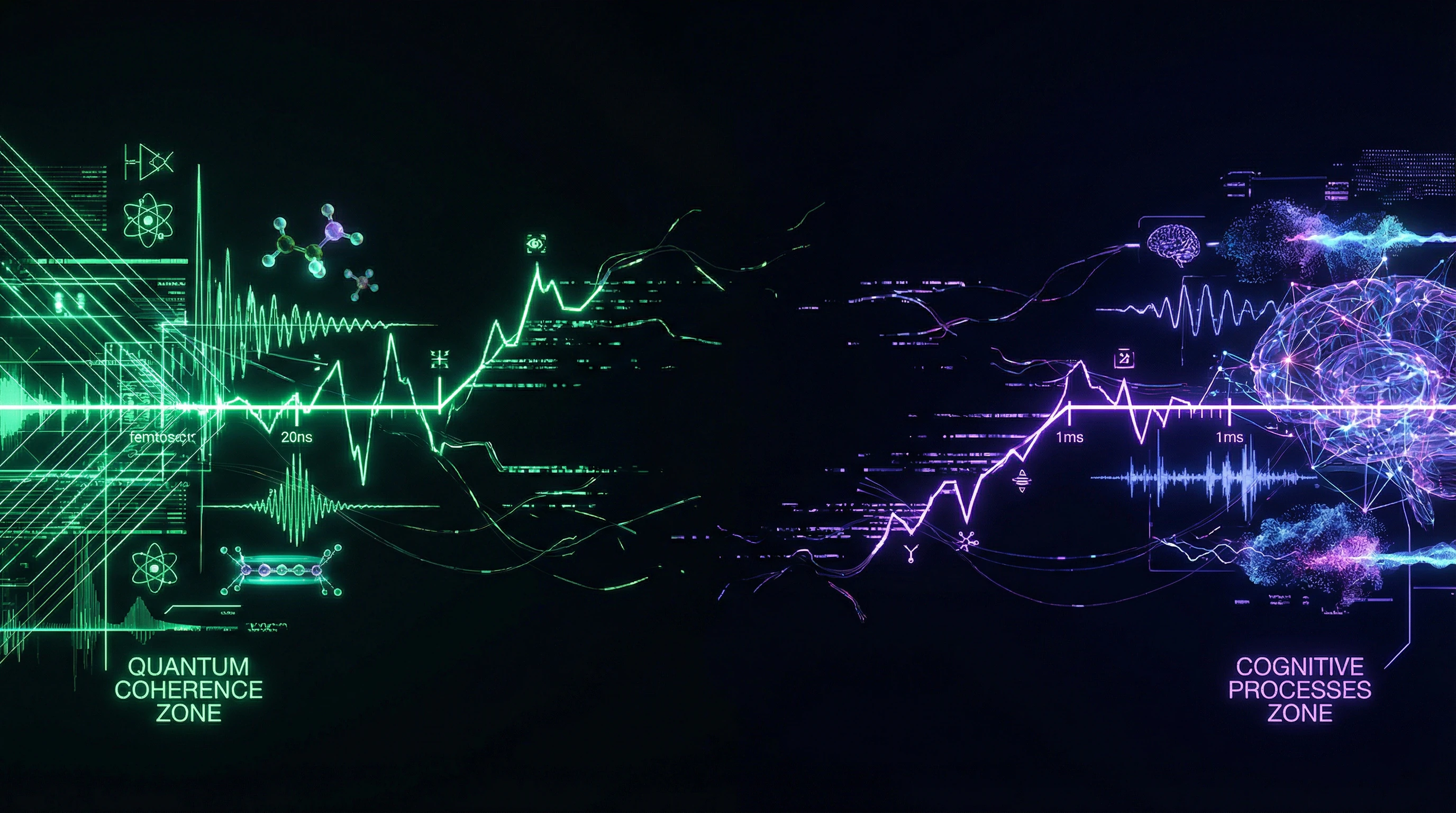
| Microtubules in the warm, wet brain environment | Quantum coherence decays in femtoseconds—too fast for cognitive processes (millisecond timescales) |
| Classical neural networks demonstrate complex behavior | The hypothesis does not explain why quantum effects are necessary for consciousness |
📡 The Intention Experiments Argument: Studies of Consciousness Influence on Quantum Systems
Some researchers claim experiments where human intention influenced quantum measurement outcomes (for example, experiments with random number generators). These studies are published in peer-reviewed journals and cited as evidence of real consciousness influence on quantum processes.
The argument uses the authority of scientific publication and statistical analysis. However, upon closer examination these experiments suffer from methodological problems: small effect sizes, reproducibility issues, multiple testing without correction, publication bias.
Meta-analyses show that the effect disappears with increased methodological rigor—a classic pattern of pseudoscience.
🌌 The Argument from Authority: Distinguished Physicists Who Spoke About the Role of Consciousness
Defenders of quantum mysticism often quote statements by the founders of quantum mechanics—Bohr, Heisenberg, Pauli, Schrödinger—about the philosophical implications of the theory and the possible role of consciousness.
Arguments from authority are always logically weak but psychologically effective. The context of these statements is critically important: physicists were discussing philosophical interpretations, not asserting the possibility of "quantum healing" or "thought materialization."
- The Citation Problem
- Modern physics has moved far beyond the discussions of the 1920s. Citing Bohr to justify "quantum leaps of consciousness" is like citing Newton to justify alchemy: historically interesting but scientifically irrelevant.
🎯 The Placebo Effect Argument: If Quantum Healing Works, Isn't That Proof?
"Quantum healing" practitioners sometimes report positive results. If people feel better after "quantum therapy," doesn't that prove the method's effectiveness?
This argument conflates effectiveness with mechanism. The placebo effect is real and can provide subjective improvement for many conditions.
If "quantum healing" works no better than placebo in controlled trials, then what's effective is not the "quantum" component but psychological factors: attention, expectation, ritual.
Calling it "quantum" means attributing the effect to the wrong cause, which impedes understanding of real mechanisms and can distract from effective treatment.
🔮 The Personal Experience Argument: Transformational Experiences After Quantum Practices
Many practitioners report profound personal transformations, insights, spiritual experiences after participating in "quantum" seminars or practices. These experiences are subjectively real and meaningful to people.
Personal experience is the most psychologically convincing but epistemologically weakest argument. Transformational experiences arise in the context of numerous practices—religious, psychotherapeutic, meditative—without invoking quantum mechanics.
- The experience is real, but its interpretation may be mistaken
- Insight can arise from group dynamics, suggestion, altered states of consciousness
- A new perspective on old problems is often perceived as revelation, regardless of source
- This does not prove that the insight was caused by quantum effects
Evidence Base: What Experiments, Mathematics, and Reproducible Research Say About Quantum-Mystical Claims
Moving from arguments to evidence requires a shift in evaluation criteria. The persuasiveness of an argument is determined by logical structure and rhetorical force. The evidential strength of a claim is determined by experimental testability, mathematical consistency, and reproducibility of results. More details in the section Water Chemistry Myths.
By these criteria, quantum-mystical claims systematically fail.
📊 Experimental Tests of Consciousness Influence on Quantum Systems: Null Results
Rigorous experimental tests of claims about human intention influencing quantum systems consistently yield null results. When experiments are conducted with proper controls—double-blind design, pre-registered hypotheses, adequate statistical power—the effect disappears.
This is a pattern characteristic of false effects, not real phenomena, which become more evident with improved methodology.
The reproducibility problem in parapsychological research is well documented: claimed effects correlate with methodological flaws. The stricter the control, the weaker the effect. This is the opposite of the pattern seen in genuine scientific discoveries.
🧮 Mathematical Incompatibility: Why Quantum Mechanics Equations Don't Support Mystical Interpretations
Quantum mechanics is a mathematical theory described by the Schrödinger equation, operator algebra, and Hilbert spaces. This mathematical structure contains no variables for "consciousness," "intention," or "spiritual energy" (S003).
Attempts to introduce such variables lead to contradictions with experimentally verified predictions of the theory. The mathematical formalism of quantum mechanics is extraordinarily successful in predicting experimental results without invoking consciousness as a physical variable.
| Theory Component | Contains Variable for Consciousness? | Experimental Verification |
|---|---|---|
| Schrödinger Equation | No | Confirmed by billions of experiments |
| Operator Algebra | No | Foundation of all quantum predictions |
| Hilbert Spaces | No | Mathematical foundation without exceptions |
| Interpretations (Copenhagen, many-worlds, etc.) | Only in some speculations | Not experimentally distinguishable |
🔍 Decoherence and Scale: Why Quantum Effects Don't Work in Warm Wet Brains
Quantum coherence is a fragile phenomenon requiring isolation from the environment. In biological systems at room temperature, decoherence time is on the order of femtoseconds (10⁻¹⁵ seconds).
Cognitive processes occur on millisecond timescales (10⁻³ seconds)—a difference of 12 orders of magnitude. This is like trying to build a structure from snowflakes in the desert: quantum coherence collapses long before it can influence neural activity.
- Exotic Quantum Biology Proposals
- Photosynthesis, bird navigation—quantum effects work in specialized molecular structures at low temperatures or in isolated systems. Extrapolating to macroscopic consciousness is an unwarranted leap across multiple scales of material organization.
- Why This Matters for Criticism
- Proponents of quantum consciousness often cite these rare examples as "proof" that quantum effects are possible in biology. In reality, they demonstrate the opposite: quantum effects require extreme conditions that don't exist in the brain.
🧾 Absence of Mechanism: How Exactly Should Consciousness Influence the Wave Function
A critical flaw in all quantum-mystical theories is the absence of a concrete interaction mechanism. How exactly does immaterial consciousness interact with the physical wave function? Through what forces? With what energy?
These questions remain unanswered not because they're too profound, but because any attempt to specify a mechanism immediately leads to contradictions with known physics.
- If consciousness collapses the wave function, it must transfer energy or information to the quantum system.
- This interaction must be measurable and obey conservation laws.
- No experiments detect such an interaction.
- The alternative—postulating a non-physical interaction—moves the claim beyond science into the realm of metaphysics.
📉 Systematic Reviews of Parapsychological Research: Effects Vanish Under Rigorous Control
The methodology of systematic reviews, widely applied in medicine and other fields, when applied to parapsychological research reveals a characteristic pattern (S010). Claimed effects—telepathy, psychokinesis, precognition—show weak statistical significance in low-quality studies and disappear in high-quality ones.
This pattern is called the "decline effect" and is characteristic of false discoveries. Real effects become more evident with improved methodology; false effects disappear.
Systematic reviews of parapsychological research consistently show: after controlling for methodological flaws, no evidence remains for anomalous phenomena requiring revision of physics. This doesn't mean parapsychology is impossible in principle—it means current data don't support its existence.
The connection between quantum mechanics and consciousness remains in the realm of speculation, not science. Physicists and philosophers have transformed a measuring device into a mystical force, but mathematics and experiments say otherwise.
The Deception Mechanism: How Quantum Terminology Exploits Cognitive Vulnerabilities and Creates the Illusion of Understanding
The effectiveness of quantum mysticism is based not on evidence, but on exploiting specific features of human cognition. Understanding these mechanisms is critically important for protection against manipulation. For more details, see the section on Statistics and Probability Theory.
🧩 The Illusion of Explanatory Depth: Why Complex Terminology Creates a Sense of Understanding
People systematically overestimate the depth of their understanding of complex phenomena—this is called the "illusion of explanatory depth." When a person can name the components of a system and use specialized terminology, they feel understanding, even if they cannot explain the mechanisms of interaction.
Quantum terminology perfectly exploits this vulnerability. Having learned the words "superposition," "entanglement," "wave function collapse," a person feels they understand quantum mechanics, even though they cannot solve a single equation. This feeling protects against critical analysis: why verify something you "understand"?
Specialized vocabulary without mathematical content creates an illusion of competence that blocks further learning.
🔁 The Halo Effect of Science: How Scientific Packaging Increases Trust
Science possesses high epistemic authority in modern culture. Claims presented as "scientific" receive trust automatically, even if the audience cannot verify them. This creates an opportunity for parasitism: it's enough to package an arbitrary claim in scientific terminology.
Quantum mechanics is especially effective for this purpose: simultaneously highly authoritative (fundamental physics, Nobel prizes, technological applications) and incomprehensible to most (requires advanced mathematics). This combination creates ideal conditions for exploitation (S005, S006).
| Feature of Legitimate Science | How Quantum Mysticism Imitates It | How to Verify Authenticity |
|---|---|---|
| Mathematical description | Uses names of equations without derivation | Ask to solve a problem or show calculations |
| Reproducible experiments | References experiments but doesn't specify protocol | Find the original paper and methodology |
| Falsifiability | Claims formulated so they cannot be refuted | Ask: "What result would disprove this claim?" |
🎭 Confirmation Bias: Why People Find Validation for Quantum Practices
Confirmation bias is the tendency to seek, interpret, and remember information that confirms existing beliefs. A person practicing "quantum meditation" notices coincidences that confirm effectiveness and ignores cases when nothing happened.
This mechanism is amplified in communities of like-minded individuals, where confirming stories circulate more actively than refuting ones. The result: an illusion of consensus and accumulation of "evidence" that is actually artifacts of cognitive processing (S003).
- Selective attention
- A person notices events that match their expectations and misses contradictory ones. If you expect healing after a quantum session, you'll notice improved well-being and won't notice that it coincides with the placebo effect or natural recovery.
- Post-hoc rationalization
- When a prediction doesn't come true, a person reinterprets events to fit the theory. "Quantum energy didn't work because I didn't believe enough"—a claim impossible to refute because belief isn't measurable.
- Social reinforcement
- In a group of quantum mysticism supporters, everyone shares success stories. Social pressure and the desire to belong to the community amplify confirmation bias and block critical thinking.
⚙️ The Dependency Cultivation Mechanism: Why People Stay in the System
Quantum mysticism functions as a closed system that generates its own evidence and blocks exit. A person who has invested time, money, and emotional energy in the practice faces cognitive dissonance when attempting critical analysis.
Abandoning the practice means admitting they wasted resources and were deceived. This is psychologically painful. It's easier to continue believing and seek new confirmations. The system is self-reinforcing: the more invested, the stronger the motivation to stay (S001).
Cognitive dissonance between invested resources and doubts about effectiveness is often resolved not by abandoning the practice, but by strengthening belief in it.
Protection against this mechanism requires not only knowledge of facts, but also understanding of one's own cognitive vulnerabilities. Critical thinking is not an innate skill, but a practice that requires constant effort and willingness to acknowledge one's own mistakes.
For in-depth analysis of manipulation mechanisms, see articles on quantum consciousness, mind control, and pseudopsychology.